

Microsoft explored a lightweight, browser-based Windows concept called Aion in 2024, according to a leaked internal video reported by Windows Central and amplified by TweakTown, with Copilot placed at the center of the desktop experience rather than bolted onto the taskbar. The concept apparently ran on a stripped-down Windows codebase, leaned heavily on Edge, and treated traditional Win32 apps as cloud-streamed exceptions rather than local citizens. That makes Aion less a product leak than a confession: Microsoft has been testing how far Windows can be stretched before it stops being Windows. The answer, for now, seems to be not that far.
The most interesting thing about Aion is not that Microsoft experimented with it. Microsoft experiments with everything. The interesting thing is that the concept appears to make explicit what years of Copilot integration have only implied: the company is tempted by a future where the operating system is less a neutral stage for software and more an orchestration layer for an AI assistant.
That is a dramatic inversion of the Windows bargain. For decades, Windows has won not because it was the cleanest, fastest, or most elegant environment, but because it ran the things people needed. Line-of-business tools, old accounting packages, weird USB peripherals, Photoshop plug-ins, game launchers, printer utilities, VPN clients, database front ends, and ancient Win32 executables all helped turn compatibility into Microsoft’s moat.
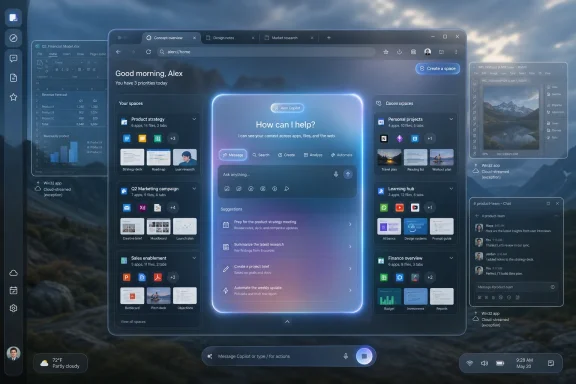
Aion, as described, would have traded much of that gravity for a browser shell wrapped around Copilot. The leaked clip reportedly shows a familiar-enough desktop with a taskbar and launcher, but those pieces are no longer the organizing principle. The center of the experience is a multimodal Copilot box that can find files, open apps, check schedules, and gather work into “Spaces.”
That sounds modern because it is modern. It also sounds risky because Windows users have spent three decades proving that they do not want the operating system to be too clever about their work.
This is not unique to Microsoft. The broader software industry has spent years taking native applications and rebuilding them as web apps, Electron apps, progressive web apps, or cloud-backed shells. The economics are obvious: one codebase, faster iteration, easier experimentation, more telemetry, and fewer platform-specific rewrites.
But Windows is not just another platform. It is the platform people use precisely because native complexity remains possible. When Microsoft turns a Windows surface into an Edge-powered surface, it is not merely choosing a development stack. It is asking users to accept a thinner, more service-dependent definition of the PC.
That distinction matters. A browser-first OS can be elegant on paper, especially for managed environments, education, kiosks, and cloud-first workers. But Windows is where people go when browser-first stops being enough.
Aion appears to combine all three impulses. It wants the simplicity of a lightweight OS, the familiarity of a Windows-like desktop, and the compatibility escape hatch of a cloud PC. That is a coherent internal prototype. It is also a fragile commercial proposition.
The problem is not that any single part is impossible. Microsoft can build a web shell. It can integrate Copilot. It can stream Windows desktops. It can design a launcher that groups work by task instead of by application. The problem is that the full package asks users to accept several trade-offs at once.
Aion would not just say, “Here is a better assistant.” It would say, “Here is a different definition of personal computing, and the old one is available remotely if you still need it.” That is a much harder sale.
Aion’s reported lack of native Win32 support is therefore the central issue, not a footnote. If traditional Windows applications have to arrive through Windows 365 Cloud PC streaming, then the local OS is no longer the place where the work happens. It becomes the access terminal.
That can be acceptable in some environments. A cloud PC can simplify provisioning, disaster recovery, remote access, and device replacement. It can also make security teams happier by keeping sensitive workloads in a managed service rather than on a lightly controlled endpoint.
But the consumer and small-business realities are messier. Streaming apps introduces latency, bandwidth dependence, subscription cost, regional availability questions, offline failure modes, and user confusion. It also turns “my PC runs my software” into “my PC reaches a service that runs my software,” which is not the same promise.
Microsoft has spent the last few years moving Copilot through a series of forms: sidebar, app, web wrapper, native-looking app, Edge-backed app, dockable panel, and assistant inside other Windows experiences. Some of those changes were useful. Some looked like indecision. Taken together, they show a company still searching for the right level of AI presence in an operating system whose users often want less interruption, not more.
That history matters because an OS-level assistant cannot feel like a promotional surface. If the shell asks users to route core tasks through Copilot, users must believe that Copilot is reliable, respectful of context, predictable about privacy, and better than doing the task directly. That is a high bar.
Today, Copilot can be impressive in bounded scenarios. It can summarize, draft, search, explain, and automate parts of a workflow. But “helpful assistant” is a long way from “primary operating environment.” The former can fail gracefully. The latter becomes the thing users blame when the day goes sideways.
Windows has never solved context well. Task View, virtual desktops, Snap groups, Start menu recommendations, recent files, and browser history all nibble at the edges. None of them fully captures the way users think: “I need to get back to the budget review,” not “I need to open Excel, Teams, Outlook, SharePoint, and that one PDF again.”
A task-based workspace layer could make Windows feel more modern without requiring users to abandon native apps. It could remember the files, windows, web apps, chats, and folders associated with a project. It could restore them across devices. It could even let Copilot assist quietly by identifying relevant materials instead of demanding to be the interface.
That is where Microsoft’s AI ambitions make practical sense. The assistant should reduce the cost of context switching. It should not require Windows to become a chatbot with a taskbar.
Local applications are not just binaries. They are habits, shortcuts, registry settings, plug-ins, file associations, shell extensions, drivers, scripts, scheduled tasks, and decades of accumulated expectation. A streamed desktop can reproduce much of the environment, but it also creates a boundary. Files live here or there. Apps run here or there. Performance depends on conditions the user may not control.
Enterprise admins can manage that boundary with policy and training. Consumers will experience it as weirdness. Power users will experience it as loss. Developers will ask what APIs they can count on. Gamers will mostly leave the room.
There is a version of cloud-streamed Windows that works brilliantly as an option. There is a much more difficult version where it becomes the price of using traditional apps on a supposedly Windows-like machine.
But ChromeOS did not have to carry the Windows inheritance. Google built ChromeOS around the web from the beginning, then added Android apps, Linux environments, and enterprise features over time. Its promise was not “all your Windows software, but different.” It was “maybe you do not need Windows here.”
Microsoft’s challenge is harder because the Windows brand implies compatibility. A lightweight browser OS from Microsoft that cannot run local Win32 apps natively would either need a new brand, a tightly scoped market, or a brutally clear explanation of what it is and is not.
That is where Aion may have struggled. If it looks like Windows, users will expect Windows. If it does not act like Windows, the betrayal is immediate.
For frontline workers, call centers, contractors, temporary staff, and regulated environments, the model is plausible. The endpoint becomes disposable. Data stays in managed services. Apps are delivered through the browser or streamed from Cloud PCs. Identity, compliance, and policy define the experience more than the local machine does.
That version of Aion would not need to replace Windows 11 Pro on a developer workstation. It would compete with thin clients, Chromebooks, virtual desktop infrastructure, and specialized managed devices. In that lane, the lack of Win32 support becomes less fatal because the environment is intentionally constrained.
The mistake would be pretending that such a device is the future of all Windows PCs. It might be the future of some workstations. That is very different.
Windows users are especially sensitive to forced surfaces because the operating system is not a social feed or a free web app. It is infrastructure. When Microsoft adds a feature that feels promotional, redundant, or difficult to remove, the reaction is harsher than it would be inside a browser tab.
Aion would have magnified that tension. A Copilot-centered shell assumes users want an assistant-mediated relationship with their PC. Some do. Many do not. Some will over time, but only if the assistant demonstrates competence without constantly demanding attention.
The lesson is not that AI has no place in Windows. The lesson is that Windows cannot become an AI product by decree. It has to become more useful in ways users can feel without being cornered.
Aion shows one side of that argument. One camp inside Microsoft clearly sees the browser, cloud, and Copilot as the new center of gravity. From that perspective, the old desktop is a compatibility layer, not the soul of the platform.
Another camp, visible in Microsoft’s more recent push toward native Windows apps and performance-conscious platform work, seems to understand that Windows still needs to feel like Windows. Native responsiveness, local execution, predictable system behavior, and deep hardware support are not nostalgic luxuries. They are the reasons people tolerate the platform’s complexity.
The future of Windows will likely be negotiated between those camps. Aion may never ship, but pieces of it almost certainly will.
Expect Windows to gain more task-aware organization, more AI-assisted search, more cloud-backed state, more Edge-mediated experiences, and more Copilot surfaces that can follow the user across apps. Expect Microsoft to keep testing how far it can push web technology inside the shell. Expect administrators to demand switches, policies, auditability, and ways to turn the noise down.
The crucial question is whether Microsoft can make those features additive rather than coercive. A Copilot that helps restore a workspace, summarize a messy project folder, or connect a local file to a Teams thread is useful. A Copilot that replaces established workflows before it has proven itself is a liability.
Aion’s apparent retreat is therefore not a failure of imagination. It is evidence that the market still disciplines even the largest platform owner. Windows can evolve, but it cannot casually discard the compatibility contract that made it dominant.
 Aion Was the Copilot Dream Taken to Its Logical Extreme
The most interesting thing about Aion is not that Microsoft experimented with it. Microsoft experiments with everything. The interesting thing is that the concept appears to make explicit what years of Copilot integration have only implied: the company is tempted by a future where the operating system is less a neutral stage for software and more an orchestration layer for an AI assistant.That is a dramatic inversion of the Windows bargain. For decades, Windows has won not because it was the cleanest, fastest, or most elegant environment, but because it ran the things people needed. Line-of-business tools, old accounting packages, weird USB peripherals, Photoshop plug-ins, game launchers, printer utilities, VPN clients, database front ends, and ancient Win32 executables all helped turn compatibility into Microsoft’s moat.
Aion, as described, would have traded much of that gravity for a browser shell wrapped around Copilot. The leaked clip reportedly shows a familiar-enough desktop with a taskbar and launcher, but those pieces are no longer the organizing principle. The center of the experience is a multimodal Copilot box that can find files, open apps, check schedules, and gather work into “Spaces.”
That sounds modern because it is modern. It also sounds risky because Windows users have spent three decades proving that they do not want the operating system to be too clever about their work.
The Browser Shell Keeps Coming Back Because It Solves Microsoft’s Problem
Aion’s reported reliance on Edge is not an oddity; it is the clearest signal in the leak. Microsoft has repeatedly moved Windows features, app experiences, and assistant surfaces toward web technologies because the browser is the one runtime the company can update quickly, control tightly, and ship across hardware without waiting for the old Windows machinery to turn.This is not unique to Microsoft. The broader software industry has spent years taking native applications and rebuilding them as web apps, Electron apps, progressive web apps, or cloud-backed shells. The economics are obvious: one codebase, faster iteration, easier experimentation, more telemetry, and fewer platform-specific rewrites.
But Windows is not just another platform. It is the platform people use precisely because native complexity remains possible. When Microsoft turns a Windows surface into an Edge-powered surface, it is not merely choosing a development stack. It is asking users to accept a thinner, more service-dependent definition of the PC.
That distinction matters. A browser-first OS can be elegant on paper, especially for managed environments, education, kiosks, and cloud-first workers. But Windows is where people go when browser-first stops being enough.
The Ghost of Windows 10X Still Haunts the Room
Aion’s alleged design lands in a long Microsoft tradition of trying to simplify Windows without losing Windows. Windows RT tried to give ARM devices a locked-down Windows experience and was punished for not running traditional desktop apps. Windows 10X tried to rethink the interface for modern, lightweight devices before being canceled and folded back into Windows 11 ideas. Cloud PC and Windows 365 then offered a different answer: if the local machine cannot or should not run the full stack, stream the full stack from Microsoft’s cloud.Aion appears to combine all three impulses. It wants the simplicity of a lightweight OS, the familiarity of a Windows-like desktop, and the compatibility escape hatch of a cloud PC. That is a coherent internal prototype. It is also a fragile commercial proposition.
The problem is not that any single part is impossible. Microsoft can build a web shell. It can integrate Copilot. It can stream Windows desktops. It can design a launcher that groups work by task instead of by application. The problem is that the full package asks users to accept several trade-offs at once.
Aion would not just say, “Here is a better assistant.” It would say, “Here is a different definition of personal computing, and the old one is available remotely if you still need it.” That is a much harder sale.
Win32 Is Not Legacy; It Is the Load-Bearing Wall
Calling Win32 “legacy” is technically defensible and practically misleading. In enterprise IT, legacy does not mean irrelevant. It often means the thing that still runs payroll, controls factory equipment, manages patient intake, talks to a label printer, or authenticates a user through a VPN client nobody wants to touch.Aion’s reported lack of native Win32 support is therefore the central issue, not a footnote. If traditional Windows applications have to arrive through Windows 365 Cloud PC streaming, then the local OS is no longer the place where the work happens. It becomes the access terminal.
That can be acceptable in some environments. A cloud PC can simplify provisioning, disaster recovery, remote access, and device replacement. It can also make security teams happier by keeping sensitive workloads in a managed service rather than on a lightly controlled endpoint.
But the consumer and small-business realities are messier. Streaming apps introduces latency, bandwidth dependence, subscription cost, regional availability questions, offline failure modes, and user confusion. It also turns “my PC runs my software” into “my PC reaches a service that runs my software,” which is not the same promise.
Copilot Has Not Earned the Right to Be the Shell
The most damning argument against Aion is not technical. It is social. Copilot has not yet earned enough user trust to become the front door to Windows.Microsoft has spent the last few years moving Copilot through a series of forms: sidebar, app, web wrapper, native-looking app, Edge-backed app, dockable panel, and assistant inside other Windows experiences. Some of those changes were useful. Some looked like indecision. Taken together, they show a company still searching for the right level of AI presence in an operating system whose users often want less interruption, not more.
That history matters because an OS-level assistant cannot feel like a promotional surface. If the shell asks users to route core tasks through Copilot, users must believe that Copilot is reliable, respectful of context, predictable about privacy, and better than doing the task directly. That is a high bar.
Today, Copilot can be impressive in bounded scenarios. It can summarize, draft, search, explain, and automate parts of a workflow. But “helpful assistant” is a long way from “primary operating environment.” The former can fail gracefully. The latter becomes the thing users blame when the day goes sideways.
Spaces Is the Smartest Idea in the Leak
If Aion contains a feature worth rescuing, it is reportedly “Spaces,” the mechanism that groups related apps and sites so a user can return to a task with one click. That idea is much more compelling than making Copilot the center of everything because it addresses a real Windows problem: modern work is scattered across windows, browser tabs, chats, files, calendars, and cloud documents.Windows has never solved context well. Task View, virtual desktops, Snap groups, Start menu recommendations, recent files, and browser history all nibble at the edges. None of them fully captures the way users think: “I need to get back to the budget review,” not “I need to open Excel, Teams, Outlook, SharePoint, and that one PDF again.”
A task-based workspace layer could make Windows feel more modern without requiring users to abandon native apps. It could remember the files, windows, web apps, chats, and folders associated with a project. It could restore them across devices. It could even let Copilot assist quietly by identifying relevant materials instead of demanding to be the interface.
That is where Microsoft’s AI ambitions make practical sense. The assistant should reduce the cost of context switching. It should not require Windows to become a chatbot with a taskbar.
A Cloud PC Escape Hatch Is Not a Compatibility Strategy
Windows 365 is a powerful product, but in an Aion-style OS it becomes a kind of compatibility alibi. If local Win32 support is gone, Microsoft can say the old world still exists in the cloud. That is true, but it changes the user’s relationship to software in ways Microsoft should not underestimate.Local applications are not just binaries. They are habits, shortcuts, registry settings, plug-ins, file associations, shell extensions, drivers, scripts, scheduled tasks, and decades of accumulated expectation. A streamed desktop can reproduce much of the environment, but it also creates a boundary. Files live here or there. Apps run here or there. Performance depends on conditions the user may not control.
Enterprise admins can manage that boundary with policy and training. Consumers will experience it as weirdness. Power users will experience it as loss. Developers will ask what APIs they can count on. Gamers will mostly leave the room.
There is a version of cloud-streamed Windows that works brilliantly as an option. There is a much more difficult version where it becomes the price of using traditional apps on a supposedly Windows-like machine.
The Chromebook Comparison Is Too Easy and Not Quite Right
It is tempting to describe Aion as Microsoft’s Copilot Chromebook. The comparison is useful up to a point. ChromeOS proved that a browser-first operating system can be viable when the target use cases are clear, the management story is strong, and the device economics are right.But ChromeOS did not have to carry the Windows inheritance. Google built ChromeOS around the web from the beginning, then added Android apps, Linux environments, and enterprise features over time. Its promise was not “all your Windows software, but different.” It was “maybe you do not need Windows here.”
Microsoft’s challenge is harder because the Windows brand implies compatibility. A lightweight browser OS from Microsoft that cannot run local Win32 apps natively would either need a new brand, a tightly scoped market, or a brutally clear explanation of what it is and is not.
That is where Aion may have struggled. If it looks like Windows, users will expect Windows. If it does not act like Windows, the betrayal is immediate.
The Enterprise Pitch Is Stronger Than the Consumer Pitch
Aion makes more sense when imagined as a managed enterprise endpoint than as a mainstream consumer OS. A company that already pays for Microsoft 365, Entra ID, Intune, Defender, Windows 365, and Copilot licensing might see appeal in a locked-down device that boots into a secure, browser-based, AI-organized workspace.For frontline workers, call centers, contractors, temporary staff, and regulated environments, the model is plausible. The endpoint becomes disposable. Data stays in managed services. Apps are delivered through the browser or streamed from Cloud PCs. Identity, compliance, and policy define the experience more than the local machine does.
That version of Aion would not need to replace Windows 11 Pro on a developer workstation. It would compete with thin clients, Chromebooks, virtual desktop infrastructure, and specialized managed devices. In that lane, the lack of Win32 support becomes less fatal because the environment is intentionally constrained.
The mistake would be pretending that such a device is the future of all Windows PCs. It might be the future of some workstations. That is very different.
Microsoft Keeps Confusing AI Ambition With User Consent
The wider Copilot story has exposed a recurring Microsoft problem: the company often treats distribution as adoption. If Copilot is in the taskbar, in Edge, in Office, in Windows search, in the app sidebar, and in system experiences, then surely users will come to rely on it. But presence is not the same as preference.Windows users are especially sensitive to forced surfaces because the operating system is not a social feed or a free web app. It is infrastructure. When Microsoft adds a feature that feels promotional, redundant, or difficult to remove, the reaction is harsher than it would be inside a browser tab.
Aion would have magnified that tension. A Copilot-centered shell assumes users want an assistant-mediated relationship with their PC. Some do. Many do not. Some will over time, but only if the assistant demonstrates competence without constantly demanding attention.
The lesson is not that AI has no place in Windows. The lesson is that Windows cannot become an AI product by decree. It has to become more useful in ways users can feel without being cornered.
The Leak Reveals Strategy Even If the Product Is Dead
Microsoft declined to comment on the Aion reporting, and there is no public evidence that this concept is headed for release. It may have been an internal prototype, a hackathon project, a future-vision video, or a serious exploration that lost a political fight. In large companies, those distinctions matter less than outsiders think; prototypes are how strategy argues with itself.Aion shows one side of that argument. One camp inside Microsoft clearly sees the browser, cloud, and Copilot as the new center of gravity. From that perspective, the old desktop is a compatibility layer, not the soul of the platform.
Another camp, visible in Microsoft’s more recent push toward native Windows apps and performance-conscious platform work, seems to understand that Windows still needs to feel like Windows. Native responsiveness, local execution, predictable system behavior, and deep hardware support are not nostalgic luxuries. They are the reasons people tolerate the platform’s complexity.
The future of Windows will likely be negotiated between those camps. Aion may never ship, but pieces of it almost certainly will.
The Real Product Is the Next Windows Compromise
The practical outcome is unlikely to be a sudden Copilot OS replacing Windows 11. Microsoft does not need that kind of rupture, and its customers would punish it for trying. The more plausible path is gradual absorption.Expect Windows to gain more task-aware organization, more AI-assisted search, more cloud-backed state, more Edge-mediated experiences, and more Copilot surfaces that can follow the user across apps. Expect Microsoft to keep testing how far it can push web technology inside the shell. Expect administrators to demand switches, policies, auditability, and ways to turn the noise down.
The crucial question is whether Microsoft can make those features additive rather than coercive. A Copilot that helps restore a workspace, summarize a messy project folder, or connect a local file to a Teams thread is useful. A Copilot that replaces established workflows before it has proven itself is a liability.
Aion’s apparent retreat is therefore not a failure of imagination. It is evidence that the market still disciplines even the largest platform owner. Windows can evolve, but it cannot casually discard the compatibility contract that made it dominant.
The Aion Leak Draws the Boundary Microsoft Keeps Testing
The concrete lessons from Aion are sharper than the concept itself. Microsoft’s prototype points toward a possible future, but it also shows why that future cannot simply be imposed on the existing Windows base.- Microsoft explored a Copilot-centered, browser-based OS concept in 2024, but there is no public indication that Aion became a shipping product.
- The reported design leaned on a stripped-down Windows foundation and Edge, making the browser runtime central to the desktop rather than merely one application among many.
- Native Win32 compatibility appears to have been the biggest trade-off, with Windows 365 Cloud PC streaming positioned as the fallback for traditional desktop software.
- The concept makes more sense for managed enterprise endpoints than for mainstream consumer PCs, especially where cloud apps and centralized policy already dominate.
- The most salvageable idea is task-based workspace grouping, because it could improve Windows without forcing users to treat Copilot as the operating system.
- Aion’s apparent non-arrival suggests Microsoft understands that Copilot still needs to earn trust before it can become the primary interface to Windows.
References
- Primary source: TweakTown
Published: Thu, 02 Jul 2026 21:50:08 GMT
Microsoft was planning to build a lightweight, browser-based OS around Copilot
A leaked 2024 video shows Microsoft once explored 'Aion,' a browser-based OS concept with Copilot at its core, though it apparently never shipped. www.tweaktown.com
- Related coverage: windowscentral.com
Microsoft Copilot OS revealed in LEAKED video: Lightweight Windows OS exploration features new desktop UI built entirely around Copilot and agentic AI | Windows Central
A leaked video from 2024 has revealed all about Microsoft's internal explorations for a Copilot OS running on a stripped back Windows codebase.www.windowscentral.com - Official source: support.microsoft.com
Streamline access to your favorite sites and apps with Sidebar in Microsoft Edge | Microsoft Support
Learn how to move your Microsoft Edge sidebar to your Windows 10 desktop to access apps and sites from anywhere on your device.support.microsoft.com - Related coverage: windowslatest.com
Microsoft's new Copilot turns into a Windows 11 sidebar that pushes your apps aside to make room
Microsoft is testing a docked Copilot sidebar in Windows 11 that pins the AI to the right edge of your screen, pushing the desktop aside. www.windowslatest.com
- Related coverage: pcworld.com
Microsoft's revamped Copilot app for Windows goes truly native | PCWorld
With this redesign of Copilot, the AI app no longer relies on web components. It's fully native to the Windows 11 operating system.www.pcworld.com - Related coverage: videocardz.com
- Related coverage: pureinfotech.com
Microsoft’s Copilot app is really just Edge in disguise on Windows 11 - Pureinfotech
Windows 11 Copilot app is just Microsoft Edge in disguise. Users reveal how AI commands run through the browser, not a standalone app. pureinfotech.com
- Related coverage: winbuzzer.com
Microsoft Adds In-App Browser to Windows 11 Copilot
Microsoft has launched web integration in the Windows 11 Copilot app, opening links in an Edge-powered side pane with opt-in per-conversation web access. winbuzzer.com
- Related coverage: notebookcheck.net
Windows 11: Microsoft backpedals on Copilot decision - Notebookcheck News
Microsoft is testing a revamped docked Copilot sidebar for Windows 11, pinning the AI to either screen edge and marking the AI assistant's sixth UI redesign. www.notebookcheck.net
- Official source: techcommunity.microsoft.com
- Official source: blogs.windows.com
Copilot App on Windows: Opening web links alongside your conversations begins rolling out to Windows Insiders
Hello Windows Insiders, In today's update, we are introducing a new way to get things done in the Copblogs.windows.com - Official source: learn.microsoft.com
Troubleshoot Copilot icon not showing in Edge sidebar - Microsoft Edge | Microsoft Learn
Resolve the missing Copilot icon in Microsoft Edge sidebar by troubleshooting for settings, policies, browser updates, and account availability.learn.microsoft.com - Related coverage: techradar.com
- Related coverage: tomshardware.com
Microsoft unveils Project Solara AI, a chip-to-cloud platform built to power a new generation of 'agent-first' enterprise devices — hardware designed to run AI agents instead of traditional apps | Tom's Hardware
Microsoft ditches Windows to build OS on Androidwww.tomshardware.com - Related coverage: pcgamer.com
Microsoft is building new '100% native' Windows programs to replace memory-hogging web apps | PC Gamer
Microsoft shows Windows 11 yet more love.www.pcgamer.com - Official source: microsoft.com
</rdf:Alt> </dc:title> <dc:description> <rdf:Alt> <rdf:li xml:lang="x-default"/> </rdf:Alt> </dc:description> <dc:creator> <rdf:Seq> <rdf:li>Lukas V
</rdf:Alt> </dc:description> <dc:creator> <rdf:Seq> <rdf:li>Lukas Velushwww.microsoft.com
