

Z.ai launched ZCode in early July 2026 as a free desktop AI coding environment for macOS, Windows, and Linux, built around its GLM-5.2 model and priced below comparable plans from Cursor and other Western coding-agent tools. The move is not just another IDE launch; it is a pricing grenade tossed into a market that has spent the past year teaching developers to accept metered AI as inevitable. ZCode’s pitch is simple enough to sound dangerous: bring the agentic workflow, keep the developer’s tools, and charge less for the privilege. That is why this launch matters even if ZCode itself still has to prove it can survive contact with real codebases, real teams, and real compliance departments.
The most interesting thing about ZCode is not that it exists. AI coding assistants are now so common that a new one almost needs a gimmick just to be noticed. Z.ai’s gimmick is not a sidebar, a mascot, or a new autocomplete demo; it is the claim that the company can package an agentic development environment around GLM-5.2 and do so at a lower monthly price than the better-known American incumbents.
That changes the conversation from features to economics. Developers have spent the last several years watching AI tools evolve from novelty autocomplete into systems that plan, edit, test, review, and sometimes break an entire repo with impressive confidence. The more capable these systems become, the more expensive they become to run, and the more vendors have shifted from simple subscriptions toward quota systems, premium requests, credits, and usage-based billing.
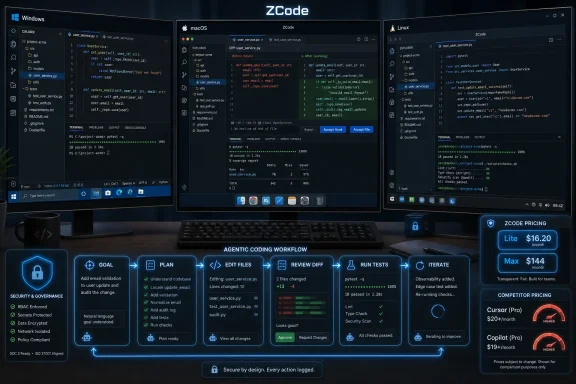
Z.ai is entering at precisely the moment when that shift has become painful. Cursor’s individual plans have clustered around familiar subscription tiers, including a $20 monthly Pro plan and a $200 monthly Ultra plan. GitHub Copilot has spent 2026 moving deeper into credit-style metering for advanced use. Anthropic’s Claude Code has made high-end coding-agent workflows feel powerful, but not cheap. ZCode’s Lite plan at $16.20 per month and Max plan at $144 per month are therefore not just prices; they are a statement of intent.
The statement is that AI coding may not remain a premium Western SaaS category forever. If Z.ai can deliver a credible agentic toolchain at a lower price, the incumbents will have to defend not merely their models, but their margins. That is the part of the story that should make every AI coding vendor uncomfortable.
ZCode is very much a product of that third wave. Z.ai describes it as an environment where a developer can state a goal, get a plan, let the agent edit files, review its own work, and iterate. That is the same broad product category occupied by Cursor, Claude Code, OpenAI’s coding-agent efforts, and the increasingly agent-heavy Copilot stack.
This is why comparisons to Cursor and Claude Code are unavoidable. ZCode is not trying to win by being a nicer wrapper around autocomplete. It is trying to sit in the development workflow as the place where intent becomes code. In that world, the IDE is no longer just a workspace; it becomes a command center for autonomous or semi-autonomous software work.
The distinction matters because agentic tools consume far more compute than traditional autocomplete. A suggestion model can operate in short bursts. An agent may read a repo, draft a plan, inspect errors, run tests, revise files, call tools, and continue reasoning across many turns. The economics of that loop are different, and so are the risks. A cheap agent that performs well can be disruptive; a cheap agent that performs inconsistently can be expensive in ways the invoice never shows.
Z.ai is also pushing the idea that ZCode can connect to third-party models through bring-your-own-key configurations. That is strategically clever. It lets the company present ZCode as a harness rather than a sealed box, which matters to developers who already pay for models from OpenAI, Anthropic, Google, or other providers. It also softens one of the biggest objections to a new coding environment: nobody wants to move workflows just to get trapped inside another vendor’s model stack.
A large context window theoretically allows a model to reason across more of a codebase, documentation, logs, tests, and architectural constraints in one session. That is useful for migrations, security reviews, dependency cleanup, cross-service refactors, and all the other work that makes professional development harder than generating a fresh demo app. The promise is not simply that the model can ingest more text. The promise is that it can maintain enough project state to avoid the shallow, amnesiac behavior that has limited many coding assistants.
But context is not comprehension. A 1 million-token window does not guarantee that the model will prioritize the right files, infer the right architecture, or avoid plausible but wrong edits. Developers already know this from experience: larger prompts can sometimes create larger hallucinations. The quality question is whether GLM-5.2 can use that context effectively, not merely advertise it.
This is where ZCode becomes an important test vehicle. A model benchmark can show progress, but a coding environment exposes the model to messy repositories, eccentric build systems, stale dependencies, private conventions, and human impatience. If GLM-5.2 performs well inside ZCode, Z.ai gains more than another app. It gains a distribution channel that turns model capability into daily developer habit.
That is why the pricing fight matters. ZCode’s discounted Lite plan at $16.20 per month and Max plan at $144 per month are designed to sit just below the psychological anchors set by products like Cursor. The difference is not enormous for a hobbyist. It becomes more meaningful when multiplied across teams, contractors, students, open-source maintainers, and developers in markets where a $20 or $200 monthly subscription is a much larger ask.
The phrase “undercuts US pricing” is easy to reduce to a simple sticker comparison, but the real issue is predictability. Developers increasingly care less about the nominal subscription price and more about what happens when they use the tool heavily. If one vendor offers a lower flat-ish tier while another moves toward credits and metered usage, the cheaper tool has an opening even if its feature set is rougher.
The incumbents know this. GitHub’s shift toward usage-based Copilot billing has been framed around fairness and sustainability: heavier, more expensive tasks should map to higher cost. That logic is defensible from the vendor side. From the developer side, it can feel like the old bargain has been rewritten just as the tools became genuinely useful.
Z.ai is exploiting that tension. It is entering while developers are still arguing about AI credits, premium requests, and the vanishing simplicity of “pay monthly, use the tool.” If ZCode can make the pricing feel less hostile, it may win attention before it wins trust.
For Z.ai, open source carries another benefit: it reframes the company from “Chinese AI lab trying to clone Western tools” to “participant in a global developer ecosystem.” That distinction matters in a market where trust is unevenly distributed and geopolitical suspicion is never far from the surface. When a user jokes that ZCode looks like a cloned Codex or an open-source Claude Code, the joke contains both admiration and accusation.
The bring-your-own-key model reinforces the same theme. ZCode can be presented as a workspace that cooperates with multiple models rather than a proprietary tunnel into GLM alone. That makes adoption easier for developers who want to experiment without abandoning their existing subscriptions. It also lets Z.ai compete for the interface layer even when the user is not ready to bet exclusively on GLM-5.2.
This is a familiar platform move. Own the workflow first, then increase the share of work handled by your own model over time. If ZCode becomes a good enough environment, GLM-5.2 does not have to win every benchmark on day one. It only has to be cheap, capable, and conveniently available inside the tool developers are already using.
For individual developers, the China factor may show up as a trust calculation. Do they want a coding agent from a Beijing-based lab reading local repositories, prompts, logs, or proprietary context? Does bring-your-own-key reduce that concern, or does the environment itself still create enough telemetry and policy ambiguity to worry them? These are not abstract questions when the product category is explicitly designed to inspect and modify code.
For enterprises, the questions become sharper. Security teams will want to know what data leaves the machine, where it is processed, how logs are retained, whether code is used for training, and whether the vendor can satisfy procurement, compliance, and contractual requirements. Even if ZCode is technically impressive, it will face a higher trust hurdle in sectors governed by export controls, data residency rules, regulated IP, or national security concerns.
That does not mean ZCode is doomed in the West. Developers have repeatedly adopted tools before enterprises were ready for them, and AI coding assistants are a prime example of that bottom-up pressure. But Z.ai’s origin will shape its adoption curve. It may find enthusiastic uptake among individual developers and open-source communities while moving more slowly inside conservative corporate environments.
The larger point is that AI coding has become part of the global technology competition. Models that can help write, analyze, and secure software are not just productivity tools. They are capability multipliers. A lower-cost Chinese entrant in this market will be read through that lens, whether Z.ai wants it or not.
The AI coding market has often been shaped by macOS-heavy startup culture, even when the products technically support Windows. A serious Windows desktop client can therefore be a practical differentiator if it handles local paths, shells, permissions, terminals, WSL, PowerShell, Git, and enterprise endpoint controls without feeling like a port. The difference between “runs on Windows” and “works well on Windows” is large.
ZCode’s promise of integrating with existing tools also intersects with the reality of Windows development. Many Windows users do not live entirely inside one blessed editor. They move between Visual Studio, VS Code, JetBrains tools, terminals, admin consoles, remote sessions, and internal build systems. An agentic environment that can coordinate with those workflows has potential. One that demands a clean-room workflow will struggle.
The remote-control features reported around messaging platforms such as WeChat, Feishu, and Telegram are also worth watching. On one hand, they point toward a world where developers can dispatch agents from wherever work conversations already happen. On the other hand, they raise the obvious security nightmare: coding agents reachable through chat surfaces will need extremely careful authentication, permissioning, audit logs, and guardrails.
For Windows administrators, this is the part of the AI coding boom that should feel familiar. Every productivity tool eventually becomes an endpoint management problem. If ZCode gains traction, admins will need to decide whether it is allowed, how it is configured, what data it can access, and whether it can run autonomous tasks against corporate repositories.
That matters because coding tools are sticky. Developers will experiment with almost anything, but they only institutionalize tools that save time reliably. An AI coding environment must be good enough not just in a launch demo, but on a rainy Tuesday when a build is failing, a migration is blocked, and the team is already annoyed. Reliability beats novelty very quickly in professional software work.
The incumbents also have model access advantages. GitHub can integrate multiple agents and models into the repository workflow. Cursor can route across popular frontier models and optimize the editor experience around them. Anthropic has built a strong reputation among developers for coding capability. OpenAI has its own momentum around coding agents and model improvements. Z.ai is not entering an empty field; it is entering a knife fight.
Still, incumbency can become a weakness when pricing hardens. Developers resent tools that become essential and then more expensive. If Z.ai can stay close enough on quality while being cheaper and more open, it does not need to defeat every incumbent outright. It only needs to become the credible alternative that users cite when complaining about the price of everything else.
A model can score well on coding tasks and still be frustrating if it cannot navigate a messy repo, preserve style, explain changes, avoid breaking tests, or recover gracefully from its own mistakes. Conversely, a model that is not always the top benchmark performer can still become beloved if the product around it is fast, predictable, transparent, and easy to steer. The interface, permissions, diffs, rollback flow, terminal integration, and review model all matter.
This is where ZCode’s “agentic development environment” framing has to prove itself. Developers do not need another black box that edits files with theatrical confidence. They need a collaborator that makes intent legible, asks for confirmation at the right time, shows its work, and fails safely. The agentic future of coding will be won by tools that make autonomy feel controllable.
There is also a social layer to coding that AI tools often underestimate. Teams need code review, conventions, issue context, security policy, and accountability. An agent can generate a patch, but a team has to own it. ZCode’s success will depend partly on whether it fits into that human machinery rather than trying to route around it.
This is not unique to ZCode. Cursor, Copilot agents, Claude Code, and similar tools all create versions of the same problem. But ZCode’s lower price and free desktop distribution could accelerate experimentation, including in environments where policy has not caught up. Shadow AI was already a headache when users were pasting snippets into chatbots. Shadow coding agents are a larger problem.
The most obvious risks are data exposure, insecure generated code, dependency confusion, prompt injection through repository content, and accidental execution of destructive commands. Less obvious is the governance risk: when an agent makes a change, who approved the plan, who reviewed the diff, and who is responsible if it introduces a vulnerability? The answer cannot be “the AI did it.”
Administrators should assume these tools are coming whether officially approved or not. The practical response is not blanket panic, but policy and instrumentation. Organizations need approved tools, logging expectations, repository access rules, secrets hygiene, and developer training. The agentic IDE is becoming part of the software supply chain, and supply chains need controls.
But Microsoft is also vulnerable to developer sentiment. If Copilot’s advanced features feel increasingly metered while lower-cost alternatives improve, users will start making comparisons even if procurement departments move slowly. The first wave of dissatisfaction rarely looks like mass migration. It looks like developers quietly keeping a second tool open.
That second-tool behavior matters. Once a developer is comfortable using multiple coding agents, the incumbent loses some of its default advantage. The user’s loyalty shifts from a product to a workflow: whichever agent handles this task best, cheapest, or fastest gets the work. Bring-your-own-key tools and multi-model harnesses encourage exactly that behavior.
ZCode therefore pressures Microsoft indirectly. It does not need to replace Copilot inside Fortune 500 accounts to affect the market. It only needs to make developers believe that coding-agent pricing is negotiable. Once that belief spreads, every vendor’s pricing page becomes a competitive surface.
This is why the product is more strategically interesting than a simple “Chinese Cursor rival” headline suggests. If ZCode becomes the environment where developers plan and execute work, Z.ai gains a privileged position even when third-party models are involved. The company can observe what workflows matter, optimize for them, and make GLM-5.2 the default option when it is good enough.
The incumbents are chasing the same prize. GitHub wants issues, pull requests, code review, Actions, and Copilot to become one continuous AI-assisted loop. Cursor wants the editor to become the agent surface. Anthropic and OpenAI want their coding agents to become trusted collaborators across tools. Everyone understands that the chatbox is not the endpoint.
For developers, this competition could be useful. It may produce better tools, lower prices, and more flexible model routing. But it could also produce fragmentation, opaque billing, and a new class of lock-in where the agent’s memory, plans, and workflow state become hard to move. The industry has a habit of calling things open until the switching costs appear.
ZCode may or may not become the coding tool that finally rattles Cursor, Copilot, and Claude Code in daily developer use, but it has already clarified where the market is headed: agentic coding is becoming powerful enough to be expensive, important enough to be geopolitical, and competitive enough that no vendor can assume developers will simply pay whatever the next pricing page demands.
 Z.ai Is Selling a Coding Tool, but It Is Really Selling Leverage
The most interesting thing about ZCode is not that it exists. AI coding assistants are now so common that a new one almost needs a gimmick just to be noticed. Z.ai’s gimmick is not a sidebar, a mascot, or a new autocomplete demo; it is the claim that the company can package an agentic development environment around GLM-5.2 and do so at a lower monthly price than the better-known American incumbents.That changes the conversation from features to economics. Developers have spent the last several years watching AI tools evolve from novelty autocomplete into systems that plan, edit, test, review, and sometimes break an entire repo with impressive confidence. The more capable these systems become, the more expensive they become to run, and the more vendors have shifted from simple subscriptions toward quota systems, premium requests, credits, and usage-based billing.
Z.ai is entering at precisely the moment when that shift has become painful. Cursor’s individual plans have clustered around familiar subscription tiers, including a $20 monthly Pro plan and a $200 monthly Ultra plan. GitHub Copilot has spent 2026 moving deeper into credit-style metering for advanced use. Anthropic’s Claude Code has made high-end coding-agent workflows feel powerful, but not cheap. ZCode’s Lite plan at $16.20 per month and Max plan at $144 per month are therefore not just prices; they are a statement of intent.
The statement is that AI coding may not remain a premium Western SaaS category forever. If Z.ai can deliver a credible agentic toolchain at a lower price, the incumbents will have to defend not merely their models, but their margins. That is the part of the story that should make every AI coding vendor uncomfortable.
The Agentic IDE Has Replaced the Chatbot as the Developer Battleground
The first wave of AI coding was about suggestions. GitHub Copilot made the magic visible by filling in functions, boilerplate, and tests from within the editor. The second wave moved into chat, where developers could ask for explanations, refactors, and debugging help. The current wave is more ambitious and more dangerous: the coding assistant wants to become an agent.ZCode is very much a product of that third wave. Z.ai describes it as an environment where a developer can state a goal, get a plan, let the agent edit files, review its own work, and iterate. That is the same broad product category occupied by Cursor, Claude Code, OpenAI’s coding-agent efforts, and the increasingly agent-heavy Copilot stack.
This is why comparisons to Cursor and Claude Code are unavoidable. ZCode is not trying to win by being a nicer wrapper around autocomplete. It is trying to sit in the development workflow as the place where intent becomes code. In that world, the IDE is no longer just a workspace; it becomes a command center for autonomous or semi-autonomous software work.
The distinction matters because agentic tools consume far more compute than traditional autocomplete. A suggestion model can operate in short bursts. An agent may read a repo, draft a plan, inspect errors, run tests, revise files, call tools, and continue reasoning across many turns. The economics of that loop are different, and so are the risks. A cheap agent that performs well can be disruptive; a cheap agent that performs inconsistently can be expensive in ways the invoice never shows.
Z.ai is also pushing the idea that ZCode can connect to third-party models through bring-your-own-key configurations. That is strategically clever. It lets the company present ZCode as a harness rather than a sealed box, which matters to developers who already pay for models from OpenAI, Anthropic, Google, or other providers. It also softens one of the biggest objections to a new coding environment: nobody wants to move workflows just to get trapped inside another vendor’s model stack.
GLM-5.2 Is the Real Product Under the Hood
ZCode’s launch is inseparable from GLM-5.2, the model Z.ai is positioning as its flagship for long-horizon coding and agentic tasks. The headline specification is a 1 million-token context window, which is exactly the sort of number that invites both excitement and skepticism. For coding, though, long context is not a vanity metric. It speaks directly to one of the most persistent failures of AI development tools: they often understand the file in front of them better than the system around it.A large context window theoretically allows a model to reason across more of a codebase, documentation, logs, tests, and architectural constraints in one session. That is useful for migrations, security reviews, dependency cleanup, cross-service refactors, and all the other work that makes professional development harder than generating a fresh demo app. The promise is not simply that the model can ingest more text. The promise is that it can maintain enough project state to avoid the shallow, amnesiac behavior that has limited many coding assistants.
But context is not comprehension. A 1 million-token window does not guarantee that the model will prioritize the right files, infer the right architecture, or avoid plausible but wrong edits. Developers already know this from experience: larger prompts can sometimes create larger hallucinations. The quality question is whether GLM-5.2 can use that context effectively, not merely advertise it.
This is where ZCode becomes an important test vehicle. A model benchmark can show progress, but a coding environment exposes the model to messy repositories, eccentric build systems, stale dependencies, private conventions, and human impatience. If GLM-5.2 performs well inside ZCode, Z.ai gains more than another app. It gains a distribution channel that turns model capability into daily developer habit.
Price Is the Weapon Because Compute Is the Constraint
The AI coding market has been moving toward a hard truth: somebody has to pay for long-running inference. Vendors can hide that cost for a while with venture capital, cloud credits, or subsidized launch pricing, but agentic coding makes the bill visible. A multi-step coding session that reads thousands of lines, reasons repeatedly, generates patches, and loops through failures is not economically equivalent to an autocomplete suggestion.That is why the pricing fight matters. ZCode’s discounted Lite plan at $16.20 per month and Max plan at $144 per month are designed to sit just below the psychological anchors set by products like Cursor. The difference is not enormous for a hobbyist. It becomes more meaningful when multiplied across teams, contractors, students, open-source maintainers, and developers in markets where a $20 or $200 monthly subscription is a much larger ask.
The phrase “undercuts US pricing” is easy to reduce to a simple sticker comparison, but the real issue is predictability. Developers increasingly care less about the nominal subscription price and more about what happens when they use the tool heavily. If one vendor offers a lower flat-ish tier while another moves toward credits and metered usage, the cheaper tool has an opening even if its feature set is rougher.
The incumbents know this. GitHub’s shift toward usage-based Copilot billing has been framed around fairness and sustainability: heavier, more expensive tasks should map to higher cost. That logic is defensible from the vendor side. From the developer side, it can feel like the old bargain has been rewritten just as the tools became genuinely useful.
Z.ai is exploiting that tension. It is entering while developers are still arguing about AI credits, premium requests, and the vanishing simplicity of “pay monthly, use the tool.” If ZCode can make the pricing feel less hostile, it may win attention before it wins trust.
Open Source Is Doing Double Duty as Philosophy and Market Entry
Z.ai has leaned heavily on open-source positioning, and that is not incidental. In the AI coding market, open source is both a technical posture and a go-to-market strategy. It attracts developers who want inspectability, portability, and leverage against lock-in. It also creates a community-driven distribution layer that closed vendors cannot easily replicate.For Z.ai, open source carries another benefit: it reframes the company from “Chinese AI lab trying to clone Western tools” to “participant in a global developer ecosystem.” That distinction matters in a market where trust is unevenly distributed and geopolitical suspicion is never far from the surface. When a user jokes that ZCode looks like a cloned Codex or an open-source Claude Code, the joke contains both admiration and accusation.
The bring-your-own-key model reinforces the same theme. ZCode can be presented as a workspace that cooperates with multiple models rather than a proprietary tunnel into GLM alone. That makes adoption easier for developers who want to experiment without abandoning their existing subscriptions. It also lets Z.ai compete for the interface layer even when the user is not ready to bet exclusively on GLM-5.2.
This is a familiar platform move. Own the workflow first, then increase the share of work handled by your own model over time. If ZCode becomes a good enough environment, GLM-5.2 does not have to win every benchmark on day one. It only has to be cheap, capable, and conveniently available inside the tool developers are already using.
The China Factor Is Not a Footnote
It would be naive to treat ZCode as just another coding tool with a lower monthly fee. Z.ai is a Chinese AI company competing in a category dominated by US firms and deeply entangled with developer infrastructure, cloud platforms, source code, and enterprise policy. That makes the launch commercially interesting and politically sensitive at the same time.For individual developers, the China factor may show up as a trust calculation. Do they want a coding agent from a Beijing-based lab reading local repositories, prompts, logs, or proprietary context? Does bring-your-own-key reduce that concern, or does the environment itself still create enough telemetry and policy ambiguity to worry them? These are not abstract questions when the product category is explicitly designed to inspect and modify code.
For enterprises, the questions become sharper. Security teams will want to know what data leaves the machine, where it is processed, how logs are retained, whether code is used for training, and whether the vendor can satisfy procurement, compliance, and contractual requirements. Even if ZCode is technically impressive, it will face a higher trust hurdle in sectors governed by export controls, data residency rules, regulated IP, or national security concerns.
That does not mean ZCode is doomed in the West. Developers have repeatedly adopted tools before enterprises were ready for them, and AI coding assistants are a prime example of that bottom-up pressure. But Z.ai’s origin will shape its adoption curve. It may find enthusiastic uptake among individual developers and open-source communities while moving more slowly inside conservative corporate environments.
The larger point is that AI coding has become part of the global technology competition. Models that can help write, analyze, and secure software are not just productivity tools. They are capability multipliers. A lower-cost Chinese entrant in this market will be read through that lens, whether Z.ai wants it or not.
Windows Developers Should Watch the Desktop Strategy Closely
For WindowsForum readers, the cross-platform desktop angle is more than a compatibility footnote. ZCode supports Windows alongside macOS and Linux, which means Z.ai is not treating the Microsoft developer ecosystem as an afterthought. That matters because Windows remains a daily workstation for enormous numbers of enterprise developers, .NET shops, game developers, data teams, students, and IT automation specialists.The AI coding market has often been shaped by macOS-heavy startup culture, even when the products technically support Windows. A serious Windows desktop client can therefore be a practical differentiator if it handles local paths, shells, permissions, terminals, WSL, PowerShell, Git, and enterprise endpoint controls without feeling like a port. The difference between “runs on Windows” and “works well on Windows” is large.
ZCode’s promise of integrating with existing tools also intersects with the reality of Windows development. Many Windows users do not live entirely inside one blessed editor. They move between Visual Studio, VS Code, JetBrains tools, terminals, admin consoles, remote sessions, and internal build systems. An agentic environment that can coordinate with those workflows has potential. One that demands a clean-room workflow will struggle.
The remote-control features reported around messaging platforms such as WeChat, Feishu, and Telegram are also worth watching. On one hand, they point toward a world where developers can dispatch agents from wherever work conversations already happen. On the other hand, they raise the obvious security nightmare: coding agents reachable through chat surfaces will need extremely careful authentication, permissioning, audit logs, and guardrails.
For Windows administrators, this is the part of the AI coding boom that should feel familiar. Every productivity tool eventually becomes an endpoint management problem. If ZCode gains traction, admins will need to decide whether it is allowed, how it is configured, what data it can access, and whether it can run autonomous tasks against corporate repositories.
The Incumbents Have More Than Price on Their Side
Z.ai’s pricing attack is credible, but it is not decisive. Cursor, GitHub, Anthropic, and OpenAI have advantages that cannot be copied with a lower plan. They have developer mindshare, mature integrations, existing billing relationships, brand trust, and ecosystems that already sit near the code. GitHub in particular has the structural advantage of being where much of the world’s code already lives.That matters because coding tools are sticky. Developers will experiment with almost anything, but they only institutionalize tools that save time reliably. An AI coding environment must be good enough not just in a launch demo, but on a rainy Tuesday when a build is failing, a migration is blocked, and the team is already annoyed. Reliability beats novelty very quickly in professional software work.
The incumbents also have model access advantages. GitHub can integrate multiple agents and models into the repository workflow. Cursor can route across popular frontier models and optimize the editor experience around them. Anthropic has built a strong reputation among developers for coding capability. OpenAI has its own momentum around coding agents and model improvements. Z.ai is not entering an empty field; it is entering a knife fight.
Still, incumbency can become a weakness when pricing hardens. Developers resent tools that become essential and then more expensive. If Z.ai can stay close enough on quality while being cheaper and more open, it does not need to defeat every incumbent outright. It only needs to become the credible alternative that users cite when complaining about the price of everything else.
The Benchmark War Will Not Settle the Workflow War
Z.ai’s GLM-5.2 claims, including long context and strong coding performance, will invite benchmark comparisons. That is inevitable, and some of those comparisons will be useful. But the AI coding market is increasingly moving beyond leaderboard worship. What matters is how tools behave inside a workflow.A model can score well on coding tasks and still be frustrating if it cannot navigate a messy repo, preserve style, explain changes, avoid breaking tests, or recover gracefully from its own mistakes. Conversely, a model that is not always the top benchmark performer can still become beloved if the product around it is fast, predictable, transparent, and easy to steer. The interface, permissions, diffs, rollback flow, terminal integration, and review model all matter.
This is where ZCode’s “agentic development environment” framing has to prove itself. Developers do not need another black box that edits files with theatrical confidence. They need a collaborator that makes intent legible, asks for confirmation at the right time, shows its work, and fails safely. The agentic future of coding will be won by tools that make autonomy feel controllable.
There is also a social layer to coding that AI tools often underestimate. Teams need code review, conventions, issue context, security policy, and accountability. An agent can generate a patch, but a team has to own it. ZCode’s success will depend partly on whether it fits into that human machinery rather than trying to route around it.
Cheap Agents Will Force a New Security Conversation
Security teams have already had to adapt to AI coding assistants, but agentic tools raise the stakes. Autocomplete leaks intent; agents may execute it. A tool that can read repositories, modify files, run commands, and interact with remote services creates a much richer attack surface than a chat window.This is not unique to ZCode. Cursor, Copilot agents, Claude Code, and similar tools all create versions of the same problem. But ZCode’s lower price and free desktop distribution could accelerate experimentation, including in environments where policy has not caught up. Shadow AI was already a headache when users were pasting snippets into chatbots. Shadow coding agents are a larger problem.
The most obvious risks are data exposure, insecure generated code, dependency confusion, prompt injection through repository content, and accidental execution of destructive commands. Less obvious is the governance risk: when an agent makes a change, who approved the plan, who reviewed the diff, and who is responsible if it introduces a vulnerability? The answer cannot be “the AI did it.”
Administrators should assume these tools are coming whether officially approved or not. The practical response is not blanket panic, but policy and instrumentation. Organizations need approved tools, logging expectations, repository access rules, secrets hygiene, and developer training. The agentic IDE is becoming part of the software supply chain, and supply chains need controls.
The Pricing Pressure Will Reach Microsoft Eventually
Microsoft is both insulated from and exposed to this competition. GitHub Copilot remains deeply embedded in the Microsoft developer universe, and that integration is a formidable moat. Copilot can live inside GitHub, VS Code, Visual Studio, and the broader Microsoft cloud story in a way that a third-party desktop tool cannot easily match.But Microsoft is also vulnerable to developer sentiment. If Copilot’s advanced features feel increasingly metered while lower-cost alternatives improve, users will start making comparisons even if procurement departments move slowly. The first wave of dissatisfaction rarely looks like mass migration. It looks like developers quietly keeping a second tool open.
That second-tool behavior matters. Once a developer is comfortable using multiple coding agents, the incumbent loses some of its default advantage. The user’s loyalty shifts from a product to a workflow: whichever agent handles this task best, cheapest, or fastest gets the work. Bring-your-own-key tools and multi-model harnesses encourage exactly that behavior.
ZCode therefore pressures Microsoft indirectly. It does not need to replace Copilot inside Fortune 500 accounts to affect the market. It only needs to make developers believe that coding-agent pricing is negotiable. Once that belief spreads, every vendor’s pricing page becomes a competitive surface.
The Real Contest Is Who Owns Developer Intent
The most valuable layer in AI coding is not the model alone. It is the place where a developer expresses intent and turns that intent into reviewed, tested, merged code. That place may be an IDE, a terminal, a repository issue, a pull request, a chat app, or some hybrid of all of them. ZCode is an attempt to own that layer.This is why the product is more strategically interesting than a simple “Chinese Cursor rival” headline suggests. If ZCode becomes the environment where developers plan and execute work, Z.ai gains a privileged position even when third-party models are involved. The company can observe what workflows matter, optimize for them, and make GLM-5.2 the default option when it is good enough.
The incumbents are chasing the same prize. GitHub wants issues, pull requests, code review, Actions, and Copilot to become one continuous AI-assisted loop. Cursor wants the editor to become the agent surface. Anthropic and OpenAI want their coding agents to become trusted collaborators across tools. Everyone understands that the chatbox is not the endpoint.
For developers, this competition could be useful. It may produce better tools, lower prices, and more flexible model routing. But it could also produce fragmentation, opaque billing, and a new class of lock-in where the agent’s memory, plans, and workflow state become hard to move. The industry has a habit of calling things open until the switching costs appear.
ZCode Turns the Coding-Agent Boom Into a Price War With Geopolitics Attached
ZCode’s launch is easiest to understand as three overlapping bets by Z.ai:- Z.ai is betting that developers are ready to try a lower-cost agentic coding environment if it feels close enough to Cursor, Claude Code, and Copilot in daily use.
- Z.ai is betting that GLM-5.2’s long-context capabilities can matter more in real repositories than in benchmark screenshots.
- Z.ai is betting that open-source positioning and bring-your-own-key support can reduce the trust barrier for a Chinese AI tool entering Western developer workflows.
- Z.ai is betting that frustration with usage-based AI pricing will make developers more willing to experiment with alternatives.
- Z.ai is betting that owning the development environment is the fastest way to turn model capability into recurring behavior.
ZCode may or may not become the coding tool that finally rattles Cursor, Copilot, and Claude Code in daily developer use, but it has already clarified where the market is headed: agentic coding is becoming powerful enough to be expensive, important enough to be geopolitical, and competitive enough that no vendor can assume developers will simply pay whatever the next pricing page demands.
References
- Primary source: Business Insider
Published: 2026-07-02T17:00:39.327587
Z.ai, Chinese Startup That Rattled Big Tech, Launches AI Coding Tool - Business Insider
Z.ai, the buzzy Chinese startup behind GLM 5.2, debuted a new AI coding tool. ZCode offers pricing tiers below those of its American competitors.www.businessinsider.com - Independent coverage: devops.com
Published: Thu, 02 Jul 2026 16:43:40 GMT
Z.ai Debuts ZCode to Compete With GitHub Copilot, Cursor and Anthropic - DevOps.com
Chinese AI developer Z.ai has introduced ZCode, a desktop application that automates software development tasks.devops.com - Independent coverage: 디지털투데이
Published: 2026-07-02T14:00:39.327282
Z.ai launches Zcode coding agent for GLM-5.2 to rival Cursor and Claude Code
Chinese AI company Z.ai has officially launched Zcode, a free desktop coding tool designed for its flagship GLM-5.2 model, VentureBeat reported on Thursday. Zcode competes directly with Cursor, Claude Code, GitHub Copilot and Google Antigravity. Z.ai said Zcode is the official development...www.digitaltoday.co.kr - Independent coverage: Crypto Briefing
Published: 2026-07-02T11:00:39.326662
Z.AI launches ZCode to compete with Cursor, Claude Code, and GitHub Copilot
Z.ai launches ZCode, a free AI coding assistant built on its GLM-5.2 model, competing with Cursor, Claude Code, and GitHub Copilot at one-fifth the cost.cryptobriefing.com - Related coverage: searchengineinsight.com
Cursor Pricing 2026: Every Plan, Cost & Credit System Explained
Cursor pricing in 2026 ranges from free to $200/month. Compare all 6 plans, understand the credit-based billing system, uncover hidden costs, and see how Cursor stacks up against GitHub Copilot, Windsurf, and Claude Code. www.searchengineinsight.com
- Official source: github.com
GitHub Copilot · Plans & pricing · GitHub
GitHub Copilot works alongside you directly in your editor, suggesting whole lines or entire functions for you. github.com
- Related coverage: ai-primer.com
Z.ai releases GLM-5.2 for Coding Plan users with 1M context and Max mode | AI Primer
Z.ai made GLM-5.2 available to GLM Coding Plan users with High and Max thinking modes, 1M context, and promised API plus MIT open source next week. Early testers reported higher plan pricing, heavy rate limits, and mixed build quality versus Opus and Fable.www.ai-primer.com - Related coverage: cursor.gr.com
- Related coverage: claw.mobile
Cursor Pricing 2026: All Plans Compared ($0–$200/mo)
Complete Cursor pricing breakdown. Free, Pro ($20/mo), Pro+ ($60/mo), Ultra ($200/mo), and Teams ($40/user/mo). What you get at each tier.claw.mobile - Related coverage: appscribed.com
Cursor Pricing Explained: Plans, Free Tier & Real Cost (2026)
Cursor pricing in 2026: free Hobby plan, $20 Pro, $60 Pro+, $200 Ultra, Business at $40/user, and Enterprise. See what each tier actually costs.appscribed.com - Official source: docs.github.com
- Related coverage: cursor.com
- Related coverage: tomshardware.com
Github Copilot customers report up to 100-fold price hikes — AI sticker shock bites as Microsoft switches to usage-based pricing | Tom's Hardware
The AI investment chickens have come home to roost.www.tomshardware.com - Related coverage: itpro.com
Everything you need to know about the GitHub Copilot pricing changes | IT Pro
GitHub Copilot pricing changes mean users will be charged based on consumption, rather than a set number of credits.www.itpro.com - Related coverage: techradar.com
GitHub integrates Claude and Codex AI coding agents directly into GitHub | TechRadar
GitHub users can now use third-party coding agentswww.techradar.com - Related coverage: techxplore.com
