

GitHub announced on July 1, 2026, that GitHub Models will be fully retired for all customers on July 30, 2026, removing the playground, model catalog, inference API, and bring-your-own-key endpoints from the service after two scheduled July brownouts. The short runway is the story: a developer-facing AI experiment that promised easy model access inside GitHub is being folded away in favor of Microsoft’s heavier enterprise AI stack. For Windows developers, sysadmins, and platform teams, this is less a surprise shutdown than a reminder that today’s AI tooling layer is still unusually disposable.
GitHub Models was never quite positioned as the grand destination for production AI workloads. It was a convenient on-ramp: a place to compare models, test prompts, call an inference API, and let teams experiment without immediately building a full Azure architecture around every prototype. That made it useful precisely because it was lightweight.
The retirement notice changes the meaning of that convenience. GitHub had already closed Models to new customers in June 2026, while letting existing users continue. The July 1 update makes the second shoe explicit: everyone loses access on July 30, including organizations with active usage.
That timeline matters because it compresses planning into weeks, not quarters. The scheduled brownouts on July 16 and July 23 are not merely polite warnings; they are operational drills. If a build script, demo environment, classroom lab, internal tool, or sidecar AI feature still depends on GitHub Models, those dates should expose it before the final cutoff does.
Those are not interchangeable pieces. Losing the playground inconveniences developers. Losing the API breaks software. Losing BYOK complicates governance patterns for teams that were using GitHub as a neutral front door to model access.
This is why the shutdown will be felt unevenly. A developer who used Models as a toy prompt bench can move on in an afternoon. A team that embedded the inference endpoint into CI jobs, issue triage, documentation generation, or an internal developer portal has migration work to do, even if the code footprint is small.
Azure AI Foundry is the platform answer. It offers a broad catalog, deployment options, evaluation tooling, and the sort of enterprise controls that procurement, compliance, and security teams expect. It is also more Azure-shaped: subscriptions, regions, quotas, billing models, role-based access, and operational responsibility all come with the territory.
GitHub Copilot is the workflow answer. It is where Microsoft wants coding assistance, pull request help, chat, and agentic developer features to live. If GitHub Models was a general-purpose model access layer inside GitHub, Copilot is the managed experience and Foundry is the production platform.
That split says a lot about Microsoft’s AI strategy. The company appears less interested in letting GitHub become a parallel AI cloud and more interested in making GitHub the collaboration surface for tools whose serious infrastructure lives elsewhere.
But the second wave is about control. Organizations now care about cost accounting, data residency, audit trails, model lifecycle management, abuse monitoring, and contractual boundaries around non-Microsoft models. Those concerns are not glamorous, but they are exactly where enterprise AI projects either graduate or die.
GitHub Models sat awkwardly between those worlds. It was more structured than a toy chatbot, but less central than Azure AI Foundry. It gave developers a fast path, but it also risked becoming another place where model usage could sprawl beyond the systems IT had already built to manage cloud services.
That tension is familiar to Windows admins. The history of enterprise software is full of useful side doors that later get closed in favor of centralized management. The side door proves demand; the platform absorbs the demand; the product team retires the bridge.
Brownouts are a practical way to turn a calendar announcement into telemetry for customers. If something breaks on July 16, the organization still has time to find the owner, inspect the dependency, and move the workload. If it breaks for the first time on July 30, the migration becomes an incident.
Administrators should treat those dates as change windows, even if GitHub frames the interruptions as brief. Watch logs. Alert on failed model calls. Ask developers to run known demos and automation jobs during or after the brownout windows. The goal is not merely to survive the interruption; it is to discover whether anyone accidentally built a production dependency on a preview-era service.
That assumption has now been corrected. GitHub is a durable development platform, but not every feature exposed inside GitHub has the same durability. Preview services, especially in the AI space, should be treated as volatile unless the vendor has made explicit commitments about support, SLAs, and lifecycle.
This is particularly important for internal developer experience teams. They often build small accelerators that spread quickly: prompt templates, repository bots, PR summarizers, scaffolding tools, documentation helpers. These are rarely governed like core applications, yet they can become embedded in daily work.
The GitHub Models retirement should push those teams to inventory their AI dependencies the same way they inventory package registries, CI runners, secrets, and deployment credentials. The question is no longer “does it work?” It is “what happens when the vendor moves the abstraction?”
From Microsoft’s perspective, this consolidation makes sense. Copilot carries the GitHub-native user experience. Foundry carries the cloud revenue and governance story. Maintaining a separate GitHub Models surface could confuse customers about where to build durable AI applications.
From a customer perspective, however, consolidation often means more ceremony. A quick prototype may now require more decisions about Azure resources, deployments, permissions, and cost controls. That may be the right tradeoff for production, but it is not the same user experience.
This is the recurring bargain of enterprise computing. The tool that made experimentation easy is replaced by the platform that makes operations defensible. Developers lose some immediacy; organizations gain control. Whether that is progress depends on where you sit.
Ease is not a governance model. If an AI feature touches corporate data, source code, customer records, logs, or privileged workflows, the model endpoint matters. So do retention policies, regional availability, authentication, and the provider’s lifecycle commitments.
GitHub Models gave developers a useful abstraction over model choice. Its retirement reinforces that abstraction layers can disappear before the habits built around them do. Admins should assume that AI endpoints are now part of the estate and should be tracked with the same seriousness as SaaS integrations and cloud resources.
That does not mean banning experimentation. It means drawing a bright line between demos and dependencies. A Friday afternoon prototype can tolerate churn. A workflow that gates a release, edits documentation, responds to tickets, or advises on security alerts cannot.
The first step is discovery. Search repositories for GitHub Models endpoint references, SDK examples, tokens, workflow variables, and internal documentation. Check GitHub Actions, Codespaces setup scripts, internal bots, and developer portals. Ask whether any training material, workshops, or onboarding labs still point to the playground.
The second step is classification. Some uses should move to Copilot because they are really developer-assistance workflows. Some should move to Azure AI Foundry because they are application workloads. Some should be retired because the prototype never became valuable enough to justify migration.
The third step is testing. Model migrations are not like swapping one REST endpoint for another. Output changes, safety behavior changes, rate limits change, latency changes, and costs change. Even when the prompt is identical, the system around the prompt is not.
GitHub Models made model access feel close to the repository. That proximity was powerful. Developers could imagine AI behavior as part of the repo lifecycle, not as a separate cloud application. Retiring the service does not erase that idea, but it moves the implementation elsewhere.
Microsoft still wants that repository-centric workflow through Copilot, agents, and GitHub-native experiences. What it appears less willing to maintain is GitHub as a broad, standalone inference surface. In other words, GitHub remains the place where developers work, but Azure remains the place where Microsoft wants serious AI infrastructure to land.
That division is defensible. It is also a reminder that where a button appears in the UI does not necessarily tell you where the strategic center of gravity lies.
The brownouts make the migration schedule even tighter. July 16 and July 23 should be treated as practical deadlines for testing, not trivia in the changelog. If a team cannot explain what will happen during those interruptions, it probably does not understand its dependency.
For organizations with mature cloud practices, this is manageable. For smaller teams, classrooms, startups, and open source maintainers who liked the low-friction GitHub surface, the change will sting more. Their replacement path may involve more Azure knowledge than they wanted to acquire just to keep an AI-enabled feature alive.
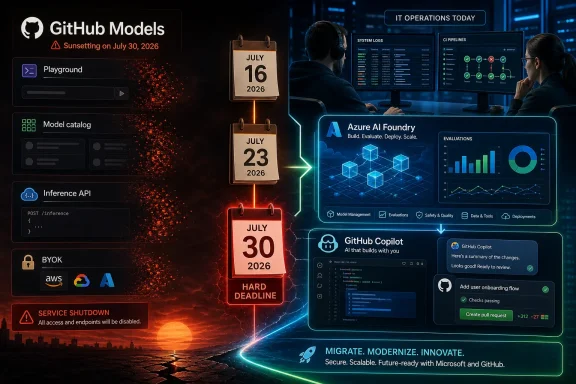 GitHub Turns a Preview Into a Deadline
GitHub Models was never quite positioned as the grand destination for production AI workloads. It was a convenient on-ramp: a place to compare models, test prompts, call an inference API, and let teams experiment without immediately building a full Azure architecture around every prototype. That made it useful precisely because it was lightweight.The retirement notice changes the meaning of that convenience. GitHub had already closed Models to new customers in June 2026, while letting existing users continue. The July 1 update makes the second shoe explicit: everyone loses access on July 30, including organizations with active usage.
That timeline matters because it compresses planning into weeks, not quarters. The scheduled brownouts on July 16 and July 23 are not merely polite warnings; they are operational drills. If a build script, demo environment, classroom lab, internal tool, or sidecar AI feature still depends on GitHub Models, those dates should expose it before the final cutoff does.
The Product Being Retired Was Small, but the Surface Area Was Not
The phrase “GitHub Models” sounds tidy, but the retirement touches several different user behaviors. The playground was for experimentation. The catalog was for discovery. The inference API was for integration. BYOK was for customers trying to connect their own provider credentials while keeping the workflow in GitHub.Those are not interchangeable pieces. Losing the playground inconveniences developers. Losing the API breaks software. Losing BYOK complicates governance patterns for teams that were using GitHub as a neutral front door to model access.
This is why the shutdown will be felt unevenly. A developer who used Models as a toy prompt bench can move on in an afternoon. A team that embedded the inference endpoint into CI jobs, issue triage, documentation generation, or an internal developer portal has migration work to do, even if the code footprint is small.
Microsoft’s Answer Is Azure, Not Another GitHub Button
GitHub’s guidance points users toward Azure AI Foundry for model access and GitHub Copilot for AI-powered workflows inside GitHub. That is an important distinction. Microsoft is not saying there is a one-for-one GitHub Models successor living under a new tab. It is steering users into two different product lanes.Azure AI Foundry is the platform answer. It offers a broad catalog, deployment options, evaluation tooling, and the sort of enterprise controls that procurement, compliance, and security teams expect. It is also more Azure-shaped: subscriptions, regions, quotas, billing models, role-based access, and operational responsibility all come with the territory.
GitHub Copilot is the workflow answer. It is where Microsoft wants coding assistance, pull request help, chat, and agentic developer features to live. If GitHub Models was a general-purpose model access layer inside GitHub, Copilot is the managed experience and Foundry is the production platform.
That split says a lot about Microsoft’s AI strategy. The company appears less interested in letting GitHub become a parallel AI cloud and more interested in making GitHub the collaboration surface for tools whose serious infrastructure lives elsewhere.
The AI Playground Era Is Giving Way to Platform Gravity
The first wave of developer AI tools rewarded immediacy. Click a model, paste a prompt, get a response, copy a snippet, ship a demo. GitHub Models fit that era neatly because it reduced friction at the point where developers were most curious and least patient.But the second wave is about control. Organizations now care about cost accounting, data residency, audit trails, model lifecycle management, abuse monitoring, and contractual boundaries around non-Microsoft models. Those concerns are not glamorous, but they are exactly where enterprise AI projects either graduate or die.
GitHub Models sat awkwardly between those worlds. It was more structured than a toy chatbot, but less central than Azure AI Foundry. It gave developers a fast path, but it also risked becoming another place where model usage could sprawl beyond the systems IT had already built to manage cloud services.
That tension is familiar to Windows admins. The history of enterprise software is full of useful side doors that later get closed in favor of centralized management. The side door proves demand; the platform absorbs the demand; the product team retires the bridge.
Brownouts Are the Most Honest Part of the Announcement
The two brownouts are a useful detail because they acknowledge the uncomfortable truth: people are using this thing in ways GitHub cannot fully see from the outside. A retirement notice can be missed. A dashboard banner can be ignored. A failing request tends to get attention.Brownouts are a practical way to turn a calendar announcement into telemetry for customers. If something breaks on July 16, the organization still has time to find the owner, inspect the dependency, and move the workload. If it breaks for the first time on July 30, the migration becomes an incident.
Administrators should treat those dates as change windows, even if GitHub frames the interruptions as brief. Watch logs. Alert on failed model calls. Ask developers to run known demos and automation jobs during or after the brownout windows. The goal is not merely to survive the interruption; it is to discover whether anyone accidentally built a production dependency on a preview-era service.
The Risk Is Not Just Broken Code, but Broken Assumptions
The obvious migration task is technical: replace API calls, update credentials, rework SDK usage, and test outputs. The subtler task is conceptual. Teams may have assumed that because GitHub is central to development, GitHub-hosted AI primitives would remain available long enough to become part of normal engineering muscle memory.That assumption has now been corrected. GitHub is a durable development platform, but not every feature exposed inside GitHub has the same durability. Preview services, especially in the AI space, should be treated as volatile unless the vendor has made explicit commitments about support, SLAs, and lifecycle.
This is particularly important for internal developer experience teams. They often build small accelerators that spread quickly: prompt templates, repository bots, PR summarizers, scaffolding tools, documentation helpers. These are rarely governed like core applications, yet they can become embedded in daily work.
The GitHub Models retirement should push those teams to inventory their AI dependencies the same way they inventory package registries, CI runners, secrets, and deployment credentials. The question is no longer “does it work?” It is “what happens when the vendor moves the abstraction?”
Copilot Gets the GitHub Seat, Foundry Gets the Platform Budget
The retirement also clarifies Microsoft’s product map. GitHub Copilot is the AI interface Microsoft wants developers to see every day. Azure AI Foundry is the platform Microsoft wants architects and enterprises to standardize on. GitHub Models occupied the middle, and the middle is where product overlap becomes expensive.From Microsoft’s perspective, this consolidation makes sense. Copilot carries the GitHub-native user experience. Foundry carries the cloud revenue and governance story. Maintaining a separate GitHub Models surface could confuse customers about where to build durable AI applications.
From a customer perspective, however, consolidation often means more ceremony. A quick prototype may now require more decisions about Azure resources, deployments, permissions, and cost controls. That may be the right tradeoff for production, but it is not the same user experience.
This is the recurring bargain of enterprise computing. The tool that made experimentation easy is replaced by the platform that makes operations defensible. Developers lose some immediacy; organizations gain control. Whether that is progress depends on where you sit.
Windows Shops Should Read This as a Governance Signal
For WindowsForum readers, the practical lesson extends beyond GitHub Models. Many Microsoft-heavy organizations are already threading AI into Windows administration, endpoint management, PowerShell automation, help desk workflows, security triage, and developer pipelines. Those efforts often begin with whatever endpoint is easiest to call.Ease is not a governance model. If an AI feature touches corporate data, source code, customer records, logs, or privileged workflows, the model endpoint matters. So do retention policies, regional availability, authentication, and the provider’s lifecycle commitments.
GitHub Models gave developers a useful abstraction over model choice. Its retirement reinforces that abstraction layers can disappear before the habits built around them do. Admins should assume that AI endpoints are now part of the estate and should be tracked with the same seriousness as SaaS integrations and cloud resources.
That does not mean banning experimentation. It means drawing a bright line between demos and dependencies. A Friday afternoon prototype can tolerate churn. A workflow that gates a release, edits documentation, responds to tickets, or advises on security alerts cannot.
The Migration Is an Opportunity to Fix the Mess
The shutdown creates work, but it also creates a convenient forcing function. Teams that adopted GitHub Models casually can now make deliberate choices about models, hosting, authentication, and monitoring. That is healthier than sleepwalking into production on a service whose long-term role was never fully clear.The first step is discovery. Search repositories for GitHub Models endpoint references, SDK examples, tokens, workflow variables, and internal documentation. Check GitHub Actions, Codespaces setup scripts, internal bots, and developer portals. Ask whether any training material, workshops, or onboarding labs still point to the playground.
The second step is classification. Some uses should move to Copilot because they are really developer-assistance workflows. Some should move to Azure AI Foundry because they are application workloads. Some should be retired because the prototype never became valuable enough to justify migration.
The third step is testing. Model migrations are not like swapping one REST endpoint for another. Output changes, safety behavior changes, rate limits change, latency changes, and costs change. Even when the prompt is identical, the system around the prompt is not.
The Real Lock-In Is at the Workflow Layer
AI vendors like to talk about model choice, and model catalogs are useful. But the stickiest part of these systems is often not the model itself. It is the workflow wrapped around the model: evaluation data, prompts, scoring logic, approvals, logs, permissions, and user habits.GitHub Models made model access feel close to the repository. That proximity was powerful. Developers could imagine AI behavior as part of the repo lifecycle, not as a separate cloud application. Retiring the service does not erase that idea, but it moves the implementation elsewhere.
Microsoft still wants that repository-centric workflow through Copilot, agents, and GitHub-native experiences. What it appears less willing to maintain is GitHub as a broad, standalone inference surface. In other words, GitHub remains the place where developers work, but Azure remains the place where Microsoft wants serious AI infrastructure to land.
That division is defensible. It is also a reminder that where a button appears in the UI does not necessarily tell you where the strategic center of gravity lies.
The July Calendar Leaves Little Room for Romantic Attachments
The concrete message for users is simple: do not spend July debating whether GitHub Models should have survived. Spend it removing dependencies. The service is scheduled to be gone on July 30, and GitHub has named the parts that disappear.The brownouts make the migration schedule even tighter. July 16 and July 23 should be treated as practical deadlines for testing, not trivia in the changelog. If a team cannot explain what will happen during those interruptions, it probably does not understand its dependency.
For organizations with mature cloud practices, this is manageable. For smaller teams, classrooms, startups, and open source maintainers who liked the low-friction GitHub surface, the change will sting more. Their replacement path may involve more Azure knowledge than they wanted to acquire just to keep an AI-enabled feature alive.
The Shutdown Playbook for Teams That Actually Used It
The urgent work is narrow enough to fit on one page, but important enough not to leave to the last week. Treat GitHub Models as a disappearing external dependency, not merely a feature going away in somebody else’s UI.- Identify every repository, workflow, script, app, demo, and internal document that references GitHub Models, its inference API, its playground, or BYOK configuration.
- Use the July 16 and July 23 brownouts as live tests to find hidden dependencies before the final retirement date.
- Move developer-assistance scenarios toward GitHub Copilot where the desired outcome is coding help, pull request support, or repository-centric AI workflow.
- Move application inference workloads toward Azure AI Foundry or another deliberately chosen model platform with clear ownership, billing, and governance.
- Re-test prompts, outputs, latency, error handling, rate limits, and cost assumptions because model access migrations can change behavior even when the surrounding application appears unchanged.
- Update onboarding material, runbooks, and security reviews so that future prototypes do not quietly rebuild on another preview service without an exit plan.
References
- Primary source: The GitHub Blog
Published: Wed, 01 Jul 2026 21:30:20 GMT
Loading…
github.blog - Official source: learn.microsoft.com
Loading…
learn.microsoft.com - Official source: azure.microsoft.com
Loading…
azure.microsoft.com - Official source: docs.github.com
Loading…
docs.github.com - Related coverage: huggingface.co
Loading…
huggingface.co - Official source: ai.azure.com
Loading…
ai.azure.com
- Related coverage: vra.github.io
Loading…
vra.github.io