

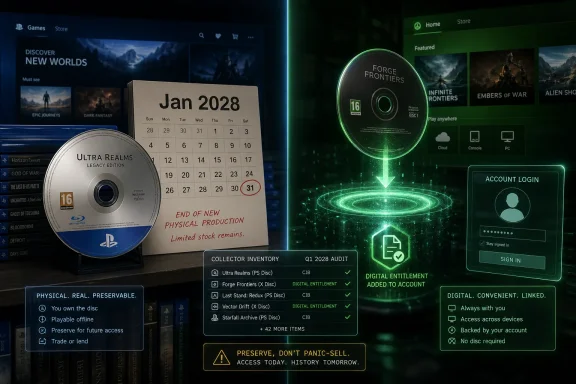
Sony’s January 2028 cutoff means new PlayStation games will stop being manufactured on physical discs, while existing and pre-2028 disc releases remain unaffected. For Xbox owners, WindowsForum user reports say Microsoft’s in-testing “Positron” program could let players convert eligible Xbox One and newer game discs into digital entitlements by installing them. The practical verdict is simple: keep valuable discs, avoid panic-selling, and treat every new physical purchase as a platform-specific bet on future access. PlayStation is drawing a line under new physical releases; Xbox, if the reporting holds, may be exploring a way to turn some discs into proof for account-based access.
If you only skim one section, make it this one:
For PlayStation, the rule is direct enough to affect behavior now. New PlayStation games stop getting physical disc production in January 2028, while Sony’s stated transition does not affect games already released on disc or games releasing on disc before that cutoff. That means a PS4 or PS5 disc you own today is not suddenly invalidated by the announcement.
For Xbox, the situation is less settled. WindowsForum’s user reports describe Microsoft’s reportedly in-testing Xbox “Positron” program as a disc-to-digital entitlement idea: eligible Xbox One and newer discs could be installed and converted into digital access tied to the player’s account. That is not the same as a final public policy. It is a reported program, and the important details remain open.
That difference matters for buying decisions. A PlayStation disc remains most useful as a disc. An Xbox disc may eventually become useful as proof that you already bought the game, but only if Microsoft ships the program in a broad and trustworthy form.
The used-game market depends on a few practical conditions: new games entering the physical supply chain, players being able to pass around physical copies without a platform account transfer, and console hardware continuing to support the format. Sony has now weakened the first condition for new PlayStation games after the cutoff. It has not said that existing discs stop working, but it has confirmed that the pipeline for new disc releases closes.
That is why the ownership question becomes sharper than the format question. The fight is not really plastic versus downloads. It is whether players retain meaningful options outside the platform holder’s storefront once new releases become digital-only.
A disc can generally be treated like an object: kept on a shelf, handed to someone else, bought used, or stored for later. A digital license is usually easier to launch and harder to separate from the account that acquired it. Once a platform stops manufacturing new discs, the user’s leverage shifts away from possession and toward policy.
That does not make every disc a treasure. It does make the end of new physical production a real change in how players should think about libraries.
But the key phrase is if that ships. The reporting points to a program in testing, not a complete public entitlement policy. That means the useful version of the story is narrow: Microsoft may be testing a way to let eligible Xbox One and newer discs become digital licenses. Anything beyond that — broad compatibility, resale effects, publisher participation, whether the disc remains usable afterward, or whether the process is reversible — remains unanswered.
If Microsoft can eventually say, “your eligible discs come with you,” that would be a powerful customer-retention message. It would not make digital ownership identical to physical ownership. It would, however, acknowledge that many players bought physical games before the industry finished moving the aisle to digital storefronts.
That is the opportunity: not to pretend the disc and the digital license are the same, but to give existing customers a credible bridge.
That is what makes a disc-to-digital conversion program both useful and complicated. For players who mainly want access, converting a disc into a digital entitlement could be a win. For collectors who care about the object, the box, the print run, and the ability to keep the game separate from an account, conversion could feel less like preservation and more like migration into platform custody.
Microsoft would need to answer the boring questions before Positron could become a serious ownership story:
The better PlayStation move is selective physical purchasing.
Do buy physical when:
For families, shared households, and budget players, the used-market angle is more immediate than the collector angle. Fewer new physical releases means fewer future chances to buy late, buy used, gift a sealed copy, or pass around a disc. That is where digital-only distribution can quietly change the cost and flexibility of participation.
The practical reason to wait is simple: eligibility is unknown. A used copy that looks like shelf clutter today could become part of an upgrade path tomorrow. Until Microsoft publishes the rules, players do not know which discs might matter, how conversion would work, or whether there will be publisher exceptions.
That uncertainty cuts both ways. Do not buy random Xbox discs purely on speculation. Do not assume every old Xbox One or Series-era disc becomes a digital key. But also do not liquidate a library you care about before Microsoft clarifies whether those discs can carry forward into account-based access.
For Xbox owners, the best checklist is short:
Convenience is not the same as control. A digital library is convenient until the account becomes the only key that matters. Physical media is inconvenient until it is the only part of the transaction not asking a storefront for permission.
For IT pros and sysadmins, this should feel familiar. Enterprises have lived this migration already: perpetual licenses became subscriptions, boxed installers became portals, offline activation became cloud identity, and “owned” software became a relationship governed by account status, licensing terms, and vendor infrastructure. The consumer console market is going through a similar abstraction, only with nostalgia, shelves, trade-ins, and family sharing attached.
That is why Microsoft’s reported approach matters beyond gaming. If the company can convert physical proof into digital entitlement without pretending the two are identical, it would be acknowledging a hybrid truth most vendors avoid: users want modern convenience, but they also want credit for what they already bought.
The risk is that a conversion feature could be marketed as generosity while leaving too many unanswered questions. If it is narrow, confusing, or full of exceptions, players will treat it as another license trap. If it is clear and broad, it could become one of Xbox’s strongest library-migration arguments.
Retailers lose the boxed product that brings customers into stores. Used-game shops lose future inventory flow. Informal lending becomes harder unless platform holders create workable digital equivalents. Parents lose an easy gift format. Collectors lose the default assumption that a major release will receive a standard physical edition.
Publishers and platform holders gain cleaner inventory, fewer manufacturing concerns, more direct pricing control, and tighter control over promotions and availability. Players gain convenience, fast access, and fewer boxes to store. But they also become more dependent on account systems, storefront rules, refund policies, and long-term platform support.
That is why “just buy digital” is too thin as advice. Digital can be the better experience for launching a game tonight. It can still be the weaker model for a library you want to manage independently over many years.
The point is not that physical is pure and digital is bad. The point is that each format now carries different risks. Physical copies can be damaged, lost, incomplete, or dependent on updates. Digital copies can be convenient, discounted, and easy to reinstall, but they are tied to accounts and platform policies. The smart move is not format loyalty. It is knowing which risk you are accepting.
Know what you own. Decide which discs matter as collectibles and which are merely convenient installers. Keep platform accounts secure. Avoid trading in potentially eligible Xbox discs until Microsoft clarifies Positron. For PlayStation, treat pre-2028 discs as the last normal window for physical purchasing, not as guaranteed lottery tickets.
For households with both platforms, the calculation changes title by title. A game you want to keep as a boxed object may still favor PlayStation physical before the cutoff. A game you expect to carry forward through a Microsoft account could favor Xbox if disc-to-digital becomes a real entitlement path. A game that is online-only, subscription-fed, or heavily patched may be better judged on price, friends list, cross-progression, and ecosystem rather than packaging.
There is no universal answer because the industry has made ownership non-universal. The box, the disc, the license, the account, the patch server, and the storefront all now share custody of the experience.
That is the part worth sitting with. The argument is no longer “physical versus digital” in a clean old-fashioned sense. It is a practical question: which combination of object, account, and platform rule gives you the most confidence for the games you care about?
That does not guarantee every game will remain fully functional forever. Some titles depend on patches, servers, accounts, or online services. But the January 2028 change is about the production of new physical releases, not an announced shutdown of discs you already own.
Prioritize games you actually care about: first-party titles, favorite series, releases with strong single-player content on disc, collector’s editions you genuinely want, or games you expect to replay. Avoid panic-buying ordinary boxed copies just because the format is winding down for new releases. A disc only has long-term value if someone wants the game, the version, or the object.
The important caveat is that this is reported testing, not a complete public rulebook. Eligibility, regions, publisher exceptions, transfer effects, and account handling are not settled in the reporting summarized here.
A disc and an account-bound license are different things. The disc is an object. The entitlement is governed by platform rules. Until Microsoft publishes the final terms, it is better to treat conversion as a convenience and migration feature, not as a perfect replacement for physical ownership.
The safe assumption is not that digital licenses will behave like discs. Check the specific platform’s current rules before making plans around resale, lending, or transferring access.
The better question is not “which format is morally superior?” It is “which format gives me the best mix of convenience, cost, access, and control for this specific game?”
In short: preserve deliberately, not desperately.
 What to Do Now
If you only skim one section, make it this one:- PlayStation collectors: Do keep the discs you care about. Do prioritize physical copies of games you actually want to preserve, display, lend, replay, or possibly resell. Don’t panic-buy every boxed release just because the clock is now visible.
- PlayStation players who mostly want convenience: Do buy digital when the price, patches, online design, or subscription access makes the disc less important to you. Don’t assume a disc automatically means a complete long-term copy of the full experience.
- Xbox owners with Xbox One or newer discs: Do hold onto the games you care about until Microsoft confirms whether “Positron” exists publicly, which discs qualify, and how conversion would work. Don’t trade in a physical Xbox library for pennies before the rules are known.
- Xbox bargain hunters: Do not buy random used discs purely as a speculation play. Eligibility, publisher participation, region handling, and account rules are all unknown.
- Everyone: Keep a simple inventory of your physical games, protect your platform accounts with strong authentication, and separate “games I want as objects” from “games I just want to launch easily.”
The Buying Advice Changed Before the Consoles Did
If you are deciding what to do with your game library in 2026, the move is not to dump discs or buy every boxed copy you see. It is to separate your collection into three piles: games you want to preserve as physical artifacts, games you mostly care about playing conveniently, and games whose value to you depends on sharing, resale, gifting, or long-term compatibility.For PlayStation, the rule is direct enough to affect behavior now. New PlayStation games stop getting physical disc production in January 2028, while Sony’s stated transition does not affect games already released on disc or games releasing on disc before that cutoff. That means a PS4 or PS5 disc you own today is not suddenly invalidated by the announcement.
For Xbox, the situation is less settled. WindowsForum’s user reports describe Microsoft’s reportedly in-testing Xbox “Positron” program as a disc-to-digital entitlement idea: eligible Xbox One and newer discs could be installed and converted into digital access tied to the player’s account. That is not the same as a final public policy. It is a reported program, and the important details remain open.
That difference matters for buying decisions. A PlayStation disc remains most useful as a disc. An Xbox disc may eventually become useful as proof that you already bought the game, but only if Microsoft ships the program in a broad and trustworthy form.
Sony Has Put a Date on the End of the Used-Game Assumption
Sony’s cutoff is not a surprise, but dates have power. “Digital is the future” was a trend; January 2028 is a procurement deadline, a collector deadline, and a planning deadline for anyone who still values boxed console games.The used-game market depends on a few practical conditions: new games entering the physical supply chain, players being able to pass around physical copies without a platform account transfer, and console hardware continuing to support the format. Sony has now weakened the first condition for new PlayStation games after the cutoff. It has not said that existing discs stop working, but it has confirmed that the pipeline for new disc releases closes.
That is why the ownership question becomes sharper than the format question. The fight is not really plastic versus downloads. It is whether players retain meaningful options outside the platform holder’s storefront once new releases become digital-only.
A disc can generally be treated like an object: kept on a shelf, handed to someone else, bought used, or stored for later. A digital license is usually easier to launch and harder to separate from the account that acquired it. Once a platform stops manufacturing new discs, the user’s leverage shifts away from possession and toward policy.
That does not make every disc a treasure. It does make the end of new physical production a real change in how players should think about libraries.
Microsoft’s Reported Positron Program Would Be More Than a Convenience Feature
On its face, Xbox “Positron” sounds like a quality-of-life feature. WindowsForum’s user reports describe the idea as follows: players would use eligible Xbox One and newer game discs to receive digital entitlements, apparently by installing those games. If that ships, it could reduce disc swapping, make all-digital hardware less hostile to older physical libraries, and ease the path for players moving from disc-based ownership habits to account-based access.But the key phrase is if that ships. The reporting points to a program in testing, not a complete public entitlement policy. That means the useful version of the story is narrow: Microsoft may be testing a way to let eligible Xbox One and newer discs become digital licenses. Anything beyond that — broad compatibility, resale effects, publisher participation, whether the disc remains usable afterward, or whether the process is reversible — remains unanswered.
If Microsoft can eventually say, “your eligible discs come with you,” that would be a powerful customer-retention message. It would not make digital ownership identical to physical ownership. It would, however, acknowledge that many players bought physical games before the industry finished moving the aisle to digital storefronts.
That is the opportunity: not to pretend the disc and the digital license are the same, but to give existing customers a credible bridge.
The Disc Is Becoming a Migration Token, Not a Forever Object
The uncomfortable truth for collectors is that modern console discs have already lost some of their old certainty. Many games rely on patches, online services, large downloads, account systems, or server-side features. The disc is still meaningful, but it is not always a complete, timeless copy of the experience.That is what makes a disc-to-digital conversion program both useful and complicated. For players who mainly want access, converting a disc into a digital entitlement could be a win. For collectors who care about the object, the box, the print run, and the ability to keep the game separate from an account, conversion could feel less like preservation and more like migration into platform custody.
Microsoft would need to answer the boring questions before Positron could become a serious ownership story:
- Which discs qualify?
- Are all publishers participating, or only some?
- Does conversion merely verify the disc, or does it change what the disc can do afterward?
- Is the entitlement tied permanently to one Microsoft account?
- What happens if a game is delisted later?
- How are region differences handled?
- Can families use the entitlement across shared consoles?
- What happens if the account is lost, banned, compromised, or inaccessible?
PlayStation Owners Should Buy Physical More Selectively, Not More Emotionally
The obvious reaction to Sony’s announcement is to start hoarding discs. That is understandable, especially for collectors who have watched older digital storefronts age, shrink, or disappear. But panic buying is rarely good preservation strategy.The better PlayStation move is selective physical purchasing.
Do buy physical when:
- You want the game as a collectible object.
- You expect to replay it years later.
- You want the option to lend the physical copy.
- You want a boxed copy for display or archival reasons.
- You are buying before the January 2028 cutoff and the physical version matters to you.
- It has a box.
- Someone online says every late-generation disc will become valuable.
- You assume scarcity alone creates resale demand.
- The disc is only a partial installer for an online-first game you do not care about preserving.
- You are stretching your budget to chase a format transition.
For families, shared households, and budget players, the used-market angle is more immediate than the collector angle. Fewer new physical releases means fewer future chances to buy late, buy used, gift a sealed copy, or pass around a disc. That is where digital-only distribution can quietly change the cost and flexibility of participation.
Xbox Owners Should Stop Thinking of Discs as Dead Weight
Xbox players with physical libraries should not assume their discs are obsolete just because future hardware may tilt digital. If Positron becomes real in the form WindowsForum users have reported, an Xbox One or newer disc could become the proof needed to claim a digital entitlement. That makes keeping the disc potentially more useful, not less.The practical reason to wait is simple: eligibility is unknown. A used copy that looks like shelf clutter today could become part of an upgrade path tomorrow. Until Microsoft publishes the rules, players do not know which discs might matter, how conversion would work, or whether there will be publisher exceptions.
That uncertainty cuts both ways. Do not buy random Xbox discs purely on speculation. Do not assume every old Xbox One or Series-era disc becomes a digital key. But also do not liquidate a library you care about before Microsoft clarifies whether those discs can carry forward into account-based access.
For Xbox owners, the best checklist is short:
- Do keep Xbox One and newer discs for games you actually care about.
- Do document what you own, especially collector’s editions or hard-to-replace titles.
- Do wait for Microsoft’s official rules before making trade-in decisions.
- Don’t assume Positron will cover every disc.
- Don’t buy piles of used discs as a bet on a program that has not been publicly detailed.
- Don’t treat digital conversion as identical to owning the disc unless Microsoft’s final terms actually support that conclusion.
The Real Platform War Is Now About Exit Options
The console business has spent years selling convenience as inevitability. Downloads are faster to browse, easier to patch, simpler to launch, and friendlier to subscriptions. That is all true. It is also incomplete.Convenience is not the same as control. A digital library is convenient until the account becomes the only key that matters. Physical media is inconvenient until it is the only part of the transaction not asking a storefront for permission.
For IT pros and sysadmins, this should feel familiar. Enterprises have lived this migration already: perpetual licenses became subscriptions, boxed installers became portals, offline activation became cloud identity, and “owned” software became a relationship governed by account status, licensing terms, and vendor infrastructure. The consumer console market is going through a similar abstraction, only with nostalgia, shelves, trade-ins, and family sharing attached.
That is why Microsoft’s reported approach matters beyond gaming. If the company can convert physical proof into digital entitlement without pretending the two are identical, it would be acknowledging a hybrid truth most vendors avoid: users want modern convenience, but they also want credit for what they already bought.
The risk is that a conversion feature could be marketed as generosity while leaving too many unanswered questions. If it is narrow, confusing, or full of exceptions, players will treat it as another license trap. If it is clear and broad, it could become one of Xbox’s strongest library-migration arguments.
Retailers, Collectors, and Shared Libraries Take the Hit
A digital-only new-release future does not just change how players buy. It changes who gets to participate in the transaction.Retailers lose the boxed product that brings customers into stores. Used-game shops lose future inventory flow. Informal lending becomes harder unless platform holders create workable digital equivalents. Parents lose an easy gift format. Collectors lose the default assumption that a major release will receive a standard physical edition.
Publishers and platform holders gain cleaner inventory, fewer manufacturing concerns, more direct pricing control, and tighter control over promotions and availability. Players gain convenience, fast access, and fewer boxes to store. But they also become more dependent on account systems, storefront rules, refund policies, and long-term platform support.
That is why “just buy digital” is too thin as advice. Digital can be the better experience for launching a game tonight. It can still be the weaker model for a library you want to manage independently over many years.
The point is not that physical is pure and digital is bad. The point is that each format now carries different risks. Physical copies can be damaged, lost, incomplete, or dependent on updates. Digital copies can be convenient, discounted, and easy to reinstall, but they are tied to accounts and platform policies. The smart move is not format loyalty. It is knowing which risk you are accepting.
The 2026 Library Strategy Is Boring, Which Is Why It Works
The smartest response now is inventory management.Know what you own. Decide which discs matter as collectibles and which are merely convenient installers. Keep platform accounts secure. Avoid trading in potentially eligible Xbox discs until Microsoft clarifies Positron. For PlayStation, treat pre-2028 discs as the last normal window for physical purchasing, not as guaranteed lottery tickets.
For households with both platforms, the calculation changes title by title. A game you want to keep as a boxed object may still favor PlayStation physical before the cutoff. A game you expect to carry forward through a Microsoft account could favor Xbox if disc-to-digital becomes a real entitlement path. A game that is online-only, subscription-fed, or heavily patched may be better judged on price, friends list, cross-progression, and ecosystem rather than packaging.
There is no universal answer because the industry has made ownership non-universal. The box, the disc, the license, the account, the patch server, and the storefront all now share custody of the experience.
That is the part worth sitting with. The argument is no longer “physical versus digital” in a clean old-fashioned sense. It is a practical question: which combination of object, account, and platform rule gives you the most confidence for the games you care about?
The Shelf Is Now a Policy Bet
The concrete takeaways are less dramatic than the headlines, but they are more useful. Sony has made the calendar visible, and Microsoft’s reported response could turn some older discs into a bridge if it becomes a real program.- PlayStation buyers should not panic-sell existing discs, because the January 2028 cutoff does not apply retroactively to games already released or releasing before then in disc format.
- PlayStation collectors should prioritize physical copies of games they genuinely want to preserve, display, lend, replay, or possibly resell.
- PlayStation buyers should not hoard every boxed game on the assumption that every disc becomes valuable.
- Xbox owners should consider holding onto Xbox One and newer discs until Microsoft confirms whether “Positron” will convert eligible discs into digital entitlements.
- Xbox owners should not assume all discs will qualify, or that conversion will preserve every practical benefit of a physical copy.
- Players should treat disc-to-digital conversion as convenient but not automatically equivalent to physical ownership.
- Digital-only releases make storefront policy, account security, and long-term platform support more important than packaging.
Frequently Asked Questions
Are my existing PlayStation discs going to stop working in January 2028?
No. The cutoff described here concerns new PlayStation games no longer being manufactured on physical discs starting in January 2028. Existing disc releases and games released on disc before that cutoff are not described as being retroactively invalidated.That does not guarantee every game will remain fully functional forever. Some titles depend on patches, servers, accounts, or online services. But the January 2028 change is about the production of new physical releases, not an announced shutdown of discs you already own.
Should PlayStation collectors start buying every physical game now?
No. Buy selectively.Prioritize games you actually care about: first-party titles, favorite series, releases with strong single-player content on disc, collector’s editions you genuinely want, or games you expect to replay. Avoid panic-buying ordinary boxed copies just because the format is winding down for new releases. A disc only has long-term value if someone wants the game, the version, or the object.
Should I sell my PlayStation discs before the cutoff?
Not as a reflex. If you do not care about a game and would rather have the money, selling may make sense. But the cutoff does not mean your current discs become useless. For games you value as collectibles, replayable favorites, or shareable household items, keeping them is the safer move.What is Xbox “Positron”?
WindowsForum user reports describe Xbox “Positron” as a reportedly in-testing Microsoft program that could let players convert eligible Xbox One and newer game discs into digital entitlements by installing them. In plain English: the disc could become proof that lets your Microsoft account receive digital access.The important caveat is that this is reported testing, not a complete public rulebook. Eligibility, regions, publisher exceptions, transfer effects, and account handling are not settled in the reporting summarized here.
Should Xbox owners keep their discs?
If they are Xbox One or newer discs for games you care about, yes, at least until Microsoft clarifies the program. Do not assume every disc will qualify. But also do not rush to trade in a library that may become useful as proof for future digital access.Should I buy used Xbox discs now in case Positron makes them valuable?
Be careful. If you already wanted a specific game, buying a cheap used copy can still be reasonable. But buying piles of discs purely to speculate on an unannounced conversion policy is risky. Nobody outside the final program rules can tell you which discs will qualify or how conversion will work.Would disc-to-digital conversion mean I still own the game physically?
It would mean you have a digital entitlement if the program works as reported and the disc qualifies. It would not automatically mean that every practical feature of physical ownership carries over.A disc and an account-bound license are different things. The disc is an object. The entitlement is governed by platform rules. Until Microsoft publishes the final terms, it is better to treat conversion as a convenience and migration feature, not as a perfect replacement for physical ownership.
What about lending, resale, inheritance, or giving games to family?
For physical discs, those actions are generally tied to having the object. For digital entitlements, those actions depend on platform rules, account access, family-sharing features, and license terms. That is the broad implication of the format shift: more control moves from the user’s possession of an object to the platform’s account system.The safe assumption is not that digital licenses will behave like discs. Check the specific platform’s current rules before making plans around resale, lending, or transferring access.
Is digital always worse than physical?
No. Digital is often cheaper during sales, easier to install, faster to switch between, better for remote downloads, and necessary for many online-first games. Physical is better when you care about the object, shelf display, used copies, lending, or keeping some distance from storefront-only access.The better question is not “which format is morally superior?” It is “which format gives me the best mix of convenience, cost, access, and control for this specific game?”
What is the safest strategy for 2026?
Keep the discs you care about. Stop buying physical copies emotionally. Do not trade in Xbox One or newer discs until Microsoft explains Positron. Buy PlayStation physical releases selectively before January 2028 if the boxed version matters to you. Use digital when it is cheaper, more practical, or when the game is already dependent on online services.In short: preserve deliberately, not desperately.
References
- Primary source: tomshardware.com
Sony officially kills the PlayStation disc, ending physical game production in 2028 — shutting down the PlayStation Store on the PlayStation 3 and PS Vita systems | Tom's Hardware
This announcement essentially sounds the death knell for physical media in cutting-edge gaming.www.tomshardware.com - Independent coverage: gamesradar.com
PlayStation is ending physical disc production for new games in 2028 as Sony says "general preference for digital media significantly outpaces physical discs" | GamesRadar+
"This is a natural direction" for the companywww.gamesradar.com - Independent coverage: techradar.com
Loading…
www.techradar.com - Independent coverage: gematsu.com
Sony Interactive Entertainment to end physical game disc production in January 2028 - Gematsu
Sony Interactive Entertainment will end physical game disc production for all new games releasing on PlayStation consoles starting January 2028…www.gematsu.com - Independent coverage: dotesports.com
PlayStation physical discs ending for new games in January 2028
Sony will stop producing physical discs for new PlayStation games from January 2028, with future releases sold digitally through PlayStation Store and retailers.dotesports.com - Independent coverage: techcrunch.com
Microsoft's open source tools were hacked to steal passwords of AI developers | TechCrunch
Microsoft shut down dozens of GitHub code repositories for Azure and AI coding tools after a reported hack.techcrunch.com
- Independent coverage: washingtonpost.com
Loading…
www.washingtonpost.com - Independent coverage: nippon.com
Loading…
www.nippon.com - Independent coverage: windowscentral.com
New details emerge on Xbox 'Positron', Microsoft's disc-to-digital program — as it seems likely Xbox Helix will drop discs too | Windows Central
Xbox Helix is likely to be joining PlayStation 5 in dropping discs. A new report describes how Microsoft plans to mitigate the issue.www.windowscentral.com - Independent coverage: elpais.com
Loading…
elpais.com - Independent coverage: thenextweb.com
Sony will stop making physical PlayStation game discs in January 2028
Sony announced it will end physical disc production for new PlayStation games starting January 2028, as digital downloads now account for 85 percent of sales.thenextweb.com - Independent coverage: techtimes.com
GitHub's AI Agent Crisis Forces Microsoft to Tap AWS as Outages Break Enterprise SLAs
GitHub infrastructure crisis reached a new level June 16 as Microsoft confirmed tapping Amazon Web Services to handle AI coding agent traffic that pushed the platform past its limits — 275M commitswww.techtimes.com