

AI is already reshaping medical practice in 2026 through ambient documentation, clinical decision support, consumer chatbots, imaging tools, and administrative automation, while two recent physician-focused articles warn that the real fight is now over clinical judgment, patient data, and legal governance. The uncomfortable thesis is that AI adoption in health care has moved faster than the professional habits and compliance machinery needed to contain it. For physicians, the danger is not only that a chatbot might hallucinate. It is that doctors may outsource thinking while also feeding protected health information into systems their practices never approved.
The first phase of medical AI was sold as relief. Doctors drowning in documentation could dictate into ambient scribes. Specialists could use image-analysis systems to flag lesions or abnormalities. Administrators could summarize records, draft appeals, and tidy up the bureaucratic wreckage left behind by modern reimbursement.
That pitch was never imaginary. U.S. health care is a paperwork machine with a hospital attached, and physicians have every reason to reach for tools that remove low-value clerical work. If an AI system can turn a rambling encounter into a usable note, or help assemble a medical-necessity addendum in seconds, the productivity argument is obvious.
But the second phase is less flattering. Once a tool becomes useful enough to depend on, the question shifts from can it help? to what does dependence do? The Passive Income MD piece frames this as a cognitive issue: physicians may lose the habit of independent reasoning if AI handles too much of the clinical thought process. The Medical Economics article frames it as a compliance issue: doctors may already be using AI with patient data in ways that violate HIPAA.
Those are not separate stories. They are two sides of the same governance failure. Medical AI is no longer a futuristic layer outside the practice; it is already inside the workflow, often unofficially, unevenly, and without the guardrails that medicine normally demands of anything touching diagnosis, documentation, or protected health information.
That is the kind of failure WindowsForum readers will recognize immediately. It is shadow IT, except the spreadsheet of customer records has become a clinical note, and the unsanctioned SaaS app has become a chatbot trained to sound confident. The security perimeter is not just the firewall or the EHR login. It is the moment a tired professional decides that copying and pasting is faster than waiting for the approved process to catch up.
Health care has a particular legal vocabulary for this. HIPAA requires covered entities to control how protected health information is disclosed, and vendors handling that information generally need a business associate agreement. A consumer AI tool is not magically exempt because it is popular, polished, or widely used outside medicine. If it receives identifiable patient data without the right contractual and security framework, the practice has created a regulatory problem.
The point is not that physicians are reckless. The point is that the consumer AI experience has been engineered to collapse friction. These systems invite users to paste messy, high-context material and reward them with clean prose. In medicine, the very details that make a prompt useful — names, dates of birth, procedure histories, imaging findings, clinical timelines — are the details that make it dangerous.
That is why “don’t paste PHI into ChatGPT” is too small a policy. The real requirement is an inventory of AI use across the practice. Many organizations do not know which tools physicians, billers, coders, scribes, and administrators are already using. A compliance program cannot govern what it refuses to see.
Deskilling is the familiar version. A physician once practiced a skill regularly, then used it less because software took over part of the work, and the skill gradually weakened. That can happen in aviation, cybersecurity, manufacturing, and medicine. The body of expertise remains, but the reflex dulls.
Never-skilling is more unsettling. It describes trainees who encounter AI so early in their development that they may never build the underlying skill in the first place. A senior physician may use an AI-generated differential diagnosis as a check against personal reasoning. A trainee may use it as the starting point, the scaffolding, and eventually the substitute.
Mis-skilling may be the quietest failure. It occurs when a clinician internalizes the system’s mistake as if it were clinical judgment. The problem is not merely that AI gives a wrong answer. The problem is that the wrong answer can be absorbed into the physician’s mental model, especially if the system is usually right, fluently written, and presented with institutional legitimacy.
This matters because medical AI does not have to be wrong often to be dangerous. In fact, high reliability can make automation bias worse. When a system is useful day after day, humans naturally reduce the intensity of their review. The rare failure then arrives at the exact moment when skepticism has been trained out of the workflow.
Medicine is not so tidy. Clinical reasoning is not merely the production of an answer. It is the process by which a physician notices what matters, weighs uncertainty, tests competing explanations, and decides when the available information is insufficient. That process is often invisible in the final note, but it is the work patients are paying for.
AI systems can support that work. They can surface overlooked possibilities, reduce administrative noise, and make it easier to compare a case against a large body of literature. Used well, they can function like a tireless assistant that never gets bored of the paperwork medicine has inflicted on itself.
Used poorly, they can become a cognitive prosthetic that weakens the underlying muscle. The clinical danger is not that every doctor becomes helpless overnight. It is that the daily habit of independent hypothesis-building becomes optional, then inefficient, then forgotten.
That is why the most important AI workflow may be deceptively simple: think first, ask second. A physician who forms an independent differential before consulting a model preserves the act of reasoning. A physician who asks the model first and then reacts to its output is practicing a different skill — model supervision — which is useful but not equivalent.
This is where small and independent practices are especially exposed. Large health systems may be slow, bureaucratic, and maddening, but they usually have legal, procurement, compliance, and security teams that know how to vet vendors. Smaller practices often have the same documentation pressures with fewer institutional defenses. A physician-owner may be clinician, executive, IT decision-maker, and emergency compliance officer all at once.
The market makes that worse. Many AI tools are marketed with broad productivity language that sounds health-care-adjacent without being legally adequate for health care use. A vendor may offer an enterprise tier, a health-care tier, or a special agreement that changes data handling. The free or consumer version sitting in a browser tab is not necessarily covered by any of that.
Nor is “we removed the name” always enough. De-identification under HIPAA is not a casual vibes-based exercise. Clinical narratives can contain dates, rare conditions, locations, procedures, and combinations of facts that point back to a patient. A rural specialist pasting a complex procedural history into a chatbot may believe the obvious identifiers are gone while leaving enough detail to create real re-identification risk.
The hard lesson for practices is that AI policy cannot live as a paragraph in the employee handbook. It has to be operational. Staff need to know which tools are allowed, which data can be entered, which uses are forbidden, and who approves exceptions. Otherwise, the default policy becomes whatever the busiest person in the clinic does at 7:42 p.m.
But an EHR integration does not automatically settle the clinical reasoning question. A compliant tool can still encourage overreliance. A legally approved system can still generate a misleading summary, omit an important detail, or nudge physicians toward accepting the machine’s framing of the patient.
This distinction matters because health-care institutions often treat compliance as the finish line. If legal has signed off, procurement has approved the vendor, and security has checked the box, the tool is treated as safe enough to deploy. That may be adequate for data handling. It is not adequate for cognition.
The better model is layered governance. Compliance asks whether the tool may touch the data. Security asks whether the tool can be controlled, audited, and contained. Clinical leadership asks whether the workflow preserves human judgment. Education leaders ask whether trainees are learning medicine or merely learning to operate the machine.
Those groups cannot work in sequence forever. If AI is embedded in documentation, diagnosis, patient communication, coding, and quality reporting, governance has to become continuous. Medicine is discovering what enterprise IT already knows: the risk is not one big launch decision, but thousands of small uses after launch.
Consumer cloud storage did this. Messaging apps did this. Browser extensions, password managers, remote-access tools, and personal email workflows did this. Generative AI is doing the same thing at higher velocity because its interface is natural language and its reward is immediate.
The medical context raises the stakes, but the pattern is the same. The weak point is not always a zero-day exploit or a malicious insider. Sometimes it is a legitimate professional using a legitimate tool for a legitimate business purpose in an illegitimate data context.
That is why technical controls matter. Practices should not rely only on annual training and stern reminders. Browser controls, data loss prevention, endpoint management, network monitoring, identity governance, and approved AI gateways all have roles to play. If a clinic manages Windows endpoints, Microsoft 365 identities, and browser policies, it already has pieces of the governance puzzle available.
But technical controls cannot substitute for professional judgment. Blocking every AI site may reduce one class of risk while pushing use onto personal devices and unmanaged accounts. Allowing everything creates a compliance vacuum. The practical path is sanctioned access with clear rules, logging, training, and consequences.
For physicians, that means separating administrative acceleration from clinical substitution. Drafting a generic patient education handout is different from generating a treatment plan from identifiable patient details. Summarizing a de-identified policy document is different from pasting a discharge summary. Asking for alternative wording is different from asking the system to decide what the physician thinks.
There are defensible uses of AI in medicine, and some will become ordinary. Ambient documentation may reduce burnout if it is governed properly. Imaging assistance may improve detection when clinicians remain engaged. Coding and billing support may reduce errors if humans audit the result. Literature triage may help physicians keep pace with research they could never fully read unaided.
The dividing line is not “AI good” or “AI bad.” The dividing line is whether the workflow preserves accountability. If the physician cannot explain the reasoning, if the practice cannot explain where the data went, or if the vendor cannot explain its obligations, the tool has outrun the institution.
AI threatens to make that struggle look inefficient. Why force a resident to generate a differential from scratch when a model can produce one instantly? Why make a student wrestle through a note when an ambient system can summarize the encounter? Why ask a trainee to search the literature when a model can synthesize it?
The answer is that training is not production. The inefficiency is the point. A trainee who struggles through reasoning is not wasting time; they are building the internal machinery that later lets them supervise tools, catch errors, and practice independently when the system is unavailable or wrong.
That does not mean banning AI from medical education. In fact, trainees need to learn how to use it because they will practice in an AI-saturated environment. But the sequence matters. If AI becomes a tutor after independent effort, it can deepen learning. If it becomes a shortcut before the mind has engaged, it can replace learning.
The same principle applies to experienced physicians, just with different consequences. Senior clinicians are less likely to never build the skill, but they can still let it atrophy. The risk is gradual enough to feel harmless until the day a difficult case exposes the missing reps.
Documentation cuts both ways here. AI-generated notes may be cleaner, more complete, and easier to bill. They may also create records that obscure who reasoned, who reviewed, and what was actually observed. A beautiful note that misstates the encounter is worse than a messy note that faithfully captures it.
This is another place where convenience can become evidence. If an organization cannot show how an AI tool was validated, how clinicians were trained, how outputs were reviewed, and how errors were handled, the tool’s use may look less like innovation and more like negligence with a subscription plan.
Patients will also become more aware of AI’s role. Some will welcome it if it means more eye contact and less keyboard time. Others will object to invisible systems listening, summarizing, or influencing care. Transparency will not be optional forever, even where the law lags behind patient expectations.
Practices that get ahead of this will treat AI disclosure and consent as part of trust-building, not just liability management. The worst version of medical AI is not the tool itself. It is the patient discovering after the fact that their information, their diagnosis, or their medical record passed through systems no one bothered to explain.
The term “HIPAA-compliant” is especially slippery. HIPAA compliance is not a sticker a vendor slaps on a model. It is a relationship among covered entities, business associates, safeguards, policies, risk analysis, training, access controls, breach notification, and actual operational behavior.
For IT professionals advising medical practices, this creates a checklist that looks familiar but has clinical consequences. Vendor review must include identity and access management, encryption, retention, auditability, data segregation, incident response, and contractual commitments. It must also include workflow design: what the tool is supposed to do, what it is forbidden to do, and how humans remain in control.
The best vendors will make governance easier. They will provide administrative controls, configurable retention, clear data-use terms, and logs that compliance teams can actually use. The weaker vendors will hide behind vague assurances and rely on the fact that clinicians are desperate for relief.
That market sorting cannot happen if buyers keep treating AI procurement as a productivity purchase. In health care, it is a data-processing, clinical-risk, and professional-liability purchase. The procurement process has to reflect that.
Managed use means the practice knows which tools are deployed. Contracts match the data being processed. Clinicians receive specific training. Outputs are reviewed. Errors are reported and studied. Trainees are taught to reason before relying on automation. Patients are not treated as invisible data sources for whatever tool happens to be convenient.
Unmanaged use means everyone improvises. One physician uses a consumer chatbot for addenda. Another uses an AI browser extension to summarize records. A biller asks a model to draft an appeal. A nurse uses a transcription app. None of it appears in the official inventory, and leadership celebrates AI adoption without knowing what has actually been adopted.
The difference will show up in audits, breaches, lawsuits, patient trust, and clinical quality. It will also show up in professional identity. Physicians who learn to use AI while preserving judgment will become more capable. Physicians who let AI quietly replace judgment may become more productive right up until productivity is no longer the metric that matters.
That distinction should sober up both the AI boosters and the skeptics. The boosters are right that medicine needs better tools. The skeptics are right that tools can deform practice. The next phase is not about choosing one camp. It is about building institutions that can absorb powerful software without surrendering accountability to it.
A useful policy should be short enough to remember and strict enough to matter. It should tell clinicians which tools are approved for PHI, which tools are approved only for non-identifiable material, and which tools are off limits. It should require independent clinical reasoning before AI-assisted decision support in contexts where learning or diagnosis is at stake.
It should also create a non-punitive way to report mistakes and near misses. If a model fabricates a detail, misses a contraindication, or produces a misleading summary, the practice needs to learn from that event. Treating AI errors as embarrassing one-offs guarantees they will remain invisible until a patient is harmed or an auditor arrives.
For Windows and Microsoft-centric shops, the operational side will increasingly run through familiar infrastructure. Endpoint policy, managed browsers, identity controls, approved app catalogs, tenant-level data protections, and audit logs are not glamorous, but they are how real governance happens. The AI policy that cannot be enforced on the devices clinicians actually use is more aspiration than control.
The medical profession often talks about AI as if it were an external force arriving from Silicon Valley. In daily practice, it is more mundane than that. It is a text box, a microphone, an add-in, a summarization button, or an “assist” feature sitting inside the workflow. That is precisely why it is so powerful and so easy to misuse.
 Medicine’s AI Problem Has Moved From Adoption to Control
The first phase of medical AI was sold as relief. Doctors drowning in documentation could dictate into ambient scribes. Specialists could use image-analysis systems to flag lesions or abnormalities. Administrators could summarize records, draft appeals, and tidy up the bureaucratic wreckage left behind by modern reimbursement.That pitch was never imaginary. U.S. health care is a paperwork machine with a hospital attached, and physicians have every reason to reach for tools that remove low-value clerical work. If an AI system can turn a rambling encounter into a usable note, or help assemble a medical-necessity addendum in seconds, the productivity argument is obvious.
But the second phase is less flattering. Once a tool becomes useful enough to depend on, the question shifts from can it help? to what does dependence do? The Passive Income MD piece frames this as a cognitive issue: physicians may lose the habit of independent reasoning if AI handles too much of the clinical thought process. The Medical Economics article frames it as a compliance issue: doctors may already be using AI with patient data in ways that violate HIPAA.
Those are not separate stories. They are two sides of the same governance failure. Medical AI is no longer a futuristic layer outside the practice; it is already inside the workflow, often unofficially, unevenly, and without the guardrails that medicine normally demands of anything touching diagnosis, documentation, or protected health information.
The Doctor With a Chatbot Is Now a Security Boundary
The most revealing scenario in the Medical Economics article is not exotic. A physician has a documentation problem, opens a consumer AI chatbot, pastes patient context into the prompt, and receives a polished draft in seconds. The tool works. The output is useful. The violation, if identifiable protected health information went into an unmanaged consumer system without the required legal agreements, may already have happened.That is the kind of failure WindowsForum readers will recognize immediately. It is shadow IT, except the spreadsheet of customer records has become a clinical note, and the unsanctioned SaaS app has become a chatbot trained to sound confident. The security perimeter is not just the firewall or the EHR login. It is the moment a tired professional decides that copying and pasting is faster than waiting for the approved process to catch up.
Health care has a particular legal vocabulary for this. HIPAA requires covered entities to control how protected health information is disclosed, and vendors handling that information generally need a business associate agreement. A consumer AI tool is not magically exempt because it is popular, polished, or widely used outside medicine. If it receives identifiable patient data without the right contractual and security framework, the practice has created a regulatory problem.
The point is not that physicians are reckless. The point is that the consumer AI experience has been engineered to collapse friction. These systems invite users to paste messy, high-context material and reward them with clean prose. In medicine, the very details that make a prompt useful — names, dates of birth, procedure histories, imaging findings, clinical timelines — are the details that make it dangerous.
That is why “don’t paste PHI into ChatGPT” is too small a policy. The real requirement is an inventory of AI use across the practice. Many organizations do not know which tools physicians, billers, coders, scribes, and administrators are already using. A compliance program cannot govern what it refuses to see.
The Old Automation Bias Has a New Bedside Manner
The Passive Income MD article lands on a different but equally important risk: AI may change not just what physicians do, but how physicians think. It highlights three concepts that should become standard vocabulary in clinical AI debates: deskilling, never-skilling, and mis-skilling.Deskilling is the familiar version. A physician once practiced a skill regularly, then used it less because software took over part of the work, and the skill gradually weakened. That can happen in aviation, cybersecurity, manufacturing, and medicine. The body of expertise remains, but the reflex dulls.
Never-skilling is more unsettling. It describes trainees who encounter AI so early in their development that they may never build the underlying skill in the first place. A senior physician may use an AI-generated differential diagnosis as a check against personal reasoning. A trainee may use it as the starting point, the scaffolding, and eventually the substitute.
Mis-skilling may be the quietest failure. It occurs when a clinician internalizes the system’s mistake as if it were clinical judgment. The problem is not merely that AI gives a wrong answer. The problem is that the wrong answer can be absorbed into the physician’s mental model, especially if the system is usually right, fluently written, and presented with institutional legitimacy.
This matters because medical AI does not have to be wrong often to be dangerous. In fact, high reliability can make automation bias worse. When a system is useful day after day, humans naturally reduce the intensity of their review. The rare failure then arrives at the exact moment when skepticism has been trained out of the workflow.
Clinical Reasoning Is Not Just Another Task to Automate
The technology industry tends to describe cognition as a queue of tasks. Summarize this. Draft that. Classify the risk. Suggest the differential. Recommend the billing code. Every item looks like a candidate for automation because every item can be represented as text, structured data, or probability.Medicine is not so tidy. Clinical reasoning is not merely the production of an answer. It is the process by which a physician notices what matters, weighs uncertainty, tests competing explanations, and decides when the available information is insufficient. That process is often invisible in the final note, but it is the work patients are paying for.
AI systems can support that work. They can surface overlooked possibilities, reduce administrative noise, and make it easier to compare a case against a large body of literature. Used well, they can function like a tireless assistant that never gets bored of the paperwork medicine has inflicted on itself.
Used poorly, they can become a cognitive prosthetic that weakens the underlying muscle. The clinical danger is not that every doctor becomes helpless overnight. It is that the daily habit of independent hypothesis-building becomes optional, then inefficient, then forgotten.
That is why the most important AI workflow may be deceptively simple: think first, ask second. A physician who forms an independent differential before consulting a model preserves the act of reasoning. A physician who asks the model first and then reacts to its output is practicing a different skill — model supervision — which is useful but not equivalent.
The Compliance Department Cannot Be the Last to Know
The Medical Economics article is blunt about the legal side: any AI system processing protected health information needs the appropriate contractual and security framework before use. That includes a business associate agreement where required, a documented security risk analysis, clear acceptable-use policies, and specific training. In plain English, the tool has to be approved before the patient data goes in.This is where small and independent practices are especially exposed. Large health systems may be slow, bureaucratic, and maddening, but they usually have legal, procurement, compliance, and security teams that know how to vet vendors. Smaller practices often have the same documentation pressures with fewer institutional defenses. A physician-owner may be clinician, executive, IT decision-maker, and emergency compliance officer all at once.
The market makes that worse. Many AI tools are marketed with broad productivity language that sounds health-care-adjacent without being legally adequate for health care use. A vendor may offer an enterprise tier, a health-care tier, or a special agreement that changes data handling. The free or consumer version sitting in a browser tab is not necessarily covered by any of that.
Nor is “we removed the name” always enough. De-identification under HIPAA is not a casual vibes-based exercise. Clinical narratives can contain dates, rare conditions, locations, procedures, and combinations of facts that point back to a patient. A rural specialist pasting a complex procedural history into a chatbot may believe the obvious identifiers are gone while leaving enough detail to create real re-identification risk.
The hard lesson for practices is that AI policy cannot live as a paragraph in the employee handbook. It has to be operational. Staff need to know which tools are allowed, which data can be entered, which uses are forbidden, and who approves exceptions. Otherwise, the default policy becomes whatever the busiest person in the clinic does at 7:42 p.m.
The EHR Is Not a Moral Force Field
There is a temptation to assume that if AI enters through the electronic health record vendor, the hard questions have been solved. That is comforting, and sometimes partly true. Enterprise deployment usually brings contracts, logging, access controls, and security review that random consumer tools lack.But an EHR integration does not automatically settle the clinical reasoning question. A compliant tool can still encourage overreliance. A legally approved system can still generate a misleading summary, omit an important detail, or nudge physicians toward accepting the machine’s framing of the patient.
This distinction matters because health-care institutions often treat compliance as the finish line. If legal has signed off, procurement has approved the vendor, and security has checked the box, the tool is treated as safe enough to deploy. That may be adequate for data handling. It is not adequate for cognition.
The better model is layered governance. Compliance asks whether the tool may touch the data. Security asks whether the tool can be controlled, audited, and contained. Clinical leadership asks whether the workflow preserves human judgment. Education leaders ask whether trainees are learning medicine or merely learning to operate the machine.
Those groups cannot work in sequence forever. If AI is embedded in documentation, diagnosis, patient communication, coding, and quality reporting, governance has to become continuous. Medicine is discovering what enterprise IT already knows: the risk is not one big launch decision, but thousands of small uses after launch.
Windows Admins Have Seen This Movie Before
For WindowsForum’s core audience, the medical AI debate should feel familiar. Every organization has lived through some version of this cycle: a new productivity tool appears, users adopt it before IT blesses it, leadership notices only after sensitive data has moved, and the cleanup becomes more expensive than the original governance would have been.Consumer cloud storage did this. Messaging apps did this. Browser extensions, password managers, remote-access tools, and personal email workflows did this. Generative AI is doing the same thing at higher velocity because its interface is natural language and its reward is immediate.
The medical context raises the stakes, but the pattern is the same. The weak point is not always a zero-day exploit or a malicious insider. Sometimes it is a legitimate professional using a legitimate tool for a legitimate business purpose in an illegitimate data context.
That is why technical controls matter. Practices should not rely only on annual training and stern reminders. Browser controls, data loss prevention, endpoint management, network monitoring, identity governance, and approved AI gateways all have roles to play. If a clinic manages Windows endpoints, Microsoft 365 identities, and browser policies, it already has pieces of the governance puzzle available.
But technical controls cannot substitute for professional judgment. Blocking every AI site may reduce one class of risk while pushing use onto personal devices and unmanaged accounts. Allowing everything creates a compliance vacuum. The practical path is sanctioned access with clear rules, logging, training, and consequences.
The Physician’s New Skill Is Knowing When Not to Ask
One irony of the AI era is that restraint is becoming a professional competency. The most sophisticated user is not the person who asks AI everything. It is the person who knows which tasks are safe to delegate, which require independent reasoning first, and which should not be placed into a model at all.For physicians, that means separating administrative acceleration from clinical substitution. Drafting a generic patient education handout is different from generating a treatment plan from identifiable patient details. Summarizing a de-identified policy document is different from pasting a discharge summary. Asking for alternative wording is different from asking the system to decide what the physician thinks.
There are defensible uses of AI in medicine, and some will become ordinary. Ambient documentation may reduce burnout if it is governed properly. Imaging assistance may improve detection when clinicians remain engaged. Coding and billing support may reduce errors if humans audit the result. Literature triage may help physicians keep pace with research they could never fully read unaided.
The dividing line is not “AI good” or “AI bad.” The dividing line is whether the workflow preserves accountability. If the physician cannot explain the reasoning, if the practice cannot explain where the data went, or if the vendor cannot explain its obligations, the tool has outrun the institution.
Medical Training Cannot Outsource the Struggle
The never-skilling problem deserves special attention because medicine is an apprenticeship culture. Trainees learn not only facts, but habits of attention. They learn how to present a case, how to build a differential, how to notice when the obvious answer does not fit, and how to sit with uncertainty long enough to do the work.AI threatens to make that struggle look inefficient. Why force a resident to generate a differential from scratch when a model can produce one instantly? Why make a student wrestle through a note when an ambient system can summarize the encounter? Why ask a trainee to search the literature when a model can synthesize it?
The answer is that training is not production. The inefficiency is the point. A trainee who struggles through reasoning is not wasting time; they are building the internal machinery that later lets them supervise tools, catch errors, and practice independently when the system is unavailable or wrong.
That does not mean banning AI from medical education. In fact, trainees need to learn how to use it because they will practice in an AI-saturated environment. But the sequence matters. If AI becomes a tutor after independent effort, it can deepen learning. If it becomes a shortcut before the mind has engaged, it can replace learning.
The same principle applies to experienced physicians, just with different consequences. Senior clinicians are less likely to never build the skill, but they can still let it atrophy. The risk is gradual enough to feel harmless until the day a difficult case exposes the missing reps.
The Malpractice Question Is Waiting in the Hallway
Legal risk in medical AI is not limited to HIPAA. Once AI tools influence documentation, diagnosis, triage, or treatment, malpractice questions become inevitable. If a physician follows an AI recommendation that turns out to be wrong, the patient will not sue the algorithm in any meaningful human sense. The accountable party will be the clinician, the practice, the institution, or some combination of vendors and health-care entities.Documentation cuts both ways here. AI-generated notes may be cleaner, more complete, and easier to bill. They may also create records that obscure who reasoned, who reviewed, and what was actually observed. A beautiful note that misstates the encounter is worse than a messy note that faithfully captures it.
This is another place where convenience can become evidence. If an organization cannot show how an AI tool was validated, how clinicians were trained, how outputs were reviewed, and how errors were handled, the tool’s use may look less like innovation and more like negligence with a subscription plan.
Patients will also become more aware of AI’s role. Some will welcome it if it means more eye contact and less keyboard time. Others will object to invisible systems listening, summarizing, or influencing care. Transparency will not be optional forever, even where the law lags behind patient expectations.
Practices that get ahead of this will treat AI disclosure and consent as part of trust-building, not just liability management. The worst version of medical AI is not the tool itself. It is the patient discovering after the fact that their information, their diagnosis, or their medical record passed through systems no one bothered to explain.
The Vendor Pitch Has to Meet the Audit Trail
AI vendors selling into health care now face a credibility test. It is no longer enough to say a product is secure, private, or “HIPAA-ready” in marketing language. Practices need concrete answers: whether a business associate agreement is available, what data is retained, whether prompts are used for training, where data is processed, who can access it, how logs are kept, and what happens after contract termination.The term “HIPAA-compliant” is especially slippery. HIPAA compliance is not a sticker a vendor slaps on a model. It is a relationship among covered entities, business associates, safeguards, policies, risk analysis, training, access controls, breach notification, and actual operational behavior.
For IT professionals advising medical practices, this creates a checklist that looks familiar but has clinical consequences. Vendor review must include identity and access management, encryption, retention, auditability, data segregation, incident response, and contractual commitments. It must also include workflow design: what the tool is supposed to do, what it is forbidden to do, and how humans remain in control.
The best vendors will make governance easier. They will provide administrative controls, configurable retention, clear data-use terms, and logs that compliance teams can actually use. The weaker vendors will hide behind vague assurances and rely on the fact that clinicians are desperate for relief.
That market sorting cannot happen if buyers keep treating AI procurement as a productivity purchase. In health care, it is a data-processing, clinical-risk, and professional-liability purchase. The procurement process has to reflect that.
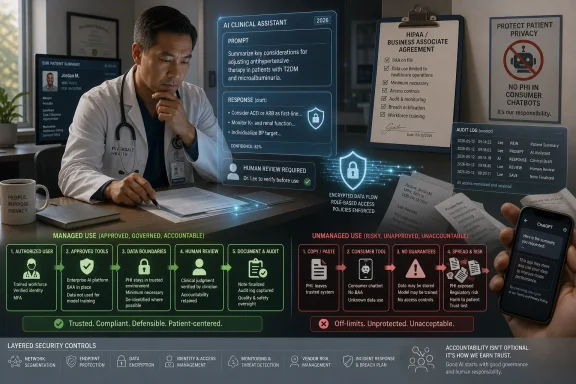
The Real AI Divide Is Between Managed and Unmanaged Medicine
The most important divide in medical AI may not be between large language models and older machine-learning systems, or between imaging and documentation, or between doctors who like AI and doctors who mistrust it. The real divide is between managed use and unmanaged use.Managed use means the practice knows which tools are deployed. Contracts match the data being processed. Clinicians receive specific training. Outputs are reviewed. Errors are reported and studied. Trainees are taught to reason before relying on automation. Patients are not treated as invisible data sources for whatever tool happens to be convenient.
Unmanaged use means everyone improvises. One physician uses a consumer chatbot for addenda. Another uses an AI browser extension to summarize records. A biller asks a model to draft an appeal. A nurse uses a transcription app. None of it appears in the official inventory, and leadership celebrates AI adoption without knowing what has actually been adopted.
The difference will show up in audits, breaches, lawsuits, patient trust, and clinical quality. It will also show up in professional identity. Physicians who learn to use AI while preserving judgment will become more capable. Physicians who let AI quietly replace judgment may become more productive right up until productivity is no longer the metric that matters.
That distinction should sober up both the AI boosters and the skeptics. The boosters are right that medicine needs better tools. The skeptics are right that tools can deform practice. The next phase is not about choosing one camp. It is about building institutions that can absorb powerful software without surrendering accountability to it.
The Prompt Box Is Now Part of the Exam Room
The practical lesson from these two physician-focused warnings is that AI governance has to move closer to the point of care. Policies written for abstract “technology use” will not survive contact with the prompt box. Doctors need rules that map to actual moments in the day: documenting an encounter, drafting a letter, summarizing a record, checking a differential, preparing an appeal, or teaching a trainee.A useful policy should be short enough to remember and strict enough to matter. It should tell clinicians which tools are approved for PHI, which tools are approved only for non-identifiable material, and which tools are off limits. It should require independent clinical reasoning before AI-assisted decision support in contexts where learning or diagnosis is at stake.
It should also create a non-punitive way to report mistakes and near misses. If a model fabricates a detail, misses a contraindication, or produces a misleading summary, the practice needs to learn from that event. Treating AI errors as embarrassing one-offs guarantees they will remain invisible until a patient is harmed or an auditor arrives.
For Windows and Microsoft-centric shops, the operational side will increasingly run through familiar infrastructure. Endpoint policy, managed browsers, identity controls, approved app catalogs, tenant-level data protections, and audit logs are not glamorous, but they are how real governance happens. The AI policy that cannot be enforced on the devices clinicians actually use is more aspiration than control.
The medical profession often talks about AI as if it were an external force arriving from Silicon Valley. In daily practice, it is more mundane than that. It is a text box, a microphone, an add-in, a summarization button, or an “assist” feature sitting inside the workflow. That is precisely why it is so powerful and so easy to misuse.
The Clinic That Governs the Prompt Will Govern the Future
The near-term action items are not mysterious, but they require discipline. The organizations that do them first will have fewer surprises when regulators, insurers, plaintiffs’ attorneys, and patients begin asking harder questions.- Every practice should inventory formal and informal AI use across physicians, staff, contractors, and personal devices used for work-related tasks.
- No identifiable patient information should enter an AI system unless the practice has verified the required legal agreements, security controls, and permitted data uses.
- Clinical workflows should preserve independent physician reasoning before AI output is reviewed, especially for diagnosis, treatment planning, and trainee education.
- AI-specific training should explain prompt-level risks, not merely repeat generic HIPAA reminders that predate modern chatbots.
- Practices should treat AI errors, misleading summaries, and automation overreliance as quality and safety events worth documenting and reviewing.
- Vendor selection should prioritize auditability, retention controls, contractual clarity, and workflow fit over demos that merely produce polished text.