

Enable Claude Tag in Slack now only as a tightly scoped pilot if your company already has AI governance, Slack administration controls, and written data-handling rules; wait on broad rollout if sensitive channels, retention expectations, or workspace-level app permissions remain unsettled. Claude Tag is a research preview, not a finished general release, and that status should shape every deployment decision.
That is the practical answer hiding beneath the announcement. Anthropic’s new Slack-based AI teammate may be useful, but it is also the kind of tool that turns collaboration history into operational context. For IT leaders, the question is not whether Claude Tag is interesting. It is whether your organization is ready for an AI identity inside Slack before Slack itself becomes the next contested perimeter.
Claude Tag arrives with a clear enterprise pitch: put Claude where work is already happening, let teams summon it inside Slack, and use the chat record as context for summaries, follow-ups, and task handling. That fits Anthropic’s broader enterprise positioning around productivity, summarization, and workflow assistance rather than treating Claude as a separate destination app.
But the most important deployment fact is simpler: Claude Tag is in research preview. That phrase matters. It means companies should treat the feature as something to evaluate under controlled conditions, not as an ordinary Slack enhancement that can be enabled across the workspace because it sounds useful.
The right first move is to identify one or two low-risk teams with clear workflows and relatively clean data boundaries. A product operations channel, an internal enablement group, or a project-management channel may be a better test bed than legal, HR, finance, executive, incident response, or customer-escalation spaces. If your first instinct is to drop Claude into the busiest or most politically sensitive channels, slow down.
The pilot should have a named owner, a written scope, and an exit plan. Decide which channels are included, what kinds of prompts are allowed, what outputs may be reused, and who reviews the experiment. If those decisions feel bureaucratic, that is a sign the organization has not yet internalized the difference between an AI chatbot and an AI participant in a corporate messaging system.
This is where many AI rollouts go wrong. A vendor describes a productivity assistant; IT has to model an access path. A user sees a bot that can summarize a thread; security sees an integration that may interact with corporate conversation history, files, channel membership boundaries, and retention policies.
Claude Tag should therefore be reviewed the same way an enterprise would review any workspace-level collaboration integration. Who can install it? Who can approve it? Which users can invoke it? Which channels can include it? What happens when a private channel contains regulated, confidential, privileged, or customer-sensitive material?
Those answers should exist before the pilot starts. If the answers depend on “we’ll see how people use it,” the organization is not ready for broad deployment. Research previews are where vendors learn, but they should not be where your company discovers that its Slack governance is mostly vibes.
Those companies can evaluate Claude Tag as an incremental workflow tool. They can ask whether it saves time in channel summarization, whether it helps teams track action items, and whether it improves coordination without creating new confusion over data boundaries. Their risk is not zero, but it is at least legible.
Companies without that foundation are in a different position. If employees are already pasting sensitive material into unsanctioned AI tools, if private Slack channels are used as informal records systems, or if retention rules vary by department without clear ownership, Claude Tag will not solve those problems. It will amplify them.
This is the core deployment framework: do not use Claude Tag to create AI governance. Use AI governance to decide whether Claude Tag belongs in your workspace.
A broad rollout also creates social lock-in. Once teams begin relying on an AI teammate for summaries, reminders, or task support, disabling it becomes a business-process disruption rather than a simple admin reversal. The feature may still be experimental, but the habits around it can become production-grade very quickly.
That does not mean preview products should never be used. It means they should be introduced with preview expectations. Put a time limit on the pilot. Tell users that the deployment may be changed, narrowed, or removed. Require feedback about failures, unwanted behavior, and ambiguous data situations, not just success stories.
The smartest organizations will treat Claude Tag like a controlled change to collaboration architecture, not like a novelty button. That posture may feel conservative, but it is exactly how IT prevents “temporary” experiments from becoming permanent compliance headaches.
Slack is an obvious target because it is where many companies narrate their work in real time. A useful AI teammate in Slack could reduce repeated context-setting, turn long threads into digestible summaries, and help teams identify follow-ups that would otherwise disappear into scrollback. WindowsForum readers have already seen similar arguments around Anthropic’s Cowork direction and the wider move toward agentic assistants inside everyday enterprise apps.
But productivity is not a trump card. The fact that an AI assistant can summarize a channel does not answer whether it should be present in that channel. The fact that it can help handle tasks does not answer whether the organization has defined the limits of delegated work.
That distinction matters because enterprise AI tools often arrive wrapped in the language of helpfulness. The risk rarely begins with a malicious scenario. It begins with a plausible convenience: summarize this thread, find the decision, draft the follow-up, pull context from adjacent work. Each step sounds reasonable until the organization realizes it has not defined the boundary between collaboration support and uncontrolled knowledge access.
Sensitive information often appears in Slack before it appears anywhere else. A sales exception gets discussed in a private channel. A security concern appears in an incident thread. An HR issue is handled in a limited group. A customer problem is pasted into a support escalation channel because speed matters more than perfect process.
Claude Tag’s value proposition is strongest precisely where Slack contains rich context. That is also where the rollout decision becomes more serious. An AI teammate that can follow work inside Slack is not merely consuming sanitized documentation; it may be operating near the raw edge of how a company thinks out loud.
This is why channel selection is the critical pilot control. Do not start by asking which team is most excited. Start by asking which Slack spaces have the clearest data boundaries, the least sensitive content, and the most measurable productivity pain.
The Slack version of that lesson is straightforward. Treat Claude Tag as a privileged collaboration integration. Put it through app review. Document the approval. Start with limited channels. Monitor usage. Revisit permissions before expanding.
This is also where desktop and collaboration AI strategies intersect. Anthropic’s broader Cowork push, including prior discussion around Claude as a desktop AI coworker for everyday tasks, points toward assistants that move across apps rather than staying in isolated chat windows. Slack may be the first visible surface for many companies, but it will not be the last.
That broader trajectory should make IT more disciplined, not less. If the future is AI embedded across workplace tools, then the first Slack deployment becomes precedent. The policies you write for Claude Tag may become the template for the next AI integration that asks for access to docs, tickets, calendars, repositories, or endpoints.
The biggest reason to wait is not that Claude Tag is uniquely dangerous. It is that Slack is already complicated. Many organizations have years of accumulated channels, inconsistent access practices, unclear ownership, and a blurry line between temporary conversation and business record. Adding an AI teammate to that environment can expose governance debt that was previously easy to ignore.
Waiting also gives Anthropic time to clarify the product through documentation, customer experience, and administrative maturity. Research preview features are supposed to teach vendors what enterprise customers need. Let that process happen before making Claude Tag a default part of how your company works.
There is no shame in saying: not yet. In enterprise IT, “not yet” is often the phrase that prevents a useful technology from being discredited by a bad deployment.
In that environment, Claude Tag can be tested against concrete operational questions. Does it reduce repetitive status requests? Does it improve thread continuity? Does it help teams capture decisions? Does it create confusion about authority, accuracy, or confidentiality? Those are answerable questions if the rollout is narrow enough.
The key is to make the pilot boring. The best early Claude Tag deployment is not the one with the flashiest use case. It is the one where permissions are understood, users are briefed, outputs are reviewed, and failure modes are documented.
That may sound less exciting than an “always-on AI teammate,” but it is how enterprise technology becomes durable. The goal is not to prove that Claude can do something impressive in Slack. The goal is to learn whether your company can use it safely, consistently, and repeatably.
The pilot should also separate experimentation from production reliance. Users should know that Claude Tag outputs may need verification and that the feature is not the final authority on decisions, obligations, or records. That is especially important in Slack, where an AI-generated summary can quickly become the version of events people remember.
Admins should watch for two categories of failure. The first is technical or functional: bad summaries, missed context, confusing task handling, or unwanted participation. The second is organizational: users invoking Claude in sensitive places, treating outputs as approved records, or asking the tool to bridge context across boundaries that were never meant to be bridged.
That second category is the one that determines whether the pilot should expand. A tool can improve. A governance culture that ignores its own rules usually gets worse under pressure.
The strongest buying signal is an organization that can answer basic questions without a meeting spiral. Which Slack admins approve workspace apps? Which channels are off-limits? Which data types may be processed by AI tools? Who can authorize exceptions? How are employees trained on AI use? What happens if a pilot reveals unsafe behavior?
If those answers are already written down, Claude Tag becomes a manageable pilot. If those answers live in scattered assumptions across legal, security, IT, and department heads, the feature will force the conversation at the worst possible time: after users have started relying on it.
This is the sharper point many launch stories miss. Claude Tag is not just a product announcement. It is an organizational maturity test disguised as a Slack feature.
That is the practical answer hiding beneath the announcement. Anthropic’s new Slack-based AI teammate may be useful, but it is also the kind of tool that turns collaboration history into operational context. For IT leaders, the question is not whether Claude Tag is interesting. It is whether your organization is ready for an AI identity inside Slack before Slack itself becomes the next contested perimeter.
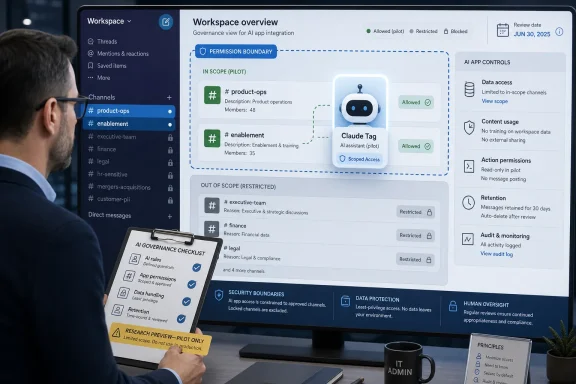 Claude Tag Is a Pilot Candidate, Not a Default-On Productivity Upgrade
Claude Tag arrives with a clear enterprise pitch: put Claude where work is already happening, let teams summon it inside Slack, and use the chat record as context for summaries, follow-ups, and task handling. That fits Anthropic’s broader enterprise positioning around productivity, summarization, and workflow assistance rather than treating Claude as a separate destination app.But the most important deployment fact is simpler: Claude Tag is in research preview. That phrase matters. It means companies should treat the feature as something to evaluate under controlled conditions, not as an ordinary Slack enhancement that can be enabled across the workspace because it sounds useful.
The right first move is to identify one or two low-risk teams with clear workflows and relatively clean data boundaries. A product operations channel, an internal enablement group, or a project-management channel may be a better test bed than legal, HR, finance, executive, incident response, or customer-escalation spaces. If your first instinct is to drop Claude into the busiest or most politically sensitive channels, slow down.
The pilot should have a named owner, a written scope, and an exit plan. Decide which channels are included, what kinds of prompts are allowed, what outputs may be reused, and who reviews the experiment. If those decisions feel bureaucratic, that is a sign the organization has not yet internalized the difference between an AI chatbot and an AI participant in a corporate messaging system.
The Slack App Boundary Is the Real Security Conversation
Anthropic’s Slack help materials indicate that the integration behaves like a workspace-level Slack app. That is not a minor implementation detail. Slack apps live inside the administrative and permissioning structure of the workspace, and their practical risk depends less on the marketing copy than on what the app can access, where it can be invoked, and how admins can constrain its footprint.This is where many AI rollouts go wrong. A vendor describes a productivity assistant; IT has to model an access path. A user sees a bot that can summarize a thread; security sees an integration that may interact with corporate conversation history, files, channel membership boundaries, and retention policies.
Claude Tag should therefore be reviewed the same way an enterprise would review any workspace-level collaboration integration. Who can install it? Who can approve it? Which users can invoke it? Which channels can include it? What happens when a private channel contains regulated, confidential, privileged, or customer-sensitive material?
Those answers should exist before the pilot starts. If the answers depend on “we’ll see how people use it,” the organization is not ready for broad deployment. Research previews are where vendors learn, but they should not be where your company discovers that its Slack governance is mostly vibes.
Broad Rollout Requires Governance That Already Works
The best candidates for enabling Claude Tag now are companies that have already done the boring work. They have a sanctioned AI-use policy. They know which categories of data may be entered into AI systems. They have Slack app approval workflows. They have channel naming conventions or data-classification norms that help users understand where sensitive work belongs.Those companies can evaluate Claude Tag as an incremental workflow tool. They can ask whether it saves time in channel summarization, whether it helps teams track action items, and whether it improves coordination without creating new confusion over data boundaries. Their risk is not zero, but it is at least legible.
Companies without that foundation are in a different position. If employees are already pasting sensitive material into unsanctioned AI tools, if private Slack channels are used as informal records systems, or if retention rules vary by department without clear ownership, Claude Tag will not solve those problems. It will amplify them.
This is the core deployment framework: do not use Claude Tag to create AI governance. Use AI governance to decide whether Claude Tag belongs in your workspace.
Research Preview Means the Calendar Is Not Your Friend
The phrase research preview should make sysadmins think about supportability as much as safety. Preview software can change behavior, administrative controls can evolve, documentation can lag behind product updates, and user expectations can harden before the feature is fully mature. That is a dangerous combination in a collaboration system people treat as operational infrastructure.A broad rollout also creates social lock-in. Once teams begin relying on an AI teammate for summaries, reminders, or task support, disabling it becomes a business-process disruption rather than a simple admin reversal. The feature may still be experimental, but the habits around it can become production-grade very quickly.
That does not mean preview products should never be used. It means they should be introduced with preview expectations. Put a time limit on the pilot. Tell users that the deployment may be changed, narrowed, or removed. Require feedback about failures, unwanted behavior, and ambiguous data situations, not just success stories.
The smartest organizations will treat Claude Tag like a controlled change to collaboration architecture, not like a novelty button. That posture may feel conservative, but it is exactly how IT prevents “temporary” experiments from becoming permanent compliance headaches.
The Productivity Case Is Real, but It Is Not Self-Justifying
There is a reason Anthropic is pushing Claude deeper into everyday apps. The workplace does not need another blank chat box. It needs help inside the messy systems where decisions, files, approvals, and half-finished tasks already live.Slack is an obvious target because it is where many companies narrate their work in real time. A useful AI teammate in Slack could reduce repeated context-setting, turn long threads into digestible summaries, and help teams identify follow-ups that would otherwise disappear into scrollback. WindowsForum readers have already seen similar arguments around Anthropic’s Cowork direction and the wider move toward agentic assistants inside everyday enterprise apps.
But productivity is not a trump card. The fact that an AI assistant can summarize a channel does not answer whether it should be present in that channel. The fact that it can help handle tasks does not answer whether the organization has defined the limits of delegated work.
That distinction matters because enterprise AI tools often arrive wrapped in the language of helpfulness. The risk rarely begins with a malicious scenario. It begins with a plausible convenience: summarize this thread, find the decision, draft the follow-up, pull context from adjacent work. Each step sounds reasonable until the organization realizes it has not defined the boundary between collaboration support and uncontrolled knowledge access.
Slack Is Where Informal Work Becomes Corporate Memory
Slack is not just chat. In many companies, it is the unofficial system of record for decisions that never make it into tickets, docs, email, or meeting notes. That makes it valuable context for an AI assistant and a difficult governance surface for administrators.Sensitive information often appears in Slack before it appears anywhere else. A sales exception gets discussed in a private channel. A security concern appears in an incident thread. An HR issue is handled in a limited group. A customer problem is pasted into a support escalation channel because speed matters more than perfect process.
Claude Tag’s value proposition is strongest precisely where Slack contains rich context. That is also where the rollout decision becomes more serious. An AI teammate that can follow work inside Slack is not merely consuming sanitized documentation; it may be operating near the raw edge of how a company thinks out loud.
This is why channel selection is the critical pilot control. Do not start by asking which team is most excited. Start by asking which Slack spaces have the clearest data boundaries, the least sensitive content, and the most measurable productivity pain.
The Windows Admin Lesson Is Old: Scope First, Scale Later
For WindowsForum’s IT audience, Claude Tag should feel familiar even if the AI layer is new. Every powerful enterprise feature follows the same pattern: the demo shows capability, the deployment exposes policy. Group Policy, endpoint management, conditional access, app control, and data loss prevention all teach the same lesson: broad access before governance creates cleanup work.The Slack version of that lesson is straightforward. Treat Claude Tag as a privileged collaboration integration. Put it through app review. Document the approval. Start with limited channels. Monitor usage. Revisit permissions before expanding.
This is also where desktop and collaboration AI strategies intersect. Anthropic’s broader Cowork push, including prior discussion around Claude as a desktop AI coworker for everyday tasks, points toward assistants that move across apps rather than staying in isolated chat windows. Slack may be the first visible surface for many companies, but it will not be the last.
That broader trajectory should make IT more disciplined, not less. If the future is AI embedded across workplace tools, then the first Slack deployment becomes precedent. The policies you write for Claude Tag may become the template for the next AI integration that asks for access to docs, tickets, calendars, repositories, or endpoints.
The “Wait” Case Is Stronger Than Vendors Want to Admit
Waiting does not mean rejecting Claude Tag. It means refusing to confuse availability with readiness. If your workspace has unresolved questions about sensitive channels, retention, app permissions, or user training, a pause is the responsible move.The biggest reason to wait is not that Claude Tag is uniquely dangerous. It is that Slack is already complicated. Many organizations have years of accumulated channels, inconsistent access practices, unclear ownership, and a blurry line between temporary conversation and business record. Adding an AI teammate to that environment can expose governance debt that was previously easy to ignore.
Waiting also gives Anthropic time to clarify the product through documentation, customer experience, and administrative maturity. Research preview features are supposed to teach vendors what enterprise customers need. Let that process happen before making Claude Tag a default part of how your company works.
There is no shame in saying: not yet. In enterprise IT, “not yet” is often the phrase that prevents a useful technology from being discredited by a bad deployment.
The “Enable Now” Case Belongs to Disciplined Organizations
There is also a legitimate case for enabling Claude Tag immediately. If your company already has a mature AI governance program, well-managed Slack app approvals, and clear rules for sensitive data, a pilot can produce useful evidence while competitors are still debating abstractions.In that environment, Claude Tag can be tested against concrete operational questions. Does it reduce repetitive status requests? Does it improve thread continuity? Does it help teams capture decisions? Does it create confusion about authority, accuracy, or confidentiality? Those are answerable questions if the rollout is narrow enough.
The key is to make the pilot boring. The best early Claude Tag deployment is not the one with the flashiest use case. It is the one where permissions are understood, users are briefed, outputs are reviewed, and failure modes are documented.
That may sound less exciting than an “always-on AI teammate,” but it is how enterprise technology becomes durable. The goal is not to prove that Claude can do something impressive in Slack. The goal is to learn whether your company can use it safely, consistently, and repeatably.
The Pilot Plan That Separates Curiosity From Readiness
A serious Claude Tag pilot should begin with a written decision memo. It does not need to be long, but it should name the business problem, the participating teams, the permitted channels, the excluded channels, the data rules, and the review date. If nobody wants to own that document, nobody should own the rollout.The pilot should also separate experimentation from production reliance. Users should know that Claude Tag outputs may need verification and that the feature is not the final authority on decisions, obligations, or records. That is especially important in Slack, where an AI-generated summary can quickly become the version of events people remember.
Admins should watch for two categories of failure. The first is technical or functional: bad summaries, missed context, confusing task handling, or unwanted participation. The second is organizational: users invoking Claude in sensitive places, treating outputs as approved records, or asking the tool to bridge context across boundaries that were never meant to be bridged.
That second category is the one that determines whether the pilot should expand. A tool can improve. A governance culture that ignores its own rules usually gets worse under pressure.
The Real Buying Signal Is Not Excitement, but Control
The decision to enable Claude Tag should not be driven by enthusiasm from power users alone. Enthusiasm tells you there is demand. Control tells you whether that demand can be safely served.The strongest buying signal is an organization that can answer basic questions without a meeting spiral. Which Slack admins approve workspace apps? Which channels are off-limits? Which data types may be processed by AI tools? Who can authorize exceptions? How are employees trained on AI use? What happens if a pilot reveals unsafe behavior?
If those answers are already written down, Claude Tag becomes a manageable pilot. If those answers live in scattered assumptions across legal, security, IT, and department heads, the feature will force the conversation at the worst possible time: after users have started relying on it.
This is the sharper point many launch stories miss. Claude Tag is not just a product announcement. It is an organizational maturity test disguised as a Slack feature.
The Rollout Decision Comes Down to Five Hard Gates
Claude Tag is worth evaluating, but the evaluation should be conditional. Treat the following as gates for broad rollout, not nice-to-have considerations after launch.- Your company should enable Claude Tag now only for a limited pilot if AI usage rules are already documented and understood by the participating users.
- Your Slack administrators should be able to constrain where the app is used and should know which channels are excluded before the pilot begins.
- Sensitive functions such as legal, HR, finance, executive communications, security incidents, and regulated customer work should stay out of the first wave unless they have separate written approval.
- The pilot should have a defined review date, a named owner, and a clear standard for expansion, rollback, or continued testing.
- Broad rollout should wait if retention, channel sensitivity, app permissions, or AI data-handling rules are still unresolved.
References
- Primary source: techcrunch.com
Anthropic’s Claude Tag is learning your company, one Slack message at a time | TechCrunch
Anthropic’s new Claude Tag brings an always-on AI teammate to Slack. But beyond productivity, the feature is a strategic play to capture organizational context, institutional knowledge, and enterprise workflows.techcrunch.com - Independent coverage: cryptobriefing.com
Anthropic launches Claude Tag as an AI teammate inside Slack
Anthropic launched Claude Tag, embedding its AI model in Slack as a persistent teammate. The near-trillion-dollar company has deep roots in crypto via FTXcryptobriefing.com - Independent coverage: claude.com
Loading…
claude.com - Independent coverage: pymnts.com
Loading…
www.pymnts.com - Independent coverage: ng.investing.com
Loading…
ng.investing.com - Independent coverage: support.claude.com
Loading…
support.claude.com