

Intel’s rumored dual-compute-tile Nova Lake desktop processors are now being linked to Z990 motherboards with three CPU-side 8-pin power connectors and a reported PL2-class power budget around 474 watts, based on leaks circulated in late June 2026. That does not mean every next-generation Intel gaming PC is about to become a space heater. It does mean Intel’s high-end desktop ambitions are moving into a power envelope that looks less like mainstream Core territory and more like a workstation fight wearing a consumer socket badge.
The important detail is not the number itself, lurid though 474 W may be. The real story is that Intel appears to be segmenting Nova Lake around physical platform capability: ordinary single-tile chips for the familiar desktop market, and dual-tile halo parts that may demand a different class of motherboard, cooling, and power supply. If the leak is accurate, Nova Lake is not just another CPU generation. It is Intel testing how much workstation DNA the desktop market will tolerate.
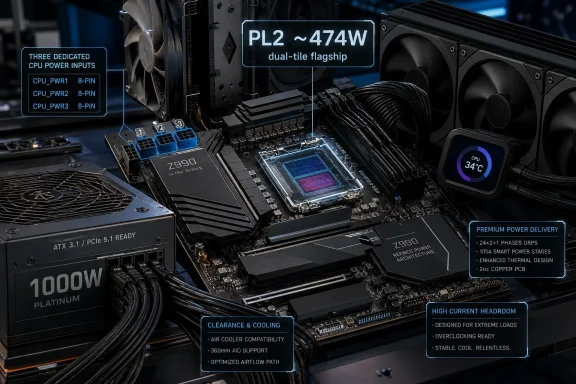
CPU power rumors are usually easy to dismiss because they arrive as screenshots, engineering chatter, or numbers stripped of context. This one has gained traction because it is tied to something physical: a next-generation Z990 motherboard layout reportedly showing three CPU-side 8-pin power connector positions. Two EPS connectors have become normal on high-end Intel boards, even when most users do not need both. Three is harder to wave away as cosmetic excess.
Motherboard vendors do not add connectors for poetry. They add them because platform guidance, electrical margin, overclocking marketing, or all three make the extra copper and board routing worthwhile. An additional connector does not prove that a retail CPU will sit at nearly 500 W in every heavy workload, but it does suggest that board makers are preparing for a top-end configuration well beyond today’s mainstream expectations.
The figure circulating with the leak is 474 W for nominal performance on dual-compute-tile Nova Lake parts, with higher draw implied for overclocking. That is being interpreted as a PL2-like ceiling or boost power target, though Intel has not publicly confirmed the product stack, the power table, or the final platform requirements. In other words, the number is plausible enough to matter and unofficial enough to treat with discipline.
That distinction matters because PC hardware discourse has become addicted to the worst possible reading of every leak. A board with three CPU power inputs does not mean a future Core Ultra 5 will need a kilowatt PSU. It means the top of Intel’s stack may be engineered for a class of desktop CPU that sits uneasily between enthusiast gaming and entry workstation.
The exotic parts are the dual-compute-tile models. Rumors have described flagship configurations with up to 52 total cores, typically framed as two compute tiles each carrying performance and efficiency cores, plus low-power cores elsewhere in the package. That is an enormous amount of client silicon to present under a desktop platform, and it explains why the power discussion has escalated so quickly.
This is not simply a matter of Intel “making a hot chip.” Tile-based design gives Intel a way to scale core counts by combining building blocks, but scaling silicon is not the same as scaling efficiency linearly. Two compute tiles mean more cores to feed, more interconnect complexity, more cache behavior to manage, and more heat concentrated under the package and cooler.
The rumored 474 W figure therefore sounds shocking only if we pretend the flagship is just a normal gaming CPU with a bigger model number. If it is better understood as a many-core workstation-class part trying to live on a high-end desktop board, the number becomes less surprising. Still, less surprising is not the same as easy to cool, easy to justify, or easy to sell.
The Core i9-14900K era taught the industry how dangerous that mess can become. Motherboard vendors chasing benchmark wins ran aggressive defaults, reviewers struggled to compare like with like, and users discovered that “stock” could mean very different things depending on the board. Intel eventually had to push clearer baseline profiles and rein in the most permissive interpretations after instability reports damaged confidence in its flagship desktop platform.
That history shadows every Nova Lake power rumor. When readers see “474 W PL2,” they are not merely asking whether the CPU can draw that much. They are asking whether motherboard vendors will treat that as a sensible ceiling, a default target, a temporary boost, or a starting line for overclocked chaos.
Intel has reasons to be more careful this time. The company cannot afford another generation where the fastest desktop chips are also associated with firmware ambiguity and reliability anxiety. But the existence of a higher power tier would still place enormous pressure on board vendors to advertise support for the biggest number, because that is how the halo market works.
The key is to separate supported boost power from pathological or maximum observed draw. A CPU may have a defined platform target, then exceed it under motherboard-enhanced settings, stress tests, or manual tuning. Enthusiast boards are built precisely to make such behavior possible, even if it has little relevance to sane everyday computing.
That is why the third connector matters more than the most sensational number. It implies a board ecosystem designed with extreme headroom in mind. A 700 W peak would still be a remarkable and niche scenario, but it no longer sounds disconnected from the platform direction if high-end boards are being prepared for nearly 500 W CPU operation before overclocking enters the conversation.
The danger for Intel is not that every user will experience those conditions. The danger is that the brand narrative becomes “Intel is back to brute force,” especially at a time when AMD’s best gaming chips have trained buyers to value cache, efficiency, and restraint as much as raw frequency.
That is why AMD’s X3D processors have been so effective. They do not win by throwing workstation core counts at games. They win by putting a large cache close to the cores that matter, reducing trips to memory and improving frame-time behavior in workloads that respond well to cache. Intel’s rumored big-cache Nova Lake variants appear to be aimed directly at that threat.
But if Intel ties its most dramatic cache configurations to dual-tile, high-power models, it risks confusing the market. Gamers do not need 52 cores to play current titles, and most will not want the cooling and platform cost that comes with feeding such a chip. The smarter product would be a cache-heavy single-tile gaming part that avoids the thermal and electrical baggage of the flagship.
PC Gamer’s own framing reflects this tension: the dual-tile parts may be exciting as engineering, but they are not the chips most gamers should buy. The broader desktop market would be better served if Intel keeps its gaming-focused Nova Lake models on the sane side of the platform divide, while reserving the three-connector motherboards for users who actually run workloads that can punish 52 cores.
This space has always been awkward. Mainstream desktops are affordable and fast but limited in I/O, memory channels, and validation. Workstation platforms offer expansion and reliability but carry higher platform costs. A many-core Nova Lake part on Z990 could appeal to buyers who want workstation-class throughput but are willing to compromise on memory bandwidth, ECC support, PCIe lane count, or enterprise platform guarantees.
That compromise is not new. AMD’s Ryzen 9 chips have long eaten into workloads that once belonged to Threadripper. Intel has every incentive to answer with a part that makes its mainstream socket look much more capable in multi-threaded benchmarks. The dual-tile Nova Lake rumor reads like a direct response to that pressure.
But workstation buyers are less forgiving about thermals than benchmark tourists. Sustained compile or render loads can run for hours. A CPU that briefly touches high power is one thing; a platform that needs to manage hundreds of watts through the socket area for long periods is another. If Intel wants these chips taken seriously by professionals, stability and predictable behavior will matter more than a heroic launch-day chart.
That would not be inherently bad. In fact, it could be healthier than forcing every buyer to subsidize extreme hardware they will never use. A gamer planning to run a single-tile cache-heavy chip should not have to pay for a board built to feed a 52-core monster under overclocked load. Conversely, a professional buying the flagship should not discover that the cheaper board technically boots the chip but throttles it into mediocrity.
The problem is naming and marketing. If the same chipset badge spans both ordinary and extreme boards, buyers will need to read specifications with unusual care. “Z990” may not be enough information. The important questions will be power-stage design, connector layout, BIOS support, sustained current capability, cooling around the socket, and whether the vendor explicitly rates the board for dual-compute-tile Nova Lake parts.
This is where Intel’s platform guidance will need to be unambiguous. The company can let board vendors compete, but it should not let them blur the line between compatibility and suitability. If a CPU’s nominal high-performance behavior depends on a board class, that needs to be visible before someone spends several hundred dollars on the wrong motherboard.
High-end liquid coolers can dissipate impressive wattage, but the details matter. Radiator size, fan speed, pump behavior, cold-plate contact, coolant temperature, case airflow, and ambient room temperature all determine whether a system can sustain performance without sounding like a server closet. A large number on an AIO box will not guarantee that a dual-tile Nova Lake chip behaves gracefully under load.
Air cooling will become even more constrained at the top of the stack. The best dual-tower coolers remain excellent for mainstream CPUs, but a nearly 500 W enthusiast processor is a different class of heat source. Some users will make it work through power limits, undervolting, or acceptance of throttling, but that is not the same as cooling the chip as intended.
This is where Intel’s efficiency story will be scrutinized. If Nova Lake delivers extraordinary multi-threaded performance per watt compared with prior Intel desktop flagships, then high absolute power can be defended as a deliberate option for users who want maximum throughput. If it merely uses more power to chase benchmark leadership, the criticism will write itself.
A realistic dual-tile Nova Lake workstation-gaming hybrid could require a 1000 W or 1200 W PSU just to feel comfortable, and more if paired with the highest-end graphics cards, multiple drives, heavy USB power draw, capture hardware, or overclocking. That does not mean the wall socket is doomed. It does mean the system builder’s old habit of treating CPU power as secondary to GPU power becomes less safe.
Cable management also matters. Three CPU-side connectors require proper PSU cabling, not sketchy adapters or daisy-chain improvisation. The entire point of spreading power across multiple connectors is to reduce current concentration and heat. Defeating that with careless cabling would be an expensive mistake.
There is also a psychological threshold here. Enthusiast buyers tolerated high GPU power because graphics cards visibly drive gaming performance. CPU power near half a kilowatt is harder to justify in a gaming build, especially when the user’s frame rate may barely move compared with a cheaper, cooler, cache-optimized part. The more Intel’s top chip looks like a workstation CPU, the more buyers should build around workstation assumptions.
Intel cannot ignore that. A dual-tile, high-core-count Nova Lake flagship may dominate certain multi-threaded workloads, but the gaming halo will depend on whether Intel can deliver low-latency, cache-rich performance without dragging buyers into an extreme platform tier. If the best gaming Nova Lake is also the one that needs a motherboard bristling with CPU power connectors, AMD will happily frame the comparison as elegance versus excess.
That said, Intel has an opportunity if it executes cleanly. A single-tile Nova Lake chip with strong new cores, improved scheduling, competitive cache, and reasonable power could be exactly what desktop buyers want. The dual-tile flagship can then exist as a separate statement of scale rather than the face of the whole generation.
The risk is that halo products distort perception. The internet will not talk about the efficient 28-core or gaming-focused cache part if the headline number is 474 W or 700 W. Intel’s marketing challenge will be to make clear that Nova Lake is a range, not a single power bill.
Windows has improved substantially since the first wave of hybrid desktop CPUs, but edge cases remain. Games, launchers, anti-cheat systems, content-creation suites, compilers, virtual machines, and background services all create different scheduling pressures. A 52-core desktop chip can look brilliant in a benchmark and still feel inconsistent if threads bounce in ways that hurt latency-sensitive work.
This is especially relevant for dual-tile designs. If cores and cache are not uniform from the software’s point of view, the OS, firmware, and Intel’s telemetry must cooperate to keep important threads where they belong. The more complex the chip, the more important boring platform maturity becomes.
For WindowsForum readers, this is the piece to watch after the power headlines fade. A big CPU that needs a BIOS update, a Windows scheduler refinement, and a chipset driver package to reach its best behavior is not unusual. But if Intel wants Nova Lake to land smoothly, those pieces need to be ready on day one, not patched into shape after early adopters become unpaid QA.
Nova Lake gives Intel a chance to show that lesson has been learned. Clear limits, conservative defaults, visible profiles, and honest motherboard validation would go a long way. So would avoiding the temptation to let every vendor define “unlimited” as the default enthusiast experience.
A 474 W platform target can be defensible if it is explicit, controlled, and aimed at the right users. It becomes toxic if it arrives wrapped in ambiguity. Nobody wants another generation where the first six months of ownership are spent discovering which BIOS setting silently traded longevity for a few benchmark points.
This is not just about protecting CPUs. It is about protecting trust. Enthusiast buyers can tolerate heat, cost, and complexity when they believe the vendor is being straight with them. They are much less patient when “stock” becomes a moving target.
That would make Nova Lake an unusually bifurcated generation. The same family could include gaming chips that compete on cache and responsiveness, mainstream chips that look like ordinary Core successors, and dual-tile flagships that fight Ryzen 9 and lower-end workstation platforms in heavily threaded work. The branding may be unified, but the buying advice will not be.
For administrators and small-office builders, the answer is simple: do not buy the halo unless your workload earns it. For enthusiasts, the answer is more subtle: wait for measured power, thermals, and frame-time data before treating core count as destiny. For motherboard shoppers, the answer is practical: assume board class matters more than chipset name.
Intel’s challenge is to make those distinctions legible. If Nova Lake’s launch message collapses into “up to 52 cores” and “nearly 500 W,” the company will have ceded the framing to its critics before reviewers even publish charts.
The important detail is not the number itself, lurid though 474 W may be. The real story is that Intel appears to be segmenting Nova Lake around physical platform capability: ordinary single-tile chips for the familiar desktop market, and dual-tile halo parts that may demand a different class of motherboard, cooling, and power supply. If the leak is accurate, Nova Lake is not just another CPU generation. It is Intel testing how much workstation DNA the desktop market will tolerate.
 The Third Power Connector Is the Leak That Speaks Loudest
CPU power rumors are usually easy to dismiss because they arrive as screenshots, engineering chatter, or numbers stripped of context. This one has gained traction because it is tied to something physical: a next-generation Z990 motherboard layout reportedly showing three CPU-side 8-pin power connector positions. Two EPS connectors have become normal on high-end Intel boards, even when most users do not need both. Three is harder to wave away as cosmetic excess.Motherboard vendors do not add connectors for poetry. They add them because platform guidance, electrical margin, overclocking marketing, or all three make the extra copper and board routing worthwhile. An additional connector does not prove that a retail CPU will sit at nearly 500 W in every heavy workload, but it does suggest that board makers are preparing for a top-end configuration well beyond today’s mainstream expectations.
The figure circulating with the leak is 474 W for nominal performance on dual-compute-tile Nova Lake parts, with higher draw implied for overclocking. That is being interpreted as a PL2-like ceiling or boost power target, though Intel has not publicly confirmed the product stack, the power table, or the final platform requirements. In other words, the number is plausible enough to matter and unofficial enough to treat with discipline.
That distinction matters because PC hardware discourse has become addicted to the worst possible reading of every leak. A board with three CPU power inputs does not mean a future Core Ultra 5 will need a kilowatt PSU. It means the top of Intel’s stack may be engineered for a class of desktop CPU that sits uneasily between enthusiast gaming and entry workstation.
Nova Lake Looks Like a Split Personality by Design
The reported Nova Lake desktop lineup is best understood as two families sharing a brand rather than one uniform successor to Arrow Lake. The mainstream parts are expected to use a single compute tile, with configurations that look much more familiar: performance cores, efficiency cores, low-power cores, and power limits in the neighborhood of today’s enthusiast desktop chips. Those are the CPUs most gamers and general-purpose builders will actually consider.The exotic parts are the dual-compute-tile models. Rumors have described flagship configurations with up to 52 total cores, typically framed as two compute tiles each carrying performance and efficiency cores, plus low-power cores elsewhere in the package. That is an enormous amount of client silicon to present under a desktop platform, and it explains why the power discussion has escalated so quickly.
This is not simply a matter of Intel “making a hot chip.” Tile-based design gives Intel a way to scale core counts by combining building blocks, but scaling silicon is not the same as scaling efficiency linearly. Two compute tiles mean more cores to feed, more interconnect complexity, more cache behavior to manage, and more heat concentrated under the package and cooler.
The rumored 474 W figure therefore sounds shocking only if we pretend the flagship is just a normal gaming CPU with a bigger model number. If it is better understood as a many-core workstation-class part trying to live on a high-end desktop board, the number becomes less surprising. Still, less surprising is not the same as easy to cool, easy to justify, or easy to sell.
Intel’s Power-Limit Vocabulary Has Become a Battlefield
Part of the confusion comes from the way Intel’s desktop power terminology has evolved from engineering guidance into a public argument. PL1 traditionally mapped to longer-duration processor base power, while PL2 represented a higher turbo power state. In practice, motherboard defaults, firmware behavior, cooling detection, and vendor enthusiasm have often turned those tidy categories into something much messier.The Core i9-14900K era taught the industry how dangerous that mess can become. Motherboard vendors chasing benchmark wins ran aggressive defaults, reviewers struggled to compare like with like, and users discovered that “stock” could mean very different things depending on the board. Intel eventually had to push clearer baseline profiles and rein in the most permissive interpretations after instability reports damaged confidence in its flagship desktop platform.
That history shadows every Nova Lake power rumor. When readers see “474 W PL2,” they are not merely asking whether the CPU can draw that much. They are asking whether motherboard vendors will treat that as a sensible ceiling, a default target, a temporary boost, or a starting line for overclocked chaos.
Intel has reasons to be more careful this time. The company cannot afford another generation where the fastest desktop chips are also associated with firmware ambiguity and reliability anxiety. But the existence of a higher power tier would still place enormous pressure on board vendors to advertise support for the biggest number, because that is how the halo market works.
The 700 W Rumor Was the Warning Shot
Earlier reports suggesting that a dual-tile Nova Lake part could consume up to 700 W under certain conditions sounded absurd at first glance. For ordinary desktop buyers, that number belongs in the realm of GPUs, not CPUs. Yet the new motherboard-power leak makes the earlier claim harder to dismiss outright, because a roughly 474 W nominal budget leaves plenty of room for heavy all-core load, transient spikes, and overclocking behavior to climb higher.The key is to separate supported boost power from pathological or maximum observed draw. A CPU may have a defined platform target, then exceed it under motherboard-enhanced settings, stress tests, or manual tuning. Enthusiast boards are built precisely to make such behavior possible, even if it has little relevance to sane everyday computing.
That is why the third connector matters more than the most sensational number. It implies a board ecosystem designed with extreme headroom in mind. A 700 W peak would still be a remarkable and niche scenario, but it no longer sounds disconnected from the platform direction if high-end boards are being prepared for nearly 500 W CPU operation before overclocking enters the conversation.
The danger for Intel is not that every user will experience those conditions. The danger is that the brand narrative becomes “Intel is back to brute force,” especially at a time when AMD’s best gaming chips have trained buyers to value cache, efficiency, and restraint as much as raw frequency.
The Gaming Case for a 52-Core Desktop CPU Is Weak
For PC gamers, the dual-tile Nova Lake flagship is almost certainly the wrong object of desire. Modern games can benefit from more CPU resources, but they do not scale cleanly across dozens of cores. The practical performance battle remains about strong primary cores, cache behavior, scheduling, memory latency, and GPU feeding under real game-engine constraints.That is why AMD’s X3D processors have been so effective. They do not win by throwing workstation core counts at games. They win by putting a large cache close to the cores that matter, reducing trips to memory and improving frame-time behavior in workloads that respond well to cache. Intel’s rumored big-cache Nova Lake variants appear to be aimed directly at that threat.
But if Intel ties its most dramatic cache configurations to dual-tile, high-power models, it risks confusing the market. Gamers do not need 52 cores to play current titles, and most will not want the cooling and platform cost that comes with feeding such a chip. The smarter product would be a cache-heavy single-tile gaming part that avoids the thermal and electrical baggage of the flagship.
PC Gamer’s own framing reflects this tension: the dual-tile parts may be exciting as engineering, but they are not the chips most gamers should buy. The broader desktop market would be better served if Intel keeps its gaming-focused Nova Lake models on the sane side of the platform divide, while reserving the three-connector motherboards for users who actually run workloads that can punish 52 cores.
The Workstation Market Is the More Honest Target
The more credible audience for a dual-compute-tile Nova Lake part is not the average gamer. It is the developer compiling massive codebases, the creator rendering locally, the engineer running simulations, the homelab user consolidating services, and the professional who wants more cores without stepping into a full workstation platform. That is where a 52-core consumer-adjacent CPU begins to make sense.This space has always been awkward. Mainstream desktops are affordable and fast but limited in I/O, memory channels, and validation. Workstation platforms offer expansion and reliability but carry higher platform costs. A many-core Nova Lake part on Z990 could appeal to buyers who want workstation-class throughput but are willing to compromise on memory bandwidth, ECC support, PCIe lane count, or enterprise platform guarantees.
That compromise is not new. AMD’s Ryzen 9 chips have long eaten into workloads that once belonged to Threadripper. Intel has every incentive to answer with a part that makes its mainstream socket look much more capable in multi-threaded benchmarks. The dual-tile Nova Lake rumor reads like a direct response to that pressure.
But workstation buyers are less forgiving about thermals than benchmark tourists. Sustained compile or render loads can run for hours. A CPU that briefly touches high power is one thing; a platform that needs to manage hundreds of watts through the socket area for long periods is another. If Intel wants these chips taken seriously by professionals, stability and predictable behavior will matter more than a heroic launch-day chart.
Motherboard Segmentation May Become the Real Product Stack
The most practical consequence of the leak may be that Nova Lake motherboards split into tiers more visibly than previous generations. There may be Z990 boards built for ordinary single-tile CPUs, with the familiar two CPU power connectors and sane VRM designs. Then there may be premium boards designed around dual-tile support, carrying three CPU-side connectors, heavier power delivery, more elaborate heatsinks, and much higher prices.That would not be inherently bad. In fact, it could be healthier than forcing every buyer to subsidize extreme hardware they will never use. A gamer planning to run a single-tile cache-heavy chip should not have to pay for a board built to feed a 52-core monster under overclocked load. Conversely, a professional buying the flagship should not discover that the cheaper board technically boots the chip but throttles it into mediocrity.
The problem is naming and marketing. If the same chipset badge spans both ordinary and extreme boards, buyers will need to read specifications with unusual care. “Z990” may not be enough information. The important questions will be power-stage design, connector layout, BIOS support, sustained current capability, cooling around the socket, and whether the vendor explicitly rates the board for dual-compute-tile Nova Lake parts.
This is where Intel’s platform guidance will need to be unambiguous. The company can let board vendors compete, but it should not let them blur the line between compatibility and suitability. If a CPU’s nominal high-performance behavior depends on a board class, that needs to be visible before someone spends several hundred dollars on the wrong motherboard.
Cooling Becomes the Platform Tax Nobody Can Ignore
A CPU power target near 474 W is not just an electrical problem. It is a thermal problem, an acoustic problem, and a case-design problem. Even if the processor only reaches that level in heavy all-core workloads, the cooler must be capable of moving a huge amount of heat away from a relatively small package area.High-end liquid coolers can dissipate impressive wattage, but the details matter. Radiator size, fan speed, pump behavior, cold-plate contact, coolant temperature, case airflow, and ambient room temperature all determine whether a system can sustain performance without sounding like a server closet. A large number on an AIO box will not guarantee that a dual-tile Nova Lake chip behaves gracefully under load.
Air cooling will become even more constrained at the top of the stack. The best dual-tower coolers remain excellent for mainstream CPUs, but a nearly 500 W enthusiast processor is a different class of heat source. Some users will make it work through power limits, undervolting, or acceptance of throttling, but that is not the same as cooling the chip as intended.
This is where Intel’s efficiency story will be scrutinized. If Nova Lake delivers extraordinary multi-threaded performance per watt compared with prior Intel desktop flagships, then high absolute power can be defended as a deliberate option for users who want maximum throughput. If it merely uses more power to chase benchmark leadership, the criticism will write itself.
Power Supplies Are Ready, but Builds Are Not Always Sensible
Modern ATX 3.x power supplies can handle high transient loads far better than the units many builders used a decade ago. Enthusiast systems with flagship GPUs already push total system power into territory that once seemed extravagant. A top-end GPU plus a 474 W CPU, however, changes the margin calculations quickly.A realistic dual-tile Nova Lake workstation-gaming hybrid could require a 1000 W or 1200 W PSU just to feel comfortable, and more if paired with the highest-end graphics cards, multiple drives, heavy USB power draw, capture hardware, or overclocking. That does not mean the wall socket is doomed. It does mean the system builder’s old habit of treating CPU power as secondary to GPU power becomes less safe.
Cable management also matters. Three CPU-side connectors require proper PSU cabling, not sketchy adapters or daisy-chain improvisation. The entire point of spreading power across multiple connectors is to reduce current concentration and heat. Defeating that with careless cabling would be an expensive mistake.
There is also a psychological threshold here. Enthusiast buyers tolerated high GPU power because graphics cards visibly drive gaming performance. CPU power near half a kilowatt is harder to justify in a gaming build, especially when the user’s frame rate may barely move compared with a cheaper, cooler, cache-optimized part. The more Intel’s top chip looks like a workstation CPU, the more buyers should build around workstation assumptions.
AMD’s X3D Success Changed the Rules Intel Must Play By
The reason Nova Lake cache rumors matter so much is that AMD has redefined gaming CPU leadership around something other than maximum platform power. Ryzen X3D chips have repeatedly shown that the right cache architecture can beat hotter, higher-clocked competitors in games. They made efficiency feel premium.Intel cannot ignore that. A dual-tile, high-core-count Nova Lake flagship may dominate certain multi-threaded workloads, but the gaming halo will depend on whether Intel can deliver low-latency, cache-rich performance without dragging buyers into an extreme platform tier. If the best gaming Nova Lake is also the one that needs a motherboard bristling with CPU power connectors, AMD will happily frame the comparison as elegance versus excess.
That said, Intel has an opportunity if it executes cleanly. A single-tile Nova Lake chip with strong new cores, improved scheduling, competitive cache, and reasonable power could be exactly what desktop buyers want. The dual-tile flagship can then exist as a separate statement of scale rather than the face of the whole generation.
The risk is that halo products distort perception. The internet will not talk about the efficient 28-core or gaming-focused cache part if the headline number is 474 W or 700 W. Intel’s marketing challenge will be to make clear that Nova Lake is a range, not a single power bill.
Windows Scheduling Will Be Part of the Performance Story
A many-core hybrid CPU is not just a silicon problem; it is a Windows problem. Intel’s performance cores, efficiency cores, and low-power cores rely on the operating system making good placement decisions. Add a second compute tile and the scheduling problem becomes even more sensitive to latency, cache locality, and workload type.Windows has improved substantially since the first wave of hybrid desktop CPUs, but edge cases remain. Games, launchers, anti-cheat systems, content-creation suites, compilers, virtual machines, and background services all create different scheduling pressures. A 52-core desktop chip can look brilliant in a benchmark and still feel inconsistent if threads bounce in ways that hurt latency-sensitive work.
This is especially relevant for dual-tile designs. If cores and cache are not uniform from the software’s point of view, the OS, firmware, and Intel’s telemetry must cooperate to keep important threads where they belong. The more complex the chip, the more important boring platform maturity becomes.
For WindowsForum readers, this is the piece to watch after the power headlines fade. A big CPU that needs a BIOS update, a Windows scheduler refinement, and a chipset driver package to reach its best behavior is not unusual. But if Intel wants Nova Lake to land smoothly, those pieces need to be ready on day one, not patched into shape after early adopters become unpaid QA.
The Reliability Lesson From Raptor Lake Still Lingers
Intel’s recent desktop history makes any high-power rumor more sensitive than it would have been five years ago. The instability controversy around 13th- and 14th-generation Core desktop chips left a mark. Even users who never experienced crashes absorbed the message that motherboard defaults, voltage behavior, and turbo policy could have real consequences.Nova Lake gives Intel a chance to show that lesson has been learned. Clear limits, conservative defaults, visible profiles, and honest motherboard validation would go a long way. So would avoiding the temptation to let every vendor define “unlimited” as the default enthusiast experience.
A 474 W platform target can be defensible if it is explicit, controlled, and aimed at the right users. It becomes toxic if it arrives wrapped in ambiguity. Nobody wants another generation where the first six months of ownership are spent discovering which BIOS setting silently traded longevity for a few benchmark points.
This is not just about protecting CPUs. It is about protecting trust. Enthusiast buyers can tolerate heat, cost, and complexity when they believe the vendor is being straight with them. They are much less patient when “stock” becomes a moving target.
The Sensible Reading Is Less Dramatic and More Important
The most likely outcome is not that Nova Lake turns every desktop into a 500 W CPU platform. The more plausible reading is that Intel is preparing a broad lineup with a very aggressive top end. That top end may require a new class of motherboard, cooler, and PSU planning, while mainstream models remain within familiar power territory.That would make Nova Lake an unusually bifurcated generation. The same family could include gaming chips that compete on cache and responsiveness, mainstream chips that look like ordinary Core successors, and dual-tile flagships that fight Ryzen 9 and lower-end workstation platforms in heavily threaded work. The branding may be unified, but the buying advice will not be.
For administrators and small-office builders, the answer is simple: do not buy the halo unless your workload earns it. For enthusiasts, the answer is more subtle: wait for measured power, thermals, and frame-time data before treating core count as destiny. For motherboard shoppers, the answer is practical: assume board class matters more than chipset name.
Intel’s challenge is to make those distinctions legible. If Nova Lake’s launch message collapses into “up to 52 cores” and “nearly 500 W,” the company will have ceded the framing to its critics before reviewers even publish charts.
The Numbers That Should Shape Nova Lake Buying Decisions
The leak is early enough that buyers should resist building imaginary shopping carts around it, but concrete enough that it should change how people think about the next Intel desktop platform. Nova Lake looks less like a routine generational swap and more like a platform split hiding inside a consumer brand.- The reported 474 W figure appears tied to dual-compute-tile Nova Lake parts, not the entire desktop lineup.
- Three CPU-side 8-pin connectors on high-end Z990 boards would point to platform headroom for extreme CPUs, not a requirement for ordinary gaming chips.
- Single-compute-tile Nova Lake models are still expected to be the sensible target for most gamers and mainstream desktop users.
- A 52-core desktop flagship would make more sense for rendering, compiling, simulation, and heavy productivity than for games.
- Motherboard validation, BIOS defaults, cooling capacity, and PSU cabling may matter as much as the CPU model number at the top of the stack.
- Intel’s biggest task will be separating a legitimate workstation-class halo from the perception that it is simply returning to brute-force power consumption.
References
- Primary source: PC Gamer
Published: Thu, 02 Jul 2026 15:19:57 GMT
Loading…
www.pcgamer.com - Related coverage: tomshardware.com
Intel's next-gen 52-core Nova Lake CPU could pull up to 474W — high-end LGA1954 motherboards may need three 8-pin power connectors to feed the monster | Tom's Hardware
A power-hungry flagship awaits.www.tomshardware.com - Related coverage: techspot.com
Loading…
www.techspot.com - Related coverage: tweaktown.com
Intel Nova Lake Hub - Tech News, Reviews & Guides | TweakTown
Intel's Nova Lake CPUs are expected in late 2026 as the Core Ultra 400 series, bringing new Coyote Cove P-cores and Arctic Wolf E-cores. Current leaks point to flagship desktop chips with up to 52 cores, including 16 P-cores, 32 E-cores, and 4 low-power E-cores. Nova Lake is also expected to... www.tweaktown.com
- Related coverage: computerbase.de
Loading…
www.computerbase.de - Related coverage: windowsforum.com
Loading…
windowsforum.com
- Related coverage: tomshardware.fr
Loading…
www.tomshardware.fr - Related coverage: usedgamer.com
Loading…
usedgamer.com - Related coverage: tech.yahoo.com
Loading…
tech.yahoo.com - Related coverage: techdefused.com
Loading…
techdefused.com - Related coverage: techradar.com
Rumor suggests Intel's next-gen flagship CPU could eat your PC's power supply for breakfast — but don't panic yet | TechRadar
Intel's Nova Lake flagship CPU spotted with 700W power usagewww.techradar.com