

CVE-2026-53049 is a Linux kernel GFS2 vulnerability published on June 24, 2026, after kernel maintainers fixed missing log-flush locking in the clustered filesystem’s
The short version of CVE-2026-53049 is brutally technical. In GFS2, the Global File System 2 used for shared-disk Linux clusters,
That sounds like engineering housekeeping, and in one sense it is. Kernel maintainers routinely fix missing locks, use-after-free hazards, refcount mistakes, and unchecked state transitions long before most users can understand the blast radius. The unsettling part is the score: kernel.org’s CNA record gives the issue a CVSS 3.1 rating of 9.8, the kind of number normally associated with remotely reachable bugs that require no privileges and can compromise confidentiality, integrity, and availability.
There is a tension here that deserves more attention than the usual vulnerability feed gives it. The description reads like a race condition in a specialized filesystem; the metric reads like an emergency siren. Until downstream vendors publish their own advisories, administrators should treat that mismatch as a signal to investigate, not as proof of apocalypse.
GFS2 is not NTFS, ReFS, or exFAT. It is a Linux clustered filesystem designed for multiple nodes accessing shared storage under a distributed lock manager. In practice, it shows up in high-availability clusters, Red Hat-style resilient storage deployments, lab environments, specialized appliances, and some enterprise Linux stacks where shared block storage is still a requirement. That makes it irrelevant to most consumer Windows machines and very relevant to a subset of administrators whose systems are expensive, stateful, and hard to reboot.
That distinction matters. When Microsoft lists a CVE, many Windows admins reflexively ask which KB fixes it. For a Windows kernel elevation-of-privilege bug, that instinct is correct. For a Linux kernel CVE, especially one originating from kernel.org, the answer may be a distribution kernel update, a cloud image refresh, a container host update, an appliance firmware release, or no action at all because the vulnerable component is not present.
The MSRC page also appeared to be unavailable behind a maintenance message when the supplied text was captured. That is annoying, but not decisive. CVE data now travels through multiple pipes: kernel.org, NVD, distribution trackers, vulnerability scanners, Microsoft portals, cloud dashboards, and vendor advisories. The practical work is to correlate them without assuming that the first dashboard to light up has the full story.
There is a broader editorial point here. Microsoft’s security ecosystem now reflects a world where Windows is not a sealed box. The company ships Linux in Azure, supports Linux containers, integrates Linux development workflows into Windows, scans Linux packages in Defender tooling, and sells management planes that see across operating systems. A Linux kernel CVE appearing in a Microsoft-facing workflow is no longer a category error. It is the new normal.
That coordination is exactly why a missing lock in the log path is serious. Filesystems are state machines with consequences. They do not merely store bytes; they preserve ordering, durability, metadata integrity, and recovery semantics. A log flush that races with concurrent transactions is not just a theoretical violation of coding style. It can undermine the assumptions that keep a clustered filesystem coherent under load.
The CVE description does not, by itself, provide a public exploit narrative. It does not say that attackers can trivially weaponize a network packet against every GFS2 mount in the world. It says the kernel had an exclusion bug in a log daemon path, and the kernel project has treated the resolution as security-relevant. Responsible administrators should resist both extremes: dismissing the issue because it sounds obscure, or declaring a universal compromise path before vendors publish impact analysis.
The uncomfortable truth is that clustered filesystems often sit under workloads administrators are reluctant to touch. Shared storage clusters may back databases, legacy line-of-business apps, research systems, imaging workflows, or vendor appliances. They are the kind of systems where “just patch the kernel and reboot” collides with change windows, quorum rules, fencing, multipath storage, and institutional memory that retired three years ago.
This is where enterprise patching often goes sideways. A scanner reports a critical Linux kernel CVE. A Windows-oriented operations team sees “critical” and asks why their Microsoft portal says a Linux bug exists. A Linux team checks
Enterprise Linux vendors routinely backport security fixes into older kernel version lines. That means version comparison alone can be misleading. A Red Hat, Ubuntu, SUSE, Oracle, Debian, or Azure-tuned kernel may carry the fix while still presenting a version number that appears old relative to upstream. Conversely, a self-built kernel or niche appliance may look modern enough at a glance while missing the exact stable commit that matters.
For CVE-2026-53049, the first triage question is not “Do we have Linux?” It is “Do we have vulnerable Linux kernels with GFS2 present and usable in any role that matters?” The second is “Who owns the kernel update path?” The third is “Can the affected nodes be rebooted safely?” That last question is where a tidy vulnerability record becomes a real operations problem.
CVE-2026-53049 is not primarily a WSL panic button. WSL’s typical distributions are not running the same kind of clustered storage role that GFS2 was built for, and consumer Windows systems are unlikely to be directly affected. But WSL has trained organizations to underestimate how many Linux kernels exist adjacent to Windows work. The machine may be branded as a Windows workstation, but the development workflow may depend on Linux userlands, Linux filesystems, Linux containers, and remote Linux build agents.
The same is true in Azure. A Windows-heavy enterprise may still run Linux virtual machines for network appliances, observability stacks, CI runners, Kubernetes nodes, storage gateways, and vendor-provided images. Some of those systems are pets, not cattle. They have names, data, and maintenance rituals. If one of them uses clustered storage, the fact that the vulnerability is “Linux” does not make it someone else’s ticket.
Microsoft’s involvement in surfacing CVEs like this therefore has a double edge. It helps defenders see risk across platforms, but it also exposes the weakness of old organizational boundaries. If your patch committee is divided into “Windows Update night” and “everything else eventually,” then modern vulnerability management will keep embarrassing you.
Deployment is harder because kernel fixes generally require booting into a corrected kernel. Live patching may be available for some distributions and subscriptions, but filesystem and locking changes are precisely the sort of area where administrators should read vendor guidance carefully before assuming a live patch exists or is sufficient. Clustered storage also raises sequencing questions: which node first, how to drain workloads, how to preserve quorum, and how to validate that the cluster returns healthy after each reboot.
The safest path is distribution-led. Administrators should look for advisories from the Linux vendor that actually supplies the kernel on the affected system. That may be Red Hat Enterprise Linux, Ubuntu, SUSE Linux Enterprise, Debian, Oracle Linux, Rocky, Alma, Amazon Linux, Azure Linux, or an appliance vendor with its own cadence. Kernel.org stable commits establish the upstream fix; the distribution advisory establishes the supportable fix for your estate.
There is also a configuration angle. If GFS2 is not used, the module’s presence alone may not represent the same risk as an active mounted clustered filesystem. In some environments, administrators may choose to prevent unused kernel modules from loading as a defense-in-depth measure. But module blacklisting is not a substitute for patching where the feature is used, and it can break systems if applied blindly to a cluster that actually depends on GFS2.
One possibility is that the scoring reflects a worst-case configuration where an attacker can trigger relevant filesystem activity through a network-facing service backed by GFS2. Another is that the CNA’s scoring model is conservative or broad for kernel flaws. A third is that additional context exists in kernel discussions or downstream advisories that has not been distilled into the short CVE description most dashboards display.
This uncertainty is not unusual. The Linux kernel CVE process has improved in speed and coverage, but the tradeoff is that administrators sometimes receive terse vulnerability descriptions before exploitability analysis has matured. A record can be technically accurate and operationally incomplete. That is why security teams should track vendor advisories over several days, not just the first NVD ingestion.
Still, lack of a public proof of concept is not a reason to ignore a critical kernel CVE. Race conditions in privileged kernel subsystems have a long history of becoming more interesting after researchers spend time with them. The window between “obscure internal bug” and “reliable exploit chain” can be shorter than change-control boards would like.
A mature inventory should answer basic questions quickly. Which Linux hosts are in the estate? Which kernels are they running? Which ones have GFS2 modules installed? Which ones have active GFS2 mounts? Which are managed by a package repository, and which are appliances? Which are in Azure, on-premises, edge locations, labs, or vendor-managed networks? If answering those questions takes a week of Slack archaeology, the vulnerability is not the only problem.
Windows-centric tooling can help, but it cannot replace system-level truth. Defender, vulnerability scanners, CMDBs, Azure Resource Graph, endpoint agents, configuration management, and package inventories each see part of the picture. The best teams reconcile them. The weakest teams pick the dashboard that makes the number go down.
This is also where false positives can waste time. Enterprise kernels may carry a backported fix without a shiny upstream version number. Scanners may flag a CVE because a package name matches, not because GFS2 is active. Conversely, unmanaged systems may evade scanners entirely. For CVE-2026-53049, the responsible posture is targeted verification: confirm the running kernel’s vendor status and confirm whether GFS2 is actually in use.
That does not argue against patching. It argues for doing the boring work properly. Administrators should identify cluster membership, validate backups, check fencing, review quorum behavior, drain applications where possible, and patch nodes in a sequence consistent with vendor support. If the cluster is old enough that nobody knows the runbook, this CVE is a useful excuse to rebuild the runbook before an outage writes it for you.
The best case is simple: a vendor advisory confirms affected versions, a patched kernel is available, nodes are updated one at a time, and the cluster remains healthy. The worst case is a fragile shared-storage system with undocumented dependencies, stale kernels, and a maintenance window that assumes reboots are ceremonial. Security bugs expose operational debt because they impose deadlines on systems designed around avoidance.
There is another wrinkle for appliances. Many storage, backup, monitoring, and security products run Linux internally, and customers may not have shell access or kernel control. If such a product uses GFS2 or a vulnerable kernel configuration, the only safe fix may come from the vendor. That makes support contracts and firmware advisories part of the security response, not procurement paperwork.
This is especially true for organizations that centralized vulnerability management under Microsoft tools. A security team may see CVE-2026-53049 in a portal and assign it to the Windows infrastructure group because the asset is in Azure, joined to a Microsoft management plane, or owned by a Windows-heavy application team. That routing may be bureaucratically convenient and technically wrong.
The right play is shared ownership. Windows, Linux, cloud, storage, and security teams need a common triage pattern for cross-platform CVEs. The first step is not arguing whose dashboard found it. The first step is deciding whether the vulnerable code exists, whether it is reachable, whether the vendor has shipped a fix, and how fast the business can apply it safely.
This is where WindowsForum’s audience has an advantage. Enthusiasts and sysadmins who understand both the desktop and the infrastructure layers are less likely to be fooled by branding. They know a “Windows shop” can run Linux in production, and a “Linux CVE” can arrive through a Microsoft portal. That practical bilingualism is becoming a core security skill.
Security teams should first identify Linux systems in scope, especially clustered storage nodes, high-availability platforms, and appliances. Then they should check whether GFS2 is installed, loadable, or mounted. After that, they should map running kernels to vendor advisories rather than relying only on upstream version strings. Finally, they should plan kernel updates with the assumption that reboots and cluster sequencing matter.
The response should also include a communication step. If Microsoft tooling raised the alert, the closure note should explain why the issue is fixed, not applicable, vendor-pending, or accepted temporarily. “Not a Windows CVE” is not enough. In hybrid estates, that phrase can be true and still operationally useless.
There is a cultural shift hiding inside this process. Patch management used to be organized around products. Modern vulnerability management is organized around services. If a business service depends on a Linux cluster, a Windows jump host, an Azure load balancer, a vendor appliance, and an Entra-integrated identity path, then a CVE in any one of those layers belongs to the service owner as much as to the platform specialist.
Here is the practical reading for administrators:
gfs2_logd() path, with kernel.org assigning a critical CVSS 3.1 score of 9.8. The bug is obscure in the way kernel bugs often are: a race in a filesystem many desktop users have never mounted. But obscurity is not irrelevance, especially in 2026, when Windows administrators increasingly inherit Linux risk through WSL, containers, Azure images, hybrid clusters, appliances, and vendor-maintained virtual machines. The lesson is not that every Windows PC is suddenly exposed; it is that the Windows estate now has a Linux underlay in more places than many patch programs admit.
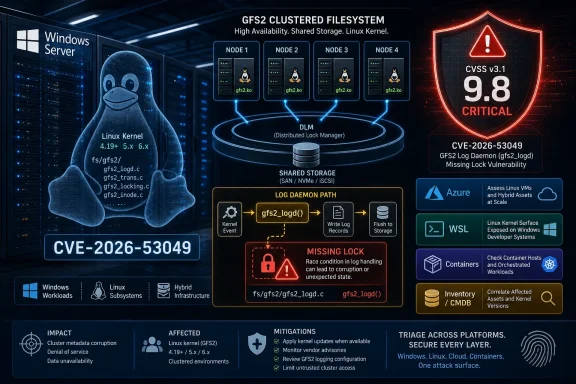 A Small Locking Bug Lands in a Very Large Attack Surface
The short version of CVE-2026-53049 is brutally technical. In GFS2, the Global File System 2 used for shared-disk Linux clusters, gfs2_logd() called several log flushing functions without holding sd_log_flush_lock, even though those functions require exclusion from concurrent transactions. The fix adds a non-locking internal flush helper and takes the lock in the daemon path before calling the relevant log routines.That sounds like engineering housekeeping, and in one sense it is. Kernel maintainers routinely fix missing locks, use-after-free hazards, refcount mistakes, and unchecked state transitions long before most users can understand the blast radius. The unsettling part is the score: kernel.org’s CNA record gives the issue a CVSS 3.1 rating of 9.8, the kind of number normally associated with remotely reachable bugs that require no privileges and can compromise confidentiality, integrity, and availability.
There is a tension here that deserves more attention than the usual vulnerability feed gives it. The description reads like a race condition in a specialized filesystem; the metric reads like an emergency siren. Until downstream vendors publish their own advisories, administrators should treat that mismatch as a signal to investigate, not as proof of apocalypse.
GFS2 is not NTFS, ReFS, or exFAT. It is a Linux clustered filesystem designed for multiple nodes accessing shared storage under a distributed lock manager. In practice, it shows up in high-availability clusters, Red Hat-style resilient storage deployments, lab environments, specialized appliances, and some enterprise Linux stacks where shared block storage is still a requirement. That makes it irrelevant to most consumer Windows machines and very relevant to a subset of administrators whose systems are expensive, stateful, and hard to reboot.
Microsoft’s Page Was the Messenger, Not the Source of the Bug
The prompt that triggered this story came from Microsoft’s Security Update Guide entry for CVE-2026-53049, but the bug itself is not a Windows kernel flaw. The record points back to the Linux kernel and the GFS2 subsystem. Microsoft’s role here is closer to aggregation and exposure management: surfacing a CVE that may affect Microsoft customers through Linux-based products, Azure workloads, Defender vulnerability inventory, WSL-related environments, or third-party software stacks.That distinction matters. When Microsoft lists a CVE, many Windows admins reflexively ask which KB fixes it. For a Windows kernel elevation-of-privilege bug, that instinct is correct. For a Linux kernel CVE, especially one originating from kernel.org, the answer may be a distribution kernel update, a cloud image refresh, a container host update, an appliance firmware release, or no action at all because the vulnerable component is not present.
The MSRC page also appeared to be unavailable behind a maintenance message when the supplied text was captured. That is annoying, but not decisive. CVE data now travels through multiple pipes: kernel.org, NVD, distribution trackers, vulnerability scanners, Microsoft portals, cloud dashboards, and vendor advisories. The practical work is to correlate them without assuming that the first dashboard to light up has the full story.
There is a broader editorial point here. Microsoft’s security ecosystem now reflects a world where Windows is not a sealed box. The company ships Linux in Azure, supports Linux containers, integrates Linux development workflows into Windows, scans Linux packages in Defender tooling, and sells management planes that see across operating systems. A Linux kernel CVE appearing in a Microsoft-facing workflow is no longer a category error. It is the new normal.
GFS2 Is Boring Until It Is Holding the Business Together
GFS2 is not fashionable technology. It does not have the glamour of Kubernetes, the ubiquity of ext4, or the branding of cloud-native storage. Its job is to let multiple Linux nodes coordinate access to a shared filesystem, using cluster locking so that one node’s writes do not trample another’s assumptions.That coordination is exactly why a missing lock in the log path is serious. Filesystems are state machines with consequences. They do not merely store bytes; they preserve ordering, durability, metadata integrity, and recovery semantics. A log flush that races with concurrent transactions is not just a theoretical violation of coding style. It can undermine the assumptions that keep a clustered filesystem coherent under load.
The CVE description does not, by itself, provide a public exploit narrative. It does not say that attackers can trivially weaponize a network packet against every GFS2 mount in the world. It says the kernel had an exclusion bug in a log daemon path, and the kernel project has treated the resolution as security-relevant. Responsible administrators should resist both extremes: dismissing the issue because it sounds obscure, or declaring a universal compromise path before vendors publish impact analysis.
The uncomfortable truth is that clustered filesystems often sit under workloads administrators are reluctant to touch. Shared storage clusters may back databases, legacy line-of-business apps, research systems, imaging workflows, or vendor appliances. They are the kind of systems where “just patch the kernel and reboot” collides with change windows, quorum rules, fencing, multipath storage, and institutional memory that retired three years ago.
The CVSS Number Is a Warning, Not a Complete Risk Model
A 9.8 CVSS score will light up dashboards, and that is partly the point. CVSS measures properties of a vulnerability in a standardized way, but it does not know your environment. It cannot tell whether you load thegfs2 module, mount a GFS2 filesystem, expose a relevant path to untrusted users, run a vulnerable kernel series, or rely on a distribution backport that already patched the flaw without changing the upstream version string.This is where enterprise patching often goes sideways. A scanner reports a critical Linux kernel CVE. A Windows-oriented operations team sees “critical” and asks why their Microsoft portal says a Linux bug exists. A Linux team checks
uname -r, sees an old-looking enterprise kernel, and either panics or dismisses the finding. Neither reaction is enough.Enterprise Linux vendors routinely backport security fixes into older kernel version lines. That means version comparison alone can be misleading. A Red Hat, Ubuntu, SUSE, Oracle, Debian, or Azure-tuned kernel may carry the fix while still presenting a version number that appears old relative to upstream. Conversely, a self-built kernel or niche appliance may look modern enough at a glance while missing the exact stable commit that matters.
For CVE-2026-53049, the first triage question is not “Do we have Linux?” It is “Do we have vulnerable Linux kernels with GFS2 present and usable in any role that matters?” The second is “Who owns the kernel update path?” The third is “Can the affected nodes be rebooted safely?” That last question is where a tidy vulnerability record becomes a real operations problem.
Windows Shops Now Own Linux Risk Whether They Like It or Not
WindowsForum readers know this transition intimately. A decade ago, many Windows administrators could treat Linux as somebody else’s problem unless they managed a mixed server room. Today, Linux is threaded through the Windows world in subtle and not-so-subtle ways. Developers run WSL. Security teams deploy Linux sensors. Cloud teams spin up Ubuntu and RHEL images from Azure Marketplace. Data teams inherit vendor appliances. Platform teams host containers on Linux nodes even when the business application is written for .NET.CVE-2026-53049 is not primarily a WSL panic button. WSL’s typical distributions are not running the same kind of clustered storage role that GFS2 was built for, and consumer Windows systems are unlikely to be directly affected. But WSL has trained organizations to underestimate how many Linux kernels exist adjacent to Windows work. The machine may be branded as a Windows workstation, but the development workflow may depend on Linux userlands, Linux filesystems, Linux containers, and remote Linux build agents.
The same is true in Azure. A Windows-heavy enterprise may still run Linux virtual machines for network appliances, observability stacks, CI runners, Kubernetes nodes, storage gateways, and vendor-provided images. Some of those systems are pets, not cattle. They have names, data, and maintenance rituals. If one of them uses clustered storage, the fact that the vulnerability is “Linux” does not make it someone else’s ticket.
Microsoft’s involvement in surfacing CVEs like this therefore has a double edge. It helps defenders see risk across platforms, but it also exposes the weakness of old organizational boundaries. If your patch committee is divided into “Windows Update night” and “everything else eventually,” then modern vulnerability management will keep embarrassing you.
The Fix Is Simple; Deploying It May Not Be
At the code level, the fix pattern is straightforward: take the correct lock around log flush activity and split out a helper so the locking rules are respected. This is exactly the kind of kernel patch that looks small in a diff and large in operational consequence. A few lines of locking discipline can determine whether a filesystem behaves predictably under concurrent pressure.Deployment is harder because kernel fixes generally require booting into a corrected kernel. Live patching may be available for some distributions and subscriptions, but filesystem and locking changes are precisely the sort of area where administrators should read vendor guidance carefully before assuming a live patch exists or is sufficient. Clustered storage also raises sequencing questions: which node first, how to drain workloads, how to preserve quorum, and how to validate that the cluster returns healthy after each reboot.
The safest path is distribution-led. Administrators should look for advisories from the Linux vendor that actually supplies the kernel on the affected system. That may be Red Hat Enterprise Linux, Ubuntu, SUSE Linux Enterprise, Debian, Oracle Linux, Rocky, Alma, Amazon Linux, Azure Linux, or an appliance vendor with its own cadence. Kernel.org stable commits establish the upstream fix; the distribution advisory establishes the supportable fix for your estate.
There is also a configuration angle. If GFS2 is not used, the module’s presence alone may not represent the same risk as an active mounted clustered filesystem. In some environments, administrators may choose to prevent unused kernel modules from loading as a defense-in-depth measure. But module blacklisting is not a substitute for patching where the feature is used, and it can break systems if applied blindly to a cluster that actually depends on GFS2.
The Exploit Story Is Still Less Clear Than the Patch Story
The public CVE text confirms the bug and the fix, but it does not fully explain exploitation. That matters because the CVSS vector assigned by kernel.org implies network attackability, no privileges, no user interaction, and high impact across confidentiality, integrity, and availability. For a filesystem race in GFS2, administrators should ask how that vector maps to real-world access paths.One possibility is that the scoring reflects a worst-case configuration where an attacker can trigger relevant filesystem activity through a network-facing service backed by GFS2. Another is that the CNA’s scoring model is conservative or broad for kernel flaws. A third is that additional context exists in kernel discussions or downstream advisories that has not been distilled into the short CVE description most dashboards display.
This uncertainty is not unusual. The Linux kernel CVE process has improved in speed and coverage, but the tradeoff is that administrators sometimes receive terse vulnerability descriptions before exploitability analysis has matured. A record can be technically accurate and operationally incomplete. That is why security teams should track vendor advisories over several days, not just the first NVD ingestion.
Still, lack of a public proof of concept is not a reason to ignore a critical kernel CVE. Race conditions in privileged kernel subsystems have a long history of becoming more interesting after researchers spend time with them. The window between “obscure internal bug” and “reliable exploit chain” can be shorter than change-control boards would like.
The Real Patch Gap Is in Inventory, Not Awareness
Most organizations know how to patch a server once they know it matters. The bigger failure is often proving whether a vulnerability applies. CVE-2026-53049 is a good test of inventory quality because it crosses several boundaries at once: operating system, kernel version, filesystem module, cluster role, and vendor ownership.A mature inventory should answer basic questions quickly. Which Linux hosts are in the estate? Which kernels are they running? Which ones have GFS2 modules installed? Which ones have active GFS2 mounts? Which are managed by a package repository, and which are appliances? Which are in Azure, on-premises, edge locations, labs, or vendor-managed networks? If answering those questions takes a week of Slack archaeology, the vulnerability is not the only problem.
Windows-centric tooling can help, but it cannot replace system-level truth. Defender, vulnerability scanners, CMDBs, Azure Resource Graph, endpoint agents, configuration management, and package inventories each see part of the picture. The best teams reconcile them. The weakest teams pick the dashboard that makes the number go down.
This is also where false positives can waste time. Enterprise kernels may carry a backported fix without a shiny upstream version number. Scanners may flag a CVE because a package name matches, not because GFS2 is active. Conversely, unmanaged systems may evade scanners entirely. For CVE-2026-53049, the responsible posture is targeted verification: confirm the running kernel’s vendor status and confirm whether GFS2 is actually in use.
Clustered Filesystems Punish Casual Maintenance
Patching a standalone Linux VM is one thing. Patching a clustered filesystem node is another. GFS2 deployments depend on coordination among nodes, shared storage, locking infrastructure, fencing behavior, and application expectations. A sloppy reboot can create more downtime than the vulnerability ever would have.That does not argue against patching. It argues for doing the boring work properly. Administrators should identify cluster membership, validate backups, check fencing, review quorum behavior, drain applications where possible, and patch nodes in a sequence consistent with vendor support. If the cluster is old enough that nobody knows the runbook, this CVE is a useful excuse to rebuild the runbook before an outage writes it for you.
The best case is simple: a vendor advisory confirms affected versions, a patched kernel is available, nodes are updated one at a time, and the cluster remains healthy. The worst case is a fragile shared-storage system with undocumented dependencies, stale kernels, and a maintenance window that assumes reboots are ceremonial. Security bugs expose operational debt because they impose deadlines on systems designed around avoidance.
There is another wrinkle for appliances. Many storage, backup, monitoring, and security products run Linux internally, and customers may not have shell access or kernel control. If such a product uses GFS2 or a vulnerable kernel configuration, the only safe fix may come from the vendor. That makes support contracts and firmware advisories part of the security response, not procurement paperwork.
Microsoft Administrators Should Read This as a Hybrid Warning
For Windows administrators, the most useful response is not to become Linux kernel specialists overnight. It is to update the mental model of what a Windows environment contains. The boundary between Windows and Linux is now porous enough that Microsoft security feeds may surface Linux vulnerabilities, and those vulnerabilities may be relevant to business services the Windows team is expected to keep online.This is especially true for organizations that centralized vulnerability management under Microsoft tools. A security team may see CVE-2026-53049 in a portal and assign it to the Windows infrastructure group because the asset is in Azure, joined to a Microsoft management plane, or owned by a Windows-heavy application team. That routing may be bureaucratically convenient and technically wrong.
The right play is shared ownership. Windows, Linux, cloud, storage, and security teams need a common triage pattern for cross-platform CVEs. The first step is not arguing whose dashboard found it. The first step is deciding whether the vulnerable code exists, whether it is reachable, whether the vendor has shipped a fix, and how fast the business can apply it safely.
This is where WindowsForum’s audience has an advantage. Enthusiasts and sysadmins who understand both the desktop and the infrastructure layers are less likely to be fooled by branding. They know a “Windows shop” can run Linux in production, and a “Linux CVE” can arrive through a Microsoft portal. That practical bilingualism is becoming a core security skill.
The Patch Queue Needs a Better Triage Script
CVE-2026-53049 should not send every Windows user hunting through their laptop for GFS2. It should send enterprise teams through a short, disciplined triage process. The goal is to separate exposed systems from irrelevant noise without letting the word “obscure” become a sedative.Security teams should first identify Linux systems in scope, especially clustered storage nodes, high-availability platforms, and appliances. Then they should check whether GFS2 is installed, loadable, or mounted. After that, they should map running kernels to vendor advisories rather than relying only on upstream version strings. Finally, they should plan kernel updates with the assumption that reboots and cluster sequencing matter.
The response should also include a communication step. If Microsoft tooling raised the alert, the closure note should explain why the issue is fixed, not applicable, vendor-pending, or accepted temporarily. “Not a Windows CVE” is not enough. In hybrid estates, that phrase can be true and still operationally useless.
There is a cultural shift hiding inside this process. Patch management used to be organized around products. Modern vulnerability management is organized around services. If a business service depends on a Linux cluster, a Windows jump host, an Azure load balancer, a vendor appliance, and an Entra-integrated identity path, then a CVE in any one of those layers belongs to the service owner as much as to the platform specialist.
The GFS2 Alert Draws a Map of the Modern Windows Estate
CVE-2026-53049 is easy to overstate for consumers and easy to understate for enterprises. That makes it a useful case study rather than just another line in a vulnerability feed. The bug is narrow, the score is severe, and the affected technology is concentrated in environments where downtime is costly.Here is the practical reading for administrators:
- Most ordinary Windows desktops are unlikely to be directly affected because the vulnerability is in the Linux kernel’s GFS2 clustered filesystem code.
- Windows-heavy organizations may still have exposure through Azure Linux workloads, vendor appliances, clustered storage systems, container hosts, or other Linux infrastructure adjacent to Microsoft-managed environments.
- The most important triage question is whether vulnerable Linux kernels are running with GFS2 present or active, not whether a Microsoft page happens to list the CVE.
- Kernel.org’s critical score should trigger investigation, but vendor advisories should drive patch decisions because enterprise kernels often receive backported fixes.
- Systems that actually use GFS2 should be patched through a planned cluster maintenance process rather than treated like disposable single-node VMs.
- A clear “not applicable” determination should be documented with evidence, because hybrid vulnerability feeds will keep producing cross-platform alerts.
References
- Primary source: MSRC
Published: 2026-07-03T01:04:14-07:00
Security Update Guide - Microsoft Security Response Center
 msrc.microsoft.com
- Related coverage: sentinelone.com
CVE-2026-53049: Linux Kernel GFS2 Race Condition Flaw
CVE-2026-53049 is a race condition vulnerability in Linux kernel GFS2. Learn about its impact, affected versions, and mitigation methods.www.sentinelone.com
- Related coverage: docs.redhat.com