

CVE-2026-53130 is a newly published Linux kernel vulnerability in the OMFS filesystem driver, disclosed by kernel.org on June 24, 2026, that allows a crafted filesystem image to trigger a massive out-of-bounds memory overwrite during mount-time filesystem handling. It is not a Windows vulnerability, but it matters to WindowsForum readers because the modern Windows estate increasingly includes Linux kernels through WSL, Hyper-V guests, containers, appliances, NAS boxes, recovery media, and security tooling. The bug is a useful reminder that “local” kernel flaws are rarely local in the operational sense. They live wherever untrusted disk images, removable media, forensic workflows, or automated mount pipelines meet privileged kernel code.
The defect behind CVE-2026-53130 is almost comically small: OMFS, the Optimized MPEG File System originally associated with Rio Karma media players, accepted an on-disk system block size that was too small. The Linux kernel’s
Later in the filesystem code,
That turns an ordinary buffer initialization into a wild kernel memory overwrite beginning at
The fix is exactly what one would expect: reject undersized
Mounting is a privileged act, but feeding images into mount-capable workflows is common. Disk images move through backup systems, forensic triage tools, malware sandboxes, CI pipelines, removable media workflows, and appliance firmware analysis. In many environments, the person or process supplying the image is not the same trust boundary as the kernel that parses it.
That is where this bug becomes more interesting than its vintage filesystem suggests. OMFS is obscure, but Linux’s filesystem stack is broad by design. That breadth is a strength when Linux must read almost anything; it is a liability when rarely used parsers remain enabled, reachable, and fuzzable long after the hardware ecosystem that justified them has faded from memory.
The user-interaction flag also deserves scrutiny. If “interaction” means a user or automation path causes a malicious image to be mounted, that covers a lot of real-world behavior. Desktop auto-mounting has become more conservative over the years, but servers and lab systems often run their own ingestion scripts, loop-mount images, or process evidence at scale.
That would be the wrong lesson. Kernel filesystem drivers do not become harmless because their users vanish. If a parser remains compiled into a kernel, loadable as a module, or available through distribution packaging, it remains part of the attack surface. A bug in a niche filesystem driver can still execute in ring 0.
The Linux kernel has spent years improving memory-safety practices, hardening allocator behavior, expanding fuzzing coverage, and tightening parser validation. Yet filesystem code remains one of the most stubborn classes of kernel risk because it accepts attacker-controlled structured data and translates it into trusted in-memory objects. The boundary between “just metadata” and “kernel control path” is thin.
CVE-2026-53130 is therefore not dramatic because OMFS is popular. It is dramatic because the failure mode is clean, deterministic, and rooted in a classic validation omission. A field is checked against a maximum but not a minimum; arithmetic wraps; a memory operation trusts the result. This is the kind of bug that security engineers use in training slides precisely because it is so easy to understand after the fact.
This is particularly true for Linux kernel CVEs, where the fixed versions and backports often matter more than the CVE landing page. The record includes multiple stable commits, reflecting the way kernel fixes propagate across supported branches. Administrators who wait for every database to agree may find themselves behind the actual patch cadence.
The affected-version data also tells an important story. OMFS support dates back to the Linux 2.6 era, and the vulnerable pattern spans a long period of kernel history. Fixed versions are listed across maintained branches, including 5.10.258, 5.15.209, 6.1.175, 6.6.141, and later stable lines as applicable.
That branch spread is typical of kernel maintenance, but it complicates asset management. “Linux kernel vulnerable” is not a useful operational statement by itself. The relevant question is which branch, which downstream vendor build, which module configuration, and which deployed system can actually reach the OMFS code.
That does not mean CVE-2026-53130 is a five-alarm emergency for every Windows admin. It means the old boundary between “Windows vulnerability” and “Linux vulnerability” is less useful than the estate map. If a Windows endpoint runs WSL 2 but never exposes OMFS support, the practical risk may be limited. If a forensic workstation routinely mounts untrusted images inside a Linux VM, the risk profile changes.
The more integrated the environment, the more misleading platform labels become. A malicious disk image may arrive through email on a Windows workstation, be copied into a Linux analysis VM, mounted by a script, and crash or corrupt the guest kernel. From the attacker’s perspective, that is not a philosophical distinction between operating systems; it is a workflow.
For WindowsForum readers, the lesson is not “patch Linux because Linux is everywhere,” though that is true enough. The sharper lesson is that Windows environments now contain Linux parsing surfaces in places that are easy to forget. WSL, containers, and virtualization have made Linux a feature of Windows operations, not merely a separate server category.
That requirement narrows the field. Many production servers will never mount OMFS. Many distributions may ship the filesystem as a module that is not loaded by default. Some hardened environments disable uncommon filesystem modules outright or restrict mounting to trusted administrators. In those places, the bug may be present in source history but difficult to exercise.
Still, “difficult to exercise” is not the same as “irrelevant.” The security industry has repeatedly learned that file parsers are attractive precisely because they cross trust boundaries through normal workflows. A crafted archive, disk image, USB device, VM image, or forensic sample can travel farther than an exploit packet.
The safest reading is measured: this is a high-severity local kernel memory corruption flaw with a plausible crafted-image trigger, not a mass internet exploitation event. Teams should patch it as part of kernel maintenance, reduce exposure to obscure filesystem parsers where practical, and pay special attention to systems that ingest untrusted storage images.
That wraparound is catastrophic because the result is used as a byte count.
This is why bounds checks must be paired with the arithmetic they protect. Checking that a value is not too large is only half the invariant when later code subtracts a fixed offset. The valid range is not “less than or equal to page size.” It is “greater than or equal to the directory start offset and less than or equal to page size.”
The patch’s elegance is almost an indictment. The bug does not require speculative execution, heap grooming, cross-cache exploitation, or a new vulnerability class. It requires an on-disk field, an incomplete range check, and a memory operation that trusts a derived length. Kernel hardening can reduce exploitability, but only input validation prevents this class cleanly.
Removing old code is politically and practically harder than it sounds. Someone may still rely on it. A distribution may prefer compatibility. A forensic or archival use case may need read access to old media. Kernel culture has historically valued broad hardware and format support, and that support is one reason Linux became the universal substrate of infrastructure.
But the security cost is real. Every parser reachable from privileged kernel context carries the possibility of a malformed-input bug. Filesystems are especially sensitive because mounting often requires privileges, yet the bytes being parsed may come from an untrusted party. The kernel is being asked to make sense of an attacker’s data structure.
The long-term answer is not simply “delete obscure filesystems,” though some environments should absolutely blacklist what they do not use. The better answer is layered: fuzz the parsers, validate invariants near the input boundary, make uncommon modules opt-in where possible, and keep reducing the blast radius of kernel memory corruption. CVE-2026-53130 is a small patch in that larger argument.
That reboot requirement is the quiet operational tax of kernel vulnerabilities. Applying a package is not enough if the old kernel keeps running. Livepatch systems may cover some kernel flaws, but filesystem driver fixes vary by provider, configuration, and patch policy. For many systems, the practical fix remains a maintenance window.
Administrators should also avoid assuming that a scanner’s silence equals safety during the enrichment window. NVD lag, distro advisory timing, and vendor backport versioning can all produce temporary ambiguity. A vendor may ship a fix without changing the upstream version number in an obvious way, or a scanner may flag a system based on version matching even when a backport is present.
The best operational evidence is boring but reliable: check the running kernel, check the vendor’s changelog or advisory, confirm whether the OMFS module is present or loadable, and reboot after updating. If the system processes untrusted images, treat the patch as more urgent than its niche-filesystem label suggests.
Those workflows often run with elevated privileges because mounting traditionally demands it. They may also run in automation, where a malformed image can be processed faster than a human can notice anything suspicious. Even if the likely outcome is a crash rather than reliable privilege escalation, a kernel crash in an analysis pipeline is still a denial-of-service event at an awkward boundary.
The CVSS score’s confidentiality, integrity, and availability impacts are all high because kernel memory corruption can theoretically lead to full compromise. That does not mean a public exploit exists, nor does it guarantee exploit reliability across modern hardened kernels. It does mean defenders should resist reducing the issue to “just a crash.”
For security teams, the practical question is whether untrusted filesystem images ever reach a kernel mount path. If they do, the safer pattern is to isolate parsing in disposable VMs, prefer user-space tooling where available, disable unused filesystem modules, and patch aggressively. The kernel is a poor place to discover whether a stranger’s disk metadata is well formed.
Most WSL users are not mounting obscure block filesystems as part of daily development. For them, this CVE is more likely to be swept up in a routine WSL kernel update than handled as an emergency. But WSL has blurred habits: developers download images, build kernels, test filesystems, and run privileged containers in ways that resemble Linux workstations more than traditional Windows desktops.
Containers add a different wrinkle. A container normally shares the host kernel, which means kernel filesystem bugs are host concerns, not container-package concerns. If a containerized workload can influence host-level mounting, loop devices, privileged containers, or storage plugins, the risk becomes more meaningful. If it cannot, the mere presence of a vulnerable source file in some unrelated image is not enough.
The key is to avoid both complacency and theater. Not every WSL or container user needs to drop everything. But anyone granting privileged container access, mounting arbitrary images, or running Linux analysis tools on a Windows-managed machine should understand that the kernel boundary is the boundary that matters.
This is where asset management either pays for itself or fails publicly. A vulnerability in an obscure filesystem should be easy to scope if teams know which kernels they run, which modules they ship, and which systems mount untrusted media. In reality, many organizations will discover the answer through scanner churn, Slack archaeology, and the one engineer who remembers why an old VM exists.
There is also a policy question hiding underneath the patch. Should rare filesystem modules be available by default on systems that never need them? Some distributions and hardened baselines already reduce this surface. Others favor compatibility and let administrators decide.
For high-assurance systems, the least controversial move is to block or avoid mounting filesystems that have no business purpose. That is not a substitute for patching; it is a way to make the next obscure parser bug less reachable. Defense-in-depth is often dull, but dull controls are exactly what turn a high-severity CVE into a non-event.
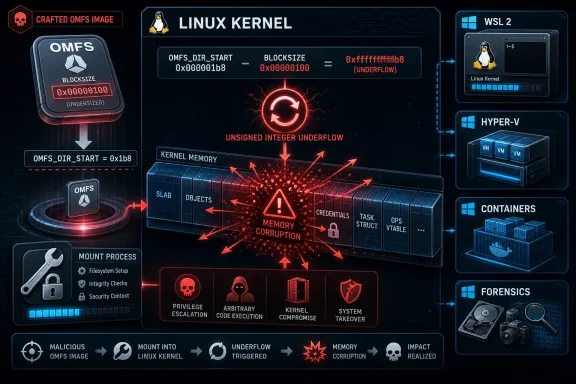 A Tiny Filesystem Check Becomes a Kernel-Sized Problem
The defect behind CVE-2026-53130 is almost comically small: OMFS, the Optimized MPEG File System originally associated with Rio Karma media players, accepted an on-disk system block size that was too small. The Linux kernel’s omfs_fill_super() path already rejected block sizes larger than PAGE_SIZE, but it did not reject values smaller than OMFS_DIR_START, a constant equal to 0x1b8, or 440 bytes. That missing lower bound is the entire story — and also the reason the story is dangerous.Later in the filesystem code,
omfs_make_empty() uses s_sys_blocksize - OMFS_DIR_START as the length argument to memset(). Because the block size field is treated as an unsigned 32-bit value, a malicious image can set it below 440 and force an unsigned underflow. Instead of a small negative number, the kernel gets a value close to 4 GiB.That turns an ordinary buffer initialization into a wild kernel memory overwrite beginning at
bh->b_data + OMFS_DIR_START. In practical terms, a malformed OMFS image can make the kernel write far past the backing block buffer. Kernel.org rates the issue as CVSS 7.8, high severity, with local attack vector, low attack complexity, no privileges required, and user interaction required.The fix is exactly what one would expect: reject undersized
s_sys_blocksize values during superblock validation, before the filesystem proceeds into deeper parsing. The patch does not add a mitigation framework, a new subsystem, or a clever runtime defense. It adds the validation that should have been paired with the existing upper-bound check from the beginning.The “Local” Label Hides the Real Attack Surface
The CVSS vector saysAV:L, and that is technically fair. An attacker needs a local path to get the vulnerable kernel to process a crafted filesystem image. But anyone who has administered Linux fleets, mixed Windows-Linux workstations, or virtualization hosts knows that local file parsing bugs are not confined to someone sitting at a keyboard.Mounting is a privileged act, but feeding images into mount-capable workflows is common. Disk images move through backup systems, forensic triage tools, malware sandboxes, CI pipelines, removable media workflows, and appliance firmware analysis. In many environments, the person or process supplying the image is not the same trust boundary as the kernel that parses it.
That is where this bug becomes more interesting than its vintage filesystem suggests. OMFS is obscure, but Linux’s filesystem stack is broad by design. That breadth is a strength when Linux must read almost anything; it is a liability when rarely used parsers remain enabled, reachable, and fuzzable long after the hardware ecosystem that justified them has faded from memory.
The user-interaction flag also deserves scrutiny. If “interaction” means a user or automation path causes a malicious image to be mounted, that covers a lot of real-world behavior. Desktop auto-mounting has become more conservative over the years, but servers and lab systems often run their own ingestion scripts, loop-mount images, or process evidence at scale.
Old Filesystem Code Is Still Kernel Code
OMFS is not ext4, XFS, Btrfs, or NTFS3. Most Linux users have never intentionally mounted it, and many administrators would struggle to name a reason it exists. That obscurity may tempt teams to dismiss CVE-2026-53130 as an exotic corner case.That would be the wrong lesson. Kernel filesystem drivers do not become harmless because their users vanish. If a parser remains compiled into a kernel, loadable as a module, or available through distribution packaging, it remains part of the attack surface. A bug in a niche filesystem driver can still execute in ring 0.
The Linux kernel has spent years improving memory-safety practices, hardening allocator behavior, expanding fuzzing coverage, and tightening parser validation. Yet filesystem code remains one of the most stubborn classes of kernel risk because it accepts attacker-controlled structured data and translates it into trusted in-memory objects. The boundary between “just metadata” and “kernel control path” is thin.
CVE-2026-53130 is therefore not dramatic because OMFS is popular. It is dramatic because the failure mode is clean, deterministic, and rooted in a classic validation omission. A field is checked against a maximum but not a minimum; arithmetic wraps; a memory operation trusts the result. This is the kind of bug that security engineers use in training slides precisely because it is so easy to understand after the fact.
The Patch Says More Than the CVE Record
The NVD entry for CVE-2026-53130 was still undergoing enrichment after publication, with NVD scores not yet assigned while kernel.org provided the CNA score. That is normal for fresh kernel CVEs, but it creates a familiar gap for defenders. The vulnerability exists, patches exist, stable-branch references exist, but the metadata that many scanners and dashboards depend on may lag behind the engineering reality.This is particularly true for Linux kernel CVEs, where the fixed versions and backports often matter more than the CVE landing page. The record includes multiple stable commits, reflecting the way kernel fixes propagate across supported branches. Administrators who wait for every database to agree may find themselves behind the actual patch cadence.
The affected-version data also tells an important story. OMFS support dates back to the Linux 2.6 era, and the vulnerable pattern spans a long period of kernel history. Fixed versions are listed across maintained branches, including 5.10.258, 5.15.209, 6.1.175, 6.6.141, and later stable lines as applicable.
That branch spread is typical of kernel maintenance, but it complicates asset management. “Linux kernel vulnerable” is not a useful operational statement by itself. The relevant question is which branch, which downstream vendor build, which module configuration, and which deployed system can actually reach the OMFS code.
Windows Shops Are Not Exempt From Linux Kernel Bugs
A Windows-first organization can still have this bug in scope. WSL 2 uses a real Linux kernel. Hyper-V hosts run Linux guests. Developers pull container images and virtual appliances from vendors. Security teams analyze disk images. Backup teams restore Linux volumes. Edge appliances, NAS devices, firewalls, media systems, and embedded platforms often run Linux under the hood even when procurement documents never say so loudly.That does not mean CVE-2026-53130 is a five-alarm emergency for every Windows admin. It means the old boundary between “Windows vulnerability” and “Linux vulnerability” is less useful than the estate map. If a Windows endpoint runs WSL 2 but never exposes OMFS support, the practical risk may be limited. If a forensic workstation routinely mounts untrusted images inside a Linux VM, the risk profile changes.
The more integrated the environment, the more misleading platform labels become. A malicious disk image may arrive through email on a Windows workstation, be copied into a Linux analysis VM, mounted by a script, and crash or corrupt the guest kernel. From the attacker’s perspective, that is not a philosophical distinction between operating systems; it is a workflow.
For WindowsForum readers, the lesson is not “patch Linux because Linux is everywhere,” though that is true enough. The sharper lesson is that Windows environments now contain Linux parsing surfaces in places that are easy to forget. WSL, containers, and virtualization have made Linux a feature of Windows operations, not merely a separate server category.
This Is a Mount-Time Bug, Not a Remote Worm
It is important not to oversell the threat. CVE-2026-53130 is not a remotely exploitable network bug in the usual sense. There is no indication from the public record that merely receiving network traffic can trigger it. The attacker needs the vulnerable kernel to process a crafted OMFS filesystem image.That requirement narrows the field. Many production servers will never mount OMFS. Many distributions may ship the filesystem as a module that is not loaded by default. Some hardened environments disable uncommon filesystem modules outright or restrict mounting to trusted administrators. In those places, the bug may be present in source history but difficult to exercise.
Still, “difficult to exercise” is not the same as “irrelevant.” The security industry has repeatedly learned that file parsers are attractive precisely because they cross trust boundaries through normal workflows. A crafted archive, disk image, USB device, VM image, or forensic sample can travel farther than an exploit packet.
The safest reading is measured: this is a high-severity local kernel memory corruption flaw with a plausible crafted-image trigger, not a mass internet exploitation event. Teams should patch it as part of kernel maintenance, reduce exposure to obscure filesystem parsers where practical, and pay special attention to systems that ingest untrusted storage images.
The Integer Underflow Is the Oldest Trick in the Book
The technical heart of CVE-2026-53130 is unsigned arithmetic doing exactly what unsigned arithmetic does. Ifs_sys_blocksize is a u32 and its value is smaller than OMFS_DIR_START, subtracting 440 does not produce a negative value that can be caught by a signed comparison. It wraps around.That wraparound is catastrophic because the result is used as a byte count.
memset() is not a semantic operation; it does not know the developer intended to fill the remainder of a directory block. It receives a pointer and a length, then writes. When the length becomes nearly 4 GiB, intent no longer matters.This is why bounds checks must be paired with the arithmetic they protect. Checking that a value is not too large is only half the invariant when later code subtracts a fixed offset. The valid range is not “less than or equal to page size.” It is “greater than or equal to the directory start offset and less than or equal to page size.”
The patch’s elegance is almost an indictment. The bug does not require speculative execution, heap grooming, cross-cache exploitation, or a new vulnerability class. It requires an on-disk field, an incomplete range check, and a memory operation that trusts a derived length. Kernel hardening can reduce exploitability, but only input validation prevents this class cleanly.
The Obscure Filesystem Problem Has No Easy Owner
One reason bugs like this persist is that legacy filesystem drivers often have ambiguous ownership. They are part of the kernel, so they inherit kernel trust. But they may have few active users, few maintainers with domain familiarity, and little day-to-day scrutiny compared with major filesystems.Removing old code is politically and practically harder than it sounds. Someone may still rely on it. A distribution may prefer compatibility. A forensic or archival use case may need read access to old media. Kernel culture has historically valued broad hardware and format support, and that support is one reason Linux became the universal substrate of infrastructure.
But the security cost is real. Every parser reachable from privileged kernel context carries the possibility of a malformed-input bug. Filesystems are especially sensitive because mounting often requires privileges, yet the bytes being parsed may come from an untrusted party. The kernel is being asked to make sense of an attacker’s data structure.
The long-term answer is not simply “delete obscure filesystems,” though some environments should absolutely blacklist what they do not use. The better answer is layered: fuzz the parsers, validate invariants near the input boundary, make uncommon modules opt-in where possible, and keep reducing the blast radius of kernel memory corruption. CVE-2026-53130 is a small patch in that larger argument.
Distributions Will Decide the Real Clock
Kernel.org can publish a fix, but most organizations do not run raw kernel.org stable trees. They run Ubuntu, Debian, Red Hat derivatives, SUSE, Arch, Alpine, Proxmox, appliance kernels, Android-derived builds, embedded vendor trees, or cloud provider kernels. The real remediation clock starts when the relevant downstream ships a patched package and the organization reboots into it.That reboot requirement is the quiet operational tax of kernel vulnerabilities. Applying a package is not enough if the old kernel keeps running. Livepatch systems may cover some kernel flaws, but filesystem driver fixes vary by provider, configuration, and patch policy. For many systems, the practical fix remains a maintenance window.
Administrators should also avoid assuming that a scanner’s silence equals safety during the enrichment window. NVD lag, distro advisory timing, and vendor backport versioning can all produce temporary ambiguity. A vendor may ship a fix without changing the upstream version number in an obvious way, or a scanner may flag a system based on version matching even when a backport is present.
The best operational evidence is boring but reliable: check the running kernel, check the vendor’s changelog or advisory, confirm whether the OMFS module is present or loadable, and reboot after updating. If the system processes untrusted images, treat the patch as more urgent than its niche-filesystem label suggests.
Attackers Love Workflows More Than Brand Names
The most plausible exploitation path for CVE-2026-53130 is not a random consumer double-clicking an OMFS volume. It is a workflow that already treats foreign storage as input. Think malware labs, incident response teams, e-discovery pipelines, backup validation systems, firmware unpacking tools, and developer environments that mount images during tests.Those workflows often run with elevated privileges because mounting traditionally demands it. They may also run in automation, where a malformed image can be processed faster than a human can notice anything suspicious. Even if the likely outcome is a crash rather than reliable privilege escalation, a kernel crash in an analysis pipeline is still a denial-of-service event at an awkward boundary.
The CVSS score’s confidentiality, integrity, and availability impacts are all high because kernel memory corruption can theoretically lead to full compromise. That does not mean a public exploit exists, nor does it guarantee exploit reliability across modern hardened kernels. It does mean defenders should resist reducing the issue to “just a crash.”
For security teams, the practical question is whether untrusted filesystem images ever reach a kernel mount path. If they do, the safer pattern is to isolate parsing in disposable VMs, prefer user-space tooling where available, disable unused filesystem modules, and patch aggressively. The kernel is a poor place to discover whether a stranger’s disk metadata is well formed.
WSL and Containers Add Nuance, Not Panic
WSL deserves a special note because it sits directly in the Windows enthusiast and developer world. WSL 2 runs a Microsoft-supplied Linux kernel, and Microsoft services that kernel through its own update channels. Whether CVE-2026-53130 is practically reachable in a given WSL setup depends on kernel version, configuration, module availability, privileges inside the distribution, and whether OMFS support is present.Most WSL users are not mounting obscure block filesystems as part of daily development. For them, this CVE is more likely to be swept up in a routine WSL kernel update than handled as an emergency. But WSL has blurred habits: developers download images, build kernels, test filesystems, and run privileged containers in ways that resemble Linux workstations more than traditional Windows desktops.
Containers add a different wrinkle. A container normally shares the host kernel, which means kernel filesystem bugs are host concerns, not container-package concerns. If a containerized workload can influence host-level mounting, loop devices, privileged containers, or storage plugins, the risk becomes more meaningful. If it cannot, the mere presence of a vulnerable source file in some unrelated image is not enough.
The key is to avoid both complacency and theater. Not every WSL or container user needs to drop everything. But anyone granting privileged container access, mounting arbitrary images, or running Linux analysis tools on a Windows-managed machine should understand that the kernel boundary is the boundary that matters.
The Fix Is Simple; The Inventory Is Not
The direct remediation for CVE-2026-53130 is straightforward: run a kernel with the OMFS lower-bound validation patch. The hard part is knowing where that kernel lives. Enterprises are full of Linux instances that are not counted as “Linux servers”: build agents, security appliances, developer VMs, storage controllers, lab machines, cloud images, and one-off forensic boxes.This is where asset management either pays for itself or fails publicly. A vulnerability in an obscure filesystem should be easy to scope if teams know which kernels they run, which modules they ship, and which systems mount untrusted media. In reality, many organizations will discover the answer through scanner churn, Slack archaeology, and the one engineer who remembers why an old VM exists.
There is also a policy question hiding underneath the patch. Should rare filesystem modules be available by default on systems that never need them? Some distributions and hardened baselines already reduce this surface. Others favor compatibility and let administrators decide.
For high-assurance systems, the least controversial move is to block or avoid mounting filesystems that have no business purpose. That is not a substitute for patching; it is a way to make the next obscure parser bug less reachable. Defense-in-depth is often dull, but dull controls are exactly what turn a high-severity CVE into a non-event.
The Small OMFS Patch Leaves Administrators With Concrete Work
CVE-2026-53130 is not the kind of vulnerability that should produce panic buying or breathless claims about the end of Linux. It is the kind that should produce a short, disciplined maintenance cycle and a longer conversation about exposed parsers.- Systems that run Linux kernels should be updated to vendor builds that include the OMFS
s_sys_blocksizelower-bound validation fix. - Administrators should confirm the running kernel after patching, because installing a kernel package without rebooting leaves the old vulnerable kernel active.
- Workstations and servers that process untrusted disk images, removable media, forensic samples, or firmware blobs deserve higher priority than ordinary systems that never mount unusual filesystems.
- Security teams should verify whether OMFS support is built in, available as a module, or disabled in their kernel configuration.
- Hardened environments should consider blocking unused filesystem modules so that obscure parsers are not reachable merely because they exist upstream.
- Windows-centric teams should include WSL, Hyper-V Linux guests, privileged containers, appliances, and analysis VMs in the scope of Linux kernel vulnerability management.
References
- Primary source: NVD / Linux Kernel
Published: 2026-07-03T01:02:24-07:00
NVD - CVE-2026-53130
 nvd.nist.gov
- Security advisory: MSRC
Published: 2026-07-03T01:02:24-07:00
Original feed URL
Security Update Guide - Microsoft Security Response Center
 msrc.microsoft.com
- Related coverage: support.bull.com