

Microsoft’s CVE-2026-52944 disclosure covers a Linux kernel ksmbd flaw, published in late June 2026, where authenticated SMB clients could use FSCTL_SET_SPARSE to change sparse-file attributes without the share-level and file-handle permission checks that should have blocked them. The bug is not a Windows Server vulnerability, but it lives in Windows’ neighborhood: SMB file sharing, mixed estates, NAS appliances, Linux file servers, and the increasingly blurry line between “Microsoft protocol” and “Microsoft product.” The practical lesson is simple and uncomfortable: permission models are only as strong as their least-audited control path.
The first trap in CVE-2026-52944 is branding. The advisory appears in Microsoft’s security orbit because SMB is inseparable from Windows administration, but the vulnerable component is ksmbd, the in-kernel SMB server in Linux. That means Windows clients may be involved in triggering the behavior, while Linux servers are where the vulnerable code runs.
That distinction matters for patch ownership. A Windows desktop connecting to a vulnerable Linux SMB share is not the machine that needs the kernel fix. The Linux host, appliance, container host, or storage platform exposing ksmbd is the asset administrators need to identify.
It also matters for risk language. This is not EternalBlue reborn, and it is not a remote unauthenticated worm primitive. The reported issue requires an authenticated SMB client and concerns an authorization bypass around a file-system control operation. That makes it narrower, but not ignorable.
The more interesting story is that SMB security assumptions are now distributed across vendors, kernels, appliances, clients, and management planes. A Windows administrator may never intentionally deploy “ksmbd,” yet still depend on it indirectly through storage, lab infrastructure, embedded devices, or Linux-based file services that impersonate a very familiar Windows file-sharing experience.
The problem described in CVE-2026-52944 is not that sparse files are dangerous. The problem is that setting the sparse attribute changes file metadata, and metadata changes are still writes in the security sense. If a share is read-only, or if a client opened a file without the relevant write rights, an SMB server should not quietly permit that state change.
According to the vulnerability description, ksmbd’s fsctl_set_sparse path modified the sparse attribute and persisted it through extended attributes without checking whether the share was writable. It also failed to verify that the client’s handle had FILE_WRITE_DATA or FILE_WRITE_ATTRIBUTES access. In other words, the code path treated a state-changing request as if it were administrative plumbing rather than an operation subject to the same authorization model as other writes.
That is the pattern administrators should recognize. Many real-world access-control bugs are not spectacular cryptographic failures or buffer overflows. They are boring-looking exceptions where one operation slips around the policy machinery everyone assumed was universal.
CVE-2026-52944 attacks that bargain at the edge. The reported bypass does not say an attacker can rewrite arbitrary file contents through this path. It says an authenticated client could alter the sparse attribute despite read-only share settings or insufficient file-handle rights. That is a smaller violation than full file overwrite, but it is still a violation of the administrator’s intent.
Security engineering has learned, painfully, that “small” metadata writes can matter. Attributes affect how systems interpret, copy, store, back up, deduplicate, or scan files. Even where the immediate impact is limited, the presence of a bypass means defenders can no longer reason cleanly about the boundary.
This is why the fix adds both share-level and handle-level checks. A writable share and a writable handle are different layers of authorization. One says the tree connection permits write operations at all; the other says this particular open file handle carries the rights needed for the requested change. Skipping either one creates a gap.
That architectural choice brings benefits, but it also shifts the cost of mistakes. A bug in an in-kernel file-sharing server is not just another daemon bug. The implementation sits close to the file system, the kernel’s permission structures, and the network attack surface exposed to clients.
This does not mean ksmbd is inherently unsafe. It means its security posture has to be evaluated with the seriousness normally reserved for kernel networking code. SMB is a large, stateful, compatibility-heavy protocol with decades of edge cases, and every server implementation has to reproduce enough Windows-compatible behavior to keep clients happy without reproducing unsafe assumptions.
That is where CVE-2026-52944 becomes more than a single patch. It shows how difficult it is to keep authorization consistent across a protocol full of special-purpose operations. A conventional file write is obvious. An FSCTL that toggles sparse behavior is less obvious. Attackers live in that difference.
This is the modern shape of platform risk. Microsoft can document, coordinate, and warn, but the patch may come from the Linux kernel stable tree, a distribution vendor, or an appliance manufacturer. The security team reading the advisory must translate across ecosystems before it can act.
That translation often fails in inventory. A vulnerability scanner may say “Linux kernel.” An administrator may think “we do not run Linux file servers.” A storage admin may know about a NAS appliance but not know whether it uses Samba, ksmbd, a proprietary SMB stack, or some vendor-patched hybrid. Meanwhile, users simply see a mapped drive letter.
The result is a patch-management blind spot. Windows administrators are conditioned to wait for Patch Tuesday, KB numbers, and cumulative updates. Linux kernel CVEs arrive through distro advisories, kernel stable releases, container base images, and vendor firmware. CVE-2026-52944 sits exactly where those workflows overlap badly.
But enterprise risk is not only about spectacle. File shares are trust distribution systems. They move scripts, configuration files, logs, backups, images, reports, application data, and operational knowledge. If a file service allows a client to perform a state-changing operation that the permission model should deny, defenders need to understand exactly what else depends on that guarantee.
The sparse attribute itself may not be the crown jewels. The broken authorization pattern is the concern. A permission check missing from one FSCTL path raises the question every security reviewer asks next: are there similar paths elsewhere, and have they been audited with the same rigor?
The kernel fix referenced in the public discussion is encouraging because it adds the missing share-level writable check and the per-handle access check. That is the right shape of repair. It restores the layered authorization model rather than merely blocking one narrow input pattern.
That means defenders should avoid framing this as “block weird clients.” A standard SMB client with credentials may be enough to exercise the vulnerable behavior if the server is unpatched and the file-sharing configuration exposes the relevant path. The access-control decision belongs on the server.
This is especially relevant in environments with service accounts. Backup systems, indexing services, content management tools, deployment agents, and user automation often have authenticated access to shares but intentionally limited rights. If a bug lets one of those identities cross a metadata-write boundary, the difference between “read-only” and “mostly read-only” becomes operationally meaningful.
The right question is not whether every authenticated user is hostile. It is whether the file server enforces the same rules for every write-like operation, including the ones most administrators never see in a GUI.
Those environments are where ksmbd-related bugs can linger. The administrator may not control the kernel version directly. The vendor may backport fixes without changing obvious version strings. Release notes may mention “SMB security improvements” without naming the CVE. Vulnerability scanners may lack the credentialed visibility to distinguish exploitable exposure from a false positive.
This is not a reason to panic; it is a reason to demand better inventory. If a device serves SMB, administrators should know which SMB stack it uses, how it receives security updates, and whether the vendor has addressed CVE-2026-52944. The answer may be “not affected,” but that answer should come from evidence rather than assumption.
For WindowsForum readers, this is a familiar pattern. The most dangerous server in a Windows network is often the one that is not managed like Windows but is trusted by Windows clients every day.
Administrators should also review whether ksmbd is enabled at all. Some Linux systems include kernel support without actively serving SMB through ksmbd. Others may use Samba instead. The difference is crucial: a vulnerable component that is present but not exposed is a different risk from an active SMB service reachable by users or other systems.
Where ksmbd is active, the priority should be systems hosting read-only shares, shares used by lower-trust users, and shares that feed automated workflows. Those are the places where a permission bypass has the cleanest operational meaning. If a share’s purpose is to publish immutable content, even a metadata-only write path deserves attention.
Monitoring is trickier. Sparse attribute changes are not the kind of event most environments alert on. That makes prevention more important than detection. Once the patch is available through the relevant kernel, distro, or appliance channel, the safest course is to treat this as a conventional security update rather than a forensic hunting exercise.
This matters because vulnerability management tools often key off CVE publication. If your patching process waits for a CVE to appear in a dashboard, you may miss the earlier moment when the fix is already available in a kernel update. Conversely, if your environment tracks upstream commits but not vendor backports, you may misread a patched distribution kernel as vulnerable because its version number looks old.
Linux kernel security is especially prone to this confusion. Enterprise distributions routinely backport fixes into older kernel branches while preserving major version numbers for stability. Appliances may do the same with even less transparency. The only reliable answer is vendor-specific: which package, build, firmware, or kernel includes the fix?
The broader lesson is that CVE identifiers are handles, not complete truth. They help teams coordinate, but they do not replace asset knowledge, vendor advisories, and change-control discipline.
That tells us the bug was not a mysterious emergent property of SMB. It was a missing authorization guard in a specific function. The server already had comparable checks in other FSCTL write operations and related code paths. FSCTL_SET_SPARSE was the outlier.
Outliers are dangerous in security-sensitive code because they defeat mental models. Developers, administrators, and auditors all assume that once a permission system exists, operations are routed through it consistently. A single exception can turn an elegant model into a collection of hopes.
This is why mature security reviews focus on classes of operations rather than only known dangerous calls. If an operation changes persistent file state, it should be treated like a write. If it is reachable over the network, it should be checked against the authenticated identity, the share policy, and the specific handle rights. CVE-2026-52944 is a compact example of that rule.
That mapping is where bugs breed. Windows access masks do not always align cleanly with Unix permissions. Share-level permissions and file-system permissions must both be honored. Metadata operations can look harmless until a client relies on them to change persistent state. Extended attributes can become the storage layer for information that the SMB client treats as first-class file metadata.
ksmbd’s performance-oriented kernel design does not exempt it from that complexity. If anything, it increases the need for careful review because mistakes happen close to privileged code. The goal is not to avoid SMB compatibility; the goal is to recognize that compatibility itself is a security tax.
For enterprises, the tax is paid in testing. Mixed Windows and Linux file-sharing environments need access-control tests that go beyond “can user read file” and “can user write file.” They need to validate metadata operations, alternate client behavior, and automation tools that use APIs rather than Explorer.
That bridge can hide accountability. The Windows team owns the clients. The Linux team owns the kernel. The storage team owns the appliance. The security team owns the scanner. The application team owns the workload using the share. When an SMB authorization bug lands, everyone can plausibly say it belongs to someone else.
CVE-2026-52944 is small enough to be manageable and specific enough to be actionable, which makes it a useful governance test. Can your organization identify ksmbd exposure? Can it tell whether the affected code is present, enabled, patched, or vendor-mitigated? Can it distinguish Samba from ksmbd without guessing?
If the answer is no, the problem is larger than this CVE. It means SMB is functioning as shared infrastructure without shared ownership.
CVE-2026-52944 will not be remembered as the loudest vulnerability of 2026, and that is precisely why it is worth studying. It shows how a narrow missing check in a compatibility-heavy subsystem can undermine an administrator’s clearest promise — read means read, write means write, and metadata changes do not get a secret side door. The future of Windows administration is not Windows alone; it is the messy, protocol-bound estate around it, and the teams that learn to audit those seams will be the ones least surprised by the next quiet permission bypass.
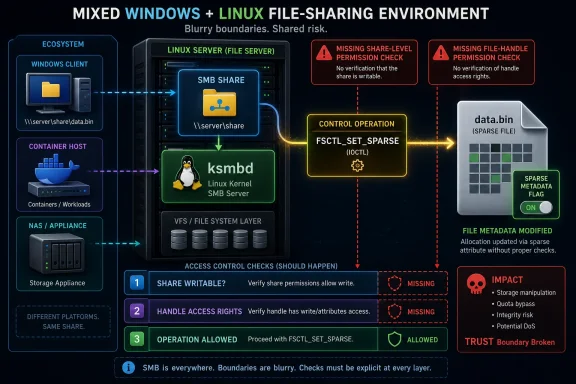 This Is an SMB Bug, Not a Windows Bug — and That Distinction Is Too Easy to Misread
The first trap in CVE-2026-52944 is branding. The advisory appears in Microsoft’s security orbit because SMB is inseparable from Windows administration, but the vulnerable component is ksmbd, the in-kernel SMB server in Linux. That means Windows clients may be involved in triggering the behavior, while Linux servers are where the vulnerable code runs.That distinction matters for patch ownership. A Windows desktop connecting to a vulnerable Linux SMB share is not the machine that needs the kernel fix. The Linux host, appliance, container host, or storage platform exposing ksmbd is the asset administrators need to identify.
It also matters for risk language. This is not EternalBlue reborn, and it is not a remote unauthenticated worm primitive. The reported issue requires an authenticated SMB client and concerns an authorization bypass around a file-system control operation. That makes it narrower, but not ignorable.
The more interesting story is that SMB security assumptions are now distributed across vendors, kernels, appliances, clients, and management planes. A Windows administrator may never intentionally deploy “ksmbd,” yet still depend on it indirectly through storage, lab infrastructure, embedded devices, or Linux-based file services that impersonate a very familiar Windows file-sharing experience.
A Sparse File Flag Became a Permission Boundary
FSCTL_SET_SPARSE sounds like a footnote from a file-system manual, and in most environments it is exactly the kind of operation that disappears beneath application behavior. Sparse files allow the file system to represent large files efficiently when parts of the file contain no meaningful data. Backup tools, virtual disk workflows, database systems, and synchronization products can all care about sparse allocation behavior.The problem described in CVE-2026-52944 is not that sparse files are dangerous. The problem is that setting the sparse attribute changes file metadata, and metadata changes are still writes in the security sense. If a share is read-only, or if a client opened a file without the relevant write rights, an SMB server should not quietly permit that state change.
According to the vulnerability description, ksmbd’s fsctl_set_sparse path modified the sparse attribute and persisted it through extended attributes without checking whether the share was writable. It also failed to verify that the client’s handle had FILE_WRITE_DATA or FILE_WRITE_ATTRIBUTES access. In other words, the code path treated a state-changing request as if it were administrative plumbing rather than an operation subject to the same authorization model as other writes.
That is the pattern administrators should recognize. Many real-world access-control bugs are not spectacular cryptographic failures or buffer overflows. They are boring-looking exceptions where one operation slips around the policy machinery everyone assumed was universal.
Read-Only Shares Are a Promise, Not a Vibe
A read-only share is one of the oldest and most trusted promises in file sharing. Administrators use it to publish software installers, reports, golden images, compliance exports, scripts, reference data, and recovery materials. Users understand the basic bargain: you can read what is there, but you cannot change it.CVE-2026-52944 attacks that bargain at the edge. The reported bypass does not say an attacker can rewrite arbitrary file contents through this path. It says an authenticated client could alter the sparse attribute despite read-only share settings or insufficient file-handle rights. That is a smaller violation than full file overwrite, but it is still a violation of the administrator’s intent.
Security engineering has learned, painfully, that “small” metadata writes can matter. Attributes affect how systems interpret, copy, store, back up, deduplicate, or scan files. Even where the immediate impact is limited, the presence of a bypass means defenders can no longer reason cleanly about the boundary.
This is why the fix adds both share-level and handle-level checks. A writable share and a writable handle are different layers of authorization. One says the tree connection permits write operations at all; the other says this particular open file handle carries the rights needed for the requested change. Skipping either one creates a gap.
The Kernel SMB Server Keeps Changing the Windows Admin Threat Model
For years, many administrators thought of SMB server behavior in three buckets: Windows Server, Samba in user space, and assorted appliances. ksmbd complicates that map. It is an SMB server implemented inside the Linux kernel, designed for performance and tight integration with Linux file-system internals.That architectural choice brings benefits, but it also shifts the cost of mistakes. A bug in an in-kernel file-sharing server is not just another daemon bug. The implementation sits close to the file system, the kernel’s permission structures, and the network attack surface exposed to clients.
This does not mean ksmbd is inherently unsafe. It means its security posture has to be evaluated with the seriousness normally reserved for kernel networking code. SMB is a large, stateful, compatibility-heavy protocol with decades of edge cases, and every server implementation has to reproduce enough Windows-compatible behavior to keep clients happy without reproducing unsafe assumptions.
That is where CVE-2026-52944 becomes more than a single patch. It shows how difficult it is to keep authorization consistent across a protocol full of special-purpose operations. A conventional file write is obvious. An FSCTL that toggles sparse behavior is less obvious. Attackers live in that difference.
Microsoft’s Advisory Is a Reminder That Ecosystems Own Protocol Risk Together
Microsoft’s presence in the disclosure trail is not an accident. SMB remains one of the company’s defining enterprise protocols, even when the server endpoint is not Windows. A vulnerability in a Linux SMB implementation can still affect Windows-heavy networks because Windows clients, Active Directory-adjacent workflows, mapped drives, and enterprise file-sharing habits are part of the exposure story.This is the modern shape of platform risk. Microsoft can document, coordinate, and warn, but the patch may come from the Linux kernel stable tree, a distribution vendor, or an appliance manufacturer. The security team reading the advisory must translate across ecosystems before it can act.
That translation often fails in inventory. A vulnerability scanner may say “Linux kernel.” An administrator may think “we do not run Linux file servers.” A storage admin may know about a NAS appliance but not know whether it uses Samba, ksmbd, a proprietary SMB stack, or some vendor-patched hybrid. Meanwhile, users simply see a mapped drive letter.
The result is a patch-management blind spot. Windows administrators are conditioned to wait for Patch Tuesday, KB numbers, and cumulative updates. Linux kernel CVEs arrive through distro advisories, kernel stable releases, container base images, and vendor firmware. CVE-2026-52944 sits exactly where those workflows overlap badly.
The Severity Is in the Assumption Break, Not the Drama
There is a temptation to rank this vulnerability by how cinematic the exploit sounds. It is authenticated. It appears to modify a file attribute, not execute code. Public reporting has not framed it as a mass exploitation event. By the standards of modern vulnerability theater, that can sound modest.But enterprise risk is not only about spectacle. File shares are trust distribution systems. They move scripts, configuration files, logs, backups, images, reports, application data, and operational knowledge. If a file service allows a client to perform a state-changing operation that the permission model should deny, defenders need to understand exactly what else depends on that guarantee.
The sparse attribute itself may not be the crown jewels. The broken authorization pattern is the concern. A permission check missing from one FSCTL path raises the question every security reviewer asks next: are there similar paths elsewhere, and have they been audited with the same rigor?
The kernel fix referenced in the public discussion is encouraging because it adds the missing share-level writable check and the per-handle access check. That is the right shape of repair. It restores the layered authorization model rather than merely blocking one narrow input pattern.
Windows Clients Are Part of the Test Case
From the client side, this bug is awkward because normal Windows behavior can become part of the reproduction path. SMB clients issue FSCTLs for legitimate reasons. They are not inherently malicious operations. The server’s job is to decide whether the client is allowed to perform the requested action on the target file under the current share and handle permissions.That means defenders should avoid framing this as “block weird clients.” A standard SMB client with credentials may be enough to exercise the vulnerable behavior if the server is unpatched and the file-sharing configuration exposes the relevant path. The access-control decision belongs on the server.
This is especially relevant in environments with service accounts. Backup systems, indexing services, content management tools, deployment agents, and user automation often have authenticated access to shares but intentionally limited rights. If a bug lets one of those identities cross a metadata-write boundary, the difference between “read-only” and “mostly read-only” becomes operationally meaningful.
The right question is not whether every authenticated user is hostile. It is whether the file server enforces the same rules for every write-like operation, including the ones most administrators never see in a GUI.
Appliance Administrators Have the Hardest Job
The cleanest remediation advice is to update the Linux kernel or install the vendor’s fixed package. That is easy to say for a general-purpose Linux server and much harder for appliances. NAS devices, hyperconverged platforms, backup targets, media systems, and edge boxes may expose SMB while hiding the implementation details behind a web console.Those environments are where ksmbd-related bugs can linger. The administrator may not control the kernel version directly. The vendor may backport fixes without changing obvious version strings. Release notes may mention “SMB security improvements” without naming the CVE. Vulnerability scanners may lack the credentialed visibility to distinguish exploitable exposure from a false positive.
This is not a reason to panic; it is a reason to demand better inventory. If a device serves SMB, administrators should know which SMB stack it uses, how it receives security updates, and whether the vendor has addressed CVE-2026-52944. The answer may be “not affected,” but that answer should come from evidence rather than assumption.
For WindowsForum readers, this is a familiar pattern. The most dangerous server in a Windows network is often the one that is not managed like Windows but is trusted by Windows clients every day.
The Patch Fixes Code, but Configuration Still Decides Exposure
Patching is the direct remedy, but configuration determines how much room the bug has to matter. ksmbd should not be exposed broadly unless there is a clear need. SMB should be segmented, monitored, and limited to authenticated clients with the narrowest workable permissions. Read-only shares should be reviewed not because this CVE invalidates them, but because it reminds us that read-only is an enforcement claim.Administrators should also review whether ksmbd is enabled at all. Some Linux systems include kernel support without actively serving SMB through ksmbd. Others may use Samba instead. The difference is crucial: a vulnerable component that is present but not exposed is a different risk from an active SMB service reachable by users or other systems.
Where ksmbd is active, the priority should be systems hosting read-only shares, shares used by lower-trust users, and shares that feed automated workflows. Those are the places where a permission bypass has the cleanest operational meaning. If a share’s purpose is to publish immutable content, even a metadata-only write path deserves attention.
Monitoring is trickier. Sparse attribute changes are not the kind of event most environments alert on. That makes prevention more important than detection. Once the patch is available through the relevant kernel, distro, or appliance channel, the safest course is to treat this as a conventional security update rather than a forensic hunting exercise.
The CVE Arrived After the Fix Was Already in Motion
The public timeline suggests the code fix was moving through the ksmbd server fix stream before the CVE record became widely visible in late June 2026. That is not unusual in kernel security work. Patches, stable backports, distribution advisories, and CVE publication do not always arrive in the neat order administrators wish they did.This matters because vulnerability management tools often key off CVE publication. If your patching process waits for a CVE to appear in a dashboard, you may miss the earlier moment when the fix is already available in a kernel update. Conversely, if your environment tracks upstream commits but not vendor backports, you may misread a patched distribution kernel as vulnerable because its version number looks old.
Linux kernel security is especially prone to this confusion. Enterprise distributions routinely backport fixes into older kernel branches while preserving major version numbers for stability. Appliances may do the same with even less transparency. The only reliable answer is vendor-specific: which package, build, firmware, or kernel includes the fix?
The broader lesson is that CVE identifiers are handles, not complete truth. They help teams coordinate, but they do not replace asset knowledge, vendor advisories, and change-control discipline.
The Fix Says Exactly What Went Wrong
The reported remediation is refreshingly direct: add the missing permission checks. FSCTL_SET_SPARSE now needs to respect whether the tree connection is writable and whether the file handle carries the necessary write-related access. The patch also reportedly uses a safer error path to avoid leaking file references.That tells us the bug was not a mysterious emergent property of SMB. It was a missing authorization guard in a specific function. The server already had comparable checks in other FSCTL write operations and related code paths. FSCTL_SET_SPARSE was the outlier.
Outliers are dangerous in security-sensitive code because they defeat mental models. Developers, administrators, and auditors all assume that once a permission system exists, operations are routed through it consistently. A single exception can turn an elegant model into a collection of hopes.
This is why mature security reviews focus on classes of operations rather than only known dangerous calls. If an operation changes persistent file state, it should be treated like a write. If it is reachable over the network, it should be checked against the authenticated identity, the share policy, and the specific handle rights. CVE-2026-52944 is a compact example of that rule.
SMB Compatibility Is a Security Tax
SMB is not a small protocol. It carries decades of client expectations, Windows compatibility behavior, file-system semantics, oplocks, leases, access masks, durable handles, named streams, extended attributes, and administrative conventions. Any non-Microsoft implementation has to decide how much of that universe to support and how to map it onto the host operating system.That mapping is where bugs breed. Windows access masks do not always align cleanly with Unix permissions. Share-level permissions and file-system permissions must both be honored. Metadata operations can look harmless until a client relies on them to change persistent state. Extended attributes can become the storage layer for information that the SMB client treats as first-class file metadata.
ksmbd’s performance-oriented kernel design does not exempt it from that complexity. If anything, it increases the need for careful review because mistakes happen close to privileged code. The goal is not to avoid SMB compatibility; the goal is to recognize that compatibility itself is a security tax.
For enterprises, the tax is paid in testing. Mixed Windows and Linux file-sharing environments need access-control tests that go beyond “can user read file” and “can user write file.” They need to validate metadata operations, alternate client behavior, and automation tools that use APIs rather than Explorer.
The WindowsForum Angle Is the Mixed Estate Nobody Fully Owns
A Windows-only shop is increasingly rare. Even organizations that standardize on Windows endpoints and Active Directory usually have Linux somewhere: storage appliances, Kubernetes nodes, developer workstations, CI systems, backup repositories, security tools, or cloud images. SMB is one of the bridges across that estate.That bridge can hide accountability. The Windows team owns the clients. The Linux team owns the kernel. The storage team owns the appliance. The security team owns the scanner. The application team owns the workload using the share. When an SMB authorization bug lands, everyone can plausibly say it belongs to someone else.
CVE-2026-52944 is small enough to be manageable and specific enough to be actionable, which makes it a useful governance test. Can your organization identify ksmbd exposure? Can it tell whether the affected code is present, enabled, patched, or vendor-mitigated? Can it distinguish Samba from ksmbd without guessing?
If the answer is no, the problem is larger than this CVE. It means SMB is functioning as shared infrastructure without shared ownership.
The Sparse-File Bug Leaves Administrators With a Concrete Checklist
The useful response to CVE-2026-52944 is not alarmism; it is disciplined scoping. The vulnerability is specific, authenticated, and patched in the relevant code path, but it touches a protocol and deployment pattern that Windows-heavy organizations often under-inventory.- Identify Linux systems, NAS devices, appliances, and embedded platforms that expose SMB shares, then determine whether they use ksmbd rather than Samba or another SMB implementation.
- Prioritize updates for ksmbd servers hosting read-only shares, low-trust user shares, software distribution points, backup repositories, or workflow-critical file stores.
- Verify remediation through the distribution or appliance vendor, because backported kernel fixes may not be obvious from the headline kernel version alone.
- Treat FSCTL_SET_SPARSE as a reminder to test metadata permissions, not merely ordinary file read and write permissions, in mixed SMB environments.
- Avoid exposing SMB services beyond the network segments and authenticated users that actually need them, because authenticated bypass bugs still depend on reachable services and usable credentials.
CVE-2026-52944 will not be remembered as the loudest vulnerability of 2026, and that is precisely why it is worth studying. It shows how a narrow missing check in a compatibility-heavy subsystem can undermine an administrator’s clearest promise — read means read, write means write, and metadata changes do not get a secret side door. The future of Windows administration is not Windows alone; it is the messy, protocol-bound estate around it, and the teams that learn to audit those seams will be the ones least surprised by the next quiet permission bypass.
References
- Primary source: MSRC
Published: 2026-07-03T01:02:51-07:00
Security Update Guide - Microsoft Security Response Center
 msrc.microsoft.com
- Related coverage: sentinelone.com
- Official source: microsoft.com
MSRC - Microsoft Security Response Center
The Microsoft Security Response Center is part of the defender community and on the front line of security response evolution. For over twenty years, we have been engaged with security researchers working to protect customers and the broader ecosystem.www.microsoft.com
- Related coverage: sra.io
- Related coverage: first.org
The National Vulnerability Database Ms. Tanya Brewer NVD Program Manager June 2024
PDF documentwww.first.org