

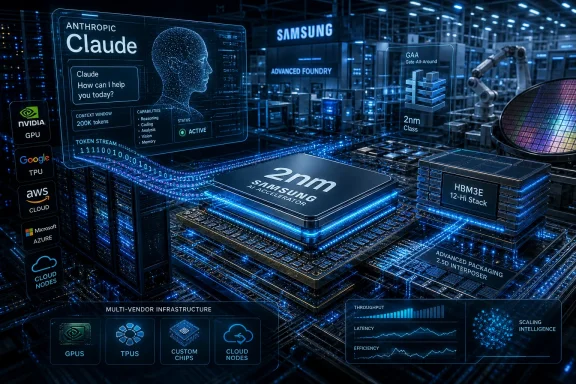
Anthropic is exploring a custom AI accelerator with Samsung Electronics, reportedly targeting Samsung’s 2-nanometer foundry process after a July 2 report said the Claude maker had entered early planning talks over chip functions, performance goals, packaging, and future server deployment. The news is less about one more AI company wanting a shiny in-house chip than about the industry’s widening belief that software leadership is no longer separable from infrastructure control. Claude may be sold as a model and a service, but the economics behind it increasingly look like a semiconductor procurement problem. If the deal advances, Anthropic would be trying to buy itself something more valuable than silicon: leverage.
For the first two years of the generative AI boom, the contest was narrated as a battle of model quality. OpenAI had GPT, Anthropic had Claude, Google had Gemini, Meta had Llama, and every benchmark became a proxy for corporate destiny. That framing was never wrong, exactly, but it was incomplete. The models were the visible surface of a much deeper fight over power, data-center space, memory bandwidth, chip supply, and the ability to turn inference into a gross-margin business rather than a bonfire.
Anthropic’s reported Samsung talks make that deeper fight explicit. A custom chip would not automatically make Claude smarter, safer, or more popular. It would, however, give Anthropic a chance to shape the cost curve of running Claude at scale, particularly if the company can design silicon around the inference workloads it expects to serve for enterprises, developers, and consumer products.
That distinction matters. Training frontier models is spectacularly expensive, but inference is where a successful AI company bleeds every day. Every prompt, every agentic workflow, every coding session, every document upload, and every API call turns into a recurring compute bill. When model usage grows faster than revenue per token, the chip under the service becomes a strategic issue rather than an engineering detail.
Nvidia remains the gravity well of the AI hardware market. Its GPUs, networking, software stack, and developer ecosystem made it the default platform for model training and high-end inference. But the very success of that platform has created the incentive for its biggest customers to look elsewhere. The more indispensable Nvidia becomes, the more rational it is for AI labs and hyperscalers to invest in alternatives, even if those alternatives take years to mature.
Anthropic’s move should be read in that light. The company is not abandoning GPUs, TPUs, or cloud-provider chips. It is trying to avoid becoming a price-taker forever.
The largest AI companies face a paradox. They can raise staggering amounts of money because investors believe demand for AI services will explode. But that demand requires infrastructure so expensive that it can consume the very capital raised to capture it. A custom accelerator is one answer to that paradox: spend more now to reduce marginal costs later.
This is why the chip race has become so contagious. Google built TPUs because it understood, earlier than most, that machine-learning workloads would eventually justify purpose-built silicon. Amazon developed Trainium and Inferentia to make AWS less dependent on outside accelerators and more attractive to AI customers. Microsoft has Maia. Meta has its own inference silicon. OpenAI has been working with Broadcom on an accelerator intended to fit its own model-serving needs. Anthropic was never likely to remain merely a buyer in a market where its closest rivals were becoming designers.
The strategic gain is not only lower cost. Owning part of the chip roadmap lets an AI company align model architecture, compiler work, memory hierarchy, networking, and deployment patterns. That does not mean every AI lab must become Apple overnight. It does mean the old separation between “the model people” and “the infrastructure people” is collapsing.
For enterprise customers, this will sound familiar. The cloud started as a way to avoid owning infrastructure. At sufficient scale, however, the largest cloud users began optimizing contracts, regions, reserved capacity, and specialized hardware as if they were running private industrial systems. AI is compressing that lifecycle. The most ambitious labs are discovering that the cloud is not an abstraction from hardware; it is a marketplace for scarce hardware.
Anthropic’s reported Samsung project is therefore less a departure than an escalation. The company already uses a multi-vendor compute strategy, including AWS Trainium, Google TPUs, and Nvidia GPUs. A proprietary chip would add another lane, not replace the highway.
Samsung’s reported pursuit of Anthropic is therefore unsurprising. A marquee AI customer would give Samsung a story it badly wants to tell: that its most advanced process nodes and packaging technologies are not merely competitive in theory, but attractive to the companies driving the next wave of compute demand. Winning an Anthropic order would not erase TSMC’s lead. It would give Samsung a reference point in a market where reference points compound.
The 2-nanometer angle is especially important. At advanced nodes, the marketing number does not translate neatly into a single physical transistor dimension, but it does signal a generational manufacturing push toward better density, lower power, and improved performance. For AI inference, power efficiency is not a footnote. It is one of the central constraints of the business.
Data centers do not scale on ambition alone. They scale on electricity, cooling, land, permitting, interconnects, and the ability to make each watt produce more useful work. If a custom accelerator can deliver better throughput per watt for a known model family, the financial effect can be substantial. If it cannot, it becomes an expensive monument to strategic anxiety.
Samsung also brings advanced packaging to the table, and that may be as important as the process node. Modern AI chips are not isolated slabs of logic. They are systems built around memory bandwidth, chip-to-chip communication, interposers, and packages designed to keep compute engines fed. High-bandwidth memory is not merely attached to the AI boom; it is one of the conditions that makes the boom possible.
That is where Samsung’s unusual position becomes interesting. Among Samsung, SK Hynix, and Micron, Samsung is the one with both memory scale and a major logic foundry business. SK Hynix and Micron are central to the memory supply chain, but they do not offer the same foundry path for a custom logic chip. Anthropic’s earlier public references to partnerships across memory, storage, and logic chips therefore made Samsung the obvious candidate for any foundry speculation.
This is why Anthropic’s relationships with Samsung, SK Hynix, and Micron deserve more attention than a normal supplier announcement. HBM supply is one of the most contested resources in the AI data-center buildout. The companies that can secure memory capacity, qualify future HBM generations, and coordinate packaging with logic manufacturing gain a practical advantage over those merely waiting in line.
A custom accelerator without memory access is not a strategy. It is a drawing. The value of a Samsung-Anthropic collaboration would depend not just on whether Samsung can print dense logic at 2nm, but whether the resulting package can deliver the bandwidth, thermals, and production reliability needed for real-world Claude workloads.
That is also why the involvement of Micron, SK Hynix, and Samsung in Anthropic’s broader infrastructure orbit is so revealing. AI labs are increasingly behaving like sovereign buyers of compute supply chains. They are not simply renting instances from cloud dashboards. They are cultivating relationships with the firms that control the materials, memory, storage, and manufacturing capacity underlying those instances.
For WindowsForum readers, this may feel distant from the desktop. It is not. The same supply constraints that make frontier AI infrastructure expensive also ripple into PC component pricing, server procurement, workstation availability, and cloud-service costs. When HBM and advanced packaging absorb capital and wafer capacity, the rest of the semiconductor market feels the tug.
The AI boom has already changed how memory vendors talk about demand. It has made high-end memory less cyclical in appearance, even if the semiconductor industry remains cyclical underneath. The danger is that everyone in the chain begins planning as if AI demand can only go up. That may be true for a while, but it is not a law of physics.
Optionality is what lets a company shift workloads between Nvidia GPUs, Google TPUs, AWS Trainium, and eventually its own silicon depending on price, availability, performance, and contractual obligations. It is also what gives a buyer leverage in negotiations. A supplier treats you differently when you have credible alternatives.
Anthropic’s existing multi-vendor posture already reflects that logic. Its relationship with Amazon gives it access to AWS infrastructure and Trainium chips. Its Google relationship gives it TPU access. Nvidia remains vital because the ecosystem around CUDA, networking, libraries, and GPU availability is still extremely hard to replace. A proprietary accelerator would add a new bargaining chip, but not a magic wand.
The practical question is workload placement. A Claude-specific chip would likely be most useful for stable, high-volume inference paths where Anthropic can predict model behavior, optimize kernels, and amortize development costs over enormous usage. It may be less compelling for experimental research workloads, rapidly changing training architectures, or tasks where software ecosystem flexibility matters more than efficiency.
This is the pattern seen across the industry. Custom silicon tends to win where workloads are predictable and scale is massive. General-purpose accelerators win where flexibility, tool maturity, and developer familiarity dominate. The frontier AI labs want both, which is why they keep buying Nvidia while funding alternatives.
The risk for Anthropic is timing. Chip projects have long lead times, and AI model architectures can change faster than silicon schedules. A chip optimized for one inference profile can look less attractive if the company’s model strategy shifts, if context windows expand in unexpected ways, if agentic workloads stress different parts of the system, or if competing accelerators improve faster than expected.
That is why “early-stage” is doing a lot of work in this story. Defining functions, performance targets, and server deployment plans is not the same as taping out a chip, qualifying it, building racks around it, and running production traffic at scale. The distance between ambition and installed capacity is measured in years, not press cycles.
OpenAI’s reported collaboration with Broadcom has become the template for how a model company can approach custom inference hardware without building an entire semiconductor company from scratch. The model lab brings workload knowledge, scale, and a brutal economic incentive. The chip partner brings design experience, IP blocks, manufacturing relationships, and the discipline required to turn a workload wish list into a manufacturable product.
But the comparison also highlights the uncertainty. OpenAI’s scale, Microsoft relationship, product mix, and traffic profile are not identical to Anthropic’s. A chip that makes sense for one lab’s inference economics may not make sense for another’s. Even if both companies are building large language model accelerators, their deployment priorities may diverge.
There is also a branding trap. Once a company announces or leaks a custom AI chip, the chip becomes part of its strategic mythology. Investors, customers, and employees start treating it as evidence that the company is vertically integrated, future-proof, and serious. But until the chip is in production and carrying meaningful workloads, it is an option, not an outcome.
This is where the Apple analogy, beloved by executives and analysts, starts to break down. Apple’s silicon transition succeeded because the company controlled the operating system, developer platform, product schedule, thermal envelope, and customer experience. AI labs control their models, but they operate inside a messier ecosystem of cloud partners, data-center constraints, enterprise contracts, and rapidly shifting research. Their vertical integration is real, but partial.
Still, partial integration can be enough. If Anthropic can move a meaningful share of Claude inference onto hardware designed for its needs, it can change the economics of serving customers. If it cannot, the project may still improve its negotiating position with other chip suppliers. In strategic terms, even a credible threat can have value.
Samsung’s advanced packaging ambitions therefore sit near the center of the Anthropic story. Large language model inference is hungry for memory bandwidth and low-latency data movement. The chip has to move tokens through layers of computation without wasting too much power shuttling data around. That is why HBM proximity, interposer design, and package-level integration have become strategic issues.
A custom Anthropic chip could, in theory, be designed around the company’s serving patterns. It might prioritize throughput for batch inference, responsiveness for interactive sessions, or efficiency for long-context workloads. It might target internal deployment in specific server designs rather than broad resale. These choices would shape not only the silicon but the infrastructure around it.
The challenge is that each optimization is also a constraint. A chip designed tightly around Claude’s current inference profile might be extremely efficient for one generation and less ideal for the next. A more flexible design may sacrifice some of the cost advantage that justified custom silicon in the first place. Hardware strategy is a series of trade-offs pretending to be a roadmap.
Samsung’s foundry story has similar tension. Landing Anthropic would help validate its advanced process and packaging push, but only if execution follows. Advanced-node customers are not buying marketing slides. They are buying yields, delivery schedules, predictable costs, and confidence that unexpected problems will be solved quickly. In the foundry business, a single high-profile win can elevate perception, but a troubled ramp can damage it just as quickly.
This is why the reported lack of finalized design, testing, and mass-production schedules is not a minor caveat. It is the story’s center of gravity. The talks show intent. The implementation will decide whether the intent matters.
Nvidia’s advantage is not merely that it sells fast chips. It sells a platform. CUDA, libraries, networking, systems, reference designs, developer familiarity, and a vast ecosystem of optimized software make Nvidia the safe choice for companies moving quickly. A custom ASIC may beat a GPU on a specific workload, but it must fight the inertia of an entire stack.
That inertia matters to developers and sysadmins. Enterprise AI deployments already suffer from fragmentation across model providers, APIs, hardware backends, and compliance requirements. If every major AI company begins optimizing for its own accelerator, the cloud layer may abstract some of the differences, but the operational reality will still become more complex. Performance, availability, latency, and pricing could vary depending on which hardware a provider routes traffic to.
For end users, the effect may be invisible until it is not. A faster or cheaper Claude service will not advertise its foundry partner in the chat window. But infrastructure economics shape product limits: context size, rate limits, feature availability, API pricing, regional deployment, and the willingness to offer compute-heavy capabilities to mainstream customers. Hardware choices eventually become product choices.
Nvidia’s strategic challenge is therefore not immediate abandonment. It is margin pressure at the edges. If hyperscalers and AI labs can peel off predictable inference workloads onto custom silicon, Nvidia may retain the high-end training and flexible acceleration markets while facing more competition in the parts of AI serving that become standardized. That is still an enviable position, but it is not the same as owning the entire stack uncontested.
The more interesting question is whether the custom silicon wave fragments AI infrastructure or professionalizes it. If each lab builds bespoke hardware that only works well internally, the industry gains efficiency but loses portability. If common patterns emerge around memory, packaging, compilers, and deployment, the whole market could become more disciplined. The answer will probably be both.
Claude is already part of the developer workflow for many engineers, including Windows developers working inside terminals, IDEs, documentation systems, and enterprise knowledge bases. If Anthropic lowers inference costs, it could offer more generous usage, faster responses, larger context windows, or more competitive API pricing. If custom silicon slips or underperforms, the company remains exposed to the same expensive compute market as everyone else.
For administrators, the relevant issue is vendor resilience. Enterprise AI procurement is no longer just about model quality and data handling. It is about whether a provider has enough infrastructure to honor service commitments during demand spikes, whether capacity is regionally available, and whether pricing will remain stable as workloads grow. A model provider with diversified hardware access may be a safer bet than one dependent on a single constrained supply chain.
There is also a security and compliance angle. Hardware diversity can reduce some concentration risks, but it introduces others. New accelerators require mature firmware, driver stacks, isolation guarantees, monitoring, and supply-chain assurance. Enterprises will not see most of that complexity directly, but they will inherit its consequences through cloud service reliability and certification.
The PC market sits downstream from these forces. As AI data centers absorb advanced chips, memory, power infrastructure, and capital expenditure, consumer hardware competes for attention in a supply chain increasingly optimized around server margins. That does not mean AI chips directly steal every part from PCs. It means the industry’s best engineering and manufacturing incentives are now tilted toward the data center.
Windows has lived through this kind of gravity shift before. The smartphone era pulled software design, chip innovation, and developer attention away from the desktop. The cloud era moved enterprise computing away from local servers. The AI infrastructure era may not kill the PC, but it will shape what local hardware is expected to do and what remains economically sensible to offload.
Semiconductor history is littered with moments when the entire industry extrapolated from a shortage into overcapacity. AI may be different because demand is broad, software-driven, and still early. But “this time is different” is not a supply-chain plan. It is a warning label.
Anthropic’s advantage is that its move appears measured rather than messianic. The company is reportedly in early planning, not promising imminent mass production. It continues to rely on AWS, Google, and Nvidia. It is building relationships across memory and infrastructure suppliers rather than betting everything on one internal program. That is the posture of a company seeking leverage, not a company declaring independence.
Samsung’s risk is more acute. It needs advanced foundry wins to narrow the perception and customer gap with TSMC. AI accelerators offer the most glamorous possible validation, but they also demand flawless execution across process, packaging, and volume. A high-profile customer can become a high-profile stress test.
For the broader market, the concern is concentration under a different name. If AI labs diversify away from Nvidia but toward a small circle of advanced foundries, HBM suppliers, and cloud campuses, the bottleneck has not disappeared. It has moved. The AI economy may end up less dependent on one GPU vendor while remaining deeply dependent on a handful of companies capable of building the substrate of modern intelligence services.
That is the uncomfortable truth behind the Anthropic-Samsung story. The future of AI may look like software to users, but it is increasingly governed by the industrial logic of semiconductors.
The concrete points are already visible, even if the silicon is not.
 The AI Model Race Has Moved Down the Stack
For the first two years of the generative AI boom, the contest was narrated as a battle of model quality. OpenAI had GPT, Anthropic had Claude, Google had Gemini, Meta had Llama, and every benchmark became a proxy for corporate destiny. That framing was never wrong, exactly, but it was incomplete. The models were the visible surface of a much deeper fight over power, data-center space, memory bandwidth, chip supply, and the ability to turn inference into a gross-margin business rather than a bonfire.Anthropic’s reported Samsung talks make that deeper fight explicit. A custom chip would not automatically make Claude smarter, safer, or more popular. It would, however, give Anthropic a chance to shape the cost curve of running Claude at scale, particularly if the company can design silicon around the inference workloads it expects to serve for enterprises, developers, and consumer products.
That distinction matters. Training frontier models is spectacularly expensive, but inference is where a successful AI company bleeds every day. Every prompt, every agentic workflow, every coding session, every document upload, and every API call turns into a recurring compute bill. When model usage grows faster than revenue per token, the chip under the service becomes a strategic issue rather than an engineering detail.
Nvidia remains the gravity well of the AI hardware market. Its GPUs, networking, software stack, and developer ecosystem made it the default platform for model training and high-end inference. But the very success of that platform has created the incentive for its biggest customers to look elsewhere. The more indispensable Nvidia becomes, the more rational it is for AI labs and hyperscalers to invest in alternatives, even if those alternatives take years to mature.
Anthropic’s move should be read in that light. The company is not abandoning GPUs, TPUs, or cloud-provider chips. It is trying to avoid becoming a price-taker forever.
Custom Silicon Is the New Enterprise Discount
The immediate temptation is to treat a Claude chip as a technical story: 2nm transistors, advanced packaging, high-bandwidth memory, performance-per-watt, and racks tuned for large language model inference. Those details are real, and they will determine whether any eventual accelerator is useful. But the business logic is simpler. Anthropic needs more compute than the open market can cheaply and reliably provide.The largest AI companies face a paradox. They can raise staggering amounts of money because investors believe demand for AI services will explode. But that demand requires infrastructure so expensive that it can consume the very capital raised to capture it. A custom accelerator is one answer to that paradox: spend more now to reduce marginal costs later.
This is why the chip race has become so contagious. Google built TPUs because it understood, earlier than most, that machine-learning workloads would eventually justify purpose-built silicon. Amazon developed Trainium and Inferentia to make AWS less dependent on outside accelerators and more attractive to AI customers. Microsoft has Maia. Meta has its own inference silicon. OpenAI has been working with Broadcom on an accelerator intended to fit its own model-serving needs. Anthropic was never likely to remain merely a buyer in a market where its closest rivals were becoming designers.
The strategic gain is not only lower cost. Owning part of the chip roadmap lets an AI company align model architecture, compiler work, memory hierarchy, networking, and deployment patterns. That does not mean every AI lab must become Apple overnight. It does mean the old separation between “the model people” and “the infrastructure people” is collapsing.
For enterprise customers, this will sound familiar. The cloud started as a way to avoid owning infrastructure. At sufficient scale, however, the largest cloud users began optimizing contracts, regions, reserved capacity, and specialized hardware as if they were running private industrial systems. AI is compressing that lifecycle. The most ambitious labs are discovering that the cloud is not an abstraction from hardware; it is a marketplace for scarce hardware.
Anthropic’s reported Samsung project is therefore less a departure than an escalation. The company already uses a multi-vendor compute strategy, including AWS Trainium, Google TPUs, and Nvidia GPUs. A proprietary chip would add another lane, not replace the highway.
Samsung Needs a Flagship Customer as Much as Anthropic Needs a Chip
If Anthropic wants leverage, Samsung wants proof. Its foundry business has long lived in the shadow of TSMC, which has become the default manufacturing partner for many of the world’s most advanced chip designers. In AI accelerators, that matters enormously. Process technology is not just a spec sheet; it is a trust relationship built around yields, packaging, capacity, design tools, and the confidence that a chip can move from promise to volume.Samsung’s reported pursuit of Anthropic is therefore unsurprising. A marquee AI customer would give Samsung a story it badly wants to tell: that its most advanced process nodes and packaging technologies are not merely competitive in theory, but attractive to the companies driving the next wave of compute demand. Winning an Anthropic order would not erase TSMC’s lead. It would give Samsung a reference point in a market where reference points compound.
The 2-nanometer angle is especially important. At advanced nodes, the marketing number does not translate neatly into a single physical transistor dimension, but it does signal a generational manufacturing push toward better density, lower power, and improved performance. For AI inference, power efficiency is not a footnote. It is one of the central constraints of the business.
Data centers do not scale on ambition alone. They scale on electricity, cooling, land, permitting, interconnects, and the ability to make each watt produce more useful work. If a custom accelerator can deliver better throughput per watt for a known model family, the financial effect can be substantial. If it cannot, it becomes an expensive monument to strategic anxiety.
Samsung also brings advanced packaging to the table, and that may be as important as the process node. Modern AI chips are not isolated slabs of logic. They are systems built around memory bandwidth, chip-to-chip communication, interposers, and packages designed to keep compute engines fed. High-bandwidth memory is not merely attached to the AI boom; it is one of the conditions that makes the boom possible.
That is where Samsung’s unusual position becomes interesting. Among Samsung, SK Hynix, and Micron, Samsung is the one with both memory scale and a major logic foundry business. SK Hynix and Micron are central to the memory supply chain, but they do not offer the same foundry path for a custom logic chip. Anthropic’s earlier public references to partnerships across memory, storage, and logic chips therefore made Samsung the obvious candidate for any foundry speculation.
The Memory Bottleneck Is No Longer Behind the Processor
The AI chip conversation often begins with GPUs and ends with Nvidia. That shorthand misses the increasingly uncomfortable truth that memory is becoming the hinge of AI infrastructure. Large models require enormous amounts of data to move rapidly between memory and compute. If the processor waits on memory, theoretical compute throughput becomes a brochure number.This is why Anthropic’s relationships with Samsung, SK Hynix, and Micron deserve more attention than a normal supplier announcement. HBM supply is one of the most contested resources in the AI data-center buildout. The companies that can secure memory capacity, qualify future HBM generations, and coordinate packaging with logic manufacturing gain a practical advantage over those merely waiting in line.
A custom accelerator without memory access is not a strategy. It is a drawing. The value of a Samsung-Anthropic collaboration would depend not just on whether Samsung can print dense logic at 2nm, but whether the resulting package can deliver the bandwidth, thermals, and production reliability needed for real-world Claude workloads.
That is also why the involvement of Micron, SK Hynix, and Samsung in Anthropic’s broader infrastructure orbit is so revealing. AI labs are increasingly behaving like sovereign buyers of compute supply chains. They are not simply renting instances from cloud dashboards. They are cultivating relationships with the firms that control the materials, memory, storage, and manufacturing capacity underlying those instances.
For WindowsForum readers, this may feel distant from the desktop. It is not. The same supply constraints that make frontier AI infrastructure expensive also ripple into PC component pricing, server procurement, workstation availability, and cloud-service costs. When HBM and advanced packaging absorb capital and wafer capacity, the rest of the semiconductor market feels the tug.
The AI boom has already changed how memory vendors talk about demand. It has made high-end memory less cyclical in appearance, even if the semiconductor industry remains cyclical underneath. The danger is that everyone in the chain begins planning as if AI demand can only go up. That may be true for a while, but it is not a law of physics.
Anthropic Is Buying Optionality, Not Independence
The cleanest but wrongest version of this story is that Anthropic wants to escape Nvidia. No serious AI lab escapes Nvidia in one move, and Anthropic has not suggested it plans to do so. The more plausible goal is optionality.Optionality is what lets a company shift workloads between Nvidia GPUs, Google TPUs, AWS Trainium, and eventually its own silicon depending on price, availability, performance, and contractual obligations. It is also what gives a buyer leverage in negotiations. A supplier treats you differently when you have credible alternatives.
Anthropic’s existing multi-vendor posture already reflects that logic. Its relationship with Amazon gives it access to AWS infrastructure and Trainium chips. Its Google relationship gives it TPU access. Nvidia remains vital because the ecosystem around CUDA, networking, libraries, and GPU availability is still extremely hard to replace. A proprietary accelerator would add a new bargaining chip, but not a magic wand.
The practical question is workload placement. A Claude-specific chip would likely be most useful for stable, high-volume inference paths where Anthropic can predict model behavior, optimize kernels, and amortize development costs over enormous usage. It may be less compelling for experimental research workloads, rapidly changing training architectures, or tasks where software ecosystem flexibility matters more than efficiency.
This is the pattern seen across the industry. Custom silicon tends to win where workloads are predictable and scale is massive. General-purpose accelerators win where flexibility, tool maturity, and developer familiarity dominate. The frontier AI labs want both, which is why they keep buying Nvidia while funding alternatives.
The risk for Anthropic is timing. Chip projects have long lead times, and AI model architectures can change faster than silicon schedules. A chip optimized for one inference profile can look less attractive if the company’s model strategy shifts, if context windows expand in unexpected ways, if agentic workloads stress different parts of the system, or if competing accelerators improve faster than expected.
That is why “early-stage” is doing a lot of work in this story. Defining functions, performance targets, and server deployment plans is not the same as taping out a chip, qualifying it, building racks around it, and running production traffic at scale. The distance between ambition and installed capacity is measured in years, not press cycles.
The OpenAI Comparison Cuts Both Ways
Anthropic’s hiring of Clive Chan from OpenAI’s chip effort gives the story an obvious human hook. Talent follows strategic importance, and AI labs now need people who understand silicon programs, supplier negotiations, and the painful coordination between model teams and hardware teams. That Anthropic is hiring from a rival’s custom chip project says the company knows this is not a side quest.OpenAI’s reported collaboration with Broadcom has become the template for how a model company can approach custom inference hardware without building an entire semiconductor company from scratch. The model lab brings workload knowledge, scale, and a brutal economic incentive. The chip partner brings design experience, IP blocks, manufacturing relationships, and the discipline required to turn a workload wish list into a manufacturable product.
But the comparison also highlights the uncertainty. OpenAI’s scale, Microsoft relationship, product mix, and traffic profile are not identical to Anthropic’s. A chip that makes sense for one lab’s inference economics may not make sense for another’s. Even if both companies are building large language model accelerators, their deployment priorities may diverge.
There is also a branding trap. Once a company announces or leaks a custom AI chip, the chip becomes part of its strategic mythology. Investors, customers, and employees start treating it as evidence that the company is vertically integrated, future-proof, and serious. But until the chip is in production and carrying meaningful workloads, it is an option, not an outcome.
This is where the Apple analogy, beloved by executives and analysts, starts to break down. Apple’s silicon transition succeeded because the company controlled the operating system, developer platform, product schedule, thermal envelope, and customer experience. AI labs control their models, but they operate inside a messier ecosystem of cloud partners, data-center constraints, enterprise contracts, and rapidly shifting research. Their vertical integration is real, but partial.
Still, partial integration can be enough. If Anthropic can move a meaningful share of Claude inference onto hardware designed for its needs, it can change the economics of serving customers. If it cannot, the project may still improve its negotiating position with other chip suppliers. In strategic terms, even a credible threat can have value.
The 2-Nanometer Bet Is Really a Packaging Bet
Process nodes attract headlines because they offer a simple hierarchy: smaller sounds better. But AI accelerators are increasingly won or lost at the system level. A 2nm logic die is only part of the story; the surrounding package, memory stack, interconnect fabric, software compiler, and data-center integration determine how much performance users actually get.Samsung’s advanced packaging ambitions therefore sit near the center of the Anthropic story. Large language model inference is hungry for memory bandwidth and low-latency data movement. The chip has to move tokens through layers of computation without wasting too much power shuttling data around. That is why HBM proximity, interposer design, and package-level integration have become strategic issues.
A custom Anthropic chip could, in theory, be designed around the company’s serving patterns. It might prioritize throughput for batch inference, responsiveness for interactive sessions, or efficiency for long-context workloads. It might target internal deployment in specific server designs rather than broad resale. These choices would shape not only the silicon but the infrastructure around it.
The challenge is that each optimization is also a constraint. A chip designed tightly around Claude’s current inference profile might be extremely efficient for one generation and less ideal for the next. A more flexible design may sacrifice some of the cost advantage that justified custom silicon in the first place. Hardware strategy is a series of trade-offs pretending to be a roadmap.
Samsung’s foundry story has similar tension. Landing Anthropic would help validate its advanced process and packaging push, but only if execution follows. Advanced-node customers are not buying marketing slides. They are buying yields, delivery schedules, predictable costs, and confidence that unexpected problems will be solved quickly. In the foundry business, a single high-profile win can elevate perception, but a troubled ramp can damage it just as quickly.
This is why the reported lack of finalized design, testing, and mass-production schedules is not a minor caveat. It is the story’s center of gravity. The talks show intent. The implementation will decide whether the intent matters.
Nvidia’s Position Is Strong Enough to Create Its Own Opposition
Every custom AI chip announcement is framed as a threat to Nvidia, but the better interpretation is that Nvidia’s dominance has created a market for hedging against Nvidia. That is not the same as displacement. It is a sign of strength, not weakness, when your largest customers spend billions trying to reduce dependence on you and still keep buying your products.Nvidia’s advantage is not merely that it sells fast chips. It sells a platform. CUDA, libraries, networking, systems, reference designs, developer familiarity, and a vast ecosystem of optimized software make Nvidia the safe choice for companies moving quickly. A custom ASIC may beat a GPU on a specific workload, but it must fight the inertia of an entire stack.
That inertia matters to developers and sysadmins. Enterprise AI deployments already suffer from fragmentation across model providers, APIs, hardware backends, and compliance requirements. If every major AI company begins optimizing for its own accelerator, the cloud layer may abstract some of the differences, but the operational reality will still become more complex. Performance, availability, latency, and pricing could vary depending on which hardware a provider routes traffic to.
For end users, the effect may be invisible until it is not. A faster or cheaper Claude service will not advertise its foundry partner in the chat window. But infrastructure economics shape product limits: context size, rate limits, feature availability, API pricing, regional deployment, and the willingness to offer compute-heavy capabilities to mainstream customers. Hardware choices eventually become product choices.
Nvidia’s strategic challenge is therefore not immediate abandonment. It is margin pressure at the edges. If hyperscalers and AI labs can peel off predictable inference workloads onto custom silicon, Nvidia may retain the high-end training and flexible acceleration markets while facing more competition in the parts of AI serving that become standardized. That is still an enviable position, but it is not the same as owning the entire stack uncontested.
The more interesting question is whether the custom silicon wave fragments AI infrastructure or professionalizes it. If each lab builds bespoke hardware that only works well internally, the industry gains efficiency but loses portability. If common patterns emerge around memory, packaging, compilers, and deployment, the whole market could become more disciplined. The answer will probably be both.
Windows Users Will Feel This Through the Cloud Before the PC
A Samsung-made Anthropic accelerator will not show up in a Windows laptop next spring. It will not replace the NPU in a Copilot+ PC, and it will not make local gaming GPUs cheaper by itself. The first impact will be in the cloud services that Windows users and IT departments increasingly depend on.Claude is already part of the developer workflow for many engineers, including Windows developers working inside terminals, IDEs, documentation systems, and enterprise knowledge bases. If Anthropic lowers inference costs, it could offer more generous usage, faster responses, larger context windows, or more competitive API pricing. If custom silicon slips or underperforms, the company remains exposed to the same expensive compute market as everyone else.
For administrators, the relevant issue is vendor resilience. Enterprise AI procurement is no longer just about model quality and data handling. It is about whether a provider has enough infrastructure to honor service commitments during demand spikes, whether capacity is regionally available, and whether pricing will remain stable as workloads grow. A model provider with diversified hardware access may be a safer bet than one dependent on a single constrained supply chain.
There is also a security and compliance angle. Hardware diversity can reduce some concentration risks, but it introduces others. New accelerators require mature firmware, driver stacks, isolation guarantees, monitoring, and supply-chain assurance. Enterprises will not see most of that complexity directly, but they will inherit its consequences through cloud service reliability and certification.
The PC market sits downstream from these forces. As AI data centers absorb advanced chips, memory, power infrastructure, and capital expenditure, consumer hardware competes for attention in a supply chain increasingly optimized around server margins. That does not mean AI chips directly steal every part from PCs. It means the industry’s best engineering and manufacturing incentives are now tilted toward the data center.
Windows has lived through this kind of gravity shift before. The smartphone era pulled software design, chip innovation, and developer attention away from the desktop. The cloud era moved enterprise computing away from local servers. The AI infrastructure era may not kill the PC, but it will shape what local hardware is expected to do and what remains economically sensible to offload.
The Real Risk Is That Everyone Builds for the Same Future
The custom AI chip rush has a strange uniformity. Every major lab and hyperscaler seems to be preparing for a world of ever-growing inference demand, ever-larger model usage, and persistent scarcity in premium accelerators and HBM. That may be the correct forecast. It is also the forecast most likely to justify today’s largest capital commitments.Semiconductor history is littered with moments when the entire industry extrapolated from a shortage into overcapacity. AI may be different because demand is broad, software-driven, and still early. But “this time is different” is not a supply-chain plan. It is a warning label.
Anthropic’s advantage is that its move appears measured rather than messianic. The company is reportedly in early planning, not promising imminent mass production. It continues to rely on AWS, Google, and Nvidia. It is building relationships across memory and infrastructure suppliers rather than betting everything on one internal program. That is the posture of a company seeking leverage, not a company declaring independence.
Samsung’s risk is more acute. It needs advanced foundry wins to narrow the perception and customer gap with TSMC. AI accelerators offer the most glamorous possible validation, but they also demand flawless execution across process, packaging, and volume. A high-profile customer can become a high-profile stress test.
For the broader market, the concern is concentration under a different name. If AI labs diversify away from Nvidia but toward a small circle of advanced foundries, HBM suppliers, and cloud campuses, the bottleneck has not disappeared. It has moved. The AI economy may end up less dependent on one GPU vendor while remaining deeply dependent on a handful of companies capable of building the substrate of modern intelligence services.
That is the uncomfortable truth behind the Anthropic-Samsung story. The future of AI may look like software to users, but it is increasingly governed by the industrial logic of semiconductors.
The Claude Chip Story Is Still Mostly a Map of the Supply Chain
The safest reading of the reported Samsung talks is neither hype nor dismissal. Anthropic is doing what any model company of its scale must do: finding ways to control cost, capacity, and leverage before inference demand turns success into a margin problem. Samsung is doing what any ambitious foundry challenger must do: chasing a customer whose workload could validate its most advanced manufacturing and packaging story.The concrete points are already visible, even if the silicon is not.
- Anthropic’s reported custom chip effort is in early planning, with no public mass-production schedule or finalized design path.
- Samsung is the logical foundry candidate among Anthropic’s memory and infrastructure partners because it has both advanced logic manufacturing and packaging ambitions.
- A 2nm process would matter less as a marketing number than as part of a larger system built around power efficiency, HBM, and server-scale deployment.
- Nvidia remains central to AI infrastructure, but its dominance gives large customers strong incentives to develop credible alternatives.
- Windows users and IT departments will feel the impact first through cloud AI pricing, capacity, latency, and product limits rather than through local PC hardware.
- The biggest uncertainty is whether custom silicon can keep pace with model changes quickly enough to justify its cost.
References
- Primary source: finance.biggo.com
Published: 2026-07-02T15:50:16.676691
Loading…
finance.biggo.com - Related coverage: tomshardware.com
Loading…
www.tomshardware.com - Related coverage: pcgamer.com
Loading…
www.pcgamer.com - Related coverage: techcrunch.com
Loading…
techcrunch.com - Related coverage: globenewswire.com
Loading…
www.globenewswire.com - Related coverage: vff.ai
Loading…
vff.ai
- Related coverage: sammobile.com
Loading…
www.sammobile.com - Related coverage: datacenterdynamics.com
Loading…
www.datacenterdynamics.com - Related coverage: techtimes.com
Loading…
www.techtimes.com - Related coverage: pccentral.net
Loading…
pccentral.net - Related coverage: aitoolsrecap.com
Loading…
aitoolsrecap.com - Related coverage: claudeainews.com
Loading…
www.claudeainews.com