

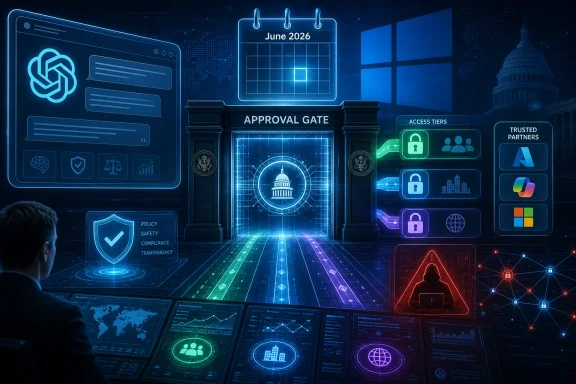
The Trump administration has reportedly pushed OpenAI to restrict the initial release of its newest ChatGPT model in late June 2026, allowing only a small group of approved partners to use it while federal officials assess cybersecurity and national-security risks. That is not a routine product delay. It is a signal that frontier AI releases are beginning to look less like software launches and more like controlled deployments of strategic infrastructure. For Windows users, developers, and IT administrators, the story is not simply whether the next chatbot arrives a few weeks late; it is whether the operating environment around advanced AI is shifting from consumer technology to regulated national capability.
For most of the generative AI boom, federal power over model launches was indirect. Agencies issued guidance, convened safety summits, negotiated voluntary commitments, bought access through procurement channels, and warned companies about biosecurity, cyber abuse, and election risks. The companies still generally decided when a model was ready, who got access, and how quickly the public rollout would widen.
The reported OpenAI restriction changes that posture. If the government can ask a leading AI lab to limit access to a frontier model before broad release, the release calendar itself becomes a policy tool. That is a significant escalation because timing is the currency of the AI industry: every week of exclusive access matters to cloud partners, enterprise customers, security researchers, app developers, and rivals trying to benchmark capability gaps.
The stated rationale is cybersecurity. Advanced models are not merely better at writing poems or summarizing PDFs; they may also become more capable at finding vulnerabilities, automating exploit chains, generating convincing spear-phishing content, or helping less sophisticated actors navigate complex attack workflows. Even if the most alarming scenarios remain contested, the government does not need certainty to act. In national-security policy, plausible capability often beats demonstrated harm.
That is where this becomes uncomfortable. A pre-release review can be framed as prudent risk management, especially if the model materially improves cyber offense. It can also become a soft licensing regime without the political accountability of a formal statute. The difference between “voluntary cooperation” and “permission to launch” gets blurry when the request comes from the White House and the product is commercially existential.
The larger OpenAI becomes, the harder it is to behave like an ordinary software vendor. A frontier model is not Windows Notepad, a browser extension, or a SaaS dashboard. It is a general-purpose capability layer that can be embedded into coding tools, productivity suites, customer-service systems, research workflows, defense applications, and automated agents. That breadth is precisely what makes the technology commercially valuable and politically sensitive.
The company’s reported resistance to making government review a permanent precondition is therefore unsurprising. OpenAI wants to avoid a world in which every major model release is hostage to a federal calendar, classified benchmarks, or shifting political priorities. The company can accept limited review as an exceptional measure; it cannot easily accept that as the default operating model without changing what kind of company it is.
Yet the company’s own ambitions invite the scrutiny. When AI labs argue that their systems will transform labor markets, accelerate science, reshape software development, and become core infrastructure for governments and businesses, they should not be shocked when governments start treating them as infrastructure. The industry asked to be understood as civilization-scale. Washington appears to be taking that claim seriously.
That is a dramatic departure from the software norms many WindowsForum readers grew up with. The old cycle was familiar: a company announced a release, insiders or beta testers kicked the tires, enterprises waited for patches, and everyone else decided whether to upgrade. Frontier AI is moving toward something closer to defense-adjacent export control, where the key question is not just whether the product works but who is allowed to touch it.
The cyber argument is stronger for AI than it would be for many other software categories. A Windows zero-day, once known, is a specific vulnerability. A stronger model is a reusable reasoning engine that may help discover many vulnerabilities, write exploit code, interpret logs, automate reconnaissance, and adapt instructions across contexts. That does not mean every new model is a cyberweapon, but it does mean release decisions can have security externalities beyond the vendor’s own customer base.
The problem is that capability thresholds are hard to define publicly. If the government says a model is too powerful for unrestricted release, it may not be able to explain exactly why without disclosing sensitive testing methods or threat assessments. That secrecy may be necessary in narrow cases, but it also weakens public trust. The more opaque the review process becomes, the easier it is for companies and critics alike to suspect favoritism, protectionism, or political leverage.
But ownership changes the oversight equation. A government that reviews model launches for safety is one kind of actor. A government that reviews model launches while also holding a financial stake in the company is another. It would have an interest in limiting reckless deployment, but also an interest in the company’s valuation, competitive position, and long-term dominance.
That conflict is not theoretical. If Washington owns part of OpenAI, does it become more likely to approve OpenAI releases than a rival’s? Does it pressure agencies to buy from the company in which taxpayers hold equity? Does it discourage enforcement actions that might reduce the value of the stake? Or does it impose tougher conditions to prove it is not captured? Every answer creates a new governance problem.
OpenAI’s possible argument is that a public stake would democratize the AI windfall. That may be politically clever, especially at a time when voters worry that automation will enrich capital while destabilizing work. But a stake is not the same as democratic control, public accountability, or fair distribution. Without a clear statutory framework, it risks becoming a symbolic bargain: the public gets a slice of paper value while private firms keep the operational power.
For enterprise buyers, the ownership question also raises procurement and trust concerns. Companies do not merely buy AI capability; they share code, documents, customer data, operational plans, and internal reasoning workflows with AI providers. If a vendor becomes partly state-owned or unusually state-entangled, customers will ask new questions about data access, lawful process, foreign compliance regimes, and cross-border deployment. The answers may be manageable, but they will not be optional.
If frontier model access becomes staggered by government approval, enterprises may see uneven capability rollouts. A cloud partner, defense contractor, or critical-infrastructure operator could receive early access while ordinary developers wait. Regulated industries may be invited into controlled pilots. Smaller software companies may discover that “general availability” is no longer the moment when innovation starts, but the moment after larger players have already adapted.
That matters for Windows administrators because AI is becoming part of the management plane. It is already being woven into endpoint security analysis, help-desk automation, scripting assistance, document review, identity workflows, and software development. A model with materially better reasoning could improve incident response or code migration. It could also introduce new compliance requirements if its use is restricted, logged, or conditioned by federal review.
Developers face a similar tension. The best coding models can raise productivity, but they also become dependencies. If an IDE extension, CI pipeline, or internal agent depends on a model that is delayed, restricted, or available only to approved customers, roadmaps get messier. The API economy assumes stable access. Frontier AI policy may make access tiered, conditional, and politically contingent.
Security teams will be split. Many will welcome a review process that tests whether a new model can meaningfully accelerate offensive cyber work. Others will worry that limiting access to vetted insiders leaves defenders without the same tools attackers may eventually obtain through leaks, foreign models, open weights, or rival jurisdictions. In cybersecurity, delaying capability for the public does not always mean denying it to adversaries.
Formal regulation has defects, but it has visible procedures. Laws define authority, courts review disputes, agencies publish rules, and companies can plan around compliance obligations. Informal pressure moves faster, but it can leave everyone guessing. A company may comply because it agrees with the safety case, because it fears retaliation, because it wants government contracts, or because it sees cooperation as the price of political survival.
The Trump administration’s approach also sits awkwardly alongside America’s usual pitch for technological leadership. U.S. officials want American AI companies to outpace foreign competitors, set global standards, and power domestic productivity. Restricting model releases may protect security in the short term, but it could also slow diffusion, frustrate developers, and push customers toward less restricted alternatives if the process feels arbitrary.
That does not mean the government should do nothing. The strongest argument for pre-release review is that frontier AI may create asymmetric risks before ordinary markets can react. Once a widely available model demonstrates a dangerous capability, recall is difficult. Guardrails can be patched, APIs can be throttled, and accounts can be banned, but knowledge diffuses quickly.
The better criticism is not that oversight exists. It is that oversight by improvisation is a poor foundation for a technology this important. If frontier model review is necessary, it should be legible enough for companies to plan, narrow enough to avoid becoming a general veto, and accountable enough that the public can distinguish safety review from political bargaining.
That creates incentives that have little to do with safety. Firms may tailor public statements to political expectations, offer government-friendly investment structures, prioritize federal use cases, or cultivate relationships with agencies that influence review. The danger is not crude censorship; it is a subtler convergence of commercial strategy and political permission.
The “approved partners” model is especially powerful because it shapes who learns first. Early users discover strengths, weaknesses, integration patterns, cost profiles, and failure modes before competitors. In enterprise software, that knowledge compounds. A month of privileged access to a frontier model can mean a month of product redesign, customer demos, security testing, and internal training.
This is where smaller companies should be nervous. If access to the strongest models is mediated through federal approval and large-cloud relationships, startups may be pushed further down the stack. They will build on older models, wait for public release, or depend on partnerships with incumbents. The AI market already favors scale; controlled rollout can make scale even more decisive.
For open-source advocates, the lesson is harsher. Government concern over frontier capability may strengthen the case for closed models, monitored APIs, and restricted access. Open weights will still exist, and foreign open models may keep improving, but the most capable U.S. systems could become increasingly gated. That would change the culture of AI development from experimentation toward clearance.
The question is whether pre-release government review actually reduces that risk. A review window can identify dangerous behaviors, test safeguards, and pressure companies to harden access controls. It can also produce a false sense of security if the evaluation is too narrow, too classified, or too focused on spectacular demonstrations rather than ordinary abuse at scale.
The most likely risks are not Hollywood scenarios. They are mundane and cumulative: faster phishing localization, better malware debugging, automated vulnerability triage, more persuasive social engineering, and cheaper reconnaissance. Those are exactly the kinds of harms that do not require a model to be superhuman. They require it to be useful, patient, scalable, and available.
For defenders, the same capabilities are valuable. A stronger model can summarize alerts, explain suspicious PowerShell, generate detection rules, review code for insecure patterns, and help junior analysts understand unfamiliar systems. If the government restricts access broadly, it may slow offensive misuse while also delaying defensive adoption. The net effect depends on who gets early access and under what conditions.
That is why the access list matters. If early availability is limited to a small circle of government-approved partners, those partners should not merely be politically convenient. They should include organizations capable of adversarial testing, defensive validation, enterprise deployment feedback, and independent evaluation. Otherwise the review becomes theater: a closed preview dressed up as national security.
That makes federal restrictions on OpenAI models indirectly relevant to Microsoft’s roadmap. If a new OpenAI model is delayed or access-limited, Microsoft’s ability to productize it across commercial services may also be constrained. The company can work around this with model routing, in-house models, smaller specialized systems, or alternative providers, but the flagship frontier layer still matters.
For IT departments, the practical advice is to stop treating AI features as ordinary SaaS upgrades. A new model can change data-handling assumptions, user behavior, support requirements, and security posture. It can also arrive unevenly across tenants, regions, licensing tiers, and regulated-customer categories. The administrative burden will be less about flipping an AI switch and more about governing a moving capability boundary.
Microsoft’s enterprise customers will want clarity. They will ask which model powers which feature, whether government review affects availability, how data is logged during restricted previews, and whether early-access programs create compliance exposure. Those questions are not anti-AI. They are the normal hygiene of adopting infrastructure that increasingly participates in decision-making and code generation.
The Windows ecosystem has absorbed this kind of shift before. Cloud identity, endpoint telemetry, and SaaS administration all changed what it meant to run a Microsoft environment. AI is doing the same, but faster and with more ambiguity. The model is no longer just another backend service; it is a policy-sensitive dependency.
OpenAI wants freedom to ship and monetize. The administration wants leverage over a strategically important industry. Large enterprise partners want early access. Rivals want the rules applied evenly. Users want better tools without becoming subjects in an opaque national experiment. Those interests overlap in places, but they are not the same.
A durable framework would need independent testing capacity, public criteria for when review applies, clear limits on government access to proprietary systems, and procedures for appeal or dispute. It would also need to separate safety evaluation from investment negotiations. If a public stake is seriously considered, Congress should define the terms rather than letting ownership emerge through private bargaining between a company and the executive branch.
The public also deserves honesty about uncertainty. No benchmark can perfectly predict misuse. No model card can eliminate geopolitical risk. No access restriction can prevent foreign competitors from advancing. The point of governance should be to reduce risk while preserving innovation, not to pretend that a 30-day review can domesticate a general-purpose technology.
This is where the Fact Check framing undersells the story. The issue is not merely whether Trump “moved to limit” a model launch. The deeper fact to check is whether America is quietly building a frontier-AI approval system without openly admitting that is what it is. If so, the debate should move from rumor and company statements to law, oversight, and public accountability.
 Washington Has Found the Model-Release Lever
For most of the generative AI boom, federal power over model launches was indirect. Agencies issued guidance, convened safety summits, negotiated voluntary commitments, bought access through procurement channels, and warned companies about biosecurity, cyber abuse, and election risks. The companies still generally decided when a model was ready, who got access, and how quickly the public rollout would widen.The reported OpenAI restriction changes that posture. If the government can ask a leading AI lab to limit access to a frontier model before broad release, the release calendar itself becomes a policy tool. That is a significant escalation because timing is the currency of the AI industry: every week of exclusive access matters to cloud partners, enterprise customers, security researchers, app developers, and rivals trying to benchmark capability gaps.
The stated rationale is cybersecurity. Advanced models are not merely better at writing poems or summarizing PDFs; they may also become more capable at finding vulnerabilities, automating exploit chains, generating convincing spear-phishing content, or helping less sophisticated actors navigate complex attack workflows. Even if the most alarming scenarios remain contested, the government does not need certainty to act. In national-security policy, plausible capability often beats demonstrated harm.
That is where this becomes uncomfortable. A pre-release review can be framed as prudent risk management, especially if the model materially improves cyber offense. It can also become a soft licensing regime without the political accountability of a formal statute. The difference between “voluntary cooperation” and “permission to launch” gets blurry when the request comes from the White House and the product is commercially existential.
OpenAI Is Learning That Scale Comes With Sovereignty Problems
OpenAI’s early public identity was built around research, safety rhetoric, and consumer accessibility. ChatGPT’s 2022 breakthrough made the company a household name because it felt like a web product: log in, type, and watch the machine produce a plausible answer. That simplicity obscured the fact that the system depended on massive compute, global distribution, enterprise integrations, and a model pipeline that increasingly overlaps with national-security concerns.The larger OpenAI becomes, the harder it is to behave like an ordinary software vendor. A frontier model is not Windows Notepad, a browser extension, or a SaaS dashboard. It is a general-purpose capability layer that can be embedded into coding tools, productivity suites, customer-service systems, research workflows, defense applications, and automated agents. That breadth is precisely what makes the technology commercially valuable and politically sensitive.
The company’s reported resistance to making government review a permanent precondition is therefore unsurprising. OpenAI wants to avoid a world in which every major model release is hostage to a federal calendar, classified benchmarks, or shifting political priorities. The company can accept limited review as an exceptional measure; it cannot easily accept that as the default operating model without changing what kind of company it is.
Yet the company’s own ambitions invite the scrutiny. When AI labs argue that their systems will transform labor markets, accelerate science, reshape software development, and become core infrastructure for governments and businesses, they should not be shocked when governments start treating them as infrastructure. The industry asked to be understood as civilization-scale. Washington appears to be taking that claim seriously.
The Anthropic Precedent Made This More Than an OpenAI Story
The OpenAI reports landed in the wake of separate government action involving Anthropic’s most advanced models. That matters because one intervention can be dismissed as a company-specific negotiation; two interventions begin to look like an emerging doctrine. The frontier AI market may be entering a phase in which the most capable systems are released first through politically mediated access lists rather than broad commercial availability.That is a dramatic departure from the software norms many WindowsForum readers grew up with. The old cycle was familiar: a company announced a release, insiders or beta testers kicked the tires, enterprises waited for patches, and everyone else decided whether to upgrade. Frontier AI is moving toward something closer to defense-adjacent export control, where the key question is not just whether the product works but who is allowed to touch it.
The cyber argument is stronger for AI than it would be for many other software categories. A Windows zero-day, once known, is a specific vulnerability. A stronger model is a reusable reasoning engine that may help discover many vulnerabilities, write exploit code, interpret logs, automate reconnaissance, and adapt instructions across contexts. That does not mean every new model is a cyberweapon, but it does mean release decisions can have security externalities beyond the vendor’s own customer base.
The problem is that capability thresholds are hard to define publicly. If the government says a model is too powerful for unrestricted release, it may not be able to explain exactly why without disclosing sensitive testing methods or threat assessments. That secrecy may be necessary in narrow cases, but it also weakens public trust. The more opaque the review process becomes, the easier it is for companies and critics alike to suspect favoritism, protectionism, or political leverage.
A Five Percent Stake Would Turn Oversight Into Something Stranger
The reported discussions about giving the U.S. government a roughly 5 percent ownership stake in OpenAI add a second, more provocative layer to the story. On paper, public equity could be sold as a way for citizens to share in the upside of AI. If a small number of companies capture enormous value from models trained on broad public knowledge, public participation in that upside has obvious political appeal.But ownership changes the oversight equation. A government that reviews model launches for safety is one kind of actor. A government that reviews model launches while also holding a financial stake in the company is another. It would have an interest in limiting reckless deployment, but also an interest in the company’s valuation, competitive position, and long-term dominance.
That conflict is not theoretical. If Washington owns part of OpenAI, does it become more likely to approve OpenAI releases than a rival’s? Does it pressure agencies to buy from the company in which taxpayers hold equity? Does it discourage enforcement actions that might reduce the value of the stake? Or does it impose tougher conditions to prove it is not captured? Every answer creates a new governance problem.
OpenAI’s possible argument is that a public stake would democratize the AI windfall. That may be politically clever, especially at a time when voters worry that automation will enrich capital while destabilizing work. But a stake is not the same as democratic control, public accountability, or fair distribution. Without a clear statutory framework, it risks becoming a symbolic bargain: the public gets a slice of paper value while private firms keep the operational power.
For enterprise buyers, the ownership question also raises procurement and trust concerns. Companies do not merely buy AI capability; they share code, documents, customer data, operational plans, and internal reasoning workflows with AI providers. If a vendor becomes partly state-owned or unusually state-entangled, customers will ask new questions about data access, lawful process, foreign compliance regimes, and cross-border deployment. The answers may be manageable, but they will not be optional.
The Windows Ecosystem Will Feel This Through Copilots, Clouds, and Code
This story may seem centered on OpenAI’s model pipeline, but its practical effects will be felt through the Microsoft-heavy stack many IT departments already run. OpenAI models are not experienced only through ChatGPT. They surface through developer tools, productivity software, Azure services, security products, custom enterprise copilots, and third-party applications that depend on hosted model APIs.If frontier model access becomes staggered by government approval, enterprises may see uneven capability rollouts. A cloud partner, defense contractor, or critical-infrastructure operator could receive early access while ordinary developers wait. Regulated industries may be invited into controlled pilots. Smaller software companies may discover that “general availability” is no longer the moment when innovation starts, but the moment after larger players have already adapted.
That matters for Windows administrators because AI is becoming part of the management plane. It is already being woven into endpoint security analysis, help-desk automation, scripting assistance, document review, identity workflows, and software development. A model with materially better reasoning could improve incident response or code migration. It could also introduce new compliance requirements if its use is restricted, logged, or conditioned by federal review.
Developers face a similar tension. The best coding models can raise productivity, but they also become dependencies. If an IDE extension, CI pipeline, or internal agent depends on a model that is delayed, restricted, or available only to approved customers, roadmaps get messier. The API economy assumes stable access. Frontier AI policy may make access tiered, conditional, and politically contingent.
Security teams will be split. Many will welcome a review process that tests whether a new model can meaningfully accelerate offensive cyber work. Others will worry that limiting access to vetted insiders leaves defenders without the same tools attackers may eventually obtain through leaks, foreign models, open weights, or rival jurisdictions. In cybersecurity, delaying capability for the public does not always mean denying it to adversaries.
The New AI Governance Is Being Built Before Anyone Names It
The most consequential feature of the reported OpenAI arrangement is that it appears to be emerging faster than the vocabulary around it. Is this voluntary safety cooperation, export control, procurement leverage, national-security review, industrial policy, or informal licensing? The answer may be “all of the above,” which is precisely why it deserves scrutiny.Formal regulation has defects, but it has visible procedures. Laws define authority, courts review disputes, agencies publish rules, and companies can plan around compliance obligations. Informal pressure moves faster, but it can leave everyone guessing. A company may comply because it agrees with the safety case, because it fears retaliation, because it wants government contracts, or because it sees cooperation as the price of political survival.
The Trump administration’s approach also sits awkwardly alongside America’s usual pitch for technological leadership. U.S. officials want American AI companies to outpace foreign competitors, set global standards, and power domestic productivity. Restricting model releases may protect security in the short term, but it could also slow diffusion, frustrate developers, and push customers toward less restricted alternatives if the process feels arbitrary.
That does not mean the government should do nothing. The strongest argument for pre-release review is that frontier AI may create asymmetric risks before ordinary markets can react. Once a widely available model demonstrates a dangerous capability, recall is difficult. Guardrails can be patched, APIs can be throttled, and accounts can be banned, but knowledge diffuses quickly.
The better criticism is not that oversight exists. It is that oversight by improvisation is a poor foundation for a technology this important. If frontier model review is necessary, it should be legible enough for companies to plan, narrow enough to avoid becoming a general veto, and accountable enough that the public can distinguish safety review from political bargaining.
The Calendar Is Now a Competitive Weapon
AI labs already compete on benchmarks, compute supply, enterprise contracts, talent, and distribution. They now may compete on regulatory access. A company that earns early government trust could launch faster to strategic customers. A company that irritates the administration could find its most important model stuck in review or limited to a narrower pool.That creates incentives that have little to do with safety. Firms may tailor public statements to political expectations, offer government-friendly investment structures, prioritize federal use cases, or cultivate relationships with agencies that influence review. The danger is not crude censorship; it is a subtler convergence of commercial strategy and political permission.
The “approved partners” model is especially powerful because it shapes who learns first. Early users discover strengths, weaknesses, integration patterns, cost profiles, and failure modes before competitors. In enterprise software, that knowledge compounds. A month of privileged access to a frontier model can mean a month of product redesign, customer demos, security testing, and internal training.
This is where smaller companies should be nervous. If access to the strongest models is mediated through federal approval and large-cloud relationships, startups may be pushed further down the stack. They will build on older models, wait for public release, or depend on partnerships with incumbents. The AI market already favors scale; controlled rollout can make scale even more decisive.
For open-source advocates, the lesson is harsher. Government concern over frontier capability may strengthen the case for closed models, monitored APIs, and restricted access. Open weights will still exist, and foreign open models may keep improving, but the most capable U.S. systems could become increasingly gated. That would change the culture of AI development from experimentation toward clearance.
The Cybersecurity Case Is Real, but It Is Not Self-Executing
It is easy to mock frontier-model panic because AI companies have often exaggerated their own technology. But security professionals should resist the opposite error. Better models can lower the skill floor for some forms of cyber misuse, especially when combined with tool use, code execution, browser automation, and agentic workflows. Even when a model cannot invent a novel exploit from scratch, it can help an operator move faster.The question is whether pre-release government review actually reduces that risk. A review window can identify dangerous behaviors, test safeguards, and pressure companies to harden access controls. It can also produce a false sense of security if the evaluation is too narrow, too classified, or too focused on spectacular demonstrations rather than ordinary abuse at scale.
The most likely risks are not Hollywood scenarios. They are mundane and cumulative: faster phishing localization, better malware debugging, automated vulnerability triage, more persuasive social engineering, and cheaper reconnaissance. Those are exactly the kinds of harms that do not require a model to be superhuman. They require it to be useful, patient, scalable, and available.
For defenders, the same capabilities are valuable. A stronger model can summarize alerts, explain suspicious PowerShell, generate detection rules, review code for insecure patterns, and help junior analysts understand unfamiliar systems. If the government restricts access broadly, it may slow offensive misuse while also delaying defensive adoption. The net effect depends on who gets early access and under what conditions.
That is why the access list matters. If early availability is limited to a small circle of government-approved partners, those partners should not merely be politically convenient. They should include organizations capable of adversarial testing, defensive validation, enterprise deployment feedback, and independent evaluation. Otherwise the review becomes theater: a closed preview dressed up as national security.
Microsoft’s Shadow Hangs Over the Whole Debate
Even when Microsoft is not the named actor in a specific report, it is never far from the OpenAI story. The company’s partnership with OpenAI made generative AI a first-class feature across Microsoft’s cloud, developer, and productivity franchises. Windows users encounter the downstream effects through Copilot branding, Azure AI services, GitHub tooling, and enterprise integrations.That makes federal restrictions on OpenAI models indirectly relevant to Microsoft’s roadmap. If a new OpenAI model is delayed or access-limited, Microsoft’s ability to productize it across commercial services may also be constrained. The company can work around this with model routing, in-house models, smaller specialized systems, or alternative providers, but the flagship frontier layer still matters.
For IT departments, the practical advice is to stop treating AI features as ordinary SaaS upgrades. A new model can change data-handling assumptions, user behavior, support requirements, and security posture. It can also arrive unevenly across tenants, regions, licensing tiers, and regulated-customer categories. The administrative burden will be less about flipping an AI switch and more about governing a moving capability boundary.
Microsoft’s enterprise customers will want clarity. They will ask which model powers which feature, whether government review affects availability, how data is logged during restricted previews, and whether early-access programs create compliance exposure. Those questions are not anti-AI. They are the normal hygiene of adopting infrastructure that increasingly participates in decision-making and code generation.
The Windows ecosystem has absorbed this kind of shift before. Cloud identity, endpoint telemetry, and SaaS administration all changed what it meant to run a Microsoft environment. AI is doing the same, but faster and with more ambiguity. The model is no longer just another backend service; it is a policy-sensitive dependency.
The Public Needs More Than Reassurance From the Same Players
The biggest weakness in the current arrangement is trust. The government asks for review authority because the technology may be dangerous. The company asks the public to trust that cooperation is temporary and not a route to capture. Both may be acting in good faith, but both also have incentives that deserve skepticism.OpenAI wants freedom to ship and monetize. The administration wants leverage over a strategically important industry. Large enterprise partners want early access. Rivals want the rules applied evenly. Users want better tools without becoming subjects in an opaque national experiment. Those interests overlap in places, but they are not the same.
A durable framework would need independent testing capacity, public criteria for when review applies, clear limits on government access to proprietary systems, and procedures for appeal or dispute. It would also need to separate safety evaluation from investment negotiations. If a public stake is seriously considered, Congress should define the terms rather than letting ownership emerge through private bargaining between a company and the executive branch.
The public also deserves honesty about uncertainty. No benchmark can perfectly predict misuse. No model card can eliminate geopolitical risk. No access restriction can prevent foreign competitors from advancing. The point of governance should be to reduce risk while preserving innovation, not to pretend that a 30-day review can domesticate a general-purpose technology.
This is where the Fact Check framing undersells the story. The issue is not merely whether Trump “moved to limit” a model launch. The deeper fact to check is whether America is quietly building a frontier-AI approval system without openly admitting that is what it is. If so, the debate should move from rumor and company statements to law, oversight, and public accountability.
The Release Notes Now Include Washington
The concrete lesson for WindowsForum readers is that frontier AI is becoming a governed dependency, not just a feature race. The next model launch may affect coding tools, cloud services, endpoint security, enterprise copilots, and procurement timelines, but it may also arrive through a policy filter that users never see directly.- OpenAI’s reported restricted rollout marks a shift from after-the-fact AI oversight toward pre-release influence over frontier models.
- The cybersecurity rationale is credible, but the effectiveness of a limited-access review depends on transparent criteria and technically serious testing.
- A possible U.S. government equity stake in OpenAI would complicate the line between public oversight, industrial policy, and market favoritism.
- Enterprise customers should expect AI availability to vary by partner status, sector, region, and regulatory sensitivity rather than assuming simultaneous public rollout.
- Windows administrators and developers should document which AI models power their workflows because model access may become a compliance and continuity issue.
- The biggest unresolved question is whether this remains an exceptional intervention or hardens into an informal licensing regime for frontier AI.
References
- Primary source: WCHS
Published: 2026-07-03T04:10:11.765902
Fact Check Team: Trump moves to limit OpenAI model launch as their involvement grows
The Trump administration is taking a more direct role in the rollout of advanced artificial intelligence, reportedly stepping in to limit OpenAI’s new model.wchstv.com - Independent coverage: KTUL
Published: Thu, 02 Jul 2026 22:10:37 GMT
Fact Check Team: Trump moves to limit OpenAI model launch as their involvement grows
KTUL ABC 8 provides local and national news, sports, weather and notice of community events in Tulsa, Oklahoma and surrounding towns including Broken Arrow, Owasso, Claremore, Jenks, Bixby, Coweta, Muskogee, Westport, Beggs, Okmulgee, Council Hill, Henryetta, Skiatook, Collinsville, and...ktul.com - Independent coverage: National Desk
Published: Thu, 02 Jul 2026 22:05:34 GMT
Fact Check Team: Trump moves to limit OpenAI model launch as their involvement grows
The Trump administration is taking a more direct role in the rollout of advanced artificial intelligence, reportedly stepping in to limit OpenAI’s new model. thenationaldesk.com
- Independent coverage: aol.com
Published: Thu, 02 Jul 2026 11:07:47 GMT
Trump Administration Seeks Limited Release Of OpenAI Model After Anthropic Shutdown - AOL
The Trump administration requested that OpenAI to stagger the release of its latest model for security concerns just weeks after Anthropic was told to suspend global access to two of its most capable artificial intelligence models. Sam Altman’s GPT 5.www.aol.com - Related coverage: axios.com
OpenAI courts Trump administration as its latest investor
The proposal comes as the government is deciding when the AI lab can release its most powerful models due to security concerns.www.axios.com
- Related coverage: tomshardware.com
OpenAI's ChatGPT-5.6 gets the same banhammer treatment as Anthropic’s Mythos from the federal government — source says that Washington cautioned OpenAI against releasing the model without receiving approval | Tom's Hardware
The U.S. government wants to ensure that its latest, most advanced AI tools can't be used against it.www.tomshardware.com
- Related coverage: washingtonpost.com
- Related coverage: euronews.com
OpenAI offers the US government a 5% ownership stake | Euronews
Sam Altman reportedly wants to hand the US government a stake in OpenAI worth tens of billions, and he wants Silicon Valley's other giants to do the same.www.euronews.com - Related coverage: forbes.com
OpenAI Reportedly Pitches Granting U.S. Government 5% Stake
The proposal being discussed by OpenAI and Trump administration officials purportedly calls for all major AI companies to grant the government a 5% stake.www.forbes.com - Related coverage: investing.com
OpenAI proposes handing Trump administration 5% stake, FT reports By Reuters
OpenAI proposes handing Trump administration 5% stake, FT reportswww.investing.com - Related coverage: techcrunch.com
The Trump administration might take an equity stake in OpenAI | TechCrunch
President Donald Trump said he's discussing deals "where the American people can benefit from the success of AI."techcrunch.com - Related coverage: elpais.com
- Related coverage: nogentech.org
OpenAI Proposes 5% Government Equity Ownership Stake
OpenAI has proposed handing a 5% equity stake worth $42.6 billion to the U.S. government to defuse mounting regulatory pressure and share the wealth of AI.www.nogentech.org - Related coverage: arstechnica.com
Trump gets OpenAI to offer US 5% stake, far lower than Sanders’ target - Ars Technica
Insiders say Sam Altman is in active talks with the Trump administration.arstechnica.com