

Amazon devices chief Panos Panay used a July 2026 CNBC interview to describe an Amazon hardware strategy built around custom device silicon, generative AI, and Amazon Leo satellite connectivity rather than another run at the smartphone market. That is the plain product story; the larger one is that Amazon is trying to make the computer less visible while making its own infrastructure more unavoidable. If Microsoft made Panay famous for turning Windows hardware into a premium object, Amazon now wants him to make hardware feel like it has disappeared. The bet is elegant, ambitious, and potentially alarming: the less you notice the device, the more power accrues to the company operating the stack behind it.
The first era of Alexa hardware was easy to understand because it looked like a consumer-electronics category. An Echo was a speaker, a Fire TV Stick was a streaming dongle, a Kindle was an e-reader, and a Ring camera was a camera with a cloud service bolted on. Amazon sold hardware as a portal into Amazon services, and the economics were blunt: cheap devices, broad distribution, recurring engagement.
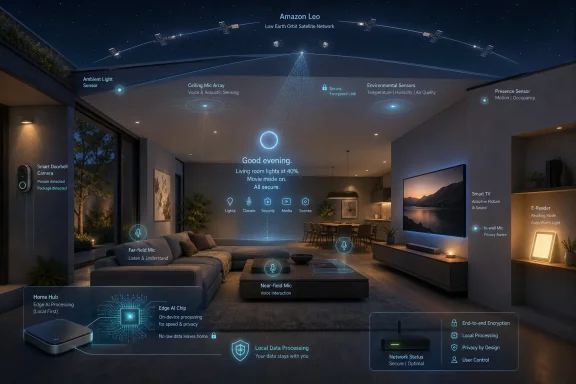
The Panay-era pitch is different. Amazon now talks about devices less as endpoints and more as pieces of an ambient computing fabric: microphones, displays, cameras, sensors, routers, televisions, e-readers, and satellites all feeding an assistant that is meant to infer intent before the user reaches for a screen. The company’s older Alexa promise was that you could ask the room a question. The newer promise is that the room may eventually know enough not to wait for the question.
That shift matters because it moves Amazon’s devices business out of the gadget aisle and into the architecture of daily life. A smart speaker that answers trivia is a convenience. A home system that understands schedules, appliances, entertainment habits, security routines, deliveries, and energy usage is closer to an operating system for the household.
This is why Panay’s comments about form factors are more important than any single product leak. Amazon does not need to beat Apple at the iPhone to change the shape of computing. It needs to convince users that the next interface is not a slab of glass at all.
Amazon’s hardware organization has historically been almost the opposite. Its devices often succeeded because they were inexpensive, useful enough, and tightly integrated with Amazon’s retail and media ecosystems. The design language was less important than the funnel: get Alexa into the kitchen, Fire TV into the HDMI port, Kindle into the bag, Ring onto the porch, and eero into the network closet.
Panay’s challenge is to impose coherence on that sprawl without destroying the economic logic that made it work. Amazon can make beautiful hardware, but beauty alone will not justify a new Echo, Fire TV, or AI wearable. The company’s advantage is distribution and services; its weakness is that users already own phones, tablets, laptops, smart TVs, and speakers that mostly work.
That is why Amazon’s current AI hardware story has to be more than “Alexa, but with a better language model.” If generative AI becomes just another voice assistant upgrade, it risks repeating the disappointment cycle that haunted Alexa for years: impressive demos, shallow daily utility, and an awkward gap between what users imagine and what the system can reliably do.
Panay appears to understand that the next device wave cannot be sold merely as a device wave. The sales pitch is not a nicer cylinder on the counter. It is a household that feels less fragmented.
The AI era has revived speculation that every major tech company needs a new personal device. OpenAI has teased dedicated AI hardware ambitions. Meta has made smart glasses feel less absurd than they did a decade ago. Apple is still searching for the right mainstream story around spatial computing. Google continues to fuse Gemini into Android, Search, and Pixel hardware.
Amazon’s alternative is to treat the phone as a gravitational force but not necessarily the object to replace. If users already carry the screen, Amazon can build the environment around it: the TV, the speaker, the doorbell, the Wi-Fi mesh, the e-reader, the tablet, the streaming interface, and eventually the satellite broadband connection. The goal is not to win every minute of attention. It is to own the moments when attention is inconvenient.
That explains the appeal of ambient AI. The phrase can sound like a marketing fog machine, but the business logic is crisp. Screens are expensive, contested, and dominated by Apple and Google. Ambient interfaces are messier, less mature, and more dependent on physical context — exactly where Amazon already has millions of installed devices listening, watching, routing, and displaying.
If Amazon can make the home feel like a computational surface, it does not need to persuade users to abandon the iPhone. It needs to persuade them that some tasks should never have required opening an app in the first place.
Latency is the obvious problem. Voice assistants already suffer when a supposedly natural interaction pauses long enough to remind users they are talking to a server. Generative AI makes that worse because richer responses, multimodal analysis, and contextual reasoning require more compute. A home assistant that takes too long to decide whether it should dim the lights or summarize a delivery notification is not ambient; it is just another slow computer.
Privacy is the deeper problem. Ambient computing asks users to tolerate persistent sensing in intimate spaces. The only politically and commercially viable version of that future is one in which more processing happens locally, with clearer boundaries around what leaves the device and why. Amazon’s historical reputation on privacy is not pristine enough for the company to hand-wave this away.
Custom silicon gives Amazon a way to argue that it can build AI features that are faster, cheaper, and less cloud-dependent. It also lets Amazon tune hardware for its own models, sensors, and service priorities rather than relying entirely on generic chips designed for broader markets. Apple proved the strategic power of owning the silicon roadmap. Amazon is now trying to apply a version of that lesson to cheaper, more distributed devices.
There is also a supply-chain angle. The AI boom has made high-end accelerators a geopolitical and financial choke point. Amazon already designs substantial data-center silicon through AWS, but consumer devices have different constraints: cost, power, thermals, manufacturing scale, and long replacement cycles. Putting more AI capability at the edge is not simply a chip-design exercise. It is a margin-management strategy for a company that wants AI everywhere without paying cloud-inference costs for every trivial interaction.
Generative AI gives Amazon a chance to reset expectations, but it also raises the cost of failure. A voice assistant that misunderstands a song request is annoying. An AI assistant that misreads household context, purchases the wrong item, mishandles a child’s request, or exposes private routines feels more invasive. The more autonomous the system becomes, the less tolerance users will have for ambiguity.
That is the paradox of ambient computing: the interface becomes more magical only if the user can predict its boundaries. People do not merely want assistants that can do more. They want assistants that know when not to act, when to ask, when to stay silent, and when to forget. Intelligence without restraint will feel less like convenience and more like surveillance with a friendly wake word.
Amazon’s advantage is that Alexa already lives in the home. Its disadvantage is that Alexa already lives in the home. Users have spent years joking about accidental activations, unexplained recordings, and the strange intimacy of corporate microphones in bedrooms and kitchens. Local AI processing can help, but architecture alone will not solve the trust problem.
The company will need to make privacy visible without making the system feel complicated. That means device-level controls, understandable data retention policies, meaningful offline modes, and a refusal to bury critical choices inside app settings. Ambient AI cannot be governed by the same consent model as a shopping website. The home is not a browser tab.
That does not mean Amazon Leo is already a mature global network. The company still faces deployment milestones, regulatory conditions, ground infrastructure requirements, terminal economics, and the brutal operational realities of maintaining a large constellation in low Earth orbit. Starlink has a substantial head start, and satellite broadband is an unforgiving business where launch cadence, capacity, pricing, and reliability all matter.
Still, the strategic connection to devices is obvious. A Fire TV, Echo hub, Ring system, or future AI device that can rely on Amazon-managed connectivity becomes more than a gadget attached to a home broadband connection. It becomes part of a vertically integrated service chain: device, chip, assistant, cloud, content, retail account, and network.
For consumers in well-served urban markets, that might sound like redundancy. For rural households, remote businesses, disaster zones, mobile work sites, and underserved regions, it could be transformational. Satellite broadband can make connected devices viable where fiber, cable, or reliable mobile broadband are absent or expensive.
But the integration cuts both ways. The same stack that can route around poor local infrastructure can also route around local incumbents, local rules, and local bargaining power. When a foreign platform company controls the device, the assistant, the marketplace, and the connection, national regulators will not treat it as a mere consumer-electronics vendor.
A satellite-connected AI hub in a rural clinic, school, farm cooperative, or small business could be genuinely useful. It could support remote consultations, logistics coordination, educational content, weather information, payments, and communication where terrestrial networks are unreliable. Amazon would not be wrong to see enormous potential in places where infrastructure gaps make traditional broadband deployment slow or uneconomic.
But it is too easy for Silicon Valley to narrate emerging markets as blank canvases. They are not. They have telecom operators, regulators, payment systems, local cloud ambitions, national data-protection laws, and citizens who may not want the next layer of digital infrastructure mediated by a U.S. retail and cloud giant. The politics of connectivity are inseparable from the economics.
Safaricom, MTN, Airtel, Vodacom, Orange, and other regional operators are not simply pipes waiting to be bypassed. They are employers, taxpayers, financial-service platforms, and national infrastructure partners. If Amazon Leo-linked devices eventually compete with or complement those networks, the outcome will depend on licensing, partnerships, spectrum policy, device pricing, and local service models.
The African opportunity is therefore not just a market-expansion slide. It is a test of whether ambient AI can be deployed without becoming a new form of dependency. Cheap devices and satellite links may widen access. They may also concentrate data and bargaining power in a stack headquartered far away.
For Amazon, this is both obstacle and opportunity. A genuinely useful AI home assistant needs to understand and control devices from many manufacturers. It cannot be limited to a handful of Amazon-branded products if it is meant to manage routines, security, energy, entertainment, and household context.
At the same time, Amazon has every incentive to become the translation layer. If Alexa becomes the place where incompatible devices become manageable, Amazon gains power even when it does not sell the light bulb, thermostat, lock, or appliance. The interface becomes the platform, and the platform captures the relationship.
That is where WindowsForum readers should hear an echo from the PC era. Microsoft’s dominance was not just that Windows ran on PCs. It was that Windows became the compatibility layer through which hardware, software, peripherals, and users met. Amazon’s home strategy is not identical, but the ambition rhymes: own the layer that makes everything else usable.
The risk is that “works with everything” becomes “works best through us.” That is a familiar path in platform economics. First comes interoperability. Then come optimizations. Then come exclusive features, preferred defaults, certification programs, and subtle penalties for wandering outside the garden.
The more important contest is over defaults. Which assistant answers when you speak in the living room? Which service summarizes the security camera footage? Which system suggests what to watch? Which device notices that the router is down, the package arrived, the child is home, or the electricity price has spiked? Which company gets to decide what information is relevant before the user asks?
Amazon has a powerful position because it already owns many domestic defaults. Fire TV is the screen interface in many homes. Echo is the voice endpoint. Ring is the porch camera. eero is the network. Kindle is the reading device. Amazon.com is the store. Prime is the subscription bundle tying much of it together.
Generative AI could make those defaults stickier. Instead of opening a dozen apps, a user may ask Alexa+ to coordinate across them. Instead of manually checking feeds, the assistant may summarize them. Instead of configuring routines, the system may propose or automate them. The convenience is real, and so is the lock-in.
For Windows users and IT pros, this should feel familiar. The most durable platforms are not always the ones with the flashiest hardware. They are the ones that quietly become the path of least resistance.
An ambient AI device connected through a satellite broadband service creates new management questions. What data does it collect? Where is that data processed? Can it be enrolled in device-management systems? Does it respect enterprise network segmentation? Can administrators disable recording, camera access, purchasing, or cloud sync? What happens when an employee brings one into a regulated workplace?
These are not theoretical concerns for schools, hospitals, law firms, factories, public agencies, and field operations. A consumer device that can hear, see, summarize, and transmit over an independent network is a compliance headache if policy lags behind deployment. The fact that it may be useful only makes the governance problem harder.
Amazon will likely present business versions, management hooks, and compliance assurances if the category matures. That is the predictable enterprise playbook. But the consumer versions will arrive first, and consumer convenience often outruns IT policy.
The lesson for administrators is not to panic about every Echo or Fire TV update. It is to recognize the direction of travel. The endpoint is no longer just the laptop, phone, or tablet. The room itself is becoming an endpoint.
Microsoft’s own Copilot strategy assumes that AI becomes a layer across Windows, Microsoft 365, Edge, Azure, and enterprise workflows. Amazon’s strategy assumes that AI becomes a layer across the home, entertainment, shopping, connectivity, and devices. Apple’s strategy is likely to remain anchored in personal hardware and privacy-branded integration. Google’s strategy ties AI to search, Android, Workspace, and the web.
Users will not experience these as separate corporate org charts. They will experience them as overlapping assistants competing for context. The Windows PC may still be where work happens, but the surrounding environment will increasingly shape how information is captured, summarized, routed, and acted upon.
That creates both friction and opportunity. A Windows laptop in a home office may coexist with Alexa-powered rooms, Ring cameras, eero networks, Fire TV displays, Android phones, iPads, and satellite backup connectivity. The old model of a single primary computing platform is giving way to a mesh of partial platforms, each claiming a slice of identity and intent.
For Microsoft, this is a warning. Owning the desktop does not guarantee ownership of the user’s context. For Amazon, it is an opening. The company does not need to own the PC if it owns enough of the environment around it.
The next decade of consumer computing may not be defined by the device you stare at, but by the systems that notice, infer, and act before you do. Amazon’s Panay-era bet is that users will welcome that shift if it feels useful enough and invisible enough. The unresolved question is whether invisible computing can remain accountable once the company behind it controls the silicon, the assistant, the marketplace, and the connection to the sky.
 Amazon Is No Longer Pretending the Echo Is Just a Speaker
The first era of Alexa hardware was easy to understand because it looked like a consumer-electronics category. An Echo was a speaker, a Fire TV Stick was a streaming dongle, a Kindle was an e-reader, and a Ring camera was a camera with a cloud service bolted on. Amazon sold hardware as a portal into Amazon services, and the economics were blunt: cheap devices, broad distribution, recurring engagement.The Panay-era pitch is different. Amazon now talks about devices less as endpoints and more as pieces of an ambient computing fabric: microphones, displays, cameras, sensors, routers, televisions, e-readers, and satellites all feeding an assistant that is meant to infer intent before the user reaches for a screen. The company’s older Alexa promise was that you could ask the room a question. The newer promise is that the room may eventually know enough not to wait for the question.
That shift matters because it moves Amazon’s devices business out of the gadget aisle and into the architecture of daily life. A smart speaker that answers trivia is a convenience. A home system that understands schedules, appliances, entertainment habits, security routines, deliveries, and energy usage is closer to an operating system for the household.
This is why Panay’s comments about form factors are more important than any single product leak. Amazon does not need to beat Apple at the iPhone to change the shape of computing. It needs to convince users that the next interface is not a slab of glass at all.
Panos Panay Brings Surface Discipline to Amazon’s Messiest Hardware Empire
Panay’s résumé gives Amazon’s hardware push a particular flavor. At Microsoft, he became associated with Surface: a line that began as a proof-of-concept for Windows hardware and gradually turned into a premium device family with a recognizable design language. Surface was not always a commercial juggernaut, but it gave Microsoft credibility in a category where OEM partners had long defined the user experience.Amazon’s hardware organization has historically been almost the opposite. Its devices often succeeded because they were inexpensive, useful enough, and tightly integrated with Amazon’s retail and media ecosystems. The design language was less important than the funnel: get Alexa into the kitchen, Fire TV into the HDMI port, Kindle into the bag, Ring onto the porch, and eero into the network closet.
Panay’s challenge is to impose coherence on that sprawl without destroying the economic logic that made it work. Amazon can make beautiful hardware, but beauty alone will not justify a new Echo, Fire TV, or AI wearable. The company’s advantage is distribution and services; its weakness is that users already own phones, tablets, laptops, smart TVs, and speakers that mostly work.
That is why Amazon’s current AI hardware story has to be more than “Alexa, but with a better language model.” If generative AI becomes just another voice assistant upgrade, it risks repeating the disappointment cycle that haunted Alexa for years: impressive demos, shallow daily utility, and an awkward gap between what users imagine and what the system can reliably do.
Panay appears to understand that the next device wave cannot be sold merely as a device wave. The sales pitch is not a nicer cylinder on the counter. It is a household that feels less fragmented.
The Screen Is the Battleground Amazon Would Rather Avoid
Amazon’s refusal to chase the smartphone market head-on is not timidity; it is scar tissue. The Fire Phone remains one of the cleanest examples of how brutally difficult it is to enter a mature platform market after the network effects have hardened. Apps, messaging, photos, payments, accessories, and user habits all conspire against late entrants.The AI era has revived speculation that every major tech company needs a new personal device. OpenAI has teased dedicated AI hardware ambitions. Meta has made smart glasses feel less absurd than they did a decade ago. Apple is still searching for the right mainstream story around spatial computing. Google continues to fuse Gemini into Android, Search, and Pixel hardware.
Amazon’s alternative is to treat the phone as a gravitational force but not necessarily the object to replace. If users already carry the screen, Amazon can build the environment around it: the TV, the speaker, the doorbell, the Wi-Fi mesh, the e-reader, the tablet, the streaming interface, and eventually the satellite broadband connection. The goal is not to win every minute of attention. It is to own the moments when attention is inconvenient.
That explains the appeal of ambient AI. The phrase can sound like a marketing fog machine, but the business logic is crisp. Screens are expensive, contested, and dominated by Apple and Google. Ambient interfaces are messier, less mature, and more dependent on physical context — exactly where Amazon already has millions of installed devices listening, watching, routing, and displaying.
If Amazon can make the home feel like a computational surface, it does not need to persuade users to abandon the iPhone. It needs to persuade them that some tasks should never have required opening an app in the first place.
Custom Silicon Is the Quiet Admission That Cloud AI Is Not Enough
The most consequential part of Panay’s recent comments may be the least glamorous: Amazon wants more control over the chips inside its devices. That is not a vanity project. It is an admission that ambient AI cannot work if every meaningful interaction has to make a round trip to a distant data center.Latency is the obvious problem. Voice assistants already suffer when a supposedly natural interaction pauses long enough to remind users they are talking to a server. Generative AI makes that worse because richer responses, multimodal analysis, and contextual reasoning require more compute. A home assistant that takes too long to decide whether it should dim the lights or summarize a delivery notification is not ambient; it is just another slow computer.
Privacy is the deeper problem. Ambient computing asks users to tolerate persistent sensing in intimate spaces. The only politically and commercially viable version of that future is one in which more processing happens locally, with clearer boundaries around what leaves the device and why. Amazon’s historical reputation on privacy is not pristine enough for the company to hand-wave this away.
Custom silicon gives Amazon a way to argue that it can build AI features that are faster, cheaper, and less cloud-dependent. It also lets Amazon tune hardware for its own models, sensors, and service priorities rather than relying entirely on generic chips designed for broader markets. Apple proved the strategic power of owning the silicon roadmap. Amazon is now trying to apply a version of that lesson to cheaper, more distributed devices.
There is also a supply-chain angle. The AI boom has made high-end accelerators a geopolitical and financial choke point. Amazon already designs substantial data-center silicon through AWS, but consumer devices have different constraints: cost, power, thermals, manufacturing scale, and long replacement cycles. Putting more AI capability at the edge is not simply a chip-design exercise. It is a margin-management strategy for a company that wants AI everywhere without paying cloud-inference costs for every trivial interaction.
Alexa’s Second Act Depends on Trust, Not Just Intelligence
Alexa’s original sin was not that it failed. It was that it succeeded at the wrong level of ambition. Timers, weather, music, alarms, smart lights, and shopping lists became useful, but the assistant never became the general-purpose household intelligence that early voice-computing hype implied.Generative AI gives Amazon a chance to reset expectations, but it also raises the cost of failure. A voice assistant that misunderstands a song request is annoying. An AI assistant that misreads household context, purchases the wrong item, mishandles a child’s request, or exposes private routines feels more invasive. The more autonomous the system becomes, the less tolerance users will have for ambiguity.
That is the paradox of ambient computing: the interface becomes more magical only if the user can predict its boundaries. People do not merely want assistants that can do more. They want assistants that know when not to act, when to ask, when to stay silent, and when to forget. Intelligence without restraint will feel less like convenience and more like surveillance with a friendly wake word.
Amazon’s advantage is that Alexa already lives in the home. Its disadvantage is that Alexa already lives in the home. Users have spent years joking about accidental activations, unexplained recordings, and the strange intimacy of corporate microphones in bedrooms and kitchens. Local AI processing can help, but architecture alone will not solve the trust problem.
The company will need to make privacy visible without making the system feel complicated. That means device-level controls, understandable data retention policies, meaningful offline modes, and a refusal to bury critical choices inside app settings. Ambient AI cannot be governed by the same consent model as a shopping website. The home is not a browser tab.
Amazon Leo Turns the Device Strategy Into an Infrastructure Strategy
The satellite piece changes the scale of the story. Amazon Leo, formerly Project Kuiper, is Amazon’s low-Earth-orbit broadband network, designed to compete with SpaceX’s Starlink and other satellite connectivity providers. After another Atlas V launch in early July 2026, roughly 400 Amazon Leo satellites have reportedly reached orbit, with the full planned constellation numbering in the low thousands.That does not mean Amazon Leo is already a mature global network. The company still faces deployment milestones, regulatory conditions, ground infrastructure requirements, terminal economics, and the brutal operational realities of maintaining a large constellation in low Earth orbit. Starlink has a substantial head start, and satellite broadband is an unforgiving business where launch cadence, capacity, pricing, and reliability all matter.
Still, the strategic connection to devices is obvious. A Fire TV, Echo hub, Ring system, or future AI device that can rely on Amazon-managed connectivity becomes more than a gadget attached to a home broadband connection. It becomes part of a vertically integrated service chain: device, chip, assistant, cloud, content, retail account, and network.
For consumers in well-served urban markets, that might sound like redundancy. For rural households, remote businesses, disaster zones, mobile work sites, and underserved regions, it could be transformational. Satellite broadband can make connected devices viable where fiber, cable, or reliable mobile broadband are absent or expensive.
But the integration cuts both ways. The same stack that can route around poor local infrastructure can also route around local incumbents, local rules, and local bargaining power. When a foreign platform company controls the device, the assistant, the marketplace, and the connection, national regulators will not treat it as a mere consumer-electronics vendor.
Emerging Markets Are Not Just a Growth Story
The source material’s emphasis on Africa is not incidental, even if some of the claims need careful handling. East Africa, West Africa, and Southern Africa include markets where mobile money, smartphone adoption, undersea cables, data centers, and startup ecosystems have developed rapidly, while rural connectivity and power reliability remain uneven. That unevenness is exactly where satellite-linked ambient devices become both attractive and politically sensitive.A satellite-connected AI hub in a rural clinic, school, farm cooperative, or small business could be genuinely useful. It could support remote consultations, logistics coordination, educational content, weather information, payments, and communication where terrestrial networks are unreliable. Amazon would not be wrong to see enormous potential in places where infrastructure gaps make traditional broadband deployment slow or uneconomic.
But it is too easy for Silicon Valley to narrate emerging markets as blank canvases. They are not. They have telecom operators, regulators, payment systems, local cloud ambitions, national data-protection laws, and citizens who may not want the next layer of digital infrastructure mediated by a U.S. retail and cloud giant. The politics of connectivity are inseparable from the economics.
Safaricom, MTN, Airtel, Vodacom, Orange, and other regional operators are not simply pipes waiting to be bypassed. They are employers, taxpayers, financial-service platforms, and national infrastructure partners. If Amazon Leo-linked devices eventually compete with or complement those networks, the outcome will depend on licensing, partnerships, spectrum policy, device pricing, and local service models.
The African opportunity is therefore not just a market-expansion slide. It is a test of whether ambient AI can be deployed without becoming a new form of dependency. Cheap devices and satellite links may widen access. They may also concentrate data and bargaining power in a stack headquartered far away.
The Smart Home Standardization Problem Is Still Unfinished Business
Amazon’s ambient vision depends on interoperability, a word that has been used so often in smart-home marketing that it now sounds like a plea. Matter was supposed to make smart-home devices easier to mix and match across platforms, and it has helped in some areas. But the lived experience remains uneven: setup flows vary, features degrade across ecosystems, and vendors still prefer to keep users inside their own apps and clouds.For Amazon, this is both obstacle and opportunity. A genuinely useful AI home assistant needs to understand and control devices from many manufacturers. It cannot be limited to a handful of Amazon-branded products if it is meant to manage routines, security, energy, entertainment, and household context.
At the same time, Amazon has every incentive to become the translation layer. If Alexa becomes the place where incompatible devices become manageable, Amazon gains power even when it does not sell the light bulb, thermostat, lock, or appliance. The interface becomes the platform, and the platform captures the relationship.
That is where WindowsForum readers should hear an echo from the PC era. Microsoft’s dominance was not just that Windows ran on PCs. It was that Windows became the compatibility layer through which hardware, software, peripherals, and users met. Amazon’s home strategy is not identical, but the ambition rhymes: own the layer that makes everything else usable.
The risk is that “works with everything” becomes “works best through us.” That is a familiar path in platform economics. First comes interoperability. Then come optimizations. Then come exclusive features, preferred defaults, certification programs, and subtle penalties for wandering outside the garden.
The AI Gadget Race Is Really a Default-Settings Race
The industry loves new form factors because they photograph well. Smart glasses, pins, pendants, AI speakers, wall displays, companion robots, and voice remotes all offer a way to tell a story that the smartphone era is ending. Most of those products will fail, or at least fail to matter at mass scale.The more important contest is over defaults. Which assistant answers when you speak in the living room? Which service summarizes the security camera footage? Which system suggests what to watch? Which device notices that the router is down, the package arrived, the child is home, or the electricity price has spiked? Which company gets to decide what information is relevant before the user asks?
Amazon has a powerful position because it already owns many domestic defaults. Fire TV is the screen interface in many homes. Echo is the voice endpoint. Ring is the porch camera. eero is the network. Kindle is the reading device. Amazon.com is the store. Prime is the subscription bundle tying much of it together.
Generative AI could make those defaults stickier. Instead of opening a dozen apps, a user may ask Alexa+ to coordinate across them. Instead of manually checking feeds, the assistant may summarize them. Instead of configuring routines, the system may propose or automate them. The convenience is real, and so is the lock-in.
For Windows users and IT pros, this should feel familiar. The most durable platforms are not always the ones with the flashiest hardware. They are the ones that quietly become the path of least resistance.
Enterprise IT Should Watch the Consumer Stack Before It Arrives at Work
It would be a mistake to treat Amazon’s ambient push as a purely consumer story. Technologies that begin in the home have a habit of walking into the enterprise through side doors. Smartphones did it. Smart speakers tried to do it. AI assistants are already doing it through browser tabs, meeting tools, note-taking apps, and employee-owned devices.An ambient AI device connected through a satellite broadband service creates new management questions. What data does it collect? Where is that data processed? Can it be enrolled in device-management systems? Does it respect enterprise network segmentation? Can administrators disable recording, camera access, purchasing, or cloud sync? What happens when an employee brings one into a regulated workplace?
These are not theoretical concerns for schools, hospitals, law firms, factories, public agencies, and field operations. A consumer device that can hear, see, summarize, and transmit over an independent network is a compliance headache if policy lags behind deployment. The fact that it may be useful only makes the governance problem harder.
Amazon will likely present business versions, management hooks, and compliance assurances if the category matures. That is the predictable enterprise playbook. But the consumer versions will arrive first, and consumer convenience often outruns IT policy.
The lesson for administrators is not to panic about every Echo or Fire TV update. It is to recognize the direction of travel. The endpoint is no longer just the laptop, phone, or tablet. The room itself is becoming an endpoint.
Windows Is Not the Center of This Story, but Windows Users Are in It
On a Windows-focused site, Amazon’s hardware strategy might seem adjacent rather than central. It is not a Windows release, not a PC architecture shift, and not a Microsoft licensing drama. But it belongs in the same conversation because it shows how the center of personal computing keeps moving.Microsoft’s own Copilot strategy assumes that AI becomes a layer across Windows, Microsoft 365, Edge, Azure, and enterprise workflows. Amazon’s strategy assumes that AI becomes a layer across the home, entertainment, shopping, connectivity, and devices. Apple’s strategy is likely to remain anchored in personal hardware and privacy-branded integration. Google’s strategy ties AI to search, Android, Workspace, and the web.
Users will not experience these as separate corporate org charts. They will experience them as overlapping assistants competing for context. The Windows PC may still be where work happens, but the surrounding environment will increasingly shape how information is captured, summarized, routed, and acted upon.
That creates both friction and opportunity. A Windows laptop in a home office may coexist with Alexa-powered rooms, Ring cameras, eero networks, Fire TV displays, Android phones, iPads, and satellite backup connectivity. The old model of a single primary computing platform is giving way to a mesh of partial platforms, each claiming a slice of identity and intent.
For Microsoft, this is a warning. Owning the desktop does not guarantee ownership of the user’s context. For Amazon, it is an opening. The company does not need to own the PC if it owns enough of the environment around it.
The Panay Blueprint Makes the Invisible Computer Harder to Ignore
The concrete news from Panay’s interview is straightforward: Amazon is investing in custom silicon for devices, experimenting with AI-enabled hardware, leaning into Alexa as an ambient assistant, and tying its long-term device ambitions to a broader infrastructure stack that now includes Amazon Leo. The implications are less tidy.- Amazon’s next major device fight is not against the smartphone alone; it is against the assumption that most computing must begin on a screen.
- Custom silicon is central because ambient AI has to be fast, cheap, power-efficient, and privacy-defensible at the edge.
- Amazon Leo gives the company a route to make some devices less dependent on local broadband providers, especially in underserved or remote markets.
- The privacy challenge grows as the assistant becomes more proactive, because autonomy requires context and context is often intimate.
- Emerging markets may benefit from satellite-linked AI devices, but regulators will scrutinize data sovereignty, telecom disruption, and platform dependency.
- IT administrators should treat ambient AI hardware as a future endpoint category, not merely as consumer electronics.
The next decade of consumer computing may not be defined by the device you stare at, but by the systems that notice, infer, and act before you do. Amazon’s Panay-era bet is that users will welcome that shift if it feels useful enough and invisible enough. The unresolved question is whether invisible computing can remain accountable once the company behind it controls the silicon, the assistant, the marketplace, and the connection to the sky.
References
- Primary source: streamlinefeed.co.ke
Published: 2026-07-03T11:52:07.699274
The Tech Download: Amazon’s Devices Chief Panos Panay on Tech Giant's AI Gadget Push | Streamline
Amazon devices chief Panos Panay reveals a radical strategy shifting the tech giant toward ambient AI, custom silicon, and satellite connectivity to dominate...streamlinefeed.co.ke - Related coverage: space.com
Atlas V rocket launches 29 Amazon Leo broadband satellites to orbit from Florida | Space
A United Launch Alliance Atlas V rocket launched 29 more Amazon Leo internet satellites to orbit from Florida early Thursday morning (July 2).www.space.com - Related coverage: netzender.com
Amazon is designing its own AI chips for Echo, Fire TV and future devices, exec tells CNBC - The world of zen
Amazon hardware chief Panos Panay says the company is designing custom chips for key devices as it experiments with AI gadgets.netzender.com - Related coverage: techspot.com
Amazon just got a reprieve: it only has 331 Leo satellites instead of the 1,616 it needed by July | TechSpot
Amazon Leo, which was formerly known as Project Kuiper, was approved by the FCC in 2020 – with conditions attached.www.techspot.com - Related coverage: financialexpress.com
- Related coverage: aboutamazon.com
Amazon Leo mission updates: 375+ satellites now in orbit after successful Atlas V launch
Follow along for updates as Amazon Leo launches more than 100 missions to deploy its low Earth orbit satellite internet constellation. www.aboutamazon.com
- Related coverage: arstechnica.com
Amazon devices chief says a new smartphone is “just not the goal” - Ars Technica
We know what customers need right now.”...arstechnica.com - Related coverage: techradar.com
'It's astonishing to watch the usage patterns' on Alexa+ - Amazon's Panos Panay | TechRadar
Amazon's Device and Services Lead sits down for a big conversationwww.techradar.com - Related coverage: digitaltrends.com
Amazon wants to design in-house chips for Kindles, Fire TV, and Echo speakers - Digital Trends
Ming-Chi Kuo's supply chain report and a same-day interview with Panos Panay paint a consistent picture. Amazon is going all in on custom chips.www.digitaltrends.com - Related coverage: orbital-intel.com
FCC Grants Amazon 50% Kuiper Deployment Extension to July 2027 — orbital-intel.com
Amazon gets deployment deadline relief but faces spectrum priority restrictions for its 3,236-satellite constellationorbital-intel.com - Related coverage: bloomberg.com
- Related coverage: techtimes.com
Atlas V 551 Closes 20-Year Run After Final Amazon Leo Satellite Mission
Amazon Leo satellite internet reached 396 active spacecraft after the final Atlas V 551 satellite mission on July 2, 2026 — but with Vulcan Centaur grounded since February and New Glenn destroyed inwww.techtimes.com - Related coverage: androidcentral.com
Amazon exec says those phone rumors you've heard aren't what you think | Android Central
This interview puts those rumors in a weird spot.www.androidcentral.com - Related coverage: tomsguide.com
'It’s just not the goal. I know there’s a lot of rumors out there': Panos Panay denies an Amazon phone is in the works but doesn't shut the door | Tom's Guide
Amazon's head of devices says the company is 'not necessarily' building a new Fire Phone.www.tomsguide.com - Related coverage: techxplore.com
Loading…
techxplore.com - Related coverage: cdn.arstechnica.net