

Second Front Systems and Microsoft are expanding their collaboration around one of the federal software market’s most stubborn barriers: obtaining an Authority to Operate, or ATO. The newly announced ATO Accelerator for Microsoft Azure Government is designed to give independent software vendors a more repeatable, managed route into accredited cloud environments, using Second Front’s Game Warden platform as the operational and compliance layer between commercial software and mission use.
For Windows and Microsoft cloud professionals, the development matters because it is not simply another Azure marketplace integration. It is an attempt to make government-grade deployment, DevSecOps, continuous monitoring, and authorization evidence less bespoke for companies building software on the Microsoft stack. The promise is compelling: reduce the distance between a commercial application that works in a developer’s environment and a production workload that a civilian agency, defense organization, or national-security customer can actually use.
That promise also needs careful interpretation. A platform can accelerate a path to authorization and help teams inherit controls, standardize evidence, and operate within an approved environment. It cannot erase the agency’s risk decision, change mission-specific requirements, or grant every application an automatic ATO. The value of this collaboration will ultimately depend on how well it translates reusable infrastructure controls into credible, application-specific security evidence.
The expanded Second Front-Microsoft arrangement centers on helping independent software vendors (ISVs) deploy workloads into Azure Government and other accredited Microsoft cloud environments. Second Front describes Game Warden as a managed DevSecOps platform that packages deployment and operation practices around the compliance expectations of government customers.
The timing is significant. Commercial software providers increasingly want to sell analytics, automation, AI, cyber defense, logistics, collaboration, and mission applications to public-sector buyers. But the federal market imposes a reality that is unfamiliar to many conventional SaaS companies: shipping a functional application is only the beginning.
A vendor may still need to demonstrate how its application handles identity, access, encryption, logging, vulnerability management, incident response, configuration control, supply-chain security, data flows, and continuous monitoring. That evidence must align with the customer’s applicable risk framework and its authorizing official’s tolerance for risk.
The ATO Accelerator is positioned as a practical answer to that operational challenge. Rather than requiring each ISV to construct an entirely separate compliant hosting and operational model, the vendor can deploy through an existing platform intended to provide a reusable set of controls and evidence-generation capabilities.
Second Front says Game Warden can help software suppliers progress from a commercial product toward deployment in demanding government environments. Microsoft, meanwhile, provides the Azure Government foundation, where eligible services can support federal compliance requirements and selected Department of Defense impact levels. Azure Government’s FedRAMP High scope includes US Gov Arizona, US Gov Texas, and US Gov Virginia, while its broader catalog documents support for different DoD authorization scopes on a service-by-service basis.
That distinction is essential. An ATO is tied to the system boundary, deployed architecture, data classification, operational processes, inherited controls, integrations, and mission use case. A vendor cannot realistically assume that a prior authorization, a cloud provider’s authorization, or another agency’s decision automatically transfers without review.
The underlying process includes far more than deploying a container or publishing an application image. In broad terms, a government-ready delivery effort must account for:
It does not mean that every deployed workload is immediately approved for every agency, classification level, data type, or mission. The agency still owns its mission risk. It may impose additional controls, restrict integrations, require a different impact categorization, or reject an architecture that does not fit its policies.
That is not a flaw in the model. It is an inherent feature of federal security governance. The more credible interpretation of the Second Front-Microsoft initiative is that it can reduce the amount of work that begins from zero, not eliminate the work that requires accountable human judgment.
The platform’s importance rests on its attempt to standardize an area where many vendors still rely on manual consulting engagements, custom documentation, separate compliance environments, and lengthy handoffs between software engineering, security teams, assessors, integrators, and agency officials.
Game Warden is intended to support the full lifecycle rather than only the initial deployment. That includes the difficult operational phase that follows authorization: keeping systems patched, monitoring changes, maintaining vulnerability visibility, generating updated evidence, and preserving an auditable configuration baseline.
Second Front advertises Game Warden as capable of automating and simplifying parts of the DoD ATO process, including the generation of compliant evidence packages. It also positions the product as a multi-cloud delivery layer with existing relationships across AWS, Google Cloud, and Microsoft.
The difference between Moderate and High is consequential. FedRAMP High carries a more demanding control baseline, deeper expectations for protection and monitoring, and an audience that includes systems supporting areas such as law enforcement, emergency services, financial operations, and health-related functions. FedRAMP categorizes cloud services across Low, Moderate, and High impact levels based on the potential adverse effect of security failures.
For a commercial vendor, the appeal is straightforward. Building an application atop a platform with a relevant authorization can create an opportunity to inherit a significant body of common controls. The vendor still has responsibilities, but it does not necessarily need to recreate every foundational capability independently.
This can be particularly meaningful for smaller ISVs. A startup with a strong product but limited compliance operations capacity may struggle to establish a standalone FedRAMP High environment, mature continuous-monitoring operation, and federal delivery organization before its first government contract. A managed route may reduce that initial barrier.
That cross-cloud history is relevant because government buyers and systems integrators rarely operate in a single, uniform environment. A vendor may encounter civilian Azure Government customers, defense workloads in a more tightly controlled environment, an allied-nation requirement, or a program using another major cloud provider. The ability to preserve software delivery patterns across those boundaries is strategically valuable.
At the same time, the Microsoft relationship has distinct importance. The Windows, Microsoft 365, Entra, Azure DevOps, GitHub, Power Platform, SQL Server, and Azure AI ecosystems remain deeply embedded across government and the defense industrial base. An Azure Government-focused accelerator gives Microsoft-aligned ISVs a more direct compliance-oriented route from familiar development tools to government deployment.
However, cloud authorization should never be confused with application authorization. Microsoft explicitly notes that customers can use Azure or Azure Government FedRAMP High authorization as a foundation for their own ATO efforts, but still need appropriate authorizations for components beyond those cloud services.
This distinction is one of the most important practical lessons for IT leaders evaluating the new collaboration.
A credible authorization package needs to establish:
If it merely creates another abstraction layer, it could have the opposite effect. Security teams do not approve a logo diagram or a marketplace listing. They approve a clearly bounded system whose controls, dependencies, data flows, operational responsibilities, and residual risks they can understand.
Microsoft’s published scope documentation also notes that some services in US Government regions require additional configuration to meet DoD Impact Level 5 compute and storage isolation requirements.
That creates an important due-diligence requirement for ISVs. Before promising a specific architecture to a government customer, vendors must validate more than the platform’s general compliance posture. They need to check:
Traditional applications already require careful control over identity, data retention, encryption, dependencies, configuration, and logging. AI-enabled applications add questions around model provenance, prompt and response handling, data residency, inference endpoints, retrieval pipelines, content filtering, training data, model updates, and the risk of sensitive information leaking into an external service.
A secure government AI architecture therefore needs more than an approved foundation model. It needs a documented operational model.
In an ideal implementation, a software update could trigger:
The difficulty is organizational as much as technical. Teams must define which changes are routine, which are significant, who reviews exceptions, and when a release should trigger further assessment. FedRAMP guidance treats a significant change as one likely to substantively affect a system’s security or privacy posture, reinforcing why rapid delivery must be paired with disciplined change governance.
That is a meaningful evolution. It recognizes that government readiness requires more than choosing the correct Azure tenant or region.
For ISVs, this may preserve engineering focus. Instead of redirecting product teams toward building an entire bespoke compliance platform, they can invest more attention in their software’s mission value, integrations, user experience, and application-level security.
It may also help systems integrators that need repeatable ways to introduce commercial capabilities into existing Microsoft-heavy programs without reinventing their delivery architecture each time.
A platform may shorten one portion of the timeline while leaving procurement, sponsorship, data agreements, integration testing, agency staffing, and final risk acceptance unchanged. Those factors remain material and can still take substantial time.
The most successful users will treat Game Warden and Azure Government as force multipliers for mature practices, not as substitutes for them.
ISVs should understand how portable their deployment definitions, evidence artifacts, observability data, secrets-management procedures, and application configurations will be if their requirements change. A multi-cloud platform strategy can mitigate some of that risk, but portability must be validated in practice rather than inferred from marketing language.
A vendor should avoid treating an unclassified FedRAMP High deployment as a simple stepping stone to every classified program. The foundational practices may transfer, but the technical boundary and approval process can change dramatically.
A clean boundary is easier to secure, easier to explain, and easier to authorize.
Ambiguity is one of the largest enemies of a successful government deployment.
Every added component expands the attack surface, evidence burden, change-management scope, and potential list of unavailable or non-authorized services.
The strongest federal SaaS vendors are not those that can assemble a compliance package once. They are those that can maintain a credible security posture through frequent updates, changing threats, and demanding mission requirements.
The answer is unlikely to be a single new policy, cloud region, compliance checklist, or marketplace listing. It is more likely to be a combination of reusable authorized platforms, well-defined control inheritance, automated evidence generation, disciplined DevSecOps, and mission owners willing to adopt more consistent authorization practices.
That is why the Second Front-Microsoft expansion deserves attention. It addresses the operational middle ground between a hyperscale cloud provider’s authorization and a specific software vendor’s mission deployment. That middle ground has historically been costly, manual, and fragmented.
For Azure Government customers and Microsoft-focused ISVs, the opportunity is to turn compliance from a late-stage obstacle into part of the delivery system itself. The caution is equally clear: faster authorization only has lasting value when it preserves the rigor of risk-based decision-making. A truly successful ATO Accelerator will not make government security easier by lowering the bar; it will make secure, evidence-driven delivery more repeatable without weakening the bar that protects the mission.
For Windows and Microsoft cloud professionals, the development matters because it is not simply another Azure marketplace integration. It is an attempt to make government-grade deployment, DevSecOps, continuous monitoring, and authorization evidence less bespoke for companies building software on the Microsoft stack. The promise is compelling: reduce the distance between a commercial application that works in a developer’s environment and a production workload that a civilian agency, defense organization, or national-security customer can actually use.
That promise also needs careful interpretation. A platform can accelerate a path to authorization and help teams inherit controls, standardize evidence, and operate within an approved environment. It cannot erase the agency’s risk decision, change mission-specific requirements, or grant every application an automatic ATO. The value of this collaboration will ultimately depend on how well it translates reusable infrastructure controls into credible, application-specific security evidence.
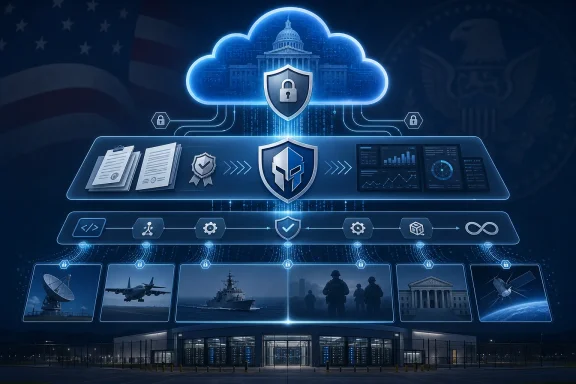 Overview: An ATO Accelerator for Azure Government
The expanded Second Front-Microsoft arrangement centers on helping independent software vendors (ISVs) deploy workloads into Azure Government and other accredited Microsoft cloud environments. Second Front describes Game Warden as a managed DevSecOps platform that packages deployment and operation practices around the compliance expectations of government customers.The timing is significant. Commercial software providers increasingly want to sell analytics, automation, AI, cyber defense, logistics, collaboration, and mission applications to public-sector buyers. But the federal market imposes a reality that is unfamiliar to many conventional SaaS companies: shipping a functional application is only the beginning.
A vendor may still need to demonstrate how its application handles identity, access, encryption, logging, vulnerability management, incident response, configuration control, supply-chain security, data flows, and continuous monitoring. That evidence must align with the customer’s applicable risk framework and its authorizing official’s tolerance for risk.
The ATO Accelerator is positioned as a practical answer to that operational challenge. Rather than requiring each ISV to construct an entirely separate compliant hosting and operational model, the vendor can deploy through an existing platform intended to provide a reusable set of controls and evidence-generation capabilities.
Second Front says Game Warden can help software suppliers progress from a commercial product toward deployment in demanding government environments. Microsoft, meanwhile, provides the Azure Government foundation, where eligible services can support federal compliance requirements and selected Department of Defense impact levels. Azure Government’s FedRAMP High scope includes US Gov Arizona, US Gov Texas, and US Gov Virginia, while its broader catalog documents support for different DoD authorization scopes on a service-by-service basis.
Why the ATO Process Remains a Major Software Delivery Problem
An Authority to Operate is not a simple certificate attached to a product. Under the federal Risk Management Framework, an ATO represents an authorizing official’s decision to accept the security and privacy risk associated with operating a system for a defined purpose and environment.That distinction is essential. An ATO is tied to the system boundary, deployed architecture, data classification, operational processes, inherited controls, integrations, and mission use case. A vendor cannot realistically assume that a prior authorization, a cloud provider’s authorization, or another agency’s decision automatically transfers without review.
The underlying process includes far more than deploying a container or publishing an application image. In broad terms, a government-ready delivery effort must account for:
- System categorization based on the potential effect of a loss of confidentiality, integrity, or availability.
- Security control selection and inheritance, including clarity about which controls belong to the cloud provider, platform operator, application vendor, and government customer.
- Implementation evidence showing that required safeguards are actually configured and operating.
- Independent assessment and remediation, including treatment of discovered weaknesses.
- Authorization package preparation, often involving system security plans, assessment reports, plans of action and milestones, and supporting artifacts.
- Continuous monitoring after deployment, because authorization is not a one-time event.
The Difference Between Faster and Automatic
The phrase “accelerate ATO” can be misunderstood, particularly by vendors new to federal procurement. Acceleration should mean less duplicated work, clearer technical baselines, better automation, more reliable evidence collection, and a stronger pathway to a customer’s authorization process.It does not mean that every deployed workload is immediately approved for every agency, classification level, data type, or mission. The agency still owns its mission risk. It may impose additional controls, restrict integrations, require a different impact categorization, or reject an architecture that does not fit its policies.
That is not a flaw in the model. It is an inherent feature of federal security governance. The more credible interpretation of the Second Front-Microsoft initiative is that it can reduce the amount of work that begins from zero, not eliminate the work that requires accountable human judgment.
What Game Warden Brings to the Microsoft Cloud Relationship
Second Front’s Game Warden is marketed as a managed platform for delivering commercial software into government environments. It combines infrastructure, deployment workflows, compliance operations, monitoring, and a framework for producing authorization-relevant artifacts.The platform’s importance rests on its attempt to standardize an area where many vendors still rely on manual consulting engagements, custom documentation, separate compliance environments, and lengthy handoffs between software engineering, security teams, assessors, integrators, and agency officials.
Game Warden is intended to support the full lifecycle rather than only the initial deployment. That includes the difficult operational phase that follows authorization: keeping systems patched, monitoring changes, maintaining vulnerability visibility, generating updated evidence, and preserving an auditable configuration baseline.
Second Front advertises Game Warden as capable of automating and simplifying parts of the DoD ATO process, including the generation of compliant evidence packages. It also positions the product as a multi-cloud delivery layer with existing relationships across AWS, Google Cloud, and Microsoft.
FedRAMP High Changes the Conversation
A major enabling factor is Game Warden’s FedRAMP High ATO, announced in August 2025. FedRAMP High is intended for cloud systems handling some of the government’s most sensitive unclassified information, where losses of confidentiality, integrity, or availability could have severe or catastrophic consequences.The difference between Moderate and High is consequential. FedRAMP High carries a more demanding control baseline, deeper expectations for protection and monitoring, and an audience that includes systems supporting areas such as law enforcement, emergency services, financial operations, and health-related functions. FedRAMP categorizes cloud services across Low, Moderate, and High impact levels based on the potential adverse effect of security failures.
For a commercial vendor, the appeal is straightforward. Building an application atop a platform with a relevant authorization can create an opportunity to inherit a significant body of common controls. The vendor still has responsibilities, but it does not necessarily need to recreate every foundational capability independently.
This can be particularly meaningful for smaller ISVs. A startup with a strong product but limited compliance operations capacity may struggle to establish a standalone FedRAMP High environment, mature continuous-monitoring operation, and federal delivery organization before its first government contract. A managed route may reduce that initial barrier.
Multi-Cloud Experience, Microsoft-Specific Momentum
Second Front’s broader strategy is not limited to Microsoft. Game Warden became available for FedRAMP High environments on Google Cloud following its 2025 authorization, adding to a wider effort to offer deployment paths across multiple hyperscale providers.That cross-cloud history is relevant because government buyers and systems integrators rarely operate in a single, uniform environment. A vendor may encounter civilian Azure Government customers, defense workloads in a more tightly controlled environment, an allied-nation requirement, or a program using another major cloud provider. The ability to preserve software delivery patterns across those boundaries is strategically valuable.
At the same time, the Microsoft relationship has distinct importance. The Windows, Microsoft 365, Entra, Azure DevOps, GitHub, Power Platform, SQL Server, and Azure AI ecosystems remain deeply embedded across government and the defense industrial base. An Azure Government-focused accelerator gives Microsoft-aligned ISVs a more direct compliance-oriented route from familiar development tools to government deployment.
Azure Government Is an Inheritance Foundation, Not a Complete Application Authorization
Azure Government already provides an important compliance foundation. Microsoft documents Azure Government FedRAMP High provisional authorization coverage for its designated US Government regions and maintains published service audit scopes across FedRAMP High and multiple DoD impact levels.However, cloud authorization should never be confused with application authorization. Microsoft explicitly notes that customers can use Azure or Azure Government FedRAMP High authorization as a foundation for their own ATO efforts, but still need appropriate authorizations for components beyond those cloud services.
This distinction is one of the most important practical lessons for IT leaders evaluating the new collaboration.
Shared Responsibility Becomes Shared Evidence
In a conventional commercial cloud project, shared responsibility is often described in simple terms: the provider secures the cloud, while the customer secures its workloads and data. In government environments, the same principle applies, but the evidence burden is far more formal.A credible authorization package needs to establish:
- Which controls are inherited from Azure Government.
- Which controls are inherited from Game Warden.
- Which controls remain the responsibility of the application provider.
- Which operational decisions belong to the agency mission owner.
- How data moves across application components, APIs, identity providers, monitoring tools, and external services.
- How changes are approved, tested, documented, monitored, and potentially reassessed.
If it merely creates another abstraction layer, it could have the opposite effect. Security teams do not approve a logo diagram or a marketplace listing. They approve a clearly bounded system whose controls, dependencies, data flows, operational responsibilities, and residual risks they can understand.
Azure Service Availability Still Matters
Not every Azure service is available in every government region or included in every authorization scope. Even when a service exists in Azure Government, its availability at a particular FedRAMP or DoD impact level can vary.Microsoft’s published scope documentation also notes that some services in US Government regions require additional configuration to meet DoD Impact Level 5 compute and storage isolation requirements.
That creates an important due-diligence requirement for ISVs. Before promising a specific architecture to a government customer, vendors must validate more than the platform’s general compliance posture. They need to check:
- Whether every required Azure service is available in the target region.
- Whether each service is in scope for the intended authorization level.
- Whether the intended data type and mission use are permitted.
- Whether the architecture needs additional isolation or network controls.
- Whether third-party dependencies can operate inside the required boundary.
- Whether AI services, logging platforms, identity integrations, and development pipelines meet the relevant requirements.
Why This Matters for AI and Modern DevSecOps
The collaboration is being framed partly around delivering advanced AI and DevSecOps capabilities to government environments. That focus is logical. Agencies want access to commercial innovation, while software vendors want to ship updates fast enough to remain competitive. Yet AI also amplifies the compliance challenge.Traditional applications already require careful control over identity, data retention, encryption, dependencies, configuration, and logging. AI-enabled applications add questions around model provenance, prompt and response handling, data residency, inference endpoints, retrieval pipelines, content filtering, training data, model updates, and the risk of sensitive information leaking into an external service.
A secure government AI architecture therefore needs more than an approved foundation model. It needs a documented operational model.
A Better DevSecOps Path Could Be the Most Valuable Outcome
The most promising aspect of an integrated platform approach is not the initial deployment. It is the potential to operationalize continuous authorization principles through DevSecOps.In an ideal implementation, a software update could trigger:
- Automated security scanning.
- Software bill of materials generation or refresh.
- Dependency analysis.
- Infrastructure-as-code validation.
- Container image verification.
- Policy checks against approved configurations.
- Test results and deployment records.
- Updated system documentation and evidence artifacts.
- Monitoring baselines after release.
The difficulty is organizational as much as technical. Teams must define which changes are routine, which are significant, who reviews exceptions, and when a release should trigger further assessment. FedRAMP guidance treats a significant change as one likely to substantively affect a system’s security or privacy posture, reinforcing why rapid delivery must be paired with disciplined change governance.
Strengths of the Expanded Second Front-Microsoft Collaboration
The announcement has several notable strengths, particularly for Microsoft-centric software vendors that have struggled to enter the federal market.A More Concrete Route to Azure Government
Many government-market strategies fail because “deploy to Azure Government” is treated as a deployment destination rather than an operating model. The new accelerator shifts the discussion toward a managed path that includes compliance and ongoing operations.That is a meaningful evolution. It recognizes that government readiness requires more than choosing the correct Azure tenant or region.
Reduced Duplication for ISVs
A reusable platform can reduce repeated work across vendors and deployments. Common infrastructure controls, compliance processes, and monitoring capabilities can potentially be established once and reused in a disciplined way.For ISVs, this may preserve engineering focus. Instead of redirecting product teams toward building an entire bespoke compliance platform, they can invest more attention in their software’s mission value, integrations, user experience, and application-level security.
Better Alignment With Microsoft-Centric Government Environments
The collaboration should be particularly attractive to vendors whose products already depend on Microsoft technologies. That can include workloads using Azure-native services, Entra ID, Windows-oriented management practices, Microsoft security tooling, or integrations with broader Microsoft government cloud environments.It may also help systems integrators that need repeatable ways to introduce commercial capabilities into existing Microsoft-heavy programs without reinventing their delivery architecture each time.
Stronger Operational Emphasis
The inclusion of monitoring and deployment operations is critical. Government software does not become secure merely because it has passed an initial assessment. Continuous monitoring, vulnerability management, patching, incident response, and controlled change management are the processes that determine whether the initial authorization remains meaningful.Risks, Limits, and Questions That Should Not Be Ignored
The collaboration is promising, but success should not be assumed. The government authorization process is complex precisely because the consequences of weak security can be serious.The “Accelerated” Claim Needs Measurable Boundaries
Vendors should ask what acceleration means in a specific engagement. Is it measured from a completed application security package to production deployment? From contract award to agency authorization? From initial architecture design to an assessable system boundary?A platform may shorten one portion of the timeline while leaving procurement, sponsorship, data agreements, integration testing, agency staffing, and final risk acceptance unchanged. Those factors remain material and can still take substantial time.
Inheritance Does Not Eliminate Vendor Accountability
Application teams remain responsible for their own code, identities, secrets, data handling, interfaces, dependencies, and operational decisions. A vendor that assumes platform inheritance removes the need for secure software engineering will create a dangerous gap.The most successful users will treat Game Warden and Azure Government as force multipliers for mature practices, not as substitutes for them.
Platform Dependency Can Become Strategic Dependency
Adopting a managed delivery platform can create lock-in at the compliance and operational layers. That does not necessarily make the decision wrong, but it should be evaluated deliberately.ISVs should understand how portable their deployment definitions, evidence artifacts, observability data, secrets-management procedures, and application configurations will be if their requirements change. A multi-cloud platform strategy can mitigate some of that risk, but portability must be validated in practice rather than inferred from marketing language.
Classified Workloads Remain a Different Challenge
The announcement describes a route spanning civilian to classified environments, but those environments are not interchangeable. Different classification levels, missions, networks, data types, personnel requirements, and operational constraints can alter the authorization calculus substantially.A vendor should avoid treating an unclassified FedRAMP High deployment as a simple stepping stone to every classified program. The foundational practices may transfer, but the technical boundary and approval process can change dramatically.
What ISVs Should Do Before Joining an ATO Accelerator
For software vendors considering the expanded collaboration, the most productive approach is to arrive with a clear understanding of their application and target customer.Start With the System Boundary
Document the application’s architecture in operational terms, not only developer terms. Identify data stores, APIs, external dependencies, identity flows, administrative interfaces, CI/CD components, monitoring systems, support access, and all paths where sensitive information could enter or leave the boundary.A clean boundary is easier to secure, easier to explain, and easier to authorize.
Establish an Honest Responsibility Matrix
Before inheriting any controls, identify who owns each responsibility. The answer should be explicit for encryption, backup, logging, alerting, vulnerability remediation, incident response, access reviews, key rotation, image scanning, patching, and evidence maintenance.Ambiguity is one of the largest enemies of a successful government deployment.
Design for Minimalism
Government architectures often become harder to authorize when they accumulate unnecessary managed services, opaque third-party dependencies, and external integrations. Use only the services required to deliver the mission outcome.Every added component expands the attack surface, evidence burden, change-management scope, and potential list of unavailable or non-authorized services.
Build Continuous Monitoring Into the Product Plan
Do not wait until the first agency assessment to think about logs, alerts, vulnerability workflows, and software supply-chain evidence. These need to be part of the product’s operational design from the beginning.The strongest federal SaaS vendors are not those that can assemble a compliance package once. They are those that can maintain a credible security posture through frequent updates, changing threats, and demanding mission requirements.
The Bigger Picture: Government Software Delivery Is Becoming a Platform Problem
Second Front and Microsoft are responding to a broad market reality. Government agencies want to consume commercial software with something closer to commercial speed, but they cannot abandon the security and accountability obligations attached to public missions.The answer is unlikely to be a single new policy, cloud region, compliance checklist, or marketplace listing. It is more likely to be a combination of reusable authorized platforms, well-defined control inheritance, automated evidence generation, disciplined DevSecOps, and mission owners willing to adopt more consistent authorization practices.
That is why the Second Front-Microsoft expansion deserves attention. It addresses the operational middle ground between a hyperscale cloud provider’s authorization and a specific software vendor’s mission deployment. That middle ground has historically been costly, manual, and fragmented.
For Azure Government customers and Microsoft-focused ISVs, the opportunity is to turn compliance from a late-stage obstacle into part of the delivery system itself. The caution is equally clear: faster authorization only has lasting value when it preserves the rigor of risk-based decision-making. A truly successful ATO Accelerator will not make government security easier by lowering the bar; it will make secure, evidence-driven delivery more repeatable without weakening the bar that protects the mission.
References
- Primary source: ExecutiveBiz
Published: 2026-07-23T14:10:33+00:00
Loading…
www.executivebiz.com - Official source: learn.microsoft.com
Loading…
learn.microsoft.com - Official source: nvlpubs.nist.gov
Loading…
nvlpubs.nist.gov - Referenced source: secondfront.com
Loading…
www.secondfront.com - Referenced source: fedramp.gov
Loading…
www.fedramp.gov - Related coverage: globenewswire.com
Loading…
www.globenewswire.com