

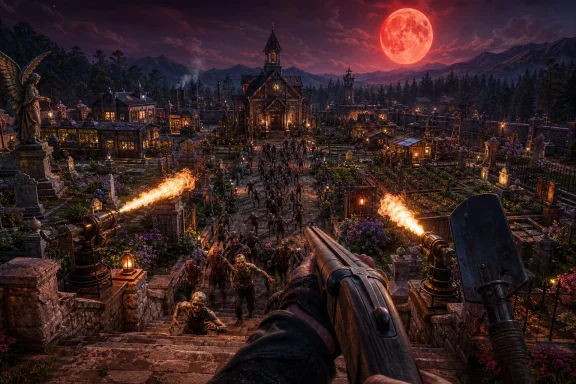
Zombie Graveyard Simulator brings an unusual blend of graveyard management, base building, first-person zombie combat, farming, and business simulation to Xbox, giving players a decidedly different answer to the familiar survival-game formula. Rather than scavenging through a ruined city or defending a generic fortress, players are tasked with running a functioning cemetery by day—then protecting it from the reanimated dead after nightfall.
The Xbox version arrives with several platform-facing advantages that matter to console players: it is optimized for Xbox Series X|S, supports Smart Delivery, includes Xbox Play Anywhere, and offers cloud saves and Xbox achievements. It is also a strictly single-player experience, positioning the game as a more personal, systems-driven survival sandbox rather than a cooperative zombie shooter.
Its central idea is instantly understandable but deceptively busy. The dead need to be buried or cremated, visitors need reassurance that their loved ones are properly cared for, facilities must be maintained, employees need management, crops need tending, and defenses must be ready before darkness arrives. Every system feeds into the next, turning what initially looks like a quirky simulator into a game about prioritization under constant pressure.
At its core, Zombie Graveyard Simulator asks players to transform a modest burial ground into a sustainable, defensible operation. Bodies arrive, graves must be prepared, cremations need to be handled, and family members return to inspect how the site is being maintained. The game’s business layer is therefore not merely decorative; visitor satisfaction is tied directly to the player’s ability to finance growth.
That premise gives the game a stronger identity than a conventional wave-defense title. The graveyard is not simply a battlefield where zombies happen to attack. It is a workplace, a public space, a production site, a farm, a chapel complex, and eventually a fortified survival outpost.
The tone walks a careful line between grim subject matter and accessible simulation design. There are flowers, benches, pathways, decorations, candles, urns, sermons, and souvenir items, but these peaceful elements exist alongside flamethrower turrets, ammunition stockpiles, zombie research, and nightly attacks. That contrast is the game’s defining hook.
For Xbox players looking for a simulation game with more immediate action than a standard city builder, the result could be appealing. Zombie Graveyard Simulator does not ask players to choose between building and fighting; it makes both responsibilities essential.
This creates a natural rhythm:
That creates a useful tension between spending on expansion and spending on survival. A player who builds a larger cemetery without improving defenses may gain access to more revenue opportunities, but may also create a more vulnerable operation. Conversely, excessive investment in barriers and weapons may protect the graveyard yet slow the commercial development needed to sustain long-term upgrades.
This means cosmetic improvements are not necessarily superficial. Benches, lights, pathways, flowers, custom urns, and other decorative elements serve a practical purpose by supporting the cemetery’s reputation. The game treats atmosphere as a management resource.
The chapel broadens that system further. Visitors can rest, attend sermons, and browse a souvenir shop stocked with small keepsakes such as candles and incense. These details help the cemetery feel like a functioning venue instead of a simple queue of graves and machines.
For players who enjoy optimizing layouts, the potential appeal is clear. A well-organized cemetery may reduce travel time for staff, make critical facilities easier to reach, create more coherent visitor routes, and improve the visual character of the grounds at the same time.
The most notable facilities include:
This is a sensible addition to a management game built around self-sufficiency. It gives the cemetery a stronger sense of place and helps the player feel that the operation is becoming increasingly industrialized over time.
The same applies to the game’s water and production systems. These may sound like minor logistical details, but they can become the difference between a reactive management game and one that rewards deliberate planning. A cemetery that is well supplied and properly staffed should be more resilient when an unexpected zombie wave or special event interrupts normal operations.
The defensive toolkit ranges from basic physical obstacles to more advanced automated hardware. Players can rely on barriers such as barbed wire and fences, then progress toward stronger systems including flamethrower turrets. Repairs, ammunition, and equipment upkeep matter, meaning a defensive line is not something players can build once and ignore indefinitely.
That is a welcome design choice. Too many base-building games turn defenses into a solved problem once the player reaches a certain technological tier. Requiring repairs and ammo management keeps the defensive side connected to the broader economy.
The inclusion of a loyal pet companion adds another layer to nighttime defense. Companion mechanics can be easy to overstate before players test them at scale, but the feature should make solo encounters feel less isolating and may offer tactical support when the player is overwhelmed.
A pistol may offer a dependable low-cost option, while rifles could help engage threats at range and shotguns may be better suited to close quarters near gates and chokepoints. The shovel, meanwhile, fits the game’s setting perfectly: it is both a tool associated with graveyard work and an emergency melee weapon when ammunition becomes scarce.
Weapons are unlocked and purchased as players level up, adding another progression track. However, the need to buy ammunition introduces a key limitation. Firepower does not eliminate economic pressure; it reinforces it. Every bullet represents a resource decision, and every difficult night can affect how much money remains for cemetery upgrades the following day.
That said, balancing will be crucial. If firearms become overwhelmingly strong, the defense-building layer could lose importance. If weapons feel weak or ammunition costs become punishing, the game could turn its nighttime battles into repetitive chores rather than satisfying survival challenges.
The most successful version of this formula will make every weapon class, defensive structure, staff upgrade, and layout choice feel useful in different circumstances. The game has a promising foundation for that kind of variety, but the depth of its late-game challenge will ultimately determine whether the hybrid design stays engaging.
Flowers can help maintain the cemetery’s appearance and support visitor satisfaction, while food can help sustain the player during demanding workdays and nighttime attacks. It is a straightforward system, but one that fits naturally into the wider economy.
The game also lets players unlock a grinder capable of turning zombie parts into fertilizer. It is a darkly humorous mechanic, but it also demonstrates how thoroughly the game connects its systems. Enemies defeated during defense can potentially become inputs for farming, which can then support flowers, food, income, and the cemetery’s overall appearance.
This kind of circular economy is often what gives management games long-term appeal. Waste becomes a resource, one facility supports another, and a player’s early improvisation can gradually develop into a self-sustaining operation.
The danger is that decoration may become another maintenance obligation rather than a satisfying expression tool. If visitors require constant micro-management of flowers and scenery, some players may find the system overly demanding. On the other hand, if the game provides sensible automation and staff support, decoration could become one of its most rewarding features.
The available staff roles include:
Automation through employees should allow players to shift from performing individual chores to managing systems. That is a natural progression for a business simulation and may be essential for preventing the game from becoming repetitive in its later stages.
A game with burials, cremations, visitors, flower management, donations, chapels, shops, farms, staff, crafting, research, defenses, weapons, ammunition, water, quarry operations, zombie processing, and expeditions has a lot to explain. If the tutorials, menus, and task priorities are unclear, new players may struggle to understand what requires urgent attention.
The game’s strongest design challenge will be maintaining clarity. It needs to tell players when a low flower supply is a cosmetic inconvenience, when it threatens revenue, when a damaged fence creates an immediate survival risk, and when an upgrade is worth delaying for a better defensive purchase.
For fans of detailed simulations, this complexity is likely a selling point. For players expecting a simpler zombie game, it may be a demanding adjustment.
This feature has real potential. Base-management games can become overly static when every meaningful activity occurs on one map. Expeditions provide a way to introduce new goals, new risks, and potentially new resources without abandoning the game’s primary loop.
The concept also reinforces the sense that the cemetery exists within a wider zombie-infested world. The player is not merely defending against isolated raids; they are operating inside a dangerous landscape where opportunities and threats arrive from outside the graveyard.
The exact structure of expeditions will be important. If missions offer meaningful rewards, unusual materials, or progression opportunities that cannot be obtained at home, they could become a valuable part of the game’s long-term loop. If they feel detached from the cemetery systems, players may treat them as optional distractions.
For a simulator that may reward long sessions of base planning and gradual upgrades, that flexibility is valuable. Players can tend to the cemetery from a living-room console setup, then return to the same operation on a Windows PC without starting over.
Cloud saves further reinforce that convenience. Management games often involve substantial time investment, and the ability to preserve progress across supported devices is more than a minor quality-of-life benefit.
The Series X|S optimization is also encouraging given the game’s design. A growing cemetery could contain visitors, employees, decorative objects, automated facilities, defenses, particle-heavy flamethrowers, and large zombie waves all at once. Consistent performance will matter greatly when a busy business simulation turns into an active survival scenario.
It should be particularly interesting for players who enjoy:
Likewise, players seeking a narrative-heavy horror experience may find the management systems more central than storytelling. The premise is built around running and defending a business rather than uncovering an elaborate cinematic mystery.
That interconnected structure is the game’s greatest strength. It suggests a simulation where practical decisions have consequences across the entire operation, from the condition of a flower bed to the availability of ammunition during a Blood Moon attack.
Its biggest risk is also its ambition. With so many systems competing for the player’s attention, the experience will depend heavily on strong onboarding, sensible automation, responsive controls, and a progression curve that remains challenging without becoming exhausting. If those elements come together, the Xbox version could offer one of the more distinctive zombie-management experiences available to players who want both a thriving business and a defensible last line against the undead.
The Xbox version arrives with several platform-facing advantages that matter to console players: it is optimized for Xbox Series X|S, supports Smart Delivery, includes Xbox Play Anywhere, and offers cloud saves and Xbox achievements. It is also a strictly single-player experience, positioning the game as a more personal, systems-driven survival sandbox rather than a cooperative zombie shooter.
Its central idea is instantly understandable but deceptively busy. The dead need to be buried or cremated, visitors need reassurance that their loved ones are properly cared for, facilities must be maintained, employees need management, crops need tending, and defenses must be ready before darkness arrives. Every system feeds into the next, turning what initially looks like a quirky simulator into a game about prioritization under constant pressure.
 Overview: A Cemetery Is Also a Business
At its core, Zombie Graveyard Simulator asks players to transform a modest burial ground into a sustainable, defensible operation. Bodies arrive, graves must be prepared, cremations need to be handled, and family members return to inspect how the site is being maintained. The game’s business layer is therefore not merely decorative; visitor satisfaction is tied directly to the player’s ability to finance growth.That premise gives the game a stronger identity than a conventional wave-defense title. The graveyard is not simply a battlefield where zombies happen to attack. It is a workplace, a public space, a production site, a farm, a chapel complex, and eventually a fortified survival outpost.
The tone walks a careful line between grim subject matter and accessible simulation design. There are flowers, benches, pathways, decorations, candles, urns, sermons, and souvenir items, but these peaceful elements exist alongside flamethrower turrets, ammunition stockpiles, zombie research, and nightly attacks. That contrast is the game’s defining hook.
For Xbox players looking for a simulation game with more immediate action than a standard city builder, the result could be appealing. Zombie Graveyard Simulator does not ask players to choose between building and fighting; it makes both responsibilities essential.
A Day-and-Night Loop Built Around Pressure
The most important structure in the game is its split between daytime administration and nighttime defense. During the day, players are expected to expand their business, process bodies, keep graves presentable, grow resources, hire staff, and upgrade facilities. At night, the focus changes sharply as zombies attack the cemetery and threaten the operation players spent the day developing.This creates a natural rhythm:
- Receive and process the dead.
- Maintain graves and visitor-facing areas.
- Generate income through services, donations, shops, and resource production.
- Invest in staffing, upgrades, defenses, and weapons.
- Prepare for the next zombie assault.
- Repair, replenish, and repeat.
That creates a useful tension between spending on expansion and spending on survival. A player who builds a larger cemetery without improving defenses may gain access to more revenue opportunities, but may also create a more vulnerable operation. Conversely, excessive investment in barriers and weapons may protect the graveyard yet slow the commercial development needed to sustain long-term upgrades.
Visitor Satisfaction Is More Than Decoration
Visitor satisfaction appears to be one of the game’s most important economic systems. Families return to see whether graves remain intact, whether flowers are fresh, and whether the environment feels respectful and inviting. A clean, attractive cemetery can encourage greater donations and create additional financial benefits.This means cosmetic improvements are not necessarily superficial. Benches, lights, pathways, flowers, custom urns, and other decorative elements serve a practical purpose by supporting the cemetery’s reputation. The game treats atmosphere as a management resource.
The chapel broadens that system further. Visitors can rest, attend sermons, and browse a souvenir shop stocked with small keepsakes such as candles and incense. These details help the cemetery feel like a functioning venue instead of a simple queue of graves and machines.
For players who enjoy optimizing layouts, the potential appeal is clear. A well-organized cemetery may reduce travel time for staff, make critical facilities easier to reach, create more coherent visitor routes, and improve the visual character of the grounds at the same time.
Burial, Cremation, and Facility Growth
The management layer goes considerably beyond digging graves. Players can expand burial areas, manage urns through a dedicated urn station, upgrade cremation operations, improve water supply, and develop additional facilities that unlock new forms of production.The most notable facilities include:
- Burial areas for processing and placing bodies
- Crematorium upgrades for expanded cremation capacity
- Urn stations for managing custom urns
- Stone Quarry operations for gathering building materials
- Workshops for crafting gravestones
- Farming areas for flowers and vegetables
- Chapel services for visitors and donations
- Souvenir shops for supplemental revenue
- Zombie Research Labs for processing captured undead
- Expedition Stations for missions beyond the cemetery walls
Crafting Makes Expansion Feel Tangible
The Stone Quarry and Workshop are particularly important because they connect expansion to resource gathering and crafting. Rather than treating gravestones as a purely menu-driven purchase, the game lets players work toward producing them through their own facilities.This is a sensible addition to a management game built around self-sufficiency. It gives the cemetery a stronger sense of place and helps the player feel that the operation is becoming increasingly industrialized over time.
The same applies to the game’s water and production systems. These may sound like minor logistical details, but they can become the difference between a reactive management game and one that rewards deliberate planning. A cemetery that is well supplied and properly staffed should be more resilient when an unexpected zombie wave or special event interrupts normal operations.
The Night Shift: Building Defenses Against Zombie Waves
When darkness falls, the graveyard’s peaceful façade gives way to its survival component. Zombie attacks arrive in waves, with increasing numbers of enemies and specialized zombie types raising the pressure over time. The game also includes special danger states, including events such as a Blood Moon, which suggest that certain nights will demand stronger preparation and a more flexible defense plan.The defensive toolkit ranges from basic physical obstacles to more advanced automated hardware. Players can rely on barriers such as barbed wire and fences, then progress toward stronger systems including flamethrower turrets. Repairs, ammunition, and equipment upkeep matter, meaning a defensive line is not something players can build once and ignore indefinitely.
That is a welcome design choice. Too many base-building games turn defenses into a solved problem once the player reaches a certain technological tier. Requiring repairs and ammo management keeps the defensive side connected to the broader economy.
Defenses Need Logistics, Not Just Firepower
The best defensive strategy is unlikely to be simply placing the most powerful turret in every available spot. A successful graveyard defense should also account for:- Choke points where enemies can be concentrated
- Repair access for damaged fences and machinery
- Ammunition reserves for weapons and automated systems
- Resource production that supports maintenance
- Clear routes for the player to move between attack zones
- Facility placement that keeps vital infrastructure away from breaches
- Emergency fallback positions when an outer line fails
The inclusion of a loyal pet companion adds another layer to nighttime defense. Companion mechanics can be easy to overstate before players test them at scale, but the feature should make solo encounters feel less isolating and may offer tactical support when the player is overwhelmed.
A 13-Plus Weapon Arsenal Changes the Equation
The game advertises an arsenal of more than 13 weapons, including pistols, rifles, shotguns, and a shovel. That variety matters because the combat has to carry its own weight alongside the business simulation systems.A pistol may offer a dependable low-cost option, while rifles could help engage threats at range and shotguns may be better suited to close quarters near gates and chokepoints. The shovel, meanwhile, fits the game’s setting perfectly: it is both a tool associated with graveyard work and an emergency melee weapon when ammunition becomes scarce.
Weapons are unlocked and purchased as players level up, adding another progression track. However, the need to buy ammunition introduces a key limitation. Firepower does not eliminate economic pressure; it reinforces it. Every bullet represents a resource decision, and every difficult night can affect how much money remains for cemetery upgrades the following day.
Combat Is a Strength, but Balance Will Matter
The direct-combat approach is one of the game’s clearest differentiators. Many management simulations can feel methodical to the point of detachment, while many zombie games reduce their progression loops to increasingly powerful weapons. Zombie Graveyard Simulator attempts to keep players involved in both.That said, balancing will be crucial. If firearms become overwhelmingly strong, the defense-building layer could lose importance. If weapons feel weak or ammunition costs become punishing, the game could turn its nighttime battles into repetitive chores rather than satisfying survival challenges.
The most successful version of this formula will make every weapon class, defensive structure, staff upgrade, and layout choice feel useful in different circumstances. The game has a promising foundation for that kind of variety, but the depth of its late-game challenge will ultimately determine whether the hybrid design stays engaging.
Farming, Fertilizer, and the “Cozy” Side of Survival
Despite the zombie premise, Zombie Graveyard Simulator makes room for a calmer form of progression. Players can grow flowers for profit and vegetables for food, with vegetables restoring energy and health. This creates a practical farming loop that supports both the business and survival sides of the experience.Flowers can help maintain the cemetery’s appearance and support visitor satisfaction, while food can help sustain the player during demanding workdays and nighttime attacks. It is a straightforward system, but one that fits naturally into the wider economy.
The game also lets players unlock a grinder capable of turning zombie parts into fertilizer. It is a darkly humorous mechanic, but it also demonstrates how thoroughly the game connects its systems. Enemies defeated during defense can potentially become inputs for farming, which can then support flowers, food, income, and the cemetery’s overall appearance.
This kind of circular economy is often what gives management games long-term appeal. Waste becomes a resource, one facility supports another, and a player’s early improvisation can gradually develop into a self-sustaining operation.
Decoration Has Strategic and Creative Value
Players can decorate the cemetery with items such as:- Benches
- Lights
- Paths
- Custom urns
- Flowers
- Grave markers
- Other ornamental details
The danger is that decoration may become another maintenance obligation rather than a satisfying expression tool. If visitors require constant micro-management of flowers and scenery, some players may find the system overly demanding. On the other hand, if the game provides sensible automation and staff support, decoration could become one of its most rewarding features.
Staff Management Could Define the Late Game
Hiring employees is a major part of the progression model. The game includes specialized roles designed to keep daily operations running while the player handles broader strategy and emergencies.The available staff roles include:
- Florist for flower-related work
- Gravekeeper for burials and cremations
- Gardener for farm upkeep
- Technician for machine maintenance
- Priest for chapel services and sermons
- Pianist for chapel ambience and events
- Custodian for cleaning and facility support
Automation through employees should allow players to shift from performing individual chores to managing systems. That is a natural progression for a business simulation and may be essential for preventing the game from becoming repetitive in its later stages.
The Risk of Too Many Interlocking Systems
The game’s feature list is unusually broad for a single-player simulator. That ambition is exciting, but it also creates some risks.A game with burials, cremations, visitors, flower management, donations, chapels, shops, farms, staff, crafting, research, defenses, weapons, ammunition, water, quarry operations, zombie processing, and expeditions has a lot to explain. If the tutorials, menus, and task priorities are unclear, new players may struggle to understand what requires urgent attention.
The game’s strongest design challenge will be maintaining clarity. It needs to tell players when a low flower supply is a cosmetic inconvenience, when it threatens revenue, when a damaged fence creates an immediate survival risk, and when an upgrade is worth delaying for a better defensive purchase.
For fans of detailed simulations, this complexity is likely a selling point. For players expecting a simpler zombie game, it may be a demanding adjustment.
Expedition Mode Extends the World Beyond the Gates
The cemetery is the central hub, but the game also includes Expedition Mode, unlocked through an Expedition Station. Radio signals lead players to dangerous missions outside the safety of their walls, expanding the experience beyond routine maintenance and nightly defense.This feature has real potential. Base-management games can become overly static when every meaningful activity occurs on one map. Expeditions provide a way to introduce new goals, new risks, and potentially new resources without abandoning the game’s primary loop.
The concept also reinforces the sense that the cemetery exists within a wider zombie-infested world. The player is not merely defending against isolated raids; they are operating inside a dangerous landscape where opportunities and threats arrive from outside the graveyard.
The exact structure of expeditions will be important. If missions offer meaningful rewards, unusual materials, or progression opportunities that cannot be obtained at home, they could become a valuable part of the game’s long-term loop. If they feel detached from the cemetery systems, players may treat them as optional distractions.
Xbox Series X|S Features and What They Mean
The Xbox listing identifies Zombie Graveyard Simulator as optimized for Xbox Series X|S, with Smart Delivery, Xbox Play Anywhere, cloud saves, achievements, and support for 19 languages. Those features make the console version more attractive for players who split their gaming time between Xbox hardware and Windows PCs.Xbox Play Anywhere Is a Meaningful Addition
Xbox Play Anywhere is especially relevant for Windows-focused players. Where eligible, the feature allows a single digital purchase to work across Xbox and Windows PC, with progress and achievements designed to carry between supported platforms.For a simulator that may reward long sessions of base planning and gradual upgrades, that flexibility is valuable. Players can tend to the cemetery from a living-room console setup, then return to the same operation on a Windows PC without starting over.
Cloud saves further reinforce that convenience. Management games often involve substantial time investment, and the ability to preserve progress across supported devices is more than a minor quality-of-life benefit.
Smart Delivery Reduces Upgrade Anxiety
Smart Delivery ensures players receive the appropriate version for their supported Xbox hardware without needing to buy a separate edition. That should remove some uncertainty for players moving between console generations or choosing where to install the game.The Series X|S optimization is also encouraging given the game’s design. A growing cemetery could contain visitors, employees, decorative objects, automated facilities, defenses, particle-heavy flamethrowers, and large zombie waves all at once. Consistent performance will matter greatly when a busy business simulation turns into an active survival scenario.
Who Should Consider Zombie Graveyard Simulator?
The game seems best suited to players who enjoy genre combinations rather than pure examples of a single category. It is not simply a first-person shooter, a farming game, a tower-defense game, or a business simulator. Its appeal lies in how those elements overlap.It should be particularly interesting for players who enjoy:
- Management games with visible growth and facility upgrades
- Zombie survival games that emphasize preparation as much as combat
- Base-building games where layout and logistics matter
- First-person action with unlockable weapons and limited ammunition
- Farming systems that serve a wider economy
- Single-player sandbox experiences with structured progression
- Darkly comic simulation concepts that balance grim themes with cozy details
Likewise, players seeking a narrative-heavy horror experience may find the management systems more central than storytelling. The premise is built around running and defending a business rather than uncovering an elaborate cinematic mystery.
Final Assessment
Zombie Graveyard Simulator on Xbox stands out because it does not treat its strange premise as a one-note joke. The cemetery theme influences nearly every major system: grave maintenance affects visitor satisfaction, visitors generate support for the business, business income funds upgrades, upgrades improve facilities and defenses, defenses repel zombies, and defeated zombies can even feed back into the farming economy.That interconnected structure is the game’s greatest strength. It suggests a simulation where practical decisions have consequences across the entire operation, from the condition of a flower bed to the availability of ammunition during a Blood Moon attack.
Its biggest risk is also its ambition. With so many systems competing for the player’s attention, the experience will depend heavily on strong onboarding, sensible automation, responsive controls, and a progression curve that remains challenging without becoming exhausting. If those elements come together, the Xbox version could offer one of the more distinctive zombie-management experiences available to players who want both a thriving business and a defensible last line against the undead.
References
- Primary source: Microsoft
Published: 2026-07-23T15:42:08.597320
Loading…
www.microsoft.com - Related coverage: store.steampowered.com
Loading…
store.steampowered.com - Related coverage: xbox.com
Loading…
www.xbox.com - Related coverage: threewgames.com
Loading…
www.threewgames.com - Related coverage: gamefaqs.gamespot.com
Loading…
gamefaqs.gamespot.com - Related coverage: mobygames.com
Loading…
www.mobygames.com