

The Incident at Galley House turns a grotesque 1936 mass-death case into a tactile, deeply satisfying act of investigation, using a strange homemade apparatus to make players earn every new fragment of the truth. It is one of the most compelling PC deduction games in recent memory: a murder mystery that trusts observation, note-taking, and lateral thinking far more than objective markers or scripted answers. Yet its strongest qualities also expose a familiar weakness in the genre. Once the most exciting unknowns have been mapped, the work can temporarily become less about solving a mystery than auditing a timeline.
Developed by William Rous and Evil Trout, and published by Evil Trout, The Incident at Galley House arrived on Steam on July 14, 2026. It is a reimagining of Type Help, Rous’s acclaimed free, text-based browser mystery, rebuilt as a more elaborate visual and audio-driven detective experience.
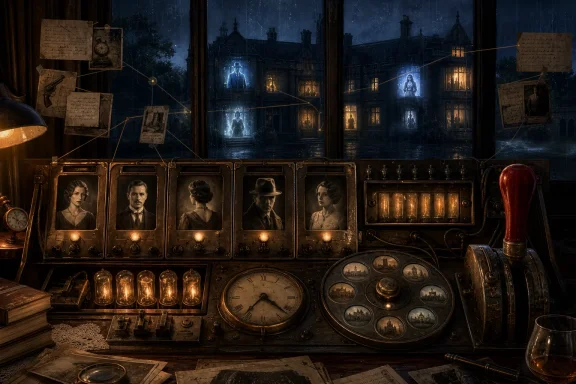
The premise is immediately effective. Decades after a catastrophic night at the titular English manor, the player arrives at the shuttered property carrying an ungainly machine that can replay echoes from the past. The device is equal parts séance equipment, switchboard, and deduction board: a panel of portraits, a location selector, a radio-like time control, indicator bulbs, a code display, and a wonderfully theatrical red lever.
The machine’s appearance matters. Rather than hide its logic behind a conventional menu, The Incident at Galley House makes the act of entering evidence feel physical. Selecting people, a place, and a moment in time becomes an in-world ritual. Pulling the lever is not merely pressing “play”; it is staking a claim that a particular combination of clues is correct.
That simple presentation supports an unusually strong detective-game loop. Learn something in one scene, recognize its implications, configure the machine, and reveal another scene that either confirms a theory or gives the investigation an entirely new direction. The result is a mystery game that makes progress feel discovered rather than granted.
The player is not handed a conventional crime board covered in solved labels. Instead, the early hours are built around uncertainty. Who are these people? Which rooms exist within the house? Where did someone go immediately before a particular confrontation? Who was absent from a scene, and why?
Those are not rhetorical story prompts. They are the game’s actual interface.
To view a memory, the machine requires a three-part solution:
This structure makes The Incident at Galley House feel less like a visual novel with puzzles between scenes and more like an archaeological dig. The player does not simply uncover story beats in a curated sequence. They reconstruct a living arrangement of movements, motives, and contradictions.
Perhaps a character says they were in the conservatory shortly before dinner. Perhaps another figure mentions meeting two particular guests at an unusual hour. Perhaps an unnamed silhouette can be identified by connecting the limited information in a police report with a line of dialogue heard elsewhere. Once those details click together, the machine can be tuned accordingly.
Then comes the lever.
It is a small flourish, but one that reinforces the game’s central achievement: deduction has texture. A correct scene code does not feel like entering a password found under a nearby lamp. It feels like the outcome of genuine reasoning.
That is increasingly rare in mystery games. Many detective titles make players collect evidence, then flatten that evidence into a dialogue-wheel choice or a final multiple-choice quiz. The Incident at Galley House instead lets knowledge itself serve as the key. If the player understands the event, they can reach it.
The game does not need to announce that an answer was “clever.” The next scene is the reward.
That approach had clear strengths. A text interface naturally encouraged players to become active participants, jotting down codes, tracking names, and constructing their own working models of events. It also created a compelling illusion that the player had stumbled onto a system not quite meant for them.
But it placed substantial administrative work outside the game.
A player could reasonably end up with a notebook, a spreadsheet, a mess of browser tabs, or all three. Tracking which character appeared at which moment, matching room abbreviations, and documenting the night’s order could become a separate challenge. For some deduction-game purists, that friction is part of the appeal. For others, one mistaken note could create a chain of false assumptions that felt more exhausting than enlightening.
The Incident at Galley House wisely preserves the intellectual core while removing much of the clerical burden.
The terminal can help players:
For Windows PC players, this design is especially welcome. The game remains ideally suited to a mouse-and-keyboard setup, where jumping between the machine, evidence terminal, and personal notes is fast and natural. It has the feel of working through a case file at a desk, rather than moving through a traditional adventure-game map.
The interface also recognizes an essential truth about modern puzzle-game design: accessibility is not the same as simplification. Reducing bookkeeping can make the reasoning more visible, not less.
At first, scenes are populated by anonymous, person-shaped silhouettes. The player can hear the conversations and grasp the broad action, but the cast is not automatically attached to a face. Character identification becomes its own puzzle, involving photographs, contextual clues, and the limited details available from the initial reports.
As profiles become more complete, scenes gain visual clarity. Figures once rendered as generic shadows are replaced with identifiable people. This makes every successful assignment feel meaningful, because the player is not merely filling out a database. They are literally making the past more legible.
That design is one of the game’s strongest thematic choices. The process of detection becomes a process of restoring identity to the dead. Faces, names, relationships, and histories gradually re-enter the scenes where they once appeared only as unknowable forms.
A transcript can tell the player that someone hesitated before answering. Voice acting and visual staging can make that hesitation feel suspicious. A line about a person’s destination can sound casual in text but become charged when delivered in a particular emotional register. A room that sounds innocuous in a notebook becomes easier to mentally place once it has an illustrated identity.
The transition from text to voiced scenes also changes the tempo of investigation. The player is no longer only parsing information; they are watching performances, listening for inflection, and storing visual memories. That makes the central mystery more atmospheric without turning it into a passive narrative experience.
The art style may not have the lavish detail of a big-budget historical thriller, but it does not need to. Galley House works because its presentation supports clarity and unease. The house is a functional puzzle space, a crime scene, and a stage for personal secrets, all at once.
The early game is full of abundance. New characters appear. Fresh rooms are named. Seemingly incidental lines turn into possible routes through the timeline. A single discovery can create several plausible leads, and the player is constantly deciding which thread deserves attention first.
This is where the game joins the best modern detective games. Like Her Story, Telling Lies, The Return of the Obra Dinn, and Evil Trout’s own The Roottrees Are Dead, it creates a uniquely satisfying relationship between player understanding and forward movement. The player is not only receiving story information. They are reorganizing it.
However, the later middle section reveals the recurring structural issue faced by many games built around deduction.
At that point, the emotional texture changes.
Instead of asking, “What kind of story is this?” or “What could possibly have happened here?”, the player can begin asking, “Which unexplored interval should be filled next?” That is still deduction, but it is a colder, more systematic form of deduction.
Some scenes exist primarily to complete a person’s timeline or establish that they were alone. These moments can be useful in aggregate, but they do not always deliver the same narrative charge as the early discoveries. The player may spend time checking combinations because a record has a gap, not because a clue has sparked a thrilling new theory.
This is not a unique problem to The Incident at Galley House. It is arguably the classic problem of the deduction-game genre.
A well-made mystery needs enough evidence to be solvable. Yet the more complete the player’s information becomes, the easier it is for the investigation to turn into procedural cleanup. A game can protect against brute-force guessing, but it cannot fully prevent the experience of filling in remaining blanks once the shape of the answer is visible.
That shift is important because it stops the case from ending as a purely mechanical reconstruction of who stood where at each minute. It reminds the player that the story has larger stakes than simply closing every open box on a timeline.
The exact nature of that escalation is best left undisclosed. The game deserves to be experienced with as little advance knowledge as possible. What matters is that Galley House finds a way to return the player to the more fertile mental state of the opening: not merely locating facts, but revising their understanding of the entire case.
Still, the temporary slog is real. Players who enjoy exhaustive note-taking and methodical elimination will likely see it as the natural cost of a rigorous mystery. Players who want constant revelations may find the central stretch less elegant than the beginning and end.
The Incident at Galley House takes a measured approach. Its optional assistance begins with relatively gentle nudges toward unresolved connections and can become more explicit if a player chooses to ask for additional clarity. It can also indicate the number of leads associated with undiscovered scenes, giving players a sense of whether they are genuinely stuck or simply overlooking information already in their possession.
That last detail is more valuable than it appears.
A common frustration in open-ended mystery games is uncertainty about uncertainty. Has the player missed a clue? Is a scene available now? Is the next step a difficult logical leap, or does it require information that has not yet been revealed? A system that communicates the state of an investigation without revealing the solution can prevent needless brute force.
The option to disable more overt guidance is equally important. Experienced players who want the rawest possible form of the mystery can retain that uncertainty. Newcomers can use the support tools without feeling that the game has solved itself for them.
This is thoughtful PC game design: tools are available, but player agency remains central.
That should make it a suitable choice for a wide range of Windows PCs, including older gaming systems and many general-purpose desktops. It is also built in the Godot Engine, and its presentation avoids the kind of high-end rendering features that can make small narrative games unexpectedly demanding.
Although it is marketed heavily to the PC audience, the game is not limited to Windows. It also supports macOS and Linux, and it is verified for Steam Deck. That wider compatibility is a welcome bonus for players who move between systems or prefer a handheld detective-game session.
That patch activity reflects a positive commitment to early support, particularly for a game that relies so heavily on text input, clue visibility, and interface precision. In a deduction title, even a small issue with a saved note, highlighted room name, or input field can disrupt the entire experience.
The risk is that players who launch immediately may encounter some rough edges that later patches have already addressed. Anyone experiencing odd audio output, keyboard-input trouble, or an apparent inability to progress should ensure the game is fully updated before assuming the mystery itself is at fault.
A notebook is not mandatory, thanks to the improved in-game tools, but it remains enjoyable. There is a particular pleasure in creating an untidy web of relationships, noting an unexplained remark, crossing out a theory, then returning an hour later to find that the discarded thought was almost right.
The game encourages a mode of play that many modern releases avoid. It is not about reflexes, build optimization, map completion, or collecting resources. It is about forming an interpretation of events and continually testing that interpretation against new evidence.
That makes it an excellent recommendation for fans of:
The story is deliberately best approached without spoilers, but the game’s structure alone is worth celebrating. It understands that a mystery is not simply a sequence of revelations. It is a system of relationships, absences, timelines, and assumptions that the player must learn to see.
Its central limitation is also an instructive one. Like many of the best games in this field, The Incident at Galley House occasionally loses momentum after the player has charted the mystery’s basic territory. The work of tracing every remaining movement can feel like inventory management rather than revelation. That middle-game drag does not ruin the case, especially because the game later finds ways to restore tension and reframe the investigation, but it prevents the experience from being perfectly paced.
Even so, this is a remarkable Windows deduction game: thoughtful, atmospheric, mechanically distinctive, and confident enough to let players feel genuinely clever. Galley House may not solve the genre’s oldest structural problem, but it demonstrates just how enthralling the genre can be while wrestling with it.
 Overview
Developed by William Rous and Evil Trout, and published by Evil Trout, The Incident at Galley House arrived on Steam on July 14, 2026. It is a reimagining of Type Help, Rous’s acclaimed free, text-based browser mystery, rebuilt as a more elaborate visual and audio-driven detective experience.The premise is immediately effective. Decades after a catastrophic night at the titular English manor, the player arrives at the shuttered property carrying an ungainly machine that can replay echoes from the past. The device is equal parts séance equipment, switchboard, and deduction board: a panel of portraits, a location selector, a radio-like time control, indicator bulbs, a code display, and a wonderfully theatrical red lever.
The machine’s appearance matters. Rather than hide its logic behind a conventional menu, The Incident at Galley House makes the act of entering evidence feel physical. Selecting people, a place, and a moment in time becomes an in-world ritual. Pulling the lever is not merely pressing “play”; it is staking a claim that a particular combination of clues is correct.
That simple presentation supports an unusually strong detective-game loop. Learn something in one scene, recognize its implications, configure the machine, and reveal another scene that either confirms a theory or gives the investigation an entirely new direction. The result is a mystery game that makes progress feel discovered rather than granted.
A Manor Full of Echoes
Galley House is the site of multiple deaths on a single night in March 1936. A newspaper clipping provides the broad outline: several people died, some by causes that seem readily apparent and others in circumstances that remain disturbingly unclear. The house, the victims, and the timeline are all incomplete at the beginning.The player is not handed a conventional crime board covered in solved labels. Instead, the early hours are built around uncertainty. Who are these people? Which rooms exist within the house? Where did someone go immediately before a particular confrontation? Who was absent from a scene, and why?
Those are not rhetorical story prompts. They are the game’s actual interface.
To view a memory, the machine requires a three-part solution:
- A time code
- A location
- The identities of the people present
This structure makes The Incident at Galley House feel less like a visual novel with puzzles between scenes and more like an archaeological dig. The player does not simply uncover story beats in a curated sequence. They reconstruct a living arrangement of movements, motives, and contradictions.
The Pleasure of a Correct Deduction
The game’s best moments occur when a vague, half-formed suspicion becomes a usable code.Perhaps a character says they were in the conservatory shortly before dinner. Perhaps another figure mentions meeting two particular guests at an unusual hour. Perhaps an unnamed silhouette can be identified by connecting the limited information in a police report with a line of dialogue heard elsewhere. Once those details click together, the machine can be tuned accordingly.
Then comes the lever.
It is a small flourish, but one that reinforces the game’s central achievement: deduction has texture. A correct scene code does not feel like entering a password found under a nearby lamp. It feels like the outcome of genuine reasoning.
That is increasingly rare in mystery games. Many detective titles make players collect evidence, then flatten that evidence into a dialogue-wheel choice or a final multiple-choice quiz. The Incident at Galley House instead lets knowledge itself serve as the key. If the player understands the event, they can reach it.
The game does not need to announce that an answer was “clever.” The next scene is the reward.
A Smart Evolution of Type Help
The relationship between Type Help and The Incident at Galley House is important because it clarifies why this adaptation works so well. The original was a barebones, terminal-styled mystery that asked players to investigate files tied to the Galley House case. Its deliberately sparse presentation made the case feel like something being pulled from an old, unreliable computer system.That approach had clear strengths. A text interface naturally encouraged players to become active participants, jotting down codes, tracking names, and constructing their own working models of events. It also created a compelling illusion that the player had stumbled onto a system not quite meant for them.
But it placed substantial administrative work outside the game.
A player could reasonably end up with a notebook, a spreadsheet, a mess of browser tabs, or all three. Tracking which character appeared at which moment, matching room abbreviations, and documenting the night’s order could become a separate challenge. For some deduction-game purists, that friction is part of the appeal. For others, one mistaken note could create a chain of false assumptions that felt more exhausting than enlightening.
The Incident at Galley House wisely preserves the intellectual core while removing much of the clerical burden.
The In-Game Investigation Terminal
A second computer terminal provides the game’s most important quality-of-life improvement. It organizes discovered information into accessible views without solving the case on the player’s behalf.The terminal can help players:
- Review a timeline of known events
- Inspect scenes connected to a particular time
- Check a character’s appearances in chronological order
- Identify gaps in a person’s movements
- Review locations and the scenes associated with them
- Keep track of unresolved leads
- Use an optional hint framework when an investigation stalls
For Windows PC players, this design is especially welcome. The game remains ideally suited to a mouse-and-keyboard setup, where jumping between the machine, evidence terminal, and personal notes is fast and natural. It has the feel of working through a case file at a desk, rather than moving through a traditional adventure-game map.
The interface also recognizes an essential truth about modern puzzle-game design: accessibility is not the same as simplification. Reducing bookkeeping can make the reasoning more visible, not less.
Silhouettes, Corpses, and Character Identification
The visual upgrade over Type Help does more than make Galley House look more expensive. It introduces another layer of deduction.At first, scenes are populated by anonymous, person-shaped silhouettes. The player can hear the conversations and grasp the broad action, but the cast is not automatically attached to a face. Character identification becomes its own puzzle, involving photographs, contextual clues, and the limited details available from the initial reports.
As profiles become more complete, scenes gain visual clarity. Figures once rendered as generic shadows are replaced with identifiable people. This makes every successful assignment feel meaningful, because the player is not merely filling out a database. They are literally making the past more legible.
That design is one of the game’s strongest thematic choices. The process of detection becomes a process of restoring identity to the dead. Faces, names, relationships, and histories gradually re-enter the scenes where they once appeared only as unknowable forms.
Visual Novel Presentation With a Purpose
The game adopts a visual novel-like format, with illustrated environments and character-focused scenes. This may initially sound like a conventional modernization, but the visuals do significant narrative work.A transcript can tell the player that someone hesitated before answering. Voice acting and visual staging can make that hesitation feel suspicious. A line about a person’s destination can sound casual in text but become charged when delivered in a particular emotional register. A room that sounds innocuous in a notebook becomes easier to mentally place once it has an illustrated identity.
The transition from text to voiced scenes also changes the tempo of investigation. The player is no longer only parsing information; they are watching performances, listening for inflection, and storing visual memories. That makes the central mystery more atmospheric without turning it into a passive narrative experience.
The art style may not have the lavish detail of a big-budget historical thriller, but it does not need to. Galley House works because its presentation supports clarity and unease. The house is a functional puzzle space, a crime scene, and a stage for personal secrets, all at once.
The Genre’s Central Challenge: Discovery Versus Completion
For much of its opening stretch, The Incident at Galley House is exhilarating.The early game is full of abundance. New characters appear. Fresh rooms are named. Seemingly incidental lines turn into possible routes through the timeline. A single discovery can create several plausible leads, and the player is constantly deciding which thread deserves attention first.
This is where the game joins the best modern detective games. Like Her Story, Telling Lies, The Return of the Obra Dinn, and Evil Trout’s own The Roottrees Are Dead, it creates a uniquely satisfying relationship between player understanding and forward movement. The player is not only receiving story information. They are reorganizing it.
However, the later middle section reveals the recurring structural issue faced by many games built around deduction.
When a Mystery Becomes a Checklist
Eventually, the broad dimensions of the case come into focus. The player has identified most major locations. The central cast is no longer mysterious. The game’s time structure is sufficiently clear that remaining unknowns can be framed as missing cells in a broader grid.At that point, the emotional texture changes.
Instead of asking, “What kind of story is this?” or “What could possibly have happened here?”, the player can begin asking, “Which unexplored interval should be filled next?” That is still deduction, but it is a colder, more systematic form of deduction.
Some scenes exist primarily to complete a person’s timeline or establish that they were alone. These moments can be useful in aggregate, but they do not always deliver the same narrative charge as the early discoveries. The player may spend time checking combinations because a record has a gap, not because a clue has sparked a thrilling new theory.
This is not a unique problem to The Incident at Galley House. It is arguably the classic problem of the deduction-game genre.
A well-made mystery needs enough evidence to be solvable. Yet the more complete the player’s information becomes, the easier it is for the investigation to turn into procedural cleanup. A game can protect against brute-force guessing, but it cannot fully prevent the experience of filling in remaining blanks once the shape of the answer is visible.
Why Galley House Mostly Survives the Dip
To its credit, The Incident at Galley House understands that the middle-game slowdown is a danger. It does not entirely eliminate it, but it contains a late-game mechanism that renews the sense of uncertainty and expands the investigation’s implications.That shift is important because it stops the case from ending as a purely mechanical reconstruction of who stood where at each minute. It reminds the player that the story has larger stakes than simply closing every open box on a timeline.
The exact nature of that escalation is best left undisclosed. The game deserves to be experienced with as little advance knowledge as possible. What matters is that Galley House finds a way to return the player to the more fertile mental state of the opening: not merely locating facts, but revising their understanding of the entire case.
Still, the temporary slog is real. Players who enjoy exhaustive note-taking and methodical elimination will likely see it as the natural cost of a rigorous mystery. Players who want constant revelations may find the central stretch less elegant than the beginning and end.
Hints That Preserve Agency
A major risk in deduction games is the hint system. Too vague, and it fails to help players escape an unproductive loop. Too direct, and it converts the game’s finest insights into instructions.The Incident at Galley House takes a measured approach. Its optional assistance begins with relatively gentle nudges toward unresolved connections and can become more explicit if a player chooses to ask for additional clarity. It can also indicate the number of leads associated with undiscovered scenes, giving players a sense of whether they are genuinely stuck or simply overlooking information already in their possession.
That last detail is more valuable than it appears.
A common frustration in open-ended mystery games is uncertainty about uncertainty. Has the player missed a clue? Is a scene available now? Is the next step a difficult logical leap, or does it require information that has not yet been revealed? A system that communicates the state of an investigation without revealing the solution can prevent needless brute force.
The option to disable more overt guidance is equally important. Experienced players who want the rawest possible form of the mystery can retain that uncertainty. Newcomers can use the support tools without feeling that the game has solved itself for them.
This is thoughtful PC game design: tools are available, but player agency remains central.
Windows Performance, Platforms, and Early Technical Considerations
The supplied review configuration—an Intel Core i7-8700, 16GB of RAM, an Nvidia GeForce GTX 1070, and Windows 11—is comfortably above what a visually modest deduction game requires. The Incident at Galley House is not a graphics showcase, nor is it trying to be. Its demands are centered on interface responsiveness, readable text, stable audio playback, and smooth scene transitions.That should make it a suitable choice for a wide range of Windows PCs, including older gaming systems and many general-purpose desktops. It is also built in the Godot Engine, and its presentation avoids the kind of high-end rendering features that can make small narrative games unexpectedly demanding.
Although it is marketed heavily to the PC audience, the game is not limited to Windows. It also supports macOS and Linux, and it is verified for Steam Deck. That wider compatibility is a welcome bonus for players who move between systems or prefer a handheld detective-game session.
Post-Launch Fixes Matter
The game received multiple updates in the days following release, addressing issues involving localization, audio behavior with headsets, keyboard support for non-English layouts, certain progression edge cases, and crashes on some Intel GPU configurations.That patch activity reflects a positive commitment to early support, particularly for a game that relies so heavily on text input, clue visibility, and interface precision. In a deduction title, even a small issue with a saved note, highlighted room name, or input field can disrupt the entire experience.
The risk is that players who launch immediately may encounter some rough edges that later patches have already addressed. Anyone experiencing odd audio output, keyboard-input trouble, or an apparent inability to progress should ensure the game is fully updated before assuming the mystery itself is at fault.
The Appeal of Deliberate Play
The Incident at Galley House is not a game designed for multitasking. It is best played with attention, patience, and a willingness to sit with uncertainty.A notebook is not mandatory, thanks to the improved in-game tools, but it remains enjoyable. There is a particular pleasure in creating an untidy web of relationships, noting an unexplained remark, crossing out a theory, then returning an hour later to find that the discarded thought was almost right.
The game encourages a mode of play that many modern releases avoid. It is not about reflexes, build optimization, map completion, or collecting resources. It is about forming an interpretation of events and continually testing that interpretation against new evidence.
That makes it an excellent recommendation for fans of:
- Deduction games driven by player understanding
- Nonlinear mystery narratives
- Historical manor-house crime stories
- Timeline reconstruction puzzles
- Games that reward handwritten notes
- The Return of the Obra Dinn, Her Story, Unheard, and The Roottrees Are Dead
- Narrative games that avoid excessive handholding
Final Verdict
The Incident at Galley House is an outstanding evolution of a clever text mystery into a richer, more accessible detective game without losing the demanding intelligence that made the original concept special. Its machine interface is memorable, its scene-code structure turns information into gameplay, and its in-game evidence tools remove unnecessary friction while preserving the thrill of independent deduction.The story is deliberately best approached without spoilers, but the game’s structure alone is worth celebrating. It understands that a mystery is not simply a sequence of revelations. It is a system of relationships, absences, timelines, and assumptions that the player must learn to see.
Its central limitation is also an instructive one. Like many of the best games in this field, The Incident at Galley House occasionally loses momentum after the player has charted the mystery’s basic territory. The work of tracing every remaining movement can feel like inventory management rather than revelation. That middle-game drag does not ruin the case, especially because the game later finds ways to restore tension and reframe the investigation, but it prevents the experience from being perfectly paced.
Even so, this is a remarkable Windows deduction game: thoughtful, atmospheric, mechanically distinctive, and confident enough to let players feel genuinely clever. Galley House may not solve the genre’s oldest structural problem, but it demonstrates just how enthralling the genre can be while wrestling with it.
References
- Primary source: Rock Paper Shotgun
Published: 2026-07-23T12:50:00+00:00
The Incident At Galley House review – an enthralling deduction game that can't escape the genre's classic problem | Rock Paper Shotgun
The Incident At Galley House is a deduction game where you must solve the mystery that led to a slew of deaths in an old manor hours. Read our review.www.rockpapershotgun.com - Related coverage: the-incident-at-galley-house.wiki
The Incident at Galley House Hidden Scenes — How to Find Every Secret Scene | The Incident at Galley House Wiki — Mystery, Walkthrough & Scene Codes
How to find all hidden and secret scenes in The Incident at Galley House. TYPE HELP code, Hallucination scene, Scene 00, and secret post-credits content.www.the-incident-at-galley-house.wiki - Related coverage: neoseeker.com