

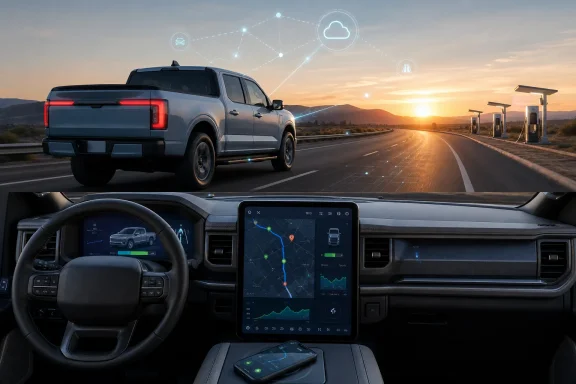
Ford’s next affordable electric vehicle platform is set to make an unusually consequential software choice: Apple Maps will be embedded directly into the vehicle’s own displays, rather than appearing only through an attached iPhone and Apple CarPlay. The first application is expected in Ford’s all-electric midsize pickup due in 2027, a vehicle intended to prove that lower-cost EVs do not have to arrive with stripped-down technology.
The move is bigger than another dashboard app announcement. It puts Apple’s mapping, traffic, search, charging-route planning, and road-level data inside Ford’s forthcoming Universal Electric Vehicle (UEV) Platform, while retaining CarPlay for customers who prefer Apple’s broader phone-projection experience. Ford is also positioning the mapping data as a building block for future iterations of BlueCruise and its hands-free highway-driving ambitions.
For Windows and connected-device enthusiasts, the announcement illustrates where the auto industry is heading: cars are rapidly becoming persistent, updateable computing platforms. The most important question is no longer whether a dashboard supports a phone ecosystem. It is whether the vehicle can combine its own battery, sensors, location, and software into an experience that is more useful than simply mirroring a handset.
For most drivers, Apple Maps in the car has meant CarPlay. An iPhone runs the application, the vehicle displays it, and the experience depends on the phone connection, account state, mobile data availability, and the compatibility layer between the phone and infotainment system.
Ford’s planned deployment changes that relationship. Apple Maps will run natively within the vehicle environment through Apple’s new MapKit for Automotive SDK, allowing Ford to incorporate mapping functions into the UEV’s screens and vehicle software without requiring a driver to plug in or wirelessly pair an iPhone.
That distinction has practical consequences.
With a native integration, Ford’s system can access information that a phone-based navigation session may not fully understand, including vehicle-specific battery behavior, charging capability, battery temperature, energy consumption, and potentially route-relevant vehicle state. The mapping platform can use those inputs to create an EV-focused route rather than simply calculate a route from one physical location to another.
Ford says the system will include:
That is the central value proposition behind embedded navigation in an EV: the system should act less like a digital road atlas and more like an energy-management assistant.
Electric driving changes those assumptions.
A less expensive EV may not rely on an oversized battery pack to overcome inefficient routing. Instead, it needs software that helps drivers get more practical utility from the battery it has. If Ford can reduce anxiety around charging stops and trip planning, it can make a more affordable vehicle feel less compromised.
That can matter greatly in cold weather, hot weather, or after sustained driving. A battery arriving at a fast charger in an unsuitable temperature range may charge more slowly than expected. Native mapping can coordinate the selected charging destination with the vehicle’s thermal-management system, helping reduce the gap between advertised charging performance and real-world experience.
This is an area where the distinction between an embedded system and a phone-projected map becomes more than cosmetic. The navigation application must not only know where the driver is going. It needs the authority and data access to prepare the vehicle for what comes next.
Ford has described the first UEV vehicle as a pickup aimed at a starting price of approximately $30,000. That figure remains a target rather than a final transaction price, and the eventual cost will depend on trim levels, destination fees, options, incentives, and market conditions. Still, the strategy is clear: Ford wants to bring a more accessible EV to a part of the market where practicality and price matter at least as much as premium technology.
The company has previously outlined several broad efficiency measures associated with the UEV effort, including:
However, large castings also introduce trade-offs. Repairability after a serious collision can become more complex, and insurers will closely watch real-world repair procedures and costs. A production innovation that improves factory economics does not automatically guarantee lower ownership costs after an accident.
Ford’s goal is nonetheless compelling. A vehicle priced for broader adoption cannot carry the full cost structure of an expensive, legacy-engineered EV. The UEV platform is Ford’s attempt to rebuild the economics from the ground up.
That decision gives Ford access to a mature consumer-facing map experience without bearing the enormous cost and long-term burden of creating a global navigation service from scratch.
Ford also gains a platform with a large amount of road, traffic, destination, and routing data. In a connected vehicle, that data can become more useful when blended with Ford’s own knowledge of the vehicle’s state.
The strategic benefits include:
CarPlay is influential, but it is still traditionally a projection layer that depends on an iPhone. A native Apple Maps deployment gives Apple a more permanent position in the vehicle’s operating environment, even when no phone is connected.
That does not mean Ford is surrendering its dashboard to Apple. Ford will still control the vehicle architecture, screens, vehicle settings, apps, branding, driver-assistance features, over-the-air update strategy, and broader ownership experience. But Apple Maps becomes a core service rather than an optional screen projection.
The arrangement may also serve as a test case for other automakers. If Ford’s launch is successful, Apple’s automotive mapping toolkit could become an appealing alternative for manufacturers that want a polished native navigation experience without adopting a complete Google-based dashboard stack or attempting to build mapping technology themselves.
A driver may prefer the embedded Ford-and-Apple navigation experience for an EV road trip, while still relying on CarPlay for messages, podcasts, calls, music, calendar events, and familiar iPhone apps. Keeping both options avoids forcing customers into an unnecessary choice.
That could look like this:
This dual-track approach reflects a maturing automotive software market. Drivers do not want to abandon their phones, but neither do they want a vehicle that becomes less capable whenever the phone is missing, out of battery, disconnected, or used by a different passenger.
A built-in navigation system should remain useful regardless of who is driving. CarPlay should remain available because it brings the driver’s personal digital life into the vehicle. Those two requirements can coexist.
Ford says road-level Apple Maps information will support work by its Latitude AI team and contribute to next-generation BlueCruise capabilities. The company has indicated that it wants future BlueCruise systems to handle more of a highway journey, including transitions associated with highway entrances and exits.
That claim deserves careful interpretation.
Even when a feature is described as hands-free, it does not mean the driver can disengage from the driving task. Monitoring systems, road limitations, weather, lane markings, construction zones, unusual traffic conditions, and system availability all matter.
The potential use of higher-quality map data can improve a driver-assistance system’s understanding of the road ahead. It may help with anticipated lane geometry, ramp locations, highway topology, speed transitions, and other contextual information. But map data is not a substitute for cameras, radar, onboard sensors, driver attention, or conservative system design.
That could reduce abrupt lane behavior, late route decisions, or awkward transitions. It may also enable more useful navigation-linked assistance, where the route and driving-assistance system share a common understanding of where the vehicle is headed.
Still, Ford will need to demonstrate the reliability of any enhanced BlueCruise functionality in real traffic conditions. Highway automation is a difficult problem because roads change constantly. Construction, lane shifts, debris, weather, temporary signs, human behavior, and inaccurate map data can undermine even well-designed systems.
The safest expectation is that Apple Maps data could become one more layer in Ford’s driver-assistance stack—not a shortcut to autonomous driving.
That is an encouraging position, but connected-car privacy requires close attention because a vehicle generates more data than a phone navigation session.
A modern EV can potentially reveal:
Ford will also need to make the system usable for drivers who do not own an iPhone, do not use an Apple Account, or do not want their vehicle experience connected to a personal ecosystem. Native Apple Maps should be a valuable service, not a dependency that divides Ford’s customer base.
If Apple changes product priorities, licensing terms, regional coverage, interface rules, update requirements, or feature availability, Ford may have limited flexibility. An automaker that promises a coherent long-term ownership experience must ensure that third-party integrations remain reliable for years, not merely impressive at launch.
The last point is particularly important. A $30,000 EV becomes less affordable if essential navigation and routing features are tied to expensive recurring fees.
Ford must therefore treat mapping integration as safety-adjacent infrastructure. The system needs strong validation, transparent fallback behavior, rapid error correction, and clear communication when its confidence is limited.
Vehicles are becoming endpoint devices in a larger connected environment. They receive over-the-air updates, maintain user profiles, connect to mobile services, run specialized apps, collect diagnostic data, and interact with business systems. That makes them resemble managed computing platforms, even if their interface is a dashboard rather than a desktop.
For Windows users, the key expectation should be cross-platform coexistence. A Ford owner may use an iPhone for navigation, a Windows PC for work, Microsoft 365 for productivity, Teams for communication, and a fleet portal or dealership application through a web browser. The vehicle should fit into that reality rather than demand loyalty to one technology vendor.
The best automotive software ecosystems will be those that support personal preferences while keeping essential vehicle functions independent, stable, and accessible.
The approach has strong potential. Native Apple Maps could make Ford’s upcoming electric pickup easier to live with, especially on longer trips where energy planning, charging speed, and battery preconditioning shape the entire experience. Retaining CarPlay is equally important, giving drivers access to their personal apps and communications without making phone projection the sole source of navigation.
The more ambitious BlueCruise connection deserves guarded optimism rather than hype. Better road data can improve driver assistance, but no map platform should be mistaken for autonomous driving. Ford’s responsibility will be to prove that its software is dependable, transparent, privacy-conscious, and resilient when conditions do not match the idealized digital model.
If Ford executes well, the 2027 UEV pickup could demonstrate that a lower-priced electric vehicle does not need to feel technologically second-rate. The partnership’s real test will not be the launch announcement or the dashboard graphics. It will be whether the system saves time, reduces charging uncertainty, respects driver choice, and works reliably when the road gets complicated.
The distinction is notable because Ford and Google announced a six-year partnership in 2021 covering Android-based in-car software, Google Maps, Google Assistant, Google Play, cloud services, and data tools. Ford will retain control of the interface and vehicle integration through MapKit for Automotive, while Apple supplies the mapping, search, traffic, and routing services.
The move is bigger than another dashboard app announcement. It puts Apple’s mapping, traffic, search, charging-route planning, and road-level data inside Ford’s forthcoming Universal Electric Vehicle (UEV) Platform, while retaining CarPlay for customers who prefer Apple’s broader phone-projection experience. Ford is also positioning the mapping data as a building block for future iterations of BlueCruise and its hands-free highway-driving ambitions.
For Windows and connected-device enthusiasts, the announcement illustrates where the auto industry is heading: cars are rapidly becoming persistent, updateable computing platforms. The most important question is no longer whether a dashboard supports a phone ecosystem. It is whether the vehicle can combine its own battery, sensors, location, and software into an experience that is more useful than simply mirroring a handset.
 Apple Maps Moves Beyond CarPlay
For most drivers, Apple Maps in the car has meant CarPlay. An iPhone runs the application, the vehicle displays it, and the experience depends on the phone connection, account state, mobile data availability, and the compatibility layer between the phone and infotainment system.Ford’s planned deployment changes that relationship. Apple Maps will run natively within the vehicle environment through Apple’s new MapKit for Automotive SDK, allowing Ford to incorporate mapping functions into the UEV’s screens and vehicle software without requiring a driver to plug in or wirelessly pair an iPhone.
That distinction has practical consequences.
With a native integration, Ford’s system can access information that a phone-based navigation session may not fully understand, including vehicle-specific battery behavior, charging capability, battery temperature, energy consumption, and potentially route-relevant vehicle state. The mapping platform can use those inputs to create an EV-focused route rather than simply calculate a route from one physical location to another.
Ford says the system will include:
- Turn-by-turn navigation using natural-language prompts
- Live traffic and road-incident information
- Destination search and detailed place information
- EV-aware route planning
- Charging-stop recommendations
- Battery preconditioning before a charging stop
- Apple Maps information rendered on Ford’s built-in displays
That is the central value proposition behind embedded navigation in an EV: the system should act less like a digital road atlas and more like an energy-management assistant.
Why Native Navigation Matters More in an Electric Vehicle
A gas-powered vehicle can generally treat navigation and refueling as separate problems. The driver picks a route, watches the fuel gauge, and stops at one of many stations when necessary. Fueling is quick, station availability is usually predictable, and the vehicle does not need a sophisticated plan to complete the trip.Electric driving changes those assumptions.
Route Planning Is Also Battery Planning
An EV route planner has to account for far more than distance and traffic. The best route may depend on:- Current battery percentage
- Usable battery capacity
- Projected energy consumption
- Elevation changes
- Ambient temperature
- Cabin climate use
- Highway speed
- Charger reliability and availability
- Charging speed at each location
- Expected charging time
- The vehicle’s battery temperature on arrival
A less expensive EV may not rely on an oversized battery pack to overcome inefficient routing. Instead, it needs software that helps drivers get more practical utility from the battery it has. If Ford can reduce anxiety around charging stops and trip planning, it can make a more affordable vehicle feel less compromised.
Battery Preconditioning Is a Valuable Detail
One of the most important claimed features is battery preconditioning before arrival at a charging station. In simple terms, this means the vehicle prepares the battery for high-speed charging by warming or cooling it to an appropriate temperature while it is still on the road.That can matter greatly in cold weather, hot weather, or after sustained driving. A battery arriving at a fast charger in an unsuitable temperature range may charge more slowly than expected. Native mapping can coordinate the selected charging destination with the vehicle’s thermal-management system, helping reduce the gap between advertised charging performance and real-world experience.
This is an area where the distinction between an embedded system and a phone-projected map becomes more than cosmetic. The navigation application must not only know where the driver is going. It needs the authority and data access to prepare the vehicle for what comes next.
Ford’s UEV Platform Is Designed Around Affordability
The Apple Maps partnership arrives as Ford prepares one of its most ambitious EV programs to date. The company’s Universal Electric Vehicle Platform is intended to support a family of more affordable, software-defined electric vehicles, beginning with a midsize four-door pickup planned for production in Louisville, Kentucky.Ford has described the first UEV vehicle as a pickup aimed at a starting price of approximately $30,000. That figure remains a target rather than a final transaction price, and the eventual cost will depend on trim levels, destination fees, options, incentives, and market conditions. Still, the strategy is clear: Ford wants to bring a more accessible EV to a part of the market where practicality and price matter at least as much as premium technology.
A New Manufacturing Formula
Ford’s UEV project is not merely a new electric truck with a new infotainment system. It combines a fresh platform, a redesigned manufacturing approach, and an effort to reduce vehicle complexity.The company has previously outlined several broad efficiency measures associated with the UEV effort, including:
- Fewer overall parts than a conventional vehicle architecture
- Fewer fasteners and reduced wiring complexity
- Large aluminum unicastings that consolidate multiple components
- A new production approach that brings major vehicle sections together later in assembly
- Lower-cost lithium iron phosphate (LFP) battery technology
- A focus on software updates that can improve the vehicle after purchase
However, large castings also introduce trade-offs. Repairability after a serious collision can become more complex, and insurers will closely watch real-world repair procedures and costs. A production innovation that improves factory economics does not automatically guarantee lower ownership costs after an accident.
Ford’s goal is nonetheless compelling. A vehicle priced for broader adoption cannot carry the full cost structure of an expensive, legacy-engineered EV. The UEV platform is Ford’s attempt to rebuild the economics from the ground up.
Apple Maps as a Software Shortcut—and a Strategic Asset
Ford could have developed a bespoke mapping platform, partnered with another mapping provider, or leaned more heavily on smartphone integration. Instead, it has chosen Apple Maps as the native navigation foundation for the UEV platform.That decision gives Ford access to a mature consumer-facing map experience without bearing the enormous cost and long-term burden of creating a global navigation service from scratch.
What Ford Gains
The most obvious benefit is a familiar interface for drivers already invested in Apple’s ecosystem. Apple Maps has become a routine navigation choice for many iPhone users, particularly those who favor its presentation, voice guidance, place cards, and integration with Apple services.Ford also gains a platform with a large amount of road, traffic, destination, and routing data. In a connected vehicle, that data can become more useful when blended with Ford’s own knowledge of the vehicle’s state.
The strategic benefits include:
- A recognized navigation brand in a competitive EV market
- Faster deployment than building a comparable service internally
- A potentially consistent experience across multiple Ford UEV models
- Better integration of charging plans with onboard energy data
- A foundation for future connected and fleet-oriented services
- An opportunity to distinguish Ford from automakers that rely chiefly on phone mirroring
What Apple Gains
Apple gains something equally significant: a direct role in the car’s native software environment.CarPlay is influential, but it is still traditionally a projection layer that depends on an iPhone. A native Apple Maps deployment gives Apple a more permanent position in the vehicle’s operating environment, even when no phone is connected.
That does not mean Ford is surrendering its dashboard to Apple. Ford will still control the vehicle architecture, screens, vehicle settings, apps, branding, driver-assistance features, over-the-air update strategy, and broader ownership experience. But Apple Maps becomes a core service rather than an optional screen projection.
The arrangement may also serve as a test case for other automakers. If Ford’s launch is successful, Apple’s automotive mapping toolkit could become an appealing alternative for manufacturers that want a polished native navigation experience without adopting a complete Google-based dashboard stack or attempting to build mapping technology themselves.
CarPlay Is Staying, and That Is the Right Decision
Ford’s announcement does not eliminate Apple CarPlay. That matters because native navigation and phone projection solve different problems.A driver may prefer the embedded Ford-and-Apple navigation experience for an EV road trip, while still relying on CarPlay for messages, podcasts, calls, music, calendar events, and familiar iPhone apps. Keeping both options avoids forcing customers into an unnecessary choice.
Native Maps and CarPlay Can Complement Each Other
The most sensible model is one where the native system handles the functions that benefit from deep vehicle integration, while CarPlay remains available as the personal-device layer.That could look like this:
| Function | Native Apple Maps in Ford | Apple CarPlay |
|---|---|---|
| EV route planning | Strong fit due to battery and charging data | Useful, but potentially less vehicle-aware |
| Battery preconditioning | Strong fit through direct vehicle integration | Dependent on vehicle support |
| Traffic and guidance | Available directly on Ford displays | Available through the paired iPhone |
| Music and podcasts | Possible through Ford’s own app ecosystem | Often strongest through iPhone apps |
| Messaging and calls | May be available through Ford features | Strong fit for personal contacts and communication |
| Phone-specific settings | Limited | Strong fit |
| Operation without a connected iPhone | Yes | No |
A built-in navigation system should remain useful regardless of who is driving. CarPlay should remain available because it brings the driver’s personal digital life into the vehicle. Those two requirements can coexist.
Road-Level Mapping and the BlueCruise Connection
The broader significance of the Ford-Apple deal lies in its relationship to advanced driver assistance.Ford says road-level Apple Maps information will support work by its Latitude AI team and contribute to next-generation BlueCruise capabilities. The company has indicated that it wants future BlueCruise systems to handle more of a highway journey, including transitions associated with highway entrances and exits.
That claim deserves careful interpretation.
BlueCruise Remains a Driver-Assist System
Ford BlueCruise is a Level 2 driver-assistance system, not a self-driving system. In a Level 2 environment, the vehicle can assist with steering and speed control under certain conditions, but the driver remains responsible for supervising the road and taking over whenever needed.Even when a feature is described as hands-free, it does not mean the driver can disengage from the driving task. Monitoring systems, road limitations, weather, lane markings, construction zones, unusual traffic conditions, and system availability all matter.
The potential use of higher-quality map data can improve a driver-assistance system’s understanding of the road ahead. It may help with anticipated lane geometry, ramp locations, highway topology, speed transitions, and other contextual information. But map data is not a substitute for cameras, radar, onboard sensors, driver attention, or conservative system design.
Better Maps Can Improve Smoothness, Not Eliminate Responsibility
Road-level mapping could make supported highway operation feel smoother and more deliberate. A system that knows a ramp or lane split is approaching can prepare earlier than one that reacts only when sensors detect it at close range.That could reduce abrupt lane behavior, late route decisions, or awkward transitions. It may also enable more useful navigation-linked assistance, where the route and driving-assistance system share a common understanding of where the vehicle is headed.
Still, Ford will need to demonstrate the reliability of any enhanced BlueCruise functionality in real traffic conditions. Highway automation is a difficult problem because roads change constantly. Construction, lane shifts, debris, weather, temporary signs, human behavior, and inaccurate map data can undermine even well-designed systems.
The safest expectation is that Apple Maps data could become one more layer in Ford’s driver-assistance stack—not a shortcut to autonomous driving.
Privacy Promises Need to Survive Vehicle Reality
Apple has built much of its Maps brand around privacy, stating that location-related information is designed not to be tied directly to a user’s Apple Account in ordinary Maps use. Ford has indicated that the automotive integration will follow Apple’s privacy approach.That is an encouraging position, but connected-car privacy requires close attention because a vehicle generates more data than a phone navigation session.
A modern EV can potentially reveal:
- Location and trip history
- Charging habits
- Home and work patterns
- Driving behavior
- Energy consumption
- Vehicle health information
- Connected-device status
- Voice-assistant interactions
- Fleet or employer data in commercial use
The Need for Clear Controls
The UEV platform should provide clear, understandable controls for:- Navigation data sharing
- Vehicle telemetry collection
- Driver-assistance data usage
- Account-linked personalization
- Third-party app permissions
- Commercial or fleet-management access
- Data deletion or account transfer when the vehicle is sold
Ford will also need to make the system usable for drivers who do not own an iPhone, do not use an Apple Account, or do not want their vehicle experience connected to a personal ecosystem. Native Apple Maps should be a valuable service, not a dependency that divides Ford’s customer base.
The Risks of a Deep Apple-Ford Integration
The partnership has clear potential, but it also carries risks that Ford must manage carefully.Dependence on an External Platform
Ford is embedding a key part of the driving experience in technology supplied by another company. That can accelerate development, but it creates dependency.If Apple changes product priorities, licensing terms, regional coverage, interface rules, update requirements, or feature availability, Ford may have limited flexibility. An automaker that promises a coherent long-term ownership experience must ensure that third-party integrations remain reliable for years, not merely impressive at launch.
Connectivity and Coverage Questions
Native mapping does not automatically mean perfect navigation in every location. Live traffic, dynamic incident data, charging availability, and fresh search results depend on data connectivity. Ford will need to clarify how the system works in poor-coverage areas, what functions remain available offline, and whether a connected-services subscription is required after any introductory period.The last point is particularly important. A $30,000 EV becomes less affordable if essential navigation and routing features are tied to expensive recurring fees.
Software Stability Is Now a Vehicle Issue
When navigation is integrated with charging, thermal preparation, and driver-assistance functions, software quality becomes directly connected to the driving experience. A bad route is inconvenient. A bad route that leaves a driver arriving at an unavailable charger with insufficient remaining charge is much more serious.Ford must therefore treat mapping integration as safety-adjacent infrastructure. The system needs strong validation, transparent fallback behavior, rapid error correction, and clear communication when its confidence is limited.
What This Means for the Windows and PC Ecosystem
The Ford-Apple announcement may seem focused entirely on iPhone users, but it also reflects a wider shift that affects Windows users, PC software developers, and enterprise IT teams.Vehicles are becoming endpoint devices in a larger connected environment. They receive over-the-air updates, maintain user profiles, connect to mobile services, run specialized apps, collect diagnostic data, and interact with business systems. That makes them resemble managed computing platforms, even if their interface is a dashboard rather than a desktop.
For Windows users, the key expectation should be cross-platform coexistence. A Ford owner may use an iPhone for navigation, a Windows PC for work, Microsoft 365 for productivity, Teams for communication, and a fleet portal or dealership application through a web browser. The vehicle should fit into that reality rather than demand loyalty to one technology vendor.
The best automotive software ecosystems will be those that support personal preferences while keeping essential vehicle functions independent, stable, and accessible.
A Sensible Bet on Useful Technology
Ford’s decision to put Apple Maps directly into its Universal Electric Vehicle Platform is a pragmatic attempt to make advanced technology matter in an affordable EV. It does not rely on a flashy dashboard gimmick or a speculative promise of full autonomy. Instead, it focuses on a daily-use function that becomes especially important when a vehicle runs on batteries: getting drivers to their destination with a realistic, efficient charging plan.The approach has strong potential. Native Apple Maps could make Ford’s upcoming electric pickup easier to live with, especially on longer trips where energy planning, charging speed, and battery preconditioning shape the entire experience. Retaining CarPlay is equally important, giving drivers access to their personal apps and communications without making phone projection the sole source of navigation.
The more ambitious BlueCruise connection deserves guarded optimism rather than hype. Better road data can improve driver assistance, but no map platform should be mistaken for autonomous driving. Ford’s responsibility will be to prove that its software is dependable, transparent, privacy-conscious, and resilient when conditions do not match the idealized digital model.
If Ford executes well, the 2027 UEV pickup could demonstrate that a lower-priced electric vehicle does not need to feel technologically second-rate. The partnership’s real test will not be the launch announcement or the dashboard graphics. It will be whether the system saves time, reduces charging uncertainty, respects driver choice, and works reliably when the road gets complicated.
Update: Additional details (July 24, 2026)
Macworld reports that Apple Maps will replace Google Maps as the embedded navigation service specifically for Ford’s forthcoming Universal Electric Vehicle platform. This does not mean Ford is ending its broader relationship with Google or removing Google-based services from existing vehicles; the change applies to the native navigation experience planned for the new affordable EV architecture.The distinction is notable because Ford and Google announced a six-year partnership in 2021 covering Android-based in-car software, Google Maps, Google Assistant, Google Play, cloud services, and data tools. Ford will retain control of the interface and vehicle integration through MapKit for Automotive, while Apple supplies the mapping, search, traffic, and routing services.
References
- Primary source: Digital Trends
Published: 2026-07-24T06:53:34+00:00
Ford's UEV platform will feature Apple Maps built in - Digital Trends
Ford's upcoming Universal Electric Vehicle platform will run Apple Maps as its built-in navigation system.www.digitaltrends.com - Independent coverage: Briefs Finance
Published: 2026-07-24T04:30:00+00:00
- Independent coverage: Detroit Free Press
Published: 2026-07-23T16:13:23+00:00
Ford says Apple Maps to be embedded in next-gen UEV Platform
Ford will offer Apple Maps integrated in its all-new electric midsize pickup coming to market in 2027. Analysts say the feature is a win for drivers.www.freep.com - Independent coverage: The Detroit News
Published: 2026-07-23T18:07:17+00:00
Ford UEV will integrate Apple Maps. How that impacts Android users
Ford is one of the first to leverage Apple's MapKit for Automotive software development kit.www.detroitnews.com - Independent coverage: Business Insider
Published: 2026-07-23T16:35:06.779000+00:00
Ford's Next Generation of EVs Will Have Apple Built Inside Their Brain - Business Insider
Apple Maps will power navigation in Ford's coming lower-cost EVs and provide road data for its next hands-free driving system.www.businessinsider.com - Related coverage: fromtheroad.ford.com
Last edited: