

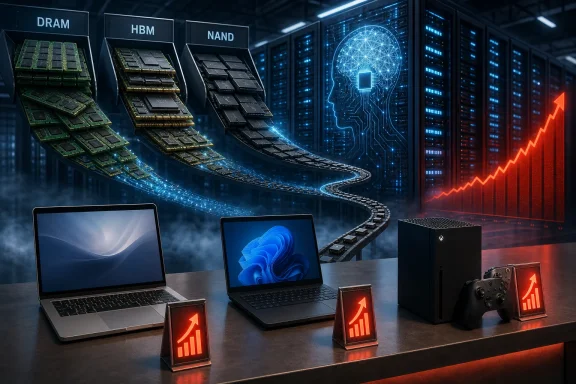
The unsettling truth behind today’s MacBook, Xbox, and Windows laptop prices is that consumers are paying for an AI infrastructure boom they may never directly use. What looks like ordinary retail inflation is increasingly a memory supply shock: data centers are buying enormous volumes of high-performance DRAM, high-bandwidth memory, and enterprise storage, while device makers compete for the remaining supply of conventional RAM and NAND flash.
For much of the past year, Windows PCs absorbed the visible impact first. Mainstream laptops that once occupied the affordable middle of the market crept upward as vendors adjusted to higher component costs, weaker margins, and a difficult currency environment in many regions. Apple, protected by long-term procurement agreements and its enormous purchasing power, initially appeared comparatively insulated.
That advantage has now narrowed. Apple’s recent increases across its Mac range underline a broader shift: the cost pressure is no longer confined to budget Windows notebooks or DIY desktop upgrades. It is reaching premium laptops, entry-level Macs, game consoles, storage devices, and ultimately almost every category of consumer technology that depends on memory.
The so-called RAM crisis is not a single event with a clear end date. It is the collision of AI demand, constrained semiconductor capacity, manufacturers prioritizing higher-margin products, currency volatility, distribution costs, and a hardware industry that has become far more dependent on memory than many buyers realize.
For decades, RAM and storage were treated as relatively predictable parts of a device bill of materials. A laptop manufacturer could plan a model around a fixed amount of DDR memory and an SSD configuration, then expect component costs to gradually fall as production scales.
That pattern has been disrupted.
Modern AI systems consume memory at extraordinary scale. Training advanced models requires massive clusters of accelerators and specialized high-bandwidth memory, or HBM, while serving those models to millions of users requires large pools of server DRAM and fast enterprise SSD storage. The growth of AI inference matters just as much as training: every prompt, document upload, image request, coding session, and chatbot conversation creates ongoing infrastructure demand.
The important distinction is that consumers are not causing the shortage simply by running ChatGPT, Microsoft Copilot, Google Gemini, Claude, or Perplexity AI on their laptops. Most of those workloads run in cloud data centers. But consumers still feel the consequences because those data centers compete for the same broad memory manufacturing ecosystem that supplies PC makers, smartphone vendors, console manufacturers, and storage brands.
In other words, the AI boom is not making your 16GB laptop inadequate by itself. It is helping make the memory inside the next laptop more expensive.
The connection is industrial rather than literal.
Memory manufacturers have finite capital, engineering resources, cleanroom capacity, packaging capability, and wafer allocation. When HBM and data-center-grade memory command much higher margins, suppliers have powerful incentives to direct investment and production capacity toward those products.
That can tighten the market for conventional DRAM even when consumer PC demand is not especially strong. The same dynamic extends to NAND flash storage, especially as cloud providers expand their need for high-capacity enterprise SSDs to store models, datasets, retrieval indexes, checkpoints, logs, and user-generated AI content.
The result is a market where a shortage at the top of the technology stack cascades down into ordinary retail hardware.
That does not make Apple immune to a sustained memory squeeze.
The reported South African pricing changes are striking. The 13-inch M5 MacBook Air reportedly moved from R19,999 to R26,499, an increase of R6,500. That is approximately a 32.5% increase, not a small annual adjustment that can be explained away as routine retail movement.
The more affordable MacBook Neo reportedly climbed from R11,999 to R13,999, an increase of roughly 16.7%. That still leaves it far below the M5 MacBook Air, but the difference between “affordable” and “entry-level” is becoming more significant as every rung of the product ladder rises.
The concern is that price hikes make the Neo feel less like a breakthrough and more like a carefully positioned compromise. A device that was compelling because it dramatically lowered the cost of Mac ownership becomes harder to celebrate once its price starts moving upward too.
However, it also makes initial configuration decisions more consequential.
In most current MacBooks, users cannot add RAM later. They cannot open the device and install a larger memory module as they might on a serviceable Windows laptop. When memory costs rise, Apple’s upgrade pricing becomes even more painful because buyers are forced to decide at checkout how much future flexibility they can afford.
This creates a difficult mismatch in the AI era. Hardware makers increasingly market local AI features, large language model workflows, image generation, transcription, coding assistants, and advanced creative tools. Yet many entry-level laptops remain configured with memory capacities that are acceptable for basic use but limiting for heavier multitasking over a multi-year ownership period.
A lower upfront price is valuable. But a low-memory configuration may become a false economy if it forces an earlier replacement cycle.
A $600 Windows laptop has very little room to absorb a sharp increase in memory and storage costs. If the vendor raises the retail price, it risks becoming uncompetitive. If it keeps the price fixed, it may reduce RAM, cut SSD capacity, use a lower-tier display, remove upgradeability, or accept a weaker margin.
That explains why laptop pricing can feel confusing right now. Two systems may carry similar model names while offering noticeably different value from one month to the next.
A manufacturer trying to preserve a familiar price point may make changes such as:
For many buyers in 2026, 16GB should be regarded as the practical baseline for a new Windows laptop intended to last several years. That is not because every user needs 16GB today, but because it creates breathing room for browsers, background apps, virtual meetings, large documents, creative tools, local development environments, and future operating-system requirements.
Priority order should generally look like this:
Traditionally, consoles get cheaper as they age. Manufacturing improves, chip yields rise, components become less expensive, and platform holders use lower hardware pricing to expand the installed base and sell more games, subscriptions, and accessories.
That logic has weakened.
The Xbox Series S launched in November 2020 at $299, while the Xbox Series X launched at $499. Those prices positioned the Series S as a lower-cost all-digital gateway to current-generation gaming and the Series X as the full-performance flagship.
Nearly six years into the generation, pricing has moved in the opposite direction.
The reported South African retail comparison is especially stark: an Xbox Series S bought for R5,999 in March 2023 now being offered at R9,998 represents an increase of R3,999, or roughly 66.7%. That is a remarkable figure for hardware that is approaching its sixth birthday.
A current price near R14,999 for the Series X reinforces the issue. Buyers are being asked to pay premium money for an established platform at the point in its lifecycle when they would normally expect greater value.
That matters because the Xbox Series consoles are unusually exposed to storage pricing. Both models rely heavily on fast solid-state storage, and the Xbox ecosystem places a premium on large game libraries, quick-resume functionality, and high-performance game installation.
Games are also getting larger. A console with limited built-in storage can quickly require expansion cards or external storage management, turning the sticker price of the console into only the first part of the expense.
The real cost of owning a current-generation console may include:
The problem is that the Series S made the most sense when it was dramatically cheaper than its rivals and its own flagship sibling.
At much higher retail prices, buyers begin comparing it not only with the Series X but also with discounted PlayStation 5 bundles, handheld PCs, gaming laptops, refurbished consoles, and the possibility of waiting for the next generation. Its value equation becomes less straightforward with every price increase.
It is important not to flatten that story into a single global number. Console pricing differs by market because taxes, currency fluctuations, local distribution arrangements, and regional pricing strategy all matter. A price increase in Europe, the Middle East, Africa, Australia, or New Zealand does not automatically mean that the same model moved by the same amount in the United States.
Still, the larger point holds: the modern console cycle is no longer reliably deflationary.
The claim that PlayStation has an installed base far larger than Xbox is directionally consistent with the market’s public perception, but direct Xbox Series sales comparisons should be treated cautiously. Sony regularly reports PlayStation hardware milestones, while Microsoft has not maintained the same rhythm of publicly disclosing Xbox Series unit sales. Exact cross-platform comparisons often depend on third-party estimates rather than equivalent company reporting.
That reporting gap does not change what consumers see at retail. Whether a buyer prefers Xbox or PlayStation, they are increasingly confronting hardware that costs more than it did years earlier.
It can reflect:
This is why buyers should be careful with claims that a product has risen by a certain percentage “everywhere.” The global trend can be real while the local effect differs dramatically.
But contracts expire. New production plans require fresh negotiations. Higher spot prices and contract prices eventually flow into new product batches.
That helps explain why Apple could appear relatively insulated before adjusting its Mac pricing. It was not necessarily unaffected by the market. It may simply have been operating with supply arrangements that delayed the retail impact.
That can produce bizarre pricing behavior:
It is a bad time to buy a device simply because it is new. It is also a bad time to pay a large premium for a configuration that will be obsolete or constrained within a short period. But a necessary purchase is still a necessary purchase, and waiting is not automatically a winning strategy.
If memory stays expensive, the industry could normalize:
There is also a risk to local AI development. If affordable consumer hardware ships with less memory, students, enthusiasts, independent developers, and small businesses will have fewer options for running local models, experimenting with machine learning, or building privacy-focused AI workflows outside large cloud platforms.
The irony is hard to miss. AI is driving demand for more memory, while the resulting shortage could make capable local AI hardware less accessible.
Apple’s MacBook price increases show that even the industry’s best-protected supply chain cannot avoid the pressure forever. Xbox pricing demonstrates that the usual rule of aging hardware becoming cheaper no longer applies. Windows laptops reveal another uncomfortable truth: when retail prices cannot rise, specifications often fall instead.
For buyers, the practical response is not panic. It is discipline. Prioritize sufficient memory, usable storage, repairability where available, and the total cost of ownership over launch-day excitement or the lowest advertised price.
The era of cheap RAM and steadily falling electronics prices may return, but there is no reliable sign that it will happen quickly. Until memory supply catches up with AI’s appetite, the most valuable technology purchase will be the one that is configured well enough to stay useful long after the initial sticker shock fades.
For much of the past year, Windows PCs absorbed the visible impact first. Mainstream laptops that once occupied the affordable middle of the market crept upward as vendors adjusted to higher component costs, weaker margins, and a difficult currency environment in many regions. Apple, protected by long-term procurement agreements and its enormous purchasing power, initially appeared comparatively insulated.
That advantage has now narrowed. Apple’s recent increases across its Mac range underline a broader shift: the cost pressure is no longer confined to budget Windows notebooks or DIY desktop upgrades. It is reaching premium laptops, entry-level Macs, game consoles, storage devices, and ultimately almost every category of consumer technology that depends on memory.
The so-called RAM crisis is not a single event with a clear end date. It is the collision of AI demand, constrained semiconductor capacity, manufacturers prioritizing higher-margin products, currency volatility, distribution costs, and a hardware industry that has become far more dependent on memory than many buyers realize.
 The New Reality: Memory Is No Longer a Background Component
For decades, RAM and storage were treated as relatively predictable parts of a device bill of materials. A laptop manufacturer could plan a model around a fixed amount of DDR memory and an SSD configuration, then expect component costs to gradually fall as production scales.That pattern has been disrupted.
Modern AI systems consume memory at extraordinary scale. Training advanced models requires massive clusters of accelerators and specialized high-bandwidth memory, or HBM, while serving those models to millions of users requires large pools of server DRAM and fast enterprise SSD storage. The growth of AI inference matters just as much as training: every prompt, document upload, image request, coding session, and chatbot conversation creates ongoing infrastructure demand.
The important distinction is that consumers are not causing the shortage simply by running ChatGPT, Microsoft Copilot, Google Gemini, Claude, or Perplexity AI on their laptops. Most of those workloads run in cloud data centers. But consumers still feel the consequences because those data centers compete for the same broad memory manufacturing ecosystem that supplies PC makers, smartphone vendors, console manufacturers, and storage brands.
In other words, the AI boom is not making your 16GB laptop inadequate by itself. It is helping make the memory inside the next laptop more expensive.
Why HBM Affects Ordinary Laptop RAM
At first glance, HBM for AI accelerators and standard DDR5 memory for a Windows laptop seem like different products. Technically, they are. They use different packaging approaches, performance characteristics, and supply chains.The connection is industrial rather than literal.
Memory manufacturers have finite capital, engineering resources, cleanroom capacity, packaging capability, and wafer allocation. When HBM and data-center-grade memory command much higher margins, suppliers have powerful incentives to direct investment and production capacity toward those products.
That can tighten the market for conventional DRAM even when consumer PC demand is not especially strong. The same dynamic extends to NAND flash storage, especially as cloud providers expand their need for high-capacity enterprise SSDs to store models, datasets, retrieval indexes, checkpoints, logs, and user-generated AI content.
The result is a market where a shortage at the top of the technology stack cascades down into ordinary retail hardware.
Apple’s Price Increases Show That Scale Has Limits
Apple has long been viewed as unusually capable of absorbing component volatility. It buys at scale, negotiates years ahead, maintains close supplier relationships, and designs its own silicon to control more of the product stack than most PC manufacturers.That does not make Apple immune to a sustained memory squeeze.
The reported South African pricing changes are striking. The 13-inch M5 MacBook Air reportedly moved from R19,999 to R26,499, an increase of R6,500. That is approximately a 32.5% increase, not a small annual adjustment that can be explained away as routine retail movement.
The more affordable MacBook Neo reportedly climbed from R11,999 to R13,999, an increase of roughly 16.7%. That still leaves it far below the M5 MacBook Air, but the difference between “affordable” and “entry-level” is becoming more significant as every rung of the product ladder rises.
The MacBook Neo Is More Important Than It Looks
The MacBook Neo has become strategically important because it gives Apple a lower-cost entry point into macOS. Its A-series chip, 8GB unified-memory baseline, and 256GB SSD configuration make it a deliberately constrained machine compared with a MacBook Air, but it can still handle common tasks well:- Web browsing and media consumption
- School and office work
- Video calls and communication apps
- Light photo editing
- Basic coding and development environments
- Everyday macOS productivity
- Cloud-based AI services
The concern is that price hikes make the Neo feel less like a breakthrough and more like a carefully positioned compromise. A device that was compelling because it dramatically lowered the cost of Mac ownership becomes harder to celebrate once its price starts moving upward too.
Unified Memory Makes Configuration Choices More Permanent
Apple’s use of unified memory is an engineering strength. CPU cores, GPU cores, and neural-processing resources can access a shared memory pool efficiently, avoiding some of the overhead associated with separate system and graphics memory.However, it also makes initial configuration decisions more consequential.
In most current MacBooks, users cannot add RAM later. They cannot open the device and install a larger memory module as they might on a serviceable Windows laptop. When memory costs rise, Apple’s upgrade pricing becomes even more painful because buyers are forced to decide at checkout how much future flexibility they can afford.
This creates a difficult mismatch in the AI era. Hardware makers increasingly market local AI features, large language model workflows, image generation, transcription, coding assistants, and advanced creative tools. Yet many entry-level laptops remain configured with memory capacities that are acceptable for basic use but limiting for heavier multitasking over a multi-year ownership period.
A lower upfront price is valuable. But a low-memory configuration may become a false economy if it forces an earlier replacement cycle.
Windows Laptops Were Hit First, but Not Necessarily Worst
Windows buyers have seen this pressure across many price categories. The reason is simple: PC vendors usually operate with thinner margins than Apple and sell into a much wider range of competitive price bands.A $600 Windows laptop has very little room to absorb a sharp increase in memory and storage costs. If the vendor raises the retail price, it risks becoming uncompetitive. If it keeps the price fixed, it may reduce RAM, cut SSD capacity, use a lower-tier display, remove upgradeability, or accept a weaker margin.
That explains why laptop pricing can feel confusing right now. Two systems may carry similar model names while offering noticeably different value from one month to the next.
The Hidden Form of Tech Inflation: Worse Specifications
Not every price increase appears as a larger number on a store shelf. Some of it shows up as specification erosion.A manufacturer trying to preserve a familiar price point may make changes such as:
- Reducing memory from 16GB to 8GB
- Dropping storage from 1TB to 512GB
- Replacing a higher-quality display with a cheaper panel
- Removing an SD card reader, USB port, or bundled charger
- Making RAM soldered rather than upgradeable
- Shipping a lower-wattage processor variant
- Cutting back on cooling hardware
- Raising the price of configuration upgrades
For many buyers in 2026, 16GB should be regarded as the practical baseline for a new Windows laptop intended to last several years. That is not because every user needs 16GB today, but because it creates breathing room for browsers, background apps, virtual meetings, large documents, creative tools, local development environments, and future operating-system requirements.
A Better Windows Buying Strategy During the Memory Crunch
The best value is no longer necessarily the cheapest laptop. Buyers should look for systems where memory and storage are both adequate and replaceable when possible.Priority order should generally look like this:
- Choose 16GB RAM before chasing a slightly faster processor.
- Avoid 128GB storage unless the device has a clearly defined lightweight purpose.
- Prefer 512GB SSD capacity for general-purpose ownership.
- Check whether RAM and storage are upgradeable before purchase.
- Compare total configuration cost, not just the advertised starting price.
- Treat a sale as meaningful only if the specifications remain strong.
Xbox Prices Break the Traditional Console Lifecycle
The console market provides one of the clearest examples of how strange the current hardware economy has become.Traditionally, consoles get cheaper as they age. Manufacturing improves, chip yields rise, components become less expensive, and platform holders use lower hardware pricing to expand the installed base and sell more games, subscriptions, and accessories.
That logic has weakened.
The Xbox Series S launched in November 2020 at $299, while the Xbox Series X launched at $499. Those prices positioned the Series S as a lower-cost all-digital gateway to current-generation gaming and the Series X as the full-performance flagship.
Nearly six years into the generation, pricing has moved in the opposite direction.
The reported South African retail comparison is especially stark: an Xbox Series S bought for R5,999 in March 2023 now being offered at R9,998 represents an increase of R3,999, or roughly 66.7%. That is a remarkable figure for hardware that is approaching its sixth birthday.
A current price near R14,999 for the Series X reinforces the issue. Buyers are being asked to pay premium money for an established platform at the point in its lifecycle when they would normally expect greater value.
Microsoft Has Acknowledged the Component Pressure
This is not merely a retailer problem. Microsoft has publicly adjusted Xbox console pricing, linking the pressure to increases in console memory and storage costs. The company has also indicated that these costs are not expected to normalize immediately.That matters because the Xbox Series consoles are unusually exposed to storage pricing. Both models rely heavily on fast solid-state storage, and the Xbox ecosystem places a premium on large game libraries, quick-resume functionality, and high-performance game installation.
Games are also getting larger. A console with limited built-in storage can quickly require expansion cards or external storage management, turning the sticker price of the console into only the first part of the expense.
The real cost of owning a current-generation console may include:
- The console itself
- Additional storage
- A second controller
- A headset
- Game purchases or a subscription
- Online services where applicable
- A higher-refresh-rate TV or monitor for advanced features
Series S Still Has a Role, but Its Value Proposition Has Changed
The Xbox Series S remains compact, capable, and appealing for players who prioritize Game Pass, digital libraries, smaller displays, or casual living-room gaming. Its lower performance target is a trade-off, but not necessarily a deal-breaker.The problem is that the Series S made the most sense when it was dramatically cheaper than its rivals and its own flagship sibling.
At much higher retail prices, buyers begin comparing it not only with the Series X but also with discounted PlayStation 5 bundles, handheld PCs, gaming laptops, refurbished consoles, and the possibility of waiting for the next generation. Its value equation becomes less straightforward with every price increase.
PlayStation Pricing Reveals the Same Structural Problem
Sony’s PlayStation 5 has experienced similar pressure in selected markets. The PS5 Digital Edition originally launched at $399.99 in the United States, and Sony later increased recommended prices in several regions, citing inflation, exchange-rate movements, and broader economic conditions.It is important not to flatten that story into a single global number. Console pricing differs by market because taxes, currency fluctuations, local distribution arrangements, and regional pricing strategy all matter. A price increase in Europe, the Middle East, Africa, Australia, or New Zealand does not automatically mean that the same model moved by the same amount in the United States.
Still, the larger point holds: the modern console cycle is no longer reliably deflationary.
The claim that PlayStation has an installed base far larger than Xbox is directionally consistent with the market’s public perception, but direct Xbox Series sales comparisons should be treated cautiously. Sony regularly reports PlayStation hardware milestones, while Microsoft has not maintained the same rhythm of publicly disclosing Xbox Series unit sales. Exact cross-platform comparisons often depend on third-party estimates rather than equivalent company reporting.
That reporting gap does not change what consumers see at retail. Whether a buyer prefers Xbox or PlayStation, they are increasingly confronting hardware that costs more than it did years earlier.
Why AI Is the Catalyst, Not the Only Cause
It would be too simple to blame every technology price rise on AI. The AI data-center buildout is a major driver, but it operates alongside other pressures.Currency and Import Costs Matter
The prices quoted in South African rand illustrate this clearly. A local price is not simply a direct conversion from a U.S. MSRP.It can reflect:
- Exchange-rate changes
- Import duties and taxes
- Shipping and insurance
- Local retail margins
- Distributor inventory cycles
- Warranty and support costs
- Regional supply constraints
- Timing differences between old and newly purchased inventory
This is why buyers should be careful with claims that a product has risen by a certain percentage “everywhere.” The global trend can be real while the local effect differs dramatically.
Long-Term Contracts Delayed the Pain
Large companies do not buy memory on the same terms as a small laptop builder or local retailer. Long-term supply agreements can lock in allocation and pricing for a period of time, shielding major manufacturers from sudden swings.But contracts expire. New production plans require fresh negotiations. Higher spot prices and contract prices eventually flow into new product batches.
That helps explain why Apple could appear relatively insulated before adjusting its Mac pricing. It was not necessarily unaffected by the market. It may simply have been operating with supply arrangements that delayed the retail impact.
Retail Inventory Creates Confusing Timelines
A store can have two shipments of the same laptop at different costs. One batch may have been purchased before a supplier increase, while the next arrives after revised component pricing, freight charges, or currency movements.That can produce bizarre pricing behavior:
- A newer model is temporarily cheaper than an older one.
- A sale price becomes the realistic market price.
- A base configuration rises sharply while higher specifications barely move.
- Retailers charge different prices for identical hardware.
- A product returns to full price at a level that seems detached from its age.
Is This Really the Worst Time to Buy Tech?
The answer is more nuanced than “never buy anything.”It is a bad time to buy a device simply because it is new. It is also a bad time to pay a large premium for a configuration that will be obsolete or constrained within a short period. But a necessary purchase is still a necessary purchase, and waiting is not automatically a winning strategy.
Buy Now When the Need Is Real
Buying now can make sense if:- Your current laptop is failing or unreliable.
- You need a device for work, education, or a time-sensitive project.
- A current model meets your needs for several years.
- You find a configuration with 16GB or more of memory at a defensible price.
- The product is on a genuine promotion rather than a manipulated “discount.”
- You can buy refurbished hardware with a meaningful warranty.
- You need a console for a specific release or subscription ecosystem.
Wait When You Are Chasing a Luxury Upgrade
Waiting is more sensible if:- Your current hardware is still functional.
- The upgrade is primarily about wanting the newest chip.
- You are considering a low-memory base configuration only because it is cheaper.
- A platform refresh appears likely in the near term.
- The price gap between a compromised model and a properly configured one is too wide.
- You expect to need more storage or RAM immediately after purchase.
The Longer-Term Risk: Consumer Hardware Becomes Permanently Less Generous
The biggest danger is not merely that MacBooks, Xbox consoles, and Windows laptops cost more in the short term. It is that manufacturers may discover consumers will tolerate weaker specifications at higher prices.If memory stays expensive, the industry could normalize:
- 8GB memory in expensive laptops
- 256GB SSDs in premium devices
- Higher charges for memory upgrades
- More soldered, non-upgradeable hardware
- Storage expansion treated as a luxury accessory
- Fewer aggressive console price cuts
- Longer gaps between meaningful hardware discounts
There is also a risk to local AI development. If affordable consumer hardware ships with less memory, students, enthusiasts, independent developers, and small businesses will have fewer options for running local models, experimenting with machine learning, or building privacy-focused AI workflows outside large cloud platforms.
The irony is hard to miss. AI is driving demand for more memory, while the resulting shortage could make capable local AI hardware less accessible.
The Bottom Line
The expensive-tech problem is real, but it is not explained by one company becoming greedier overnight or one retailer deciding to raise prices. AI-driven demand for memory and storage has collided with a supply chain built around higher-margin data-center products, and the cost is now filtering through every layer of consumer hardware.Apple’s MacBook price increases show that even the industry’s best-protected supply chain cannot avoid the pressure forever. Xbox pricing demonstrates that the usual rule of aging hardware becoming cheaper no longer applies. Windows laptops reveal another uncomfortable truth: when retail prices cannot rise, specifications often fall instead.
For buyers, the practical response is not panic. It is discipline. Prioritize sufficient memory, usable storage, repairability where available, and the total cost of ownership over launch-day excitement or the lowest advertised price.
The era of cheap RAM and steadily falling electronics prices may return, but there is no reliable sign that it will happen quickly. Until memory supply catches up with AI’s appetite, the most valuable technology purchase will be the one that is configured well enough to stay useful long after the initial sticker shock fades.