

Samsung’s foldable phone range has become more interesting—and considerably harder to decode. The arrival of the Galaxy Z Fold8 Ultra, the newly shaped Galaxy Z Fold8, and the compact Galaxy Z Flip8 gives buyers three distinctly different takes on a premium Android phone, while Samsung’s wider foldable ambitions make the lineup feel even less linear than before.
The important change is not simply that Samsung has released more hardware. It is that the company is now treating foldables as separate categories rather than variations of one expensive idea. The Galaxy Z Fold8 Ultra carries forward the familiar book-style Fold concept for power users. The standard Galaxy Z Fold8 introduces a shorter, wider, passport-like design that prioritizes reading and entertainment. The Galaxy Z Flip8 remains the compact clamshell for people who want a full-size smartphone that disappears into a pocket.
That broader choice is good news for Windows users, Android multitaskers, and anyone tired of conventional phone slabs. But it also means shoppers should resist the urge to buy solely by name, price tier, or camera megapixels. Samsung’s three current foldables solve different problems—and each asks buyers to accept a different compromise.
For years, Samsung’s foldable decision was relatively simple. Buyers picked a Galaxy Z Fold if they wanted a phone that opened into a tablet, or a Galaxy Z Flip if they wanted a compact clamshell with a bit of retro charm.
The Galaxy Z Series 8 changes that formula. Samsung now has two devices with the Fold name that differ dramatically in physical shape and intended use.
At a glance, the choices are clearer than the naming suggests:
That overlap matters. The best Samsung foldable is not the device with the word Ultra in its name. It is the device whose shape most closely matches the way it will be used every day.
Its outer display measures 6.5 inches, while the main internal panel expands to 8 inches. The inner display uses a near-square layout that offers substantial room for multitasking, document review, web research, photo editing, remote desktop work, and side-by-side app windows.
At 215 grams, the Fold8 Ultra is not a lightweight phone in the traditional sense, but it is notably manageable for a device with an 8-inch internal display. When unfolded, it measures only 4.1mm at its thinnest point, though that figure does not include the display frame. Folded, it is 8.9mm thick.
For Windows enthusiasts, that wider workspace has obvious appeal. A large unfolded screen is better suited to reviewing cloud documents, participating in Microsoft Teams calls, handling Outlook email, working in browser-based productivity suites, using remote desktop tools, or managing multiple apps at once. Samsung’s multi-window software approach remains one of the strongest arguments for a book-style foldable.
A conventional phone can show a spreadsheet. The Fold8 Ultra can make a spreadsheet less frustrating. That distinction is the foundation of its appeal.
Samsung’s decision to place its most capable cameras in the productivity-branded Fold8 Ultra may seem unusual at first. But it makes sense when the device is viewed as a premium all-purpose machine. The Fold8 Ultra is built for people who do not want to choose between a large display, a serious camera system, and a high-end processor.
That matters most when typing, reading dense text, or using apps that are not especially well optimized for foldable screens. The cover display can handle these tasks, but its proportions will not suit everyone. Users who spend nearly all day on the outer display may wonder whether they are paying for an internal screen they rarely open.
The other limitation is media. The Fold8 Ultra’s internal display is large and bright, but its more square aspect ratio can leave black bars above and below wide video content. It is excellent for multitasking and gaming layouts that benefit from extra vertical space. It is not automatically the most cinematic foldable in Samsung’s range.
This is the model for buyers who find the Fold8 Ultra too tall and work-focused, but see the Flip8 as too small or too limiting. Its design can reasonably be described as Samsung’s Goldilocks foldable: larger and more immersive than a clamshell, less elongated and less work-centric than the Ultra.
When folded, the Z Fold8 uses a 5.5-inch cover display with a wider layout. When opened, it becomes a 7.6-inch internal display with a more traditional 4:3-style canvas. It weighs 201 grams, making it lighter than the Fold8 Ultra despite remaining a substantial device.
The wider internal display is better matched to several common activities:
That distinction is easy to underestimate. A foldable is not just a phone with a larger screen; its proportions define what it is pleasant to do. The Fold8’s broader dimensions should reduce the black bars that can appear during widescreen video playback on square-ish tablet displays. For users who watch a lot of video while traveling, commuting, or relaxing at home, that may be more valuable than the Ultra’s larger panel.
The Fold8 is also Samsung’s lightest Fold to date. At 201 grams, it is closer to the weight of a conventional large flagship phone than many buyers may expect from a device that unfolds into a 7.6-inch screen.
A 5.5-inch external screen sounds fairly normal on paper, but diagonal size says little about usability. Its wider-but-shorter proportions may be appealing for reading, navigation, quick messages, and landscape media controls. Yet people who prefer a tall smartphone display for scrolling through feeds, typing long messages, or using vertically optimized apps may find the format cramped.
The Fold8 asks users to rethink what a folded phone should look like. That can be refreshing. It can also be polarizing.
The best way to understand the Fold8 is to view it as a small tablet that folds into a compact, wide phone—not as a normal phone that happens to open wider. Anyone considering it should spend time with the cover display before committing, because that is the screen most likely to determine whether the format feels brilliant or awkward after the initial novelty fades.
This is the central trade-off. Buyers who want a foldable mainly for video, reading, browsing, and gaming may not care. Buyers who want reliable optical zoom and Samsung’s most advanced imaging system should not assume the Fold8 is a lower-cost way to get the complete Ultra experience.
It is not.
Fold it shut and it takes up far less pocket space. Open it and it becomes a standard-looking 6.9-inch smartphone. This remains one of the simplest and most compelling arguments in foldable design.
The Flip8 is Samsung’s thinnest and lightest Flip to date, measuring 6.1mm when unfolded and weighing 180 grams. Those figures matter because comfort is core to the Flip concept. A clamshell foldable succeeds when it feels less like a technological compromise and more like a phone that happens to be unusually convenient to carry.
Samsung has expanded the cover-screen experience to include more apps, quick actions, AI-powered suggestions, glanceable information, voice-driven assistance, music controls, replies, and connected tasks. The idea is to let owners do more without opening the device.
That can make a genuine difference in daily use:
For many people, that will feel faster and less distracting than unlocking a large conventional phone dozens of times per day.
Samsung also emphasizes features such as automatic framing, dual-camera capture modes, AI editing, and camcorder-style video shooting. These tools are not exclusive to the Flip8, but its physical design makes them more practical.
The device can sit on a desk for a video call. It can function as a tiny tripod for group photos. It can shoot hands-free cooking clips, unboxing videos, workouts, and casual vlogs without requiring a separate stand.
For people who regularly create social content, the Flip8’s camera experience may be more useful than its specification sheet initially suggests.
Once opened, it is essentially a standard smartphone with a flexible display. That is enough for most people, and it is exactly why the Flip line has wide appeal. But users who want split-screen productivity, desktop-like messaging and calendar views, spacious document reading, or tablet-scale gaming should look to either Fold model.
Its 4,300mAh battery is respectable considering the compact frame, but buyers should not assume it will match the endurance potential of the Fold8 Ultra’s 5,000mAh battery. Real-world battery life will depend heavily on 5G use, display brightness, camera activity, gaming, AI features, and the frequency with which the main display is opened.
IP48 does not mean these devices are invincible. Samsung’s guidance still makes clear that water resistance is not permanent and can diminish through normal wear. Beach sand, fine dust, accidental drops, pressure on the folding display, and damage to the hinge remain concerns that owners of conventional slab phones do not face to the same degree.
Samsung has improved the formula with Armor Aluminum frames, reinforced hinge engineering, stronger glass protection, and, in the Fold8 Ultra’s case, a titanium-based internal display reinforcement approach. These are welcome advances. But foldables remain mechanically more complex devices.
Buyers should budget with that reality in mind.
A practical ownership plan includes:
Samsung’s foldables run Android, not Windows, but they increasingly fit into a Windows-centered setup through cloud storage, Microsoft 365, Outlook, Teams, Phone Link-style cross-device workflows, browser services, remote desktops, and Android apps that support multitasking.
It is especially suitable for:
The cost, size, and pocket footprint are the trade-offs.
It is the best match for:
The Fold8’s lack of a telephoto camera and smaller battery compared with the Ultra are sensible compromises for many users, but they should be considered before purchase rather than rationalized afterward.
It is particularly strong for:
The Fold8 Ultra proves that the classic book-style foldable still has room to evolve. The Fold8 recognizes that not everyone wants a tall device optimized around work. The Flip8 remains a persuasive answer for people who simply want their big phone to take up less room.
Yet more choice can create more confusion. The naming is particularly challenging because the Galaxy Z Fold8 Ultra is the direct continuation of the traditional Fold family, while the Galaxy Z Fold8 is a new form factor. A buyer could reasonably assume the Fold8 is a smaller version of the Fold8 Ultra, when in practice it is a different product with a different philosophy.
That is the key takeaway from Samsung’s new foldable strategy: do not shop by hierarchy; shop by shape.
The Fold8 Ultra is the safest choice for the buyer who wants maximum capability and can tolerate the cost and size. The Fold8 is the intriguing option for people who have wanted a better media-oriented foldable without a conventional tall Fold design. The Flip8 is the most practical choice for anyone who values pocketability, creativity, and a more familiar smartphone experience.
Samsung has not found one definitive foldable design because there may not be one. The company’s 2026 lineup instead makes a more convincing argument: the best foldable phone is the one whose compromises barely feel like compromises at all.
The important change is not simply that Samsung has released more hardware. It is that the company is now treating foldables as separate categories rather than variations of one expensive idea. The Galaxy Z Fold8 Ultra carries forward the familiar book-style Fold concept for power users. The standard Galaxy Z Fold8 introduces a shorter, wider, passport-like design that prioritizes reading and entertainment. The Galaxy Z Flip8 remains the compact clamshell for people who want a full-size smartphone that disappears into a pocket.
That broader choice is good news for Windows users, Android multitaskers, and anyone tired of conventional phone slabs. But it also means shoppers should resist the urge to buy solely by name, price tier, or camera megapixels. Samsung’s three current foldables solve different problems—and each asks buyers to accept a different compromise.
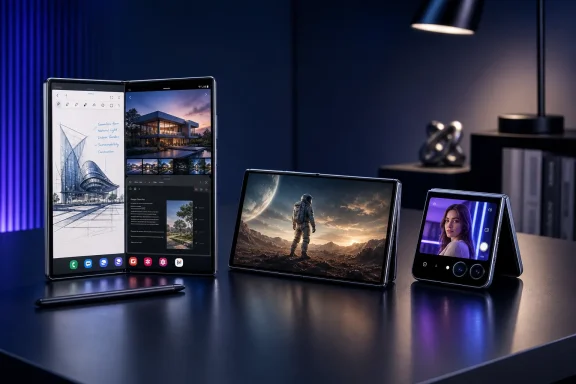 Overview: Samsung Has Split the Foldable Market Into Three Jobs
For years, Samsung’s foldable decision was relatively simple. Buyers picked a Galaxy Z Fold if they wanted a phone that opened into a tablet, or a Galaxy Z Flip if they wanted a compact clamshell with a bit of retro charm.The Galaxy Z Series 8 changes that formula. Samsung now has two devices with the Fold name that differ dramatically in physical shape and intended use.
At a glance, the choices are clearer than the naming suggests:
- Galaxy Z Fold8 Ultra: the flagship productivity foldable, with the biggest screen, the strongest camera system, premium performance, and a traditional tall cover display.
- Galaxy Z Fold8: a wider, shorter foldable designed around media, browsing, reading, gaming, and more natural landscape viewing.
- Galaxy Z Flip8: the portable, style-led clamshell with a larger cover screen, hands-free camera modes, and a familiar full-height phone display when open.
That overlap matters. The best Samsung foldable is not the device with the word Ultra in its name. It is the device whose shape most closely matches the way it will be used every day.
The Galaxy Z Fold8 Ultra: The All-in-One Flagship
The Galaxy Z Fold8 Ultra is the most straightforward member of the new lineup. It is effectively the successor to Samsung’s established large Fold concept: a tall smartphone when closed, a tablet-like device when opened.Its outer display measures 6.5 inches, while the main internal panel expands to 8 inches. The inner display uses a near-square layout that offers substantial room for multitasking, document review, web research, photo editing, remote desktop work, and side-by-side app windows.
At 215 grams, the Fold8 Ultra is not a lightweight phone in the traditional sense, but it is notably manageable for a device with an 8-inch internal display. When unfolded, it measures only 4.1mm at its thinnest point, though that figure does not include the display frame. Folded, it is 8.9mm thick.
Why the Fold8 Ultra is the productivity choice
Samsung has equipped the Fold8 Ultra with the hardware expected from its most premium foldable:- Snapdragon 8 Elite Gen 5 for Galaxy processor
- 8-inch Dynamic AMOLED 2X internal display
- 6.5-inch Dynamic AMOLED 2X cover display
- Adaptive refresh rates up to 120Hz on both screens
- 16GB RAM option paired with 1TB of storage
- 5,000mAh dual battery
- 45W wired charging
- Wi-Fi 7 and Bluetooth 6.0 support
- Android 17 with One UI 9
- Up to seven generations of operating system and security updates
For Windows enthusiasts, that wider workspace has obvious appeal. A large unfolded screen is better suited to reviewing cloud documents, participating in Microsoft Teams calls, handling Outlook email, working in browser-based productivity suites, using remote desktop tools, or managing multiple apps at once. Samsung’s multi-window software approach remains one of the strongest arguments for a book-style foldable.
A conventional phone can show a spreadsheet. The Fold8 Ultra can make a spreadsheet less frustrating. That distinction is the foundation of its appeal.
The Ultra camera advantage is real
The Fold8 Ultra also makes the strongest case for buyers who want a foldable without accepting a major camera downgrade. It includes:- A 200MP wide camera
- A 50MP ultra-wide camera
- A 10MP telephoto camera with 3x optical zoom
- 10MP cameras for the cover and main displays
- 8K video support
- Enhanced low-light imaging tools
- Advanced video and color options aimed at creators
Samsung’s decision to place its most capable cameras in the productivity-branded Fold8 Ultra may seem unusual at first. But it makes sense when the device is viewed as a premium all-purpose machine. The Fold8 Ultra is built for people who do not want to choose between a large display, a serious camera system, and a high-end processor.
The compromise: tall, narrow, and still expensive
The Fold8 Ultra’s large internal panel is excellent for multitasking, but its folded shape remains a compromise. The tall outer display is more conventional than older Fold designs, yet it is still a narrower experience than a standard large smartphone.That matters most when typing, reading dense text, or using apps that are not especially well optimized for foldable screens. The cover display can handle these tasks, but its proportions will not suit everyone. Users who spend nearly all day on the outer display may wonder whether they are paying for an internal screen they rarely open.
The other limitation is media. The Fold8 Ultra’s internal display is large and bright, but its more square aspect ratio can leave black bars above and below wide video content. It is excellent for multitasking and gaming layouts that benefit from extra vertical space. It is not automatically the most cinematic foldable in Samsung’s range.
The Galaxy Z Fold8: The New “Goldilocks” Foldable
The Galaxy Z Fold8 is the most important device in Samsung’s revised strategy because it introduces a genuinely different foldable shape. Rather than functioning as a smaller Fold8 Ultra, it uses a shorter, wider format that changes how the phone feels both closed and open.This is the model for buyers who find the Fold8 Ultra too tall and work-focused, but see the Flip8 as too small or too limiting. Its design can reasonably be described as Samsung’s Goldilocks foldable: larger and more immersive than a clamshell, less elongated and less work-centric than the Ultra.
When folded, the Z Fold8 uses a 5.5-inch cover display with a wider layout. When opened, it becomes a 7.6-inch internal display with a more traditional 4:3-style canvas. It weighs 201 grams, making it lighter than the Fold8 Ultra despite remaining a substantial device.
A foldable designed around content rather than spreadsheets
Samsung positions the standard Fold8 as the entertainment-first model, and the physical design supports that argument.The wider internal display is better matched to several common activities:
- Streaming video in landscape orientation
- Watching sports, films, and YouTube content
- Gaming with broader on-screen controls
- Reading e-books, comics, articles, and documents
- Browsing social media feeds
- Viewing photographs and editing images
- Video calling with a more natural desktop-like layout
That distinction is easy to underestimate. A foldable is not just a phone with a larger screen; its proportions define what it is pleasant to do. The Fold8’s broader dimensions should reduce the black bars that can appear during widescreen video playback on square-ish tablet displays. For users who watch a lot of video while traveling, commuting, or relaxing at home, that may be more valuable than the Ultra’s larger panel.
The Fold8 is not simply a cheaper Fold8 Ultra
The standard Fold8 shares several meaningful flagship features with its larger sibling:- Snapdragon 8 Elite Gen 5 for Galaxy
- 7.6-inch Dynamic AMOLED 2X main display
- 5.5-inch Dynamic AMOLED 2X cover display
- Up to 120Hz adaptive refresh rate
- 4,800mAh dual battery
- 45W wired charging
- Wi-Fi 7 and Bluetooth 6.0
- Android 17 and One UI 9
- IP48 water and dust resistance
The Fold8 is also Samsung’s lightest Fold to date. At 201 grams, it is closer to the weight of a conventional large flagship phone than many buyers may expect from a device that unfolds into a 7.6-inch screen.
The biggest risk: the cover screen remains unusual
The Fold8’s passport-style shape is exciting precisely because it is unconventional. That is also its main risk.A 5.5-inch external screen sounds fairly normal on paper, but diagonal size says little about usability. Its wider-but-shorter proportions may be appealing for reading, navigation, quick messages, and landscape media controls. Yet people who prefer a tall smartphone display for scrolling through feeds, typing long messages, or using vertically optimized apps may find the format cramped.
The Fold8 asks users to rethink what a folded phone should look like. That can be refreshing. It can also be polarizing.
The best way to understand the Fold8 is to view it as a small tablet that folds into a compact, wide phone—not as a normal phone that happens to open wider. Anyone considering it should spend time with the cover display before committing, because that is the screen most likely to determine whether the format feels brilliant or awkward after the initial novelty fades.
The camera system is capable, but not Ultra-grade
The Fold8 uses a dual rear-camera system:- 50MP wide camera
- 50MP ultra-wide camera
- 10MP cover camera
- 10MP internal camera
This is the central trade-off. Buyers who want a foldable mainly for video, reading, browsing, and gaming may not care. Buyers who want reliable optical zoom and Samsung’s most advanced imaging system should not assume the Fold8 is a lower-cost way to get the complete Ultra experience.
It is not.
The Galaxy Z Flip8: The Compact Foldable Still Makes the Most Immediate Sense
The Galaxy Z Flip8 remains Samsung’s most intuitive foldable proposition. Instead of trying to replace a tablet, it turns a full-size smartphone into something dramatically easier to carry.Fold it shut and it takes up far less pocket space. Open it and it becomes a standard-looking 6.9-inch smartphone. This remains one of the simplest and most compelling arguments in foldable design.
The Flip8 is Samsung’s thinnest and lightest Flip to date, measuring 6.1mm when unfolded and weighing 180 grams. Those figures matter because comfort is core to the Flip concept. A clamshell foldable succeeds when it feels less like a technological compromise and more like a phone that happens to be unusually convenient to carry.
The FlexWindow is now central to the experience
The Flip8’s 4.1-inch FlexWindow is not just a notification screen. It is a major part of the phone’s identity.Samsung has expanded the cover-screen experience to include more apps, quick actions, AI-powered suggestions, glanceable information, voice-driven assistance, music controls, replies, and connected tasks. The idea is to let owners do more without opening the device.
That can make a genuine difference in daily use:
- Check messages without unfolding the phone
- Manage media controls quickly
- View schedules and contextual prompts
- Respond to notifications
- Use voice assistance
- Preview and frame photos with the rear cameras
- Access practical shortcuts while the phone stays compact
For many people, that will feel faster and less distracting than unlocking a large conventional phone dozens of times per day.
The best camera format for casual creators
The Flip8’s 50MP main camera is less ambitious than the Fold8 Ultra’s system, but the clamshell design creates its own photographic advantages. FlexCam enables the phone to hold itself at an angle for hands-free shooting, while the cover screen can serve as a preview display when using the better rear cameras for selfies.Samsung also emphasizes features such as automatic framing, dual-camera capture modes, AI editing, and camcorder-style video shooting. These tools are not exclusive to the Flip8, but its physical design makes them more practical.
The device can sit on a desk for a video call. It can function as a tiny tripod for group photos. It can shoot hands-free cooking clips, unboxing videos, workouts, and casual vlogs without requiring a separate stand.
For people who regularly create social content, the Flip8’s camera experience may be more useful than its specification sheet initially suggests.
The compromise: a clamshell is still a clamshell
The Flip8’s compactness comes with the clearest trade-off in Samsung’s foldable range: it does not create a larger workspace.Once opened, it is essentially a standard smartphone with a flexible display. That is enough for most people, and it is exactly why the Flip line has wide appeal. But users who want split-screen productivity, desktop-like messaging and calendar views, spacious document reading, or tablet-scale gaming should look to either Fold model.
Its 4,300mAh battery is respectable considering the compact frame, but buyers should not assume it will match the endurance potential of the Fold8 Ultra’s 5,000mAh battery. Real-world battery life will depend heavily on 5G use, display brightness, camera activity, gaming, AI features, and the frequency with which the main display is opened.
Durability, Repairs, and the Reality of Foldable Ownership
All three Galaxy Z Series 8 phones carry an IP48 rating for water and dust resistance. That is an important step for foldables, but it should not be misunderstood.IP48 does not mean these devices are invincible. Samsung’s guidance still makes clear that water resistance is not permanent and can diminish through normal wear. Beach sand, fine dust, accidental drops, pressure on the folding display, and damage to the hinge remain concerns that owners of conventional slab phones do not face to the same degree.
Samsung has improved the formula with Armor Aluminum frames, reinforced hinge engineering, stronger glass protection, and, in the Fold8 Ultra’s case, a titanium-based internal display reinforcement approach. These are welcome advances. But foldables remain mechanically more complex devices.
Buyers should budget with that reality in mind.
Protection is part of the purchase decision
Anyone choosing a Fold8 Ultra, Fold8, or Flip8 should weigh the cost of extended protection as seriously as storage capacity or color.A practical ownership plan includes:
- Using a case that protects the hinge area rather than only the rear panel.
- Keeping the inner display away from sharp objects and abrasive debris.
- Avoiding extreme pressure on the internal screen.
- Being cautious around sand, pools, and dusty workspaces.
- Reviewing repair and accidental-damage coverage before the return window closes.
How Windows Users Should Choose
For WindowsForum readers, the decision should begin with workflow rather than fashion.Samsung’s foldables run Android, not Windows, but they increasingly fit into a Windows-centered setup through cloud storage, Microsoft 365, Outlook, Teams, Phone Link-style cross-device workflows, browser services, remote desktops, and Android apps that support multitasking.
Choose the Galaxy Z Fold8 Ultra if you need a mobile work surface
The Fold8 Ultra is the strongest pick for people who regularly handle work outside the office.It is especially suitable for:
- Managing multiple email and chat windows
- Reviewing documents and presentations
- Remote desktop access
- Calendar and Teams workflows
- Browser research with multiple tabs
- Editing photos and video on the go
- Gaming and emulation on a large display
- Replacing a small tablet during travel
The cost, size, and pocket footprint are the trade-offs.
Choose the Galaxy Z Fold8 if media comes before multitasking
The Fold8 is for users who want a foldable display but do not necessarily want to carry the largest or tallest Fold form factor.It is the best match for:
- Watching movies and shows
- Reading books, comics, and long-form web content
- Browsing social media
- Casual gaming
- Viewing photos
- Using a foldable more like a compact entertainment tablet
- Carrying a lighter Fold-class device
The Fold8’s lack of a telephoto camera and smaller battery compared with the Ultra are sensible compromises for many users, but they should be considered before purchase rather than rationalized afterward.
Choose the Galaxy Z Flip8 if portability changes your behavior
The Flip8 is the best choice when compactness is not a minor preference but a daily benefit.It is particularly strong for:
- Small pockets and compact bags
- Travelers who value minimal bulk
- Quick cover-screen interactions
- Casual photography and selfies
- Hands-free filming and video calls
- People who want a normal phone experience when open
- Buyers who want foldable novelty without committing to a tablet-style device
Samsung’s Expanding Foldable Lineup Is a Strength—and a Warning
Samsung deserves credit for no longer treating foldables as a single category. The Fold8 Ultra, Fold8, and Flip8 each make a more coherent case than a lineup built only around storage tiers and incremental annual revisions.The Fold8 Ultra proves that the classic book-style foldable still has room to evolve. The Fold8 recognizes that not everyone wants a tall device optimized around work. The Flip8 remains a persuasive answer for people who simply want their big phone to take up less room.
Yet more choice can create more confusion. The naming is particularly challenging because the Galaxy Z Fold8 Ultra is the direct continuation of the traditional Fold family, while the Galaxy Z Fold8 is a new form factor. A buyer could reasonably assume the Fold8 is a smaller version of the Fold8 Ultra, when in practice it is a different product with a different philosophy.
That is the key takeaway from Samsung’s new foldable strategy: do not shop by hierarchy; shop by shape.
The Fold8 Ultra is the safest choice for the buyer who wants maximum capability and can tolerate the cost and size. The Fold8 is the intriguing option for people who have wanted a better media-oriented foldable without a conventional tall Fold design. The Flip8 is the most practical choice for anyone who values pocketability, creativity, and a more familiar smartphone experience.
Samsung has not found one definitive foldable design because there may not be one. The company’s 2026 lineup instead makes a more convincing argument: the best foldable phone is the one whose compromises barely feel like compromises at all.
References
- Primary source: CNET
Published: 2026-07-23T23:24:30+00:00
Loading…
www.cnet.com - Related coverage: androidcentral.com
The Galaxy Z Fold 8 is official, and it changes what Samsung's foldable lineup looks like | Android Central
Samsung's book-style foldable lineup gets a new shape, and it's not the one carrying the Fold name you'd expect.www.androidcentral.com - Related coverage: techadvisor.com
Loading…
www.techadvisor.com - Related coverage: news.samsung.com
Loading…
news.samsung.com - Related coverage: image-us.samsung.com
Loading…
image-us.samsung.com