

A ten-question shootout between Apple’s emerging Siri AI and OpenAI’s ChatGPT makes for entertaining reading, but its most useful finding is not that one assistant has decisively beaten the other. It is that the two products are already being shaped around different jobs: Siri AI aims to be a compact, system-aware assistant that delivers the next useful action, while ChatGPT remains a more expansive conversational tool that often shows more of its working—and occasionally trips over it.
The comparison covers public transport, classic logic riddles, ambiguity, future events, ethical judgment, creative writing, self-awareness, and multi-step arithmetic. On the surface, that is a sensible spread of prompts. Both assistants correctly handled most of the deliberately simple reasoning questions, refused to invent a winner for the still-unplayed 2034 FIFA World Cup, and produced usable answers on ethics and creativity.
Yet the exercise also exposes the problem with declaring an AI winner from a small collection of neatly framed questions. A modern AI assistant is not a single static model. Its answer can depend on the selected mode, available tools, web access, location permissions, account tier, conversation history, software build, safety policies, and whether the service has been updated since the last test. That matters even more when one side is a pre-release assistant deeply integrated into a device ecosystem and the other is a fast-changing cross-platform service available on Windows, the web, mobile, and desktop.
For Windows users, the story is less about choosing sides in an Apple-versus-OpenAI contest than understanding what kind of AI assistance is becoming normal. Brevity can be a feature. Visible reasoning can be valuable. Neither is enough by itself if the answer is wrong, stale, poorly sourced, or based on an assumption the user did not intend.
The prompt set is designed to probe several familiar failure points for generative AI:
Still, the questions are not an exhaustive benchmark. They do not examine document analysis, coding, image understanding, accessibility, long-context recall, security behavior, app control, citation quality, source selection, spreadsheet work, or the practical reliability of task completion. Those are the categories where an assistant can become genuinely useful—or actively inconvenient—on a Windows PC or a smartphone.
The test therefore provides a useful snapshot of response style and basic reasoning, not a final measure of intelligence.
That distinction is important. A traditional chatbot is largely judged by the quality of the text it produces. A system assistant must also be judged by whether it can safely find the right email, identify the correct calendar event, act on the content currently displayed, understand an incomplete instruction, and complete an action without damaging user trust.
That makes any early comparison inherently provisional.
Pre-release software can be impressive in constrained demonstrations and still show gaps when exposed to millions of real-world requests. It can also improve dramatically between builds. A response that looks overly terse, repetitive, or unusually polished may be a characteristic of a particular version rather than a permanent product decision.
The same caveat applies to ChatGPT, whose models, tools, default behavior, and available capabilities change regularly. A one-day test is a photograph, not a permanent leaderboard.
A mobile assistant does not always need to produce a miniature essay. If someone asks for the answer to a familiar riddle, the ideal outcome is often:
That is not a lesser form of intelligence. It is a product decision: optimize for interruption-free answers, speed, and actionability rather than maximize visible deliberation.
The danger is that concise responses can conceal untested assumptions. When an answer is right, the brevity feels confident and helpful. When it is wrong, the same brevity provides little opportunity for the user to spot where the assistant went off course.
That is good reasoning. The system recognized that the core problem was not weather data but underspecified intent.
At the same time, the response illustrates why users can find ChatGPT more verbose than necessary. A person asking about tomorrow’s weather may not want a discussion of ambiguity before receiving the practical answer. They may simply want the forecast for London at departure and Sydney at arrival.
The arithmetic is straightforward:
This is a minor error in an artificial puzzle, but it represents a major usability lesson. Users do not judge AI systems solely by their final paragraph. They judge them by whether they can trust the first thing displayed. An assistant that presents a confident wrong answer before correcting itself creates unnecessary friction, especially in situations where the user may not read every line.
For work involving calculations, schedules, financial estimates, or technical troubleshooting, intermediate consistency matters as much as final correctness.
Siri AI apparently assumes the user wants the arrival forecast for Sydney, then adds a clarification that another Sydney could have been intended. ChatGPT foregrounds the ambiguity and distinguishes between departure and arrival conditions.
Both approaches can be defended.
By making that assumption, Siri AI avoids forcing the user into a clarification loop. This can feel natural and efficient.
The risk is that the answer may solve the wrong problem. A traveler packing for departure, considering airport transport, or worried about weather disruptions may care far more about London conditions than Sydney’s forecast.
That can reduce the chance of a confidently irrelevant answer. It is especially appropriate in domains where ambiguity has consequences, such as medicine, finance, law, travel bookings, IT administration, or security.
But a chatbot can overuse this pattern. If every ordinary request triggers a list of caveats, it becomes slower and less pleasant to use. Users should not have to negotiate a contract with an assistant before asking for a restaurant recommendation or a simple weather forecast.
Siri AI’s added detail is accurate and relevant. Saudi Arabia was appointed host for the 2034 tournament, but that fact must not be confused with knowledge of a future winner.
This distinction is central to assessing generative AI. A model can write a fluent answer about a future event, give it a confident tone, and even populate it with plausible-sounding details. None of that makes it true.
A short answer that says “there is no winner yet” is more valuable than a beautifully written false answer naming a fictional champion.
Both assistants identify the familiar subway routes serving Coney Island–Stillwell Avenue, including the D, F, N, and Q lines. In broad terms, that is the right route family. A journey in the rough range of an hour is also reasonable under ordinary conditions.
But no static answer should be treated as a travel plan.
The issue is not merely whether the number is correct. It is whether the assistant makes clear that it is a time-sensitive figure.
A robust answer should include:
Both Siri AI and ChatGPT pass them.
The task measures reading precision rather than advanced reasoning. Both assistants correctly interpret the phrase.
If the ball were ten cents, the bat would cost $1.10 and the total would be $1.20. At five cents for the ball and $1.05 for the bat, the total is $1.10.
This question remains useful because it catches systems that pattern-match toward the tempting but incorrect answer without verifying the sum.
Again, both systems get the correct answer. That demonstrates baseline competence, but it does not tell us much about performance on long calculations, spreadsheet formulas, code debugging, or multi-document analysis.
The major takeaway is simple: passing familiar riddles should be expected, not treated as proof that an AI can reason reliably in every setting.
That is a sound, mainstream explanation. It also shows that AI can offer a useful moral framework without pretending that every ethical question has a single mechanical solution.
The more meaningful difference is tone.
Siri AI’s answer is restrained and structured. ChatGPT gives a little more contextual distinction, noting that lies used merely to avoid embarrassment have much weaker justification because they undermine trust. Neither response is especially surprising, but both are better than a shallow “lying is always wrong” or “lying is always acceptable if it helps” answer.
This is a preference contest. Some readers will prefer Siri’s antique phrasing; others will prefer ChatGPT’s smoother rhythm and clearer imagery.
The important point is that creative outputs should be judged on fit to the prompt, not on whether they sound literary in isolation. If the request says “in the style of a medieval bard,” then archaic diction, lyrical imagery, and a sense of performance matter more than technical accuracy about wireless networking.
ChatGPT says it does not know the current queue time at a nearby passport office and explains that it would need a location and current official information. Siri AI says it does not know current traffic on the user’s daily commute and indicates that real-time mapping and transit data would be needed.
These are good responses because both assistants avoid claiming omniscience.
However, statements about “internal tools” deserve scrutiny. An AI should not imply it can access data, devices, accounts, locations, or services unless those permissions and integrations are actually available in the current interaction. A user should always be able to tell the difference between:
ChatGPT, by contrast, is available across platforms, including Windows, where its desktop experience increasingly combines chat, search, files, browsing, and work-oriented tools. That broad availability makes it relevant even when the headline comparison is framed around an Apple product.
That flexibility has practical benefits:
That is potentially transformative for everyday computing. But it also raises the bar for privacy safeguards and error handling. An assistant that can draft text incorrectly is inconvenient. An assistant that can send a message, alter a calendar event, change a reminder, or access personal information must be much more dependable.
The future competition is not simply about who writes the best paragraph. It is about who can combine reasoning, tools, context, privacy, permissions, and interface design without creating new hazards.
Siri AI appears strongest when the goal is a compact, mobile-friendly response. Its answers are mostly correct, its train calculation is clean, and its directness is likely to appeal to people who want an assistant rather than a verbose conversational partner. It also demonstrates why Apple’s system-level vision could matter more than raw chatbot performance if its personal-context and app-action features work reliably at scale.
ChatGPT remains more willing to acknowledge ambiguity and explain the boundaries of a question. That can be a significant advantage when the user’s wording is incomplete or the stakes are high. But the contradictory opening in the train answer is a reminder that more explanation does not guarantee more reliability. Extra text can occasionally expose confusion instead of resolving it.
The better lesson is not that users should demand one response style from every AI. It is that assistants should adapt. A riddle needs a fast answer. A weather request needs a stated assumption and current data. A travel query needs live service information. A future-event question needs an honest refusal to speculate. A calculation needs a consistent result. A sensitive action needs explicit permission.
As Siri AI moves from testing toward broader availability, its biggest challenge will be proving that concise, integrated answers remain accurate when users ask messy, personal, real-world questions. ChatGPT’s challenge is the reverse: retaining the richness and flexibility that make it powerful while becoming more disciplined, less meandering, and more consistently correct on the first line.
That is the AI assistant contest that matters—not which system writes the better medieval Wi-Fi poem, but which one earns enough trust to become part of everyday computing.
The comparison covers public transport, classic logic riddles, ambiguity, future events, ethical judgment, creative writing, self-awareness, and multi-step arithmetic. On the surface, that is a sensible spread of prompts. Both assistants correctly handled most of the deliberately simple reasoning questions, refused to invent a winner for the still-unplayed 2034 FIFA World Cup, and produced usable answers on ethics and creativity.
Yet the exercise also exposes the problem with declaring an AI winner from a small collection of neatly framed questions. A modern AI assistant is not a single static model. Its answer can depend on the selected mode, available tools, web access, location permissions, account tier, conversation history, software build, safety policies, and whether the service has been updated since the last test. That matters even more when one side is a pre-release assistant deeply integrated into a device ecosystem and the other is a fast-changing cross-platform service available on Windows, the web, mobile, and desktop.
For Windows users, the story is less about choosing sides in an Apple-versus-OpenAI contest than understanding what kind of AI assistance is becoming normal. Brevity can be a feature. Visible reasoning can be valuable. Neither is enough by itself if the answer is wrong, stale, poorly sourced, or based on an assumption the user did not intend.
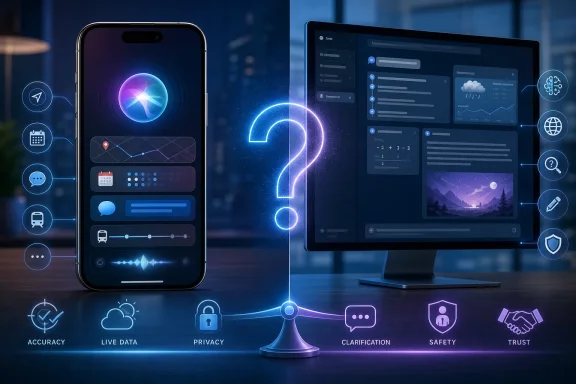 Overview: What the Ten Questions Actually Tested
The prompt set is designed to probe several familiar failure points for generative AI:- Live information retrieval, using transit and weather.
- Basic logical comprehension, using “all but nine die.”
- Resistance to intuitive but incorrect answers, using the bat-and-ball puzzle.
- Ambiguity handling, using a London-to-Sydney weather request.
- Hallucination resistance, using the 2034 World Cup.
- Rate reasoning, using machines producing widgets.
- Ethical explanation, using a question about lying.
- Stylistic creativity, using a medieval Wi-Fi poem.
- Knowledge boundaries, using a self-awareness question.
- Multi-step arithmetic, using two trains travelling toward each other.
Still, the questions are not an exhaustive benchmark. They do not examine document analysis, coding, image understanding, accessibility, long-context recall, security behavior, app control, citation quality, source selection, spreadsheet work, or the practical reliability of task completion. Those are the categories where an assistant can become genuinely useful—or actively inconvenient—on a Windows PC or a smartphone.
The test therefore provides a useful snapshot of response style and basic reasoning, not a final measure of intelligence.
Apple’s Siri AI Is a Different Kind of Product
Apple’s Siri AI is not simply the old voice assistant with a chatbot bolted onto the side. Apple has positioned it as a substantially rebuilt assistant with conversational capabilities, personal-context awareness, onscreen understanding, web-backed answers, and deeper action-taking across applications.That distinction is important. A traditional chatbot is largely judged by the quality of the text it produces. A system assistant must also be judged by whether it can safely find the right email, identify the correct calendar event, act on the content currently displayed, understand an incomplete instruction, and complete an action without damaging user trust.
A Pre-Release Caveat Cannot Be Ignored
The comparison arrives while Siri AI is still in a staged rollout. Apple has made developer testing available for its new software platforms, while broader user availability for Siri AI is planned as a beta release later in the year for supported devices and languages.That makes any early comparison inherently provisional.
Pre-release software can be impressive in constrained demonstrations and still show gaps when exposed to millions of real-world requests. It can also improve dramatically between builds. A response that looks overly terse, repetitive, or unusually polished may be a characteristic of a particular version rather than a permanent product decision.
The same caveat applies to ChatGPT, whose models, tools, default behavior, and available capabilities change regularly. A one-day test is a photograph, not a permanent leaderboard.
Apple’s Short-Answer Philosophy
The most striking pattern in the Siri AI responses is their economy. On the sheep riddle, widget puzzle, and train question, the assistant gives a direct result and enough explanation to show the logic. On a phone, smartwatch, or in-car interface, that can be exactly the right design choice.A mobile assistant does not always need to produce a miniature essay. If someone asks for the answer to a familiar riddle, the ideal outcome is often:
Then, if needed, a one-line explanation.Nine sheep remain.
That is not a lesser form of intelligence. It is a product decision: optimize for interruption-free answers, speed, and actionability rather than maximize visible deliberation.
The danger is that concise responses can conceal untested assumptions. When an answer is right, the brevity feels confident and helpful. When it is wrong, the same brevity provides little opportunity for the user to spot where the assistant went off course.
ChatGPT’s Strength Is Range—And Its Risk Is Overproduction
ChatGPT’s answers in the comparison generally show a familiar pattern: more context, more caveats, more formatting, and a greater willingness to articulate uncertainty. That style is particularly evident in the weather question, where ChatGPT identifies that “I’m flying from London to Sydney tomorrow” does not specify whether the user wants departure weather, arrival weather, en-route conditions, or even which Sydney is intended.That is good reasoning. The system recognized that the core problem was not weather data but underspecified intent.
At the same time, the response illustrates why users can find ChatGPT more verbose than necessary. A person asking about tomorrow’s weather may not want a discussion of ambiguity before receiving the practical answer. They may simply want the forecast for London at departure and Sydney at arrival.
The Train Answer Shows Why Clean Reasoning Matters
The train question is the most revealing moment in the test. ChatGPT reportedly begins by stating that the trains meet at 11:12 a.m., then calculates the correct result: 11:13:20 a.m.The arithmetic is straightforward:
- The London train leaves at 10:00 a.m. and travels at 80 mph.
- By 11:00 a.m., it has travelled 80 miles.
- Since London and Birmingham are 120 miles apart, 40 miles remain between the trains.
- From 11:00 a.m., the trains move toward one another at a combined speed of 180 mph.
- Covering 40 miles at 180 mph takes two-ninths of an hour.
- Two-ninths of an hour equals 13 minutes and 20 seconds.
- The meeting time is therefore 11:13:20 a.m.
This is a minor error in an artificial puzzle, but it represents a major usability lesson. Users do not judge AI systems solely by their final paragraph. They judge them by whether they can trust the first thing displayed. An assistant that presents a confident wrong answer before correcting itself creates unnecessary friction, especially in situations where the user may not read every line.
For work involving calculations, schedules, financial estimates, or technical troubleshooting, intermediate consistency matters as much as final correctness.
The Weather Question Reveals Two Competing AI Design Choices
The London-to-Sydney prompt is arguably the best question in the entire set because it has no single ideal response.Siri AI apparently assumes the user wants the arrival forecast for Sydney, then adds a clarification that another Sydney could have been intended. ChatGPT foregrounds the ambiguity and distinguishes between departure and arrival conditions.
Both approaches can be defended.
Siri AI’s Approach: Infer the Likely Intent
Siri’s response reflects an assistant designed to reduce conversational drag. Most people saying they are flying from London to Sydney tomorrow probably mean the Australian city and likely care about the conditions they will encounter after landing.By making that assumption, Siri AI avoids forcing the user into a clarification loop. This can feel natural and efficient.
The risk is that the answer may solve the wrong problem. A traveler packing for departure, considering airport transport, or worried about weather disruptions may care far more about London conditions than Sydney’s forecast.
ChatGPT’s Approach: Surface the Uncertainty
ChatGPT’s approach better demonstrates epistemic caution. It identifies uncertainty before treating an interpretation as fact.That can reduce the chance of a confidently irrelevant answer. It is especially appropriate in domains where ambiguity has consequences, such as medicine, finance, law, travel bookings, IT administration, or security.
But a chatbot can overuse this pattern. If every ordinary request triggers a list of caveats, it becomes slower and less pleasant to use. Users should not have to negotiate a contract with an assistant before asking for a restaurant recommendation or a simple weather forecast.
The Better Standard: Answer, Then Qualify
The most effective AI behavior often combines both approaches:- Make the most likely reasonable assumption.
- State that assumption plainly.
- Give the requested answer.
- Offer the alternate interpretation only when it meaningfully changes the result.
That is concise, useful, and transparent.Assuming you mean Sydney, Australia, expect cool winter conditions on arrival. London’s departure weather may be very different, so check both forecasts before packing.
Hallucination Resistance Is More Important Than Creative Fluency
Both systems correctly refuse to invent a winner for the 2034 FIFA World Cup, because the tournament has not yet happened. Siri AI adds that Saudi Arabia is scheduled to host the competition, while ChatGPT stops after explaining that any claimed winner would be fabricated.Siri AI’s added detail is accurate and relevant. Saudi Arabia was appointed host for the 2034 tournament, but that fact must not be confused with knowledge of a future winner.
This distinction is central to assessing generative AI. A model can write a fluent answer about a future event, give it a confident tone, and even populate it with plausible-sounding details. None of that makes it true.
A Useful Rule for AI Outputs
When an answer concerns a future event, a current price, a schedule, an election, a product release, a public figure, travel conditions, weather, or a software version, users should expect the AI to do one of two things:- Use current, verifiable information and clearly distinguish facts from predictions.
- State that it cannot verify the information rather than fill the gap with plausible fiction.
A short answer that says “there is no winner yet” is more valuable than a beautifully written false answer naming a fictional champion.
Transit Answers Need Live Data, Not Just Correct-Looking Facts
The Times Square-to-Coney Island question looks simple, but it is one of the least stable prompts in the test. Transit service changes due to maintenance work, weekend schedules, reroutes, accessibility outages, station closures, and fare revisions.Both assistants identify the familiar subway routes serving Coney Island–Stillwell Avenue, including the D, F, N, and Q lines. In broad terms, that is the right route family. A journey in the rough range of an hour is also reasonable under ordinary conditions.
But no static answer should be treated as a travel plan.
Why the Fare Detail Is a Warning Sign
The quoted responses specify a subway fare of $2.90. Even if that number was accurate at the time a specific model was updated or a tool query was run, fares are precisely the kind of information that should be retrieved live.The issue is not merely whether the number is correct. It is whether the assistant makes clear that it is a time-sensitive figure.
A robust answer should include:
- The likely fastest route.
- An estimated travel duration.
- A statement that service conditions can alter the route.
- A current fare check where live data is available.
- A practical instruction to verify service changes before departing.
The Logic Questions Were Easy—But Still Worth Including
The sheep riddle, bat-and-ball puzzle, and widget question are longstanding tests of whether a system will jump to the most intuitive answer rather than follow the wording and arithmetic.Both Siri AI and ChatGPT pass them.
The Sheep Riddle
“All but nine die” means that nine survive. It does not mean eight die or that there is a subtraction problem to solve.The task measures reading precision rather than advanced reasoning. Both assistants correctly interpret the phrase.
The Bat and Ball Puzzle
The ball costs five cents, not ten cents.If the ball were ten cents, the bat would cost $1.10 and the total would be $1.20. At five cents for the ball and $1.05 for the bat, the total is $1.10.
This question remains useful because it catches systems that pattern-match toward the tempting but incorrect answer without verifying the sum.
The Widget Problem
If five machines make five widgets in five minutes, each machine makes one widget in five minutes. Therefore, 100 machines operating simultaneously make 100 widgets in the same five minutes.Again, both systems get the correct answer. That demonstrates baseline competence, but it does not tell us much about performance on long calculations, spreadsheet formulas, code debugging, or multi-document analysis.
The major takeaway is simple: passing familiar riddles should be expected, not treated as proof that an AI can reason reliably in every setting.
Ethics and Creativity Show Tone More Than Truth
The question about lying produces broadly similar answers from both tools. Each identifies the common extreme case: lying to protect someone from immediate violence can be ethically justified because preventing grave harm outweighs the general value of truthfulness.That is a sound, mainstream explanation. It also shows that AI can offer a useful moral framework without pretending that every ethical question has a single mechanical solution.
The more meaningful difference is tone.
Siri AI’s answer is restrained and structured. ChatGPT gives a little more contextual distinction, noting that lies used merely to avoid embarrassment have much weaker justification because they undermine trust. Neither response is especially surprising, but both are better than a shallow “lying is always wrong” or “lying is always acceptable if it helps” answer.
Medieval Wi-Fi Is a Style Test, Not a Capability Test
The four-line medieval bard poem is enjoyable precisely because it has no factual stakes. Siri AI produces a more elevated, courtly style, while ChatGPT uses a more direct rhyme structure and makes the Wi-Fi concept easy to understand.This is a preference contest. Some readers will prefer Siri’s antique phrasing; others will prefer ChatGPT’s smoother rhythm and clearer imagery.
The important point is that creative outputs should be judged on fit to the prompt, not on whether they sound literary in isolation. If the request says “in the style of a medieval bard,” then archaic diction, lyrical imagery, and a sense of performance matter more than technical accuracy about wireless networking.
What “Self-Awareness” Really Means in AI
Neither Siri AI nor ChatGPT is self-aware in the human sense. The self-awareness prompt is better understood as a test of knowledge boundaries and tool transparency.ChatGPT says it does not know the current queue time at a nearby passport office and explains that it would need a location and current official information. Siri AI says it does not know current traffic on the user’s daily commute and indicates that real-time mapping and transit data would be needed.
These are good responses because both assistants avoid claiming omniscience.
However, statements about “internal tools” deserve scrutiny. An AI should not imply it can access data, devices, accounts, locations, or services unless those permissions and integrations are actually available in the current interaction. A user should always be able to tell the difference between:
- Information the model knows from general training.
- Information retrieved from the web.
- Information provided in the current chat.
- Information available through connected apps or services.
- Information that requires the user’s permission.
Why This Matters for Windows Users
Siri AI is built around Apple’s devices, services, operating systems, and application framework. Its promise is that it can understand personal context and take actions where the user already is.ChatGPT, by contrast, is available across platforms, including Windows, where its desktop experience increasingly combines chat, search, files, browsing, and work-oriented tools. That broad availability makes it relevant even when the headline comparison is framed around an Apple product.
The Windows Advantage: Choice
Windows users are not locked into a single assistant philosophy. They can use ChatGPT, Microsoft’s AI experiences, browser-based tools, local models, coding assistants, and enterprise AI platforms depending on the task.That flexibility has practical benefits:
- Choose a concise assistant for quick retrieval.
- Choose a research-oriented tool for a cited, multi-source investigation.
- Choose a coding assistant for development work.
- Keep sensitive work in approved enterprise environments.
- Use local or privacy-focused models where cloud processing is not appropriate.
The Apple Advantage: Integration
Apple’s approach has a different strength. When an assistant can see the relevant screen, understand a message, locate a personal detail, and safely trigger an app action, it can reduce the need to manually copy and paste context into a chat window.That is potentially transformative for everyday computing. But it also raises the bar for privacy safeguards and error handling. An assistant that can draft text incorrectly is inconvenient. An assistant that can send a message, alter a calendar event, change a reminder, or access personal information must be much more dependable.
The future competition is not simply about who writes the best paragraph. It is about who can combine reasoning, tools, context, privacy, permissions, and interface design without creating new hazards.
The Verdict: Siri AI Wins Brevity, ChatGPT Wins Transparency—Neither Wins Everything
The ten-question comparison supports a measured conclusion.Siri AI appears strongest when the goal is a compact, mobile-friendly response. Its answers are mostly correct, its train calculation is clean, and its directness is likely to appeal to people who want an assistant rather than a verbose conversational partner. It also demonstrates why Apple’s system-level vision could matter more than raw chatbot performance if its personal-context and app-action features work reliably at scale.
ChatGPT remains more willing to acknowledge ambiguity and explain the boundaries of a question. That can be a significant advantage when the user’s wording is incomplete or the stakes are high. But the contradictory opening in the train answer is a reminder that more explanation does not guarantee more reliability. Extra text can occasionally expose confusion instead of resolving it.
The better lesson is not that users should demand one response style from every AI. It is that assistants should adapt. A riddle needs a fast answer. A weather request needs a stated assumption and current data. A travel query needs live service information. A future-event question needs an honest refusal to speculate. A calculation needs a consistent result. A sensitive action needs explicit permission.
As Siri AI moves from testing toward broader availability, its biggest challenge will be proving that concise, integrated answers remain accurate when users ask messy, personal, real-world questions. ChatGPT’s challenge is the reverse: retaining the richness and flexibility that make it powerful while becoming more disciplined, less meandering, and more consistently correct on the first line.
That is the AI assistant contest that matters—not which system writes the better medieval Wi-Fi poem, but which one earns enough trust to become part of everyday computing.
References
- Primary source: stuff.tv
Published: 2026-07-23T16:19:55+00:00
Loading…
www.stuff.tv - Official source: apple.com
Loading…
www.apple.com - Official source: developer.apple.com
Loading…
developer.apple.com - Related coverage: tomsguide.com
Loading…
www.tomsguide.com - Related coverage: techradar.com
This is how Apple built 'a Siri that’s profoundly more capable' — and yes, it was done with Google and Nvidia's help | TechRadar
The all-new Siri AI is the product of intense collaboration between Apple and Google that stops short of Google's AI assistantwww.techradar.com - Related coverage: androidcentral.com
Loading…
www.androidcentral.com