

Mercedes-Maybach has turned its largest SUV into an even more overt statement of luxury, performance, and software-driven refinement with the updated GLS 680. The facelift brings a substantially stronger twin-turbo V8, a new three-screen MBUX Superscreen cabin, predictive air suspension technology, enhanced rear-seat comfort, and a lighting treatment that leaves no doubt about the vehicle’s ultra-luxury positioning. For U.S. buyers, this is expected to arrive as the 2027 Mercedes-Maybach GLS 680, marking a shift from the outgoing GLS 600 designation.
The update is not a clean-sheet redesign. Instead, it is a comprehensive reworking of the existing Mercedes-Maybach SUV formula, focused on the areas that matter most to its intended audience: effortless performance, isolation from the outside world, rear-seat indulgence, personalization, and a more capable digital experience.
That approach makes sense. The Mercedes-Maybach GLS has never competed on understatement, off-road ruggedness, or value. It exists to offer a highly conspicuous alternative to vehicles such as the Bentley Bentayga, Range Rover SV, Aston Martin DBX707, and Rolls-Royce Cullinan. The refreshed GLS 680 adds more technology and more theatricality without abandoning the V8-powered character that has defined the model.
The biggest mechanical change is found beneath the hood. The Mercedes-Maybach GLS 680 uses the updated M177 Evo 4.0-liter twin-turbocharged V8, supported by a 48-volt mild-hybrid electrical system.
The engine produces 603 horsepower and 850 Nm of torque, equivalent to roughly 627 lb-ft. That represents a meaningful increase over the previous Mercedes-Maybach GLS 600, which delivered 550 horsepower and 730 Nm of torque in most markets.
The integrated starter-generator can provide a temporary 23-horsepower boost when conditions demand it. While the mild-hybrid system does not turn the GLS 680 into a hybrid SUV in the plug-in sense, it supports smoother stop-start operation, energy recuperation, coasting, and more immediate low-speed response.
That distinction matters. A Maybach owner expects the GLS 680 to merge, overtake, and climb steep grades with no audible strain and no dramatic transmission activity. The power increase should be felt less as aggression and more as effortlessness.
The revised engine also gives the GLS 680 a stronger technical justification for its new designation. The previous GLS 600 badge was already a little misleading in the traditional Mercedes-Benz sense, since it did not denote a 6.0-liter engine. The move to GLS 680 better reflects its elevated status in the range, even though the SUV remains V8-powered rather than adopting the V12 used in the Mercedes-Maybach S 680 sedan.
For buyers who value the smoothness and emotional character of a V8, that will be a strength. The mild-hybrid system improves refinement without changing the core experience. For buyers looking for extended electric-only driving, a plug-in hybrid option, or a fully electric Maybach SUV, the GLS 680 does not answer that demand.
That is increasingly notable in a market where premium brands are adding more electrified options at the top end. Mercedes-Benz does offer battery-electric luxury models elsewhere in its portfolio, but the refreshed Maybach GLS continues to serve customers who are not ready to leave combustion power behind.
The most interesting development is cloud-based predictive damping. Instead of responding only after the vehicle detects a bump or road imperfection, the system can use road-condition information gathered by other Mercedes-Benz vehicles ahead. That enables the suspension to prepare for imperfections before the GLS 680 reaches them.
In principle, this is exactly the kind of technology that suits a Maybach. The occupants should not have to notice the road surface; the vehicle’s electronics, sensors, and dampers should deal with it in the background.
In the GLS 680, the connected approach could allow the suspension to alter its strategy before encountering known rough pavement, speed humps, road seams, or other surface disturbances. The advantage is not necessarily sharper handling. The goal is to make the cabin feel calmer and more isolated.
For an SUV this large, that is more valuable than it may first appear. Big wheels, substantial curb weight, and a tall body can work against ride comfort. Predictive damping offers a way to preserve the GLS 680’s commanding stance while reducing the sense that occupants are riding in a massive machine.
One of its more memorable functions is its ability to lean the SUV slightly into corners. Rather than allowing passengers to be pushed outward by lateral forces, the body can tilt into the bend in an effort to make the ride feel more natural and less taxing.
This is a feature that sounds excessive until it is placed in context. The Mercedes-Maybach GLS 680 is designed for owners and passengers who may spend long stretches being driven through city traffic, on highways, or between airports and private residences. Reducing fatigue and motion discomfort can be more meaningful than delivering the last word in handling precision.
Still, buyers should be realistic about the trade-offs. Sophisticated active suspension systems can deliver remarkable composure, but they also add complexity, cost, and potential long-term maintenance exposure. On a vehicle expected to wear optional 23-inch wheels, replacement tire costs and suspension repair bills are unlikely to be modest.
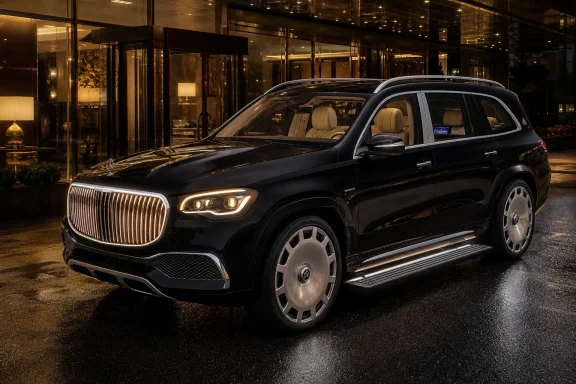
At the front, reshaped LED headlamps feature rose-gold details and a dual three-pointed-star daytime-running-light signature. The grille remains imposing and chrome-heavy, but it now adds illumination around its perimeter and lights the Maybach wordmark itself.
An illuminated hood-mounted Mercedes-Benz star is also available, adding another layer of visual ceremony to the front end.
The vehicle’s styling works as a form of status communication. The glowing grille, bright chrome trim, patterned lighting signatures, and optional hood ornament make the GLS 680 impossible to mistake for a standard Mercedes-Benz SUV at night.
That will appeal to some buyers and repel others. The Mercedes-Maybach GLS has always been a polarizing design because it prioritizes presence over restraint. This facelift doubles down on that character rather than softening it.
New paint choices include:
These features are not necessary in any functional sense. They are deliberate rituals. The vehicle is designed to make getting in and out feel like an occasion, particularly in the rear-seat-focused specification that defines the Maybach experience.
The changes are evolutionary rather than transformative. That is arguably the right decision, since the main task at the rear is to preserve the GLS’s recognizable shape while bringing it into line with the newest Mercedes-Benz lighting language.
This is a major shift from the previous interior, which used a more conventional dual-screen arrangement. The new setup gives the GLS 680 a much stronger connection to Mercedes-Benz’s latest digital design direction.
The screens operate through MB.OS, the company’s newer software architecture, and support over-the-air updates. The voice assistant also incorporates generative AI capabilities connected to platforms including ChatGPT, Google Gemini, and Microsoft services.
For drivers and passengers, that can mean more natural voice interaction, more personalized interfaces, improved navigation behavior, additional apps, and a better ability to update functions after the vehicle has left the dealership.
For a WindowsForum audience, the transition is familiar. The automotive industry is moving toward the same model seen across PCs, smartphones, and connected home devices: hardware remains important, but the user experience increasingly depends on the quality, reliability, security, and longevity of the operating system.
There are also privacy considerations. AI-enabled assistants, cloud-based navigation, predictive suspension data, and connected services rely on data exchange. Mercedes-Benz will need to ensure that owners have clear controls over what information is collected, how it is processed, and which features remain available if connectivity is limited.
That is a sensible decision. Climate functions are among the most frequently adjusted in any vehicle, and physical controls are generally easier to use by feel than buried touchscreen menus. In an ultra-luxury vehicle, convenience should not be sacrificed merely to create a cleaner-looking dashboard.
The redesigned dash also replaces the previous four central vents with two wider units, while turbine-style vents occupy each end of the dashboard. The result should feel more integrated with the Superscreen architecture, even if some traditionalists may prefer the warmer, more visibly mechanical dashboard design of the outgoing model.
New Nappa leather choices, revised trim combinations, improved sound insulation, and upgraded air filtration all serve the same purpose: making the rear compartment feel closer to a private lounge than an SUV cabin.
That may seem like a minor detail, but it underscores the Maybach approach. The company is not merely adding technology for its own sake. It is targeting small sources of discomfort that become relevant when people are regularly chauffeured over long distances.
Rear-seat passengers can also benefit from available executive-style accommodations and a refrigerated compartment between the seats. This remains one of the clearest examples of the GLS 680’s intended role: it is an SUV designed not just for owners, but for the people owners want to transport in comfort.
Cabin quietness is a core luxury metric. A flagship SUV should isolate its occupants from tire roar, wind noise, road harshness, engine vibration, and the random disruptions of city traffic. The new GLS 680 appears to treat acoustic refinement as a central engineering goal rather than an afterthought.
The cabin air system is another important element. Improved filtration is increasingly valuable in congested urban environments, particularly for a vehicle likely to be used in major global cities. Luxury is no longer just about leather and wood; it is also about creating a cleaner, calmer, more controlled interior environment.
In practical terms, the additional speakers should help create a more enveloping soundstage, particularly for rear passengers. That matters in a vehicle where music, streaming video, calls, and rear-seat entertainment are all part of the broader ownership proposition.
A premium audio system is especially valuable in a more heavily insulated cabin. Reducing exterior noise gives the sound system a better acoustic environment, allowing it to reproduce fine details at lower, more comfortable volume levels.
As with much of the GLS 680 package, the audio system is not just about specification-sheet bragging rights. It reinforces the SUV’s role as a moving private space where the outside world is deliberately muted.
These technologies can include adaptive cruise control, lane-centering support, parking assistance, collision mitigation features, and other Level 2 functions. However, the important distinction remains: Level 2 driver assistance is not autonomous driving.
The driver remains responsible for monitoring the environment and taking control whenever necessary. That is particularly important in a large, powerful SUV where the technology may inspire a false sense of confidence.
The concern is not whether these features are welcome—they are—but whether buyers understand their limits. The more a vehicle can steer, brake, accelerate, park, and interpret traffic, the more critical it becomes that the interface communicates clear system status and requires active driver engagement.
The Range Rover SV emphasizes design sophistication, breadth of powertrain choice, and a more discreet kind of luxury. The Bentley Bentayga offers craftsmanship and sharper performance credentials. The Rolls-Royce Cullinan remains the ultimate expression of SUV opulence, with a much higher price and a uniquely imposing identity.
The Mercedes-Maybach GLS 680 takes a different route. It is more technology-forward than the Rolls-Royce, less traditional than the Bentley, and more outwardly extravagant than the Range Rover. It also benefits from Mercedes-Benz’s scale, global service presence, and growing software ecosystem.
Its updated V8 makes the SUV faster and more relaxed under load. Its predictive suspension gives the chassis a more intelligent route to ride comfort. Its new Superscreen and MB.OS architecture bring the cabin into Mercedes-Benz’s latest software era. And its expanded massage, audio, air-quality, and insulation features make the rear compartment even more central to the vehicle’s identity.
The result is a flagship SUV that embraces both old-world and new-world luxury. The old-world elements are still there: Nappa leather, polished trim, rear-seat comfort, a powerful V8, and conspicuous chrome. The new-world elements are equally obvious: cloud-connected suspension data, over-the-air updates, AI-enhanced voice assistance, multi-display interfaces, and software-defined functionality.
For buyers who want quiet confidence, the Mercedes-Maybach GLS 680 will remain too flashy. For buyers who want a luxury SUV that treats every arrival, every journey, and every rear-seat mile as an event, the facelift makes a persuasive case that Mercedes-Maybach understands the assignment better than ever.
The update is not a clean-sheet redesign. Instead, it is a comprehensive reworking of the existing Mercedes-Maybach SUV formula, focused on the areas that matter most to its intended audience: effortless performance, isolation from the outside world, rear-seat indulgence, personalization, and a more capable digital experience.
That approach makes sense. The Mercedes-Maybach GLS has never competed on understatement, off-road ruggedness, or value. It exists to offer a highly conspicuous alternative to vehicles such as the Bentley Bentayga, Range Rover SV, Aston Martin DBX707, and Rolls-Royce Cullinan. The refreshed GLS 680 adds more technology and more theatricality without abandoning the V8-powered character that has defined the model.
 A New Name and a More Powerful V8
The biggest mechanical change is found beneath the hood. The Mercedes-Maybach GLS 680 uses the updated M177 Evo 4.0-liter twin-turbocharged V8, supported by a 48-volt mild-hybrid electrical system.The engine produces 603 horsepower and 850 Nm of torque, equivalent to roughly 627 lb-ft. That represents a meaningful increase over the previous Mercedes-Maybach GLS 600, which delivered 550 horsepower and 730 Nm of torque in most markets.
The integrated starter-generator can provide a temporary 23-horsepower boost when conditions demand it. While the mild-hybrid system does not turn the GLS 680 into a hybrid SUV in the plug-in sense, it supports smoother stop-start operation, energy recuperation, coasting, and more immediate low-speed response.
More power without changing the mission
A 603-hp V8 is a formidable powerplant for any vehicle, but the point of the GLS 680 is not to make the driver feel as though they are operating a track-focused performance SUV. Mercedes-Maybach’s objective is different: the powertrain should make a three-ton luxury SUV feel unburdened.That distinction matters. A Maybach owner expects the GLS 680 to merge, overtake, and climb steep grades with no audible strain and no dramatic transmission activity. The power increase should be felt less as aggression and more as effortlessness.
The revised engine also gives the GLS 680 a stronger technical justification for its new designation. The previous GLS 600 badge was already a little misleading in the traditional Mercedes-Benz sense, since it did not denote a 6.0-liter engine. The move to GLS 680 better reflects its elevated status in the range, even though the SUV remains V8-powered rather than adopting the V12 used in the Mercedes-Maybach S 680 sedan.
Mild hybrid, not electrified luxury in the full sense
The 48-volt system is useful, but it is important not to mistake it for a major electrification strategy. The GLS 680 remains fundamentally a gasoline-powered luxury SUV, with a large-displacement twin-turbo engine doing the overwhelming majority of the work.For buyers who value the smoothness and emotional character of a V8, that will be a strength. The mild-hybrid system improves refinement without changing the core experience. For buyers looking for extended electric-only driving, a plug-in hybrid option, or a fully electric Maybach SUV, the GLS 680 does not answer that demand.
That is increasingly notable in a market where premium brands are adding more electrified options at the top end. Mercedes-Benz does offer battery-electric luxury models elsewhere in its portfolio, but the refreshed Maybach GLS continues to serve customers who are not ready to leave combustion power behind.
Predictive Suspension Brings the Cloud to Ride Comfort
The Mercedes-Maybach GLS 680’s engineering updates go beyond the engine. Mercedes-Benz has revised the steering calibration and introduced a more advanced version of its standard AIRMATIC air suspension.The most interesting development is cloud-based predictive damping. Instead of responding only after the vehicle detects a bump or road imperfection, the system can use road-condition information gathered by other Mercedes-Benz vehicles ahead. That enables the suspension to prepare for imperfections before the GLS 680 reaches them.
In principle, this is exactly the kind of technology that suits a Maybach. The occupants should not have to notice the road surface; the vehicle’s electronics, sensors, and dampers should deal with it in the background.
How predictive damping changes the experience
Traditional adaptive dampers react quickly to changes in body movement, wheel travel, acceleration, steering input, and road conditions. Predictive systems add another layer by using forward-looking data from cameras, navigation information, or connected-car infrastructure.In the GLS 680, the connected approach could allow the suspension to alter its strategy before encountering known rough pavement, speed humps, road seams, or other surface disturbances. The advantage is not necessarily sharper handling. The goal is to make the cabin feel calmer and more isolated.
For an SUV this large, that is more valuable than it may first appear. Big wheels, substantial curb weight, and a tall body can work against ride comfort. Predictive damping offers a way to preserve the GLS 680’s commanding stance while reducing the sense that occupants are riding in a massive machine.
E-Active Body Control remains the ultimate option
Buyers can also select E-Active Body Control, Mercedes-Benz’s advanced active suspension system. The setup can manage body movements at each wheel individually and counteract pitch, roll, and other unwanted motions.One of its more memorable functions is its ability to lean the SUV slightly into corners. Rather than allowing passengers to be pushed outward by lateral forces, the body can tilt into the bend in an effort to make the ride feel more natural and less taxing.
This is a feature that sounds excessive until it is placed in context. The Mercedes-Maybach GLS 680 is designed for owners and passengers who may spend long stretches being driven through city traffic, on highways, or between airports and private residences. Reducing fatigue and motion discomfort can be more meaningful than delivering the last word in handling precision.
Still, buyers should be realistic about the trade-offs. Sophisticated active suspension systems can deliver remarkable composure, but they also add complexity, cost, and potential long-term maintenance exposure. On a vehicle expected to wear optional 23-inch wheels, replacement tire costs and suspension repair bills are unlikely to be modest.
Exterior Design: More Illumination, More Maybach
The facelifted GLS 680 embraces a clear design philosophy: a luxury flagship should be immediately recognizable in any lighting condition. Mercedes-Maybach has not attempted to make the SUV more subtle. It has made it more distinct.At the front, reshaped LED headlamps feature rose-gold details and a dual three-pointed-star daytime-running-light signature. The grille remains imposing and chrome-heavy, but it now adds illumination around its perimeter and lights the Maybach wordmark itself.
An illuminated hood-mounted Mercedes-Benz star is also available, adding another layer of visual ceremony to the front end.
The grille is now part of the light show
Illuminated grilles have become common in modern premium vehicles, particularly as brands try to preserve recognizable identity in an era when EVs need less functional cooling area. In the GLS 680, however, the illuminated grille is not merely a design trend. It is entirely consistent with the Maybach mission.The vehicle’s styling works as a form of status communication. The glowing grille, bright chrome trim, patterned lighting signatures, and optional hood ornament make the GLS 680 impossible to mistake for a standard Mercedes-Benz SUV at night.
That will appeal to some buyers and repel others. The Mercedes-Maybach GLS has always been a polarizing design because it prioritizes presence over restraint. This facelift doubles down on that character rather than softening it.
New wheels, colors, and arrival details
Standard wheels are now 22 inches, while larger 23-inch monoblock wheels are available. The latter are expected to be a popular choice among buyers who want the most dramatic visual effect, though the 22-inch option may offer a more forgiving ride over damaged pavement.New paint choices include:
- Dark Petrol
- Verde Silver Metallic
- A new two-tone exterior treatment
These features are not necessary in any functional sense. They are deliberate rituals. The vehicle is designed to make getting in and out feel like an occasion, particularly in the rear-seat-focused specification that defines the Maybach experience.
Rear styling remains familiar but more polished
At the rear, the GLS 680 receives redesigned wraparound LED taillamps with star-shaped internal graphics. A glossy black panel bridges the lamps and incorporates Mercedes-Benz branding.The changes are evolutionary rather than transformative. That is arguably the right decision, since the main task at the rear is to preserve the GLS’s recognizable shape while bringing it into line with the newest Mercedes-Benz lighting language.
MBUX Superscreen Arrives in the Maybach GLS
The most significant interior change is the introduction of the MBUX Superscreen layout. The dashboard now incorporates three 12.3-inch displays: one for the driver, one central infotainment screen, and one passenger display.This is a major shift from the previous interior, which used a more conventional dual-screen arrangement. The new setup gives the GLS 680 a much stronger connection to Mercedes-Benz’s latest digital design direction.
The screens operate through MB.OS, the company’s newer software architecture, and support over-the-air updates. The voice assistant also incorporates generative AI capabilities connected to platforms including ChatGPT, Google Gemini, and Microsoft services.
A luxury cabin with a software-defined core
The move to MB.OS is about more than screen size. Mercedes-Benz is increasingly treating the vehicle as a software platform, capable of receiving updates, introducing features over time, and connecting different systems through a shared digital framework.For drivers and passengers, that can mean more natural voice interaction, more personalized interfaces, improved navigation behavior, additional apps, and a better ability to update functions after the vehicle has left the dealership.
For a WindowsForum audience, the transition is familiar. The automotive industry is moving toward the same model seen across PCs, smartphones, and connected home devices: hardware remains important, but the user experience increasingly depends on the quality, reliability, security, and longevity of the operating system.
The benefits and risks of an AI-enhanced cabin
Mercedes-Benz’s strategy has clear benefits:- More conversational voice commands
- Better contextual responses
- Potentially smarter route and destination assistance
- Over-the-air software improvements
- A more modern interface for front-seat occupants
- Greater personalization across displays and functions
There are also privacy considerations. AI-enabled assistants, cloud-based navigation, predictive suspension data, and connected services rely on data exchange. Mercedes-Benz will need to ensure that owners have clear controls over what information is collected, how it is processed, and which features remain available if connectivity is limited.
Physical climate controls survive
One reassuring detail is that Mercedes-Benz has retained physical controls for the four-zone climate system. Rotary knobs and toggles remain on the center console even as the dashboard becomes more display-focused.That is a sensible decision. Climate functions are among the most frequently adjusted in any vehicle, and physical controls are generally easier to use by feel than buried touchscreen menus. In an ultra-luxury vehicle, convenience should not be sacrificed merely to create a cleaner-looking dashboard.
The redesigned dash also replaces the previous four central vents with two wider units, while turbine-style vents occupy each end of the dashboard. The result should feel more integrated with the Superscreen architecture, even if some traditionalists may prefer the warmer, more visibly mechanical dashboard design of the outgoing model.
Rear-Seat Luxury Gets Even More Serious
The Mercedes-Maybach GLS 680 is most compelling in its rear cabin. While the driver receives more power, sharper steering, and better digital tools, the rear occupants receive the features that most clearly separate this SUV from a regular GLS.New Nappa leather choices, revised trim combinations, improved sound insulation, and upgraded air filtration all serve the same purpose: making the rear compartment feel closer to a private lounge than an SUV cabin.
Massage now reaches the calf rests
The front seats gain improved massage functionality, including vibration-based massage in the cushions. The more notable upgrade is in the rear, where massage functions now extend into the footrests or calf supports.That may seem like a minor detail, but it underscores the Maybach approach. The company is not merely adding technology for its own sake. It is targeting small sources of discomfort that become relevant when people are regularly chauffeured over long distances.
Rear-seat passengers can also benefit from available executive-style accommodations and a refrigerated compartment between the seats. This remains one of the clearest examples of the GLS 680’s intended role: it is an SUV designed not just for owners, but for the people owners want to transport in comfort.
A quieter cabin is a meaningful upgrade
Mercedes-Maybach has also focused on sound insulation. More acoustic material and enhanced filtration systems may not generate the same headlines as a 603-hp V8 or an illuminated grille, but they can do more to transform the actual ownership experience.Cabin quietness is a core luxury metric. A flagship SUV should isolate its occupants from tire roar, wind noise, road harshness, engine vibration, and the random disruptions of city traffic. The new GLS 680 appears to treat acoustic refinement as a central engineering goal rather than an afterthought.
The cabin air system is another important element. Improved filtration is increasingly valuable in congested urban environments, particularly for a vehicle likely to be used in major global cities. Luxury is no longer just about leather and wood; it is also about creating a cleaner, calmer, more controlled interior environment.
Burmester Audio Adds More Speakers and More Power
The Burmester 3D surround sound system has been upgraded from 13 to 15 speakers and now uses a 710-watt amplifier. It also supports Dolby Atmos content, bringing a more immersive audio format into the Maybach cabin.In practical terms, the additional speakers should help create a more enveloping soundstage, particularly for rear passengers. That matters in a vehicle where music, streaming video, calls, and rear-seat entertainment are all part of the broader ownership proposition.
A premium audio system is especially valuable in a more heavily insulated cabin. Reducing exterior noise gives the sound system a better acoustic environment, allowing it to reproduce fine details at lower, more comfortable volume levels.
As with much of the GLS 680 package, the audio system is not just about specification-sheet bragging rights. It reinforces the SUV’s role as a moving private space where the outside world is deliberately muted.
Driver Assistance Expands, but It Is Still Level 2
Mercedes-Benz has expanded driver-assistance features for selected markets. The GLS 680 offers a broad suite of camera- and sensor-based systems intended to reduce fatigue and make highway and parking tasks easier.These technologies can include adaptive cruise control, lane-centering support, parking assistance, collision mitigation features, and other Level 2 functions. However, the important distinction remains: Level 2 driver assistance is not autonomous driving.
The driver remains responsible for monitoring the environment and taking control whenever necessary. That is particularly important in a large, powerful SUV where the technology may inspire a false sense of confidence.
Convenience should not become complacency
The GLS 680’s driver-assistance suite will likely be most useful in situations that are tedious rather than exciting:- Heavy highway traffic
- Long interstate drives
- Congested city streets
- Tight parking garages
- Repetitive stop-and-go commuting
- Low-speed maneuvering around obstacles
The concern is not whether these features are welcome—they are—but whether buyers understand their limits. The more a vehicle can steer, brake, accelerate, park, and interpret traffic, the more critical it becomes that the interface communicates clear system status and requires active driver engagement.
Where the Mercedes-Maybach GLS 680 Stands in the Luxury SUV Market
The facelifted Mercedes-Maybach GLS 680 enters a luxury SUV segment that has become increasingly crowded, but it still occupies a distinctive position.The Range Rover SV emphasizes design sophistication, breadth of powertrain choice, and a more discreet kind of luxury. The Bentley Bentayga offers craftsmanship and sharper performance credentials. The Rolls-Royce Cullinan remains the ultimate expression of SUV opulence, with a much higher price and a uniquely imposing identity.
The Mercedes-Maybach GLS 680 takes a different route. It is more technology-forward than the Rolls-Royce, less traditional than the Bentley, and more outwardly extravagant than the Range Rover. It also benefits from Mercedes-Benz’s scale, global service presence, and growing software ecosystem.
Strengths of the updated Maybach flagship
The new GLS 680’s strongest attributes are clear:- 603-hp twin-turbo V8 with mild-hybrid assistance
- Predictive AIRMATIC suspension technology
- Available E-Active Body Control
- A more modern MBUX Superscreen dashboard
- Expanded AI-assisted voice functionality
- Improved rear-seat massage and calf-rest comfort
- Better cabin isolation and filtration
- Larger, more advanced Burmester audio system
- Distinctive lighting and exterior personalization
- A recognizable Maybach identity that does not resemble a standard luxury SUV
Potential concerns
The same features that make the GLS 680 appealing also create potential drawbacks:- The design will remain too ornate for buyers who prefer understated luxury.
- The three-screen dashboard may age faster than traditional craftsmanship-focused interiors.
- Dependence on connected software raises questions about long-term support and privacy.
- Large optional wheels may compromise ride quality on poor roads.
- Advanced suspension hardware can be expensive to maintain outside warranty coverage.
- The powertrain is still a large gasoline V8 at a time when regulations and buyer preferences are moving toward deeper electrification.
- Pricing has not been confirmed for the U.S. market, but it is likely to sit comfortably above the outgoing GLS 600’s already substantial cost.
A More Complete Expression of the Maybach Idea
The updated Mercedes-Maybach GLS 680 is not trying to reinvent ultra-luxury transportation. It is refining and intensifying a formula that already has a devoted global audience.Its updated V8 makes the SUV faster and more relaxed under load. Its predictive suspension gives the chassis a more intelligent route to ride comfort. Its new Superscreen and MB.OS architecture bring the cabin into Mercedes-Benz’s latest software era. And its expanded massage, audio, air-quality, and insulation features make the rear compartment even more central to the vehicle’s identity.
The result is a flagship SUV that embraces both old-world and new-world luxury. The old-world elements are still there: Nappa leather, polished trim, rear-seat comfort, a powerful V8, and conspicuous chrome. The new-world elements are equally obvious: cloud-connected suspension data, over-the-air updates, AI-enhanced voice assistance, multi-display interfaces, and software-defined functionality.
For buyers who want quiet confidence, the Mercedes-Maybach GLS 680 will remain too flashy. For buyers who want a luxury SUV that treats every arrival, every journey, and every rear-seat mile as an event, the facelift makes a persuasive case that Mercedes-Maybach understands the assignment better than ever.
References
- Primary source: DriveSpark
Published: 2026-07-24T02:46:26+00:00
Mercedes-Maybach GLS 680 Facelift Revealed - Specs| Features| Images - DriveSpark News
The Mercedes-Maybach GLS 680 facelift brings a 600bhp V8, a new Hyperscreen cabin, updated suspension and more comfort features to the flagship SUV.www.drivespark.com - Related coverage: team-bhp.com
2026 Mercedes-Maybach GLS 680 facelift breaks cover | Team-BHP
Mercedes-Benz has unveiled its flagship luxury SUV, the Maybach GLS facelift, based on the updated GLS that was introduced earlier this year.The 2026 Maybach GLS 680 comes with a large chrome grille with an illuminated frame and the ‘Maybach’ script.www.team-bhp.com
- Related coverage: ndtv.com
- Related coverage: mbusa.com
2027 Mercedes-Maybach GLS 680 | Future Vehicles | Mercedes-Benz USA | Mercedes-Benz USA
The 2027 Mercedes-Maybach GLS 680 combines commanding design with a powerful V8 engine, exclusive interior refinement, and seamless digital experience.www.mbusa.com
- Related coverage: caranddriver.com
2027 Mercedes-Maybach GLS680: A Bedazzled, Powerhouse Luxury SUV
Don't be fooled by the sparkle and sophisticated air suspension; this spa-like SUV moves out with V-8 grunt.www.caranddriver.com
- Related coverage: autocarindia.com