

Microsoft’s newest Xbox cloud gaming experiment could become one of the company’s most consequential service changes in years: a free, ad-supported way to stream select games already owned by a player, without an Xbox Game Pass subscription. The initial test is deliberately narrow, limited to Xbox Insiders and capped at one-hour sessions, but it establishes a clear new possibility for the Xbox ecosystem—cloud access as a no-cost entry point rather than a subscription-only benefit.
For players, the headline is simple: watch a commercial before a session, then stream an eligible game without ads interrupting the action. For Xbox, the model is more complex. It is a test of whether advertising can subsidize expensive cloud infrastructure, attract occasional players who would not otherwise pay for Game Pass, and create a new funnel into the broader Xbox platform without compromising the experience that paying members expect.
That distinction matters. This is not Xbox turning every game into an advertising vehicle, nor is it a free replacement for Game Pass. At least in its current form, the initiative is a controlled cloud streaming trial focused on games players already own. Yet it is also the clearest indication so far that Xbox sees ad-supported cloud gaming as a potentially permanent part of its future.
The ad-supported Xbox cloud streaming test is available only through the Xbox Insider Program, Microsoft’s long-running preview channel for console, PC, and service features that are still under development. Access is therefore not universal, and the experience may change rapidly as Xbox collects feedback and adjusts the technical, commercial, and policy details.
The proposed value exchange is straightforward:
Instead, Xbox is experimenting with a middle ground: a player who has purchased a compatible game may be able to launch it from the cloud, on an approved device, for a limited session after seeing a pre-roll advertisement.
That means the feature is fundamentally different from a free subscription catalog. A player must already own an eligible title, and Xbox must make that title available for cloud streaming under the experiment’s conditions. The eligible library may also be far smaller than a user’s total purchase history.
This model serves several purposes for Microsoft. It creates a new use case for digital game ownership, gives players a way to access their purchases without a download, and avoids immediately placing the full cost of an all-you-can-play catalog behind advertising revenue.
It also means that the feature could have particular appeal for players who buy a few games each year but do not see enough value in a recurring Game Pass subscription.
The problem is that cloud gaming is costly. Every streamed session requires remote hardware, data-center capacity, video encoding, networking, storage, support systems, licensing arrangements, and bandwidth. Unlike a downloaded game, cloud gaming keeps consuming resources for as long as someone is playing.
A paid subscription is the most obvious way to recover those costs. But subscriptions also create a barrier for users who only want occasional access. An ad-supported option gives Xbox a way to lower that barrier while testing whether advertising can help pay for the infrastructure.
For years, Xbox Cloud Gaming has largely been tied to premium Game Pass access. That arrangement made sense as a subscription benefit, but it also meant that someone who owned Xbox games still had to pay monthly before using cloud streaming. The new test separates ownership from subscription, at least for certain games and under certain limitations.
That can expand the reach of Xbox in several ways:
That is a meaningful conceptual shift.
But the limit is not arbitrary. It controls infrastructure costs and prevents free sessions from becoming an unlimited replacement for paid cloud access. It also creates a familiar upgrade path: a player who values longer, more flexible, ad-free cloud gaming has a clear reason to consider a paid tier.
One-hour sessions may work best for:
Gaming is not passive video viewing. A mid-match commercial interruption in a multiplayer shooter, a boss fight, a racing event, or a story sequence would be far more disruptive than a standard streaming-video ad break. Input timing, immersion, online coordination, and competitive fairness all make in-game interruption especially sensitive.
By positioning commercials before a session starts, Xbox is following a cleaner model already seen in other cloud gaming services. Players understand the trade: there is a small hurdle before entry, but the game itself remains intact once play begins.
First, the option is voluntary. Users can still download games, play locally, use an existing subscription route, or avoid cloud streaming entirely. The test does not force advertisements into games that players have already installed on their own hardware.
Second, Xbox is emphasizing that ads should not interrupt play. That commitment needs to be preserved if the initiative grows. The line between pre-session ads and in-game monetization is a crucial one, and players will watch carefully for any effort to blur it.
Third, the company is framing ads as a way to reduce the cost of access. That is a more defensible use of advertising than simply adding commercials to a paid service with no corresponding improvement in value.
Finally, the limited rollout through Xbox Insiders provides a practical feedback loop. If ad lengths are excessive, game eligibility is too narrow, cloud queues are too long, or session restarts feel punishing, Xbox can see those issues before committing to a broad launch.
Ad duration will matter immediately. A brief, clearly labeled pre-roll is likely to be more acceptable than a long sequence of unskippable commercials. If every one-hour session begins with an extended ad block, users may perceive the service as extracting too much value from an already limited offer.
Ad relevance and privacy will matter just as much. Players will want clarity around whether ads are broadly targeted, account-targeted, region-targeted, or based on gaming behavior. Xbox must make the privacy choices understandable rather than burying them in account settings and policy language.
Queue times could determine whether the model succeeds. Free cloud tiers often face pressure during peak periods. A user who sees an ad and then waits a long time for an available streaming slot is likely to view the experience as doubly frustrating.
Game selection will also be critical. If the trial includes only a handful of niche or older titles, it may not reveal how consumers would respond to the service at scale. If it includes popular owned games but the cloud performance is inconsistent, it could harm confidence in Xbox Cloud Gaming more broadly.
And there is the fundamental issue of ownership expectations. A player who bought a digital game may reasonably ask why cloud access is not part of that purchase by default. Xbox’s answer is implicitly that cloud rendering has an ongoing operating cost. That is understandable, but it makes the feature’s price—in time, advertising exposure, and session limits—central to its perceived fairness.
Game Pass Ultimate remains the premium option for users who want a broad catalog, cloud access without pre-roll advertising, online features, day-one releases where applicable, and fewer compromises around convenience. At $22.99 per month in the United States, Ultimate is still positioned for committed players who use Xbox across console, PC, and cloud.
The new streaming experiment targets a very different profile:
A fair upgrade model would look something like this:
The comparison is useful, but the services are not identical.
GeForce NOW is primarily a PC-focused cloud platform that connects to supported games from multiple PC game stores and subscription libraries. Xbox Cloud Gaming is built around the Xbox ecosystem, Xbox account entitlements, Microsoft’s cloud network, and its own console-oriented platform strategy.
Still, the overlap is obvious:
For Microsoft, the test is therefore less about proving whether the model exists and more about proving whether it works for Xbox players, Xbox-owned content, Xbox devices, and Xbox business economics.
Those are strong principles on paper. The hard part is implementation.
The feature will be judged through a simple equation:
There is a meaningful difference between:
Xbox has an opportunity to define a clearer standard for ad-supported gaming: ads may help fund access to a service, but they should not seize control of a game that the player has already started.
PC players are accustomed to a fragmented landscape of launchers, subscriptions, local installations, driver updates, storage constraints, hardware requirements, and compatibility variables. Cloud gaming cannot solve every one of those issues, but it can reduce the friction of getting into a game quickly.
For a Windows laptop with integrated graphics, an aging desktop, a work-travel machine, or a secondary household PC, the ability to stream an owned Xbox title could be valuable. It may enable quick access to a game that would otherwise require a lengthy download or hardware that is not currently available.
That does not mean cloud streaming replaces local PC gaming. Native play still delivers the best control over settings, mods, latency, offline access, image quality, and long-term ownership experience. But cloud access can be an effective complement when convenience matters more than maximum fidelity.
The experience is likely to vary based on:
The current test does not confirm:
The more accurate reading is that Microsoft is gathering data. It wants to learn whether players will accept a clear exchange of pre-session advertising for limited cloud access to owned games. It also wants to understand which games, devices, session patterns, and audiences make that exchange viable.
That is a practical response to a gaming market where console hardware is expensive, PC components remain costly, subscription fatigue is real, and players increasingly expect games and saves to follow them across devices.
The risk is that Xbox’s ecosystem becomes difficult to explain. A player may need to understand ownership rights, Game Pass tiers, streaming eligibility, device support, ad conditions, session limits, regional restrictions, and cloud queues before they can decide whether a game is available to them.
Simplicity will therefore be a competitive advantage. The best version of this feature would make the experience obvious: you own this game, you can stream it now, you will see one ad first, your session lasts up to one hour, and here is what happens when time expires.
Anything less transparent will create confusion at the exact moment Xbox is trying to lower the barrier to entry.
The early safeguards are encouraging. Ads are intended to run before a session rather than during gameplay, participation is optional, and the free offer is framed as an additional access route rather than a replacement for paid services. The one-hour limit, however, will make the experience feel like a convenience tool rather than a complete cloud gaming solution—and that may be exactly the point.
If Xbox can keep the ads brief, the rules clear, the performance reliable, and the game selection meaningful, free ad-supported cloud gaming could become a useful on-ramp for millions of players. If it introduces excessive waiting, unclear ownership rules, intrusive targeting, or creeping gameplay interruptions, it will reinforce the fear that modern gaming is becoming harder to enjoy without paying at every turn.
For now, Xbox is making a measured bet: players may accept a commercial before play if it gives them a genuinely useful new way to access games they already own.
For players, the headline is simple: watch a commercial before a session, then stream an eligible game without ads interrupting the action. For Xbox, the model is more complex. It is a test of whether advertising can subsidize expensive cloud infrastructure, attract occasional players who would not otherwise pay for Game Pass, and create a new funnel into the broader Xbox platform without compromising the experience that paying members expect.
That distinction matters. This is not Xbox turning every game into an advertising vehicle, nor is it a free replacement for Game Pass. At least in its current form, the initiative is a controlled cloud streaming trial focused on games players already own. Yet it is also the clearest indication so far that Xbox sees ad-supported cloud gaming as a potentially permanent part of its future.
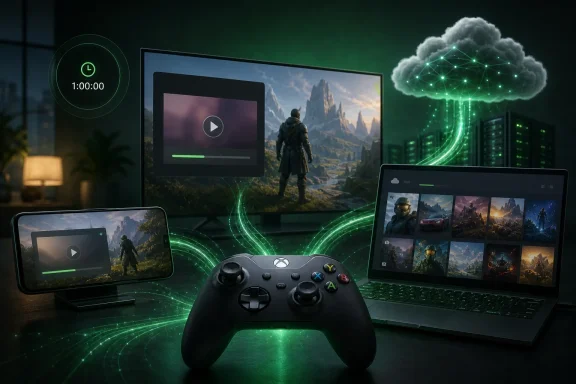 Overview: What Xbox Is Actually Testing
The ad-supported Xbox cloud streaming test is available only through the Xbox Insider Program, Microsoft’s long-running preview channel for console, PC, and service features that are still under development. Access is therefore not universal, and the experience may change rapidly as Xbox collects feedback and adjusts the technical, commercial, and policy details.The proposed value exchange is straightforward:
- Players can stream select eligible games from their owned library.
- A Game Pass subscription is not required for this specific test.
- Advertising appears before a gaming session begins.
- Ads are not intended to interrupt active gameplay.
- Sessions are limited to one hour.
- Availability depends on supported devices, regions, and title eligibility.
- The test is temporary and should not be treated as a promise of a final public product.
Instead, Xbox is experimenting with a middle ground: a player who has purchased a compatible game may be able to launch it from the cloud, on an approved device, for a limited session after seeing a pre-roll advertisement.
An Owned-Game Model, Not a Free Game Library
The biggest source of possible confusion is the phrase “free cloud gaming.” The streaming itself may be free during the test, but the games remain subject to Xbox’s ownership and cloud-entitlement rules.That means the feature is fundamentally different from a free subscription catalog. A player must already own an eligible title, and Xbox must make that title available for cloud streaming under the experiment’s conditions. The eligible library may also be far smaller than a user’s total purchase history.
This model serves several purposes for Microsoft. It creates a new use case for digital game ownership, gives players a way to access their purchases without a download, and avoids immediately placing the full cost of an all-you-can-play catalog behind advertising revenue.
It also means that the feature could have particular appeal for players who buy a few games each year but do not see enough value in a recurring Game Pass subscription.
Why Ad-Supported Cloud Gaming Matters for Xbox
Xbox has spent years presenting itself as an ecosystem that extends beyond a single box under the television. Its games, social network, subscriptions, PC storefront, cloud service, mobile touch controls, controllers, and smart-device integrations all support the broader idea that an Xbox experience can travel with the player.The problem is that cloud gaming is costly. Every streamed session requires remote hardware, data-center capacity, video encoding, networking, storage, support systems, licensing arrangements, and bandwidth. Unlike a downloaded game, cloud gaming keeps consuming resources for as long as someone is playing.
A paid subscription is the most obvious way to recover those costs. But subscriptions also create a barrier for users who only want occasional access. An ad-supported option gives Xbox a way to lower that barrier while testing whether advertising can help pay for the infrastructure.
A New Entry Point Into the Xbox Ecosystem
The most strategically significant part of the trial is not the ad itself. It is the removal of the subscription requirement.For years, Xbox Cloud Gaming has largely been tied to premium Game Pass access. That arrangement made sense as a subscription benefit, but it also meant that someone who owned Xbox games still had to pay monthly before using cloud streaming. The new test separates ownership from subscription, at least for certain games and under certain limitations.
That can expand the reach of Xbox in several ways:
- A player can try cloud gaming before committing to Game Pass.
- Someone away from their primary console can access a purchased game more easily.
- A household may avoid a large installation for a short session.
- A player with limited local storage may have another option for supported titles.
- Xbox can bring lapsed users back into its ecosystem through their existing game libraries.
- The company can measure demand among users who actively avoid subscriptions.
That is a meaningful conceptual shift.
The One-Hour Limit Is a Business Tool, Not Just a Technical Limit
The one-hour session cap may sound restrictive, and for many games it will be. Role-playing games, competitive multiplayer titles, live-service games, long campaigns, and cooperative sessions do not naturally fit into a 60-minute window.But the limit is not arbitrary. It controls infrastructure costs and prevents free sessions from becoming an unlimited replacement for paid cloud access. It also creates a familiar upgrade path: a player who values longer, more flexible, ad-free cloud gaming has a clear reason to consider a paid tier.
One-hour sessions may work best for:
- Trying a title before downloading it elsewhere.
- Completing a quick challenge or daily objective.
- Playing during travel.
- Launching a game on a secondary device.
- Using cloud access while storage or updates are inconvenient.
- Sampling an owned game that has been sitting untouched in a digital library.
The Player Experience: The Best-Case Scenario and the Risks
Xbox’s stated approach gives the trial an important advantage: advertising is supposed to appear before gameplay rather than during it. That is the right starting point.Gaming is not passive video viewing. A mid-match commercial interruption in a multiplayer shooter, a boss fight, a racing event, or a story sequence would be far more disruptive than a standard streaming-video ad break. Input timing, immersion, online coordination, and competitive fairness all make in-game interruption especially sensitive.
By positioning commercials before a session starts, Xbox is following a cleaner model already seen in other cloud gaming services. Players understand the trade: there is a small hurdle before entry, but the game itself remains intact once play begins.
What Xbox Gets Right
The early design contains several player-friendly principles.First, the option is voluntary. Users can still download games, play locally, use an existing subscription route, or avoid cloud streaming entirely. The test does not force advertisements into games that players have already installed on their own hardware.
Second, Xbox is emphasizing that ads should not interrupt play. That commitment needs to be preserved if the initiative grows. The line between pre-session ads and in-game monetization is a crucial one, and players will watch carefully for any effort to blur it.
Third, the company is framing ads as a way to reduce the cost of access. That is a more defensible use of advertising than simply adding commercials to a paid service with no corresponding improvement in value.
Finally, the limited rollout through Xbox Insiders provides a practical feedback loop. If ad lengths are excessive, game eligibility is too narrow, cloud queues are too long, or session restarts feel punishing, Xbox can see those issues before committing to a broad launch.
The Potential Friction Points
Good intentions will not automatically produce a good experience. The test still carries several risks that Xbox needs to address.Ad duration will matter immediately. A brief, clearly labeled pre-roll is likely to be more acceptable than a long sequence of unskippable commercials. If every one-hour session begins with an extended ad block, users may perceive the service as extracting too much value from an already limited offer.
Ad relevance and privacy will matter just as much. Players will want clarity around whether ads are broadly targeted, account-targeted, region-targeted, or based on gaming behavior. Xbox must make the privacy choices understandable rather than burying them in account settings and policy language.
Queue times could determine whether the model succeeds. Free cloud tiers often face pressure during peak periods. A user who sees an ad and then waits a long time for an available streaming slot is likely to view the experience as doubly frustrating.
Game selection will also be critical. If the trial includes only a handful of niche or older titles, it may not reveal how consumers would respond to the service at scale. If it includes popular owned games but the cloud performance is inconsistent, it could harm confidence in Xbox Cloud Gaming more broadly.
And there is the fundamental issue of ownership expectations. A player who bought a digital game may reasonably ask why cloud access is not part of that purchase by default. Xbox’s answer is implicitly that cloud rendering has an ongoing operating cost. That is understandable, but it makes the feature’s price—in time, advertising exposure, and session limits—central to its perceived fairness.
How This Fits Alongside Game Pass
The free ad-supported trial does not replace Xbox Game Pass. Instead, it gives Microsoft another way to segment its audience.Game Pass Ultimate remains the premium option for users who want a broad catalog, cloud access without pre-roll advertising, online features, day-one releases where applicable, and fewer compromises around convenience. At $22.99 per month in the United States, Ultimate is still positioned for committed players who use Xbox across console, PC, and cloud.
The new streaming experiment targets a very different profile:
- Players who own games but do not subscribe.
- Casual users with limited monthly gaming time.
- People who are curious about cloud gaming.
- Players who need temporary access away from their main machine.
- Users who are comfortable exchanging attention for access.
The Upgrade Path Must Feel Fair
An ad-supported cloud tier could become a good discovery tool for Game Pass—but only if the free experience feels honest. If it is deliberately frustrating, players will not necessarily upgrade. They may simply leave.A fair upgrade model would look something like this:
- The free tier makes cloud gaming genuinely usable for short sessions.
- Ads are predictable and restricted to clearly defined moments.
- Eligible game ownership is easy to understand.
- The user can see exactly what paid membership adds.
- The paid tier removes friction rather than fixing artificial problems.
Nvidia GeForce NOW Shows the Model Can Work
Xbox is not inventing the idea of free, ad-supported cloud gaming. Nvidia’s GeForce NOW has already shown that players will use a free tier that includes advertisements before sessions and limits session duration.The comparison is useful, but the services are not identical.
GeForce NOW is primarily a PC-focused cloud platform that connects to supported games from multiple PC game stores and subscription libraries. Xbox Cloud Gaming is built around the Xbox ecosystem, Xbox account entitlements, Microsoft’s cloud network, and its own console-oriented platform strategy.
Still, the overlap is obvious:
- Both approaches can let players stream games they already have access to.
- Both use advertising to support a free tier.
- Both employ one-hour session limits for free users.
- Both make paid access more attractive through fewer restrictions.
- Both rely on the premise that cloud gaming can be a service rather than a hardware purchase.
For Microsoft, the test is therefore less about proving whether the model exists and more about proving whether it works for Xbox players, Xbox-owned content, Xbox devices, and Xbox business economics.
Advertising Principles Will Be Tested as Closely as the Technology
Xbox has outlined a player-first framework for advertising, including commitments that ads should create value, avoid interrupting gameplay, meet a quality standard, remain clearly identifiable as advertising, and fit what users expect on each platform.Those are strong principles on paper. The hard part is implementation.
“Ads Should Create Value” Needs a Concrete Meaning
For an ad to create value, the benefit to the player must be visible. In this case, the value is free cloud streaming without a Game Pass requirement. That is tangible—but it will only remain persuasive if the service is reliable and the restrictions are reasonable.The feature will be judged through a simple equation:
For a player on a phone, laptop, or secondary screen who wants a quick session, the answer may often be yes. For someone who owns a console, has a fast connection, and expects immediate access, it may not be.Is the time spent watching the ad worth the ability to launch this game from the cloud right now?
“We Do Not Interrupt Gameplay” Must Remain a Hard Boundary
The commitment to avoid ads during active play is the most important safeguard in the entire program. It should not be treated as temporary wording for a test phase.There is a meaningful difference between:
- A commercial before a cloud session begins.
- A branded tile in a storefront.
- An optional reward ad in a free-to-play game.
- Product placement that developers build into a game world.
- A forced commercial appearing in the middle of a paid game session.
Xbox has an opportunity to define a clearer standard for ad-supported gaming: ads may help fund access to a service, but they should not seize control of a game that the player has already started.
Windows PCs Could Be a Major Beneficiary
Although the exact device scope will depend on the test’s supported hardware and regional availability, the concept has obvious relevance for Windows 10 and Windows 11 gaming.PC players are accustomed to a fragmented landscape of launchers, subscriptions, local installations, driver updates, storage constraints, hardware requirements, and compatibility variables. Cloud gaming cannot solve every one of those issues, but it can reduce the friction of getting into a game quickly.
For a Windows laptop with integrated graphics, an aging desktop, a work-travel machine, or a secondary household PC, the ability to stream an owned Xbox title could be valuable. It may enable quick access to a game that would otherwise require a lengthy download or hardware that is not currently available.
That does not mean cloud streaming replaces local PC gaming. Native play still delivers the best control over settings, mods, latency, offline access, image quality, and long-term ownership experience. But cloud access can be an effective complement when convenience matters more than maximum fidelity.
Network Quality Remains Non-Negotiable
No advertising model can hide weak cloud performance. Cloud gaming depends on stable internet connectivity, sufficient bandwidth, manageable latency, reliable Wi-Fi or wired networking, and nearby data-center capacity.The experience is likely to vary based on:
- Connection quality and congestion.
- Distance from Xbox cloud infrastructure.
- Wi-Fi stability.
- Input method and controller latency.
- Display resolution and refresh rate.
- Regional demand at peak hours.
- The performance requirements of the selected game.
What the Test Does Not Prove Yet
It is tempting to see the announcement as evidence that Xbox is about to launch an ad-supported Game Pass plan or put advertising throughout its gaming platform. That conclusion goes beyond what has been announced.The current test does not confirm:
- A lower-priced ad-supported Game Pass subscription tier.
- A permanent public rollout date.
- Unlimited free cloud gaming.
- A full free catalog of games.
- Ads during gameplay.
- Changes to the core Game Pass experience for paid subscribers.
- Availability on every Xbox Cloud Gaming device.
- The final ad frequency, ad duration, queue policy, or game selection.
- The ultimate business model for Xbox cloud access.
The more accurate reading is that Microsoft is gathering data. It wants to learn whether players will accept a clear exchange of pre-session advertising for limited cloud access to owned games. It also wants to understand which games, devices, session patterns, and audiences make that exchange viable.
The Bigger Strategic Signal for Xbox
Even as a small Insider experiment, this move sends a larger message about Xbox’s direction. Microsoft is continuing to search for ways to increase the value and reach of the Xbox platform without requiring every player to buy the same hardware or pay the same monthly fee.That is a practical response to a gaming market where console hardware is expensive, PC components remain costly, subscription fatigue is real, and players increasingly expect games and saves to follow them across devices.
The risk is that Xbox’s ecosystem becomes difficult to explain. A player may need to understand ownership rights, Game Pass tiers, streaming eligibility, device support, ad conditions, session limits, regional restrictions, and cloud queues before they can decide whether a game is available to them.
Simplicity will therefore be a competitive advantage. The best version of this feature would make the experience obvious: you own this game, you can stream it now, you will see one ad first, your session lasts up to one hour, and here is what happens when time expires.
Anything less transparent will create confusion at the exact moment Xbox is trying to lower the barrier to entry.
Conclusion
Xbox’s ad-supported cloud streaming test is a carefully constrained experiment, but it is far more important than a minor Insider feature. By allowing select players to stream eligible owned games without Game Pass, Microsoft is testing a new relationship between digital ownership, cloud infrastructure, advertising, and subscription value.The early safeguards are encouraging. Ads are intended to run before a session rather than during gameplay, participation is optional, and the free offer is framed as an additional access route rather than a replacement for paid services. The one-hour limit, however, will make the experience feel like a convenience tool rather than a complete cloud gaming solution—and that may be exactly the point.
If Xbox can keep the ads brief, the rules clear, the performance reliable, and the game selection meaningful, free ad-supported cloud gaming could become a useful on-ramp for millions of players. If it introduces excessive waiting, unclear ownership rules, intrusive targeting, or creeping gameplay interruptions, it will reinforce the fear that modern gaming is becoming harder to enjoy without paying at every turn.
For now, Xbox is making a measured bet: players may accept a commercial before play if it gives them a genuinely useful new way to access games they already own.
References
- Primary source: PCMag Australia
Published: 2026-07-23T19:40:35+00:00
Xbox Tests Ad-Supported Cloud Streaming, No Game Pass Required
'Our overall goal is simple: to give players more affordable options to play,' Xbox's chief strategy officer says of the experiment, which is currently limited to Xbox Insiders.au.pcmag.com - Related coverage: gamesradar.com
Xbox adds advertisements to games in "ad-supported" streaming trial | GamesRadar+
"Ads will play before sessions begin," Microsoft sayswww.gamesradar.com - Related coverage: windowscentral.com
Xbox's plan to bring Xbox Cloud Gaming to the mass market — Free tier revealed, powered by ads, with access to all games you own | Windows Central
Here are the details of Xbox's initial ad-powered Xbox Cloud Gaming service, set to go live soon in an early testing phase.www.windowscentral.com - Related coverage: news.xbox.com
Xbox Game Pass Ultimate Price Update - XBOX Wire
Starting today, Game Pass Ultimate drops from $29.99 to $22.99 a month. Find out more inside.news.xbox.com - Related coverage: xbox.com
Buy Xbox Game Pass Ultimate — Xbox Game Pass Ultimate 1 Month | Xbox
New games on day one. 300+ console and PC games. Stream and play anywhere.* Get all benefits. Earn even more exclusive rewards.www.xbox.com - Related coverage: techspot.com
Microsoft is testing free Xbox cloud gaming with ads, no subscription required | TechSpot
For a limited time, Xbox Insiders can now access games they own over the cloud on Xbox consoles, PCs, and mobile devices without subscribing to Game Pass....www.techspot.com