

Tesla’s Robotaxi fleet is already serving as the first public proving ground for early Full Self-Driving v15 software, placing the company’s next-generation autonomy stack on public streets before it reaches privately owned vehicles.
The confirmation came during Tesla’s second-quarter earnings call, where AI chief Ashok Elluswamy said the operating Robotaxi fleet is running early v15 builds while conducting driverless rides across six cities in Texas and Florida. That matters because the service is not a simulation, a closed-track demonstration, or an interface feature within the regular Tesla mobile app. It is an operational ride-hailing network using real Model Y vehicles, real passengers, public roads, and an evolving version of Tesla’s most ambitious driving software.
Tesla says the Robotaxi program has now accumulated more than 380,000 miles of unsupervised operation across two states. Elluswamy described its safety record as “impeccable,” claiming no notable incidents during that total. The statement is significant, but it also deserves careful interpretation: a company-reported operating metric is not the same thing as an independently audited safety comparison across equivalent roads, weather conditions, traffic density, and operational constraints.
Still, the broader message is unmistakable. Tesla is no longer treating FSD v15 as a distant consumer software update. It is actively using early versions of the system in a commercial Robotaxi environment, and that decision may shape the roadmap for Hardware 4 owners, Hardware 3 customers, Tesla’s camera-only autonomy strategy, and the company’s push to scale driverless rides beyond a handful of carefully managed service areas.
For Tesla owners, the most important development is not merely that FSD v15 exists internally. Tesla has previously discussed future versions, larger AI models, better planning behavior, and the eventual goal of unsupervised driving. The more consequential news is that early v15 code is already operating in Tesla’s Robotaxi fleet.
This is a practical shift in how the company is validating its autonomy software. Instead of limiting the new stack to internal engineering vehicles or controlled employee testing, Tesla is feeding it into a service that must repeatedly complete trips, handle passenger pickup and drop-off, react to traffic, navigate dense urban areas, and recover from unpredictable real-world conditions.
Tesla’s current Robotaxi network relies heavily on retrofitted Model Y vehicles rather than the forthcoming Cybercab. That distinction is important because the Model Y is a familiar consumer platform, not a purpose-built autonomous shuttle with a radically different sensor package or a separate computing architecture.
In other words, the Robotaxi deployment gives Tesla a public validation environment for software that is closely tied to the hardware already present in many newer customer vehicles.
Tesla did say the work is progressing in parallel rather than serially. That approach suggests v15 is not one isolated upgrade, such as better lane selection or smoother turns, but a broader revision to the driving system’s perception, prediction, planning, control, training, or inference pipeline.
The company says the early Robotaxi builds already include about 40% of those planned improvements, and that internal benchmarks are meeting their objectives. That is an encouraging claim, but owners should be cautious about converting it into a release-date promise or assuming that 40% of internal work translates directly into 40% of a consumer-visible upgrade.
Autonomous driving software does not improve in a neat linear fashion. A change that makes one category of driving dramatically better can introduce regressions elsewhere. The challenge is not simply to make the vehicle more capable in average conditions. It is to make its behavior more predictable, safer, more comfortable, and more robust in the rare edge cases that drivers remember most.
That is strategically meaningful.
Competitors in the autonomous vehicle market have generally pursued specialized fleets equipped with combinations of lidar, radar, cameras, high-precision maps, redundant compute systems, and operational support infrastructure. Tesla continues to argue that a camera-based neural-network approach can achieve safe autonomy without the additional sensor stack.
That does not mean every Hardware 4 Tesla will automatically become an unsupervised vehicle. Consumer deployment is a separate question involving software maturity, regulatory approval, insurance, geography, operational support, liability, and product policy.
But it does provide an important technical signal: Tesla is not reserving early FSD v15 solely for a future hardware platform. Hardware 4 is participating in the company’s driverless service effort today.
The Robotaxi Model Ys do appear to include fleet-specific operational equipment. Tesla has not published a complete specification sheet for every retrofit, and external reports have pointed to dedicated communications hardware and practical modifications such as enhanced camera cleaning support. Those additions are understandable for vehicles that operate repeatedly without an onboard driver.
However, the core takeaway remains that the vehicles are not visibly transformed into lidar-heavy experimental machines. Tesla is using a relatively conventional Model Y platform to test a much less conventional operating model.
Fleet vehicles can operate within carefully defined service zones. They can be monitored by a dedicated operations team. Their software can be deployed selectively, rolled back rapidly, and paired with operational restrictions that consumer vehicles do not have. Tesla can also decide when and where a Robotaxi may operate based on road geometry, mapping confidence, weather, demand, local regulations, and service readiness.
A privately owned vehicle is much harder to constrain. It may be driven on unfamiliar rural roads, through construction zones, in severe weather, on poorly marked streets, or in environments that Tesla has not operationally prepared for.
That is why the Robotaxi fleet running FSD v15 should be viewed as evidence of progress, not proof that a consumer-grade unsupervised driving release is imminent.
The scale also indicates that Tesla is gathering valuable real-world information. Every completed trip can generate data on pedestrian behavior, passenger pickup patterns, unexpected road closures, emergency vehicles, congestion, merging traffic, lane changes, weather effects, and the countless small irregularities that challenge automated driving systems.
Those events are central to Tesla’s AI strategy.
Tesla’s approach depends on collecting driving data at scale, identifying difficult scenarios, training new neural-network behavior, validating that behavior, and deploying it through over-the-air software updates. A Robotaxi network provides a concentrated source of high-value operational data because the cars are driving frequently, in urban environments, with a direct service goal.
That feedback loop could help Tesla improve FSD v15 faster than a traditional vehicle development cycle would allow.
Tesla’s “zero notable incidents” statement is a company characterization, and the term “notable” is not a standardized public safety metric. It does not automatically reveal the number of hard braking events, remote interventions, uncomfortable maneuvers, near misses, passenger complaints, roadside assistance events, weather-related service suspensions, or minor operational anomalies.
A meaningful safety assessment needs more than a mileage number. It requires context such as:
The company’s confidence is understandable. Building a driverless ride-hailing network without lidar, radar, or detailed high-definition maps is an enormous technical challenge. Yet confidence must be matched by transparency, particularly as the company seeks wider public deployment.
Tesla argues that humans drive using visual perception, so an AI system should be able to navigate the world through cameras combined with sufficiently capable neural networks and compute hardware. This argument has always been central to Tesla’s autonomy strategy, but the Robotaxi network raises the stakes considerably.
A supervised driver-assistance feature can rely on a human driver as the ultimate fallback. A driverless ride-hailing service cannot.
Lidar and radar can provide different types of environmental information and redundancy. They add complexity and cost, but they can also support detection when cameras are challenged. Tesla’s decision to rely on cameras means its AI system must compensate through software capability, sensor placement, training data, and operational caution.
That makes FSD v15 especially consequential. If the new version delivers a major jump in perception and planning quality, it strengthens Tesla’s case that a vision-first strategy can work. If it encounters persistent challenges in rare but safety-critical conditions, the company may face pressure to rethink how much redundancy is necessary for broader driverless deployment.
Hardware 4 represents a substantial step forward from Tesla’s previous onboard computer generation. It is associated with newer camera hardware, greater processing headroom, and an architecture designed for more demanding neural-network workloads.
FSD v15 is expected to be a larger and more sophisticated system than earlier consumer builds. Tesla and its executives have repeatedly suggested that future autonomy gains will require significantly more capable models and faster edge inference.
Even if the final v15 stack is dramatically larger, parameter count alone does not determine driving quality.
A larger model can improve pattern recognition, scene interpretation, prediction, and behavioral nuance. But it can also require more compute, more memory bandwidth, more power efficiency, and more careful optimization to run quickly in a car. Real-time driving systems cannot tolerate long delays between sensing a hazard and selecting a response.
The better question is whether v15 produces consistently better decisions at road speed. That means smoother behavior, fewer unnecessary slowdowns, more natural interaction with other road users, stronger navigation choices, and safer responses when the environment becomes ambiguous.
The Robotaxi disclosure makes a consumer release more plausible, but it does not erase the gap between fleet validation and broad over-the-air deployment. Tesla has often used staged releases, early-access testing, and limited geographic exposure before expanding major FSD versions.
For Hardware 4 owners, the most rational interpretation is straightforward: v15 compatibility appears real, but timing and feature scope remain unsettled.
Tesla has acknowledged that Hardware 3 lacks the capability needed for its unsupervised autonomy ambitions. That does not mean Hardware 3 vehicles are obsolete overnight, and it does not prevent Tesla from improving the supervised FSD experience. But it establishes a hard ceiling on what the older platform can realistically support.
Tesla has begun deploying FSD v14 Lite for Hardware 3 vehicles, a trimmed and optimized version intended to bring some newer software behavior to the legacy fleet. That rollout is meaningful because it gives older owners access to improvements that would otherwise remain exclusive to newer vehicles.
A smaller model can be distilled from a larger one, optimized to run within tighter compute limits, and tuned to retain useful driving behavior. This is a common strategy in modern AI: use a larger system as a teacher, then create a smaller student model that can operate more efficiently on constrained hardware.
But compression comes with trade-offs.
Hardware 3 versions may not retain every capability, every model component, or every future improvement available to Hardware 4 vehicles. The software can become better, but the compute, camera, and architecture limitations of the platform remain.
For owners who purchased FSD years ago expecting eventual autonomous capability, that creates a difficult product and value question. Tesla may need to provide a clearer long-term answer on retrofit options, upgrade pricing, eligibility, installation capacity, and whether an older vehicle’s cameras and wiring can support a meaningful transition to newer autonomy hardware.
If a newer autonomy system depends on improved cameras, revised connectors, different power requirements, additional cooling, or a redesigned vehicle architecture, upgrading an older car can become more complicated than replacing a single circuit board. Tesla has handled hardware retrofits before, but scaling them across a large legacy fleet would be expensive and operationally demanding.
The company therefore faces a delicate balancing act:
The company’s strategy appears to be centered on controlled expansion: establish a limited operating area, use Model Y vehicles, gather data, monitor performance, and expand gradually once the service proves reliable enough.
Tesla’s Robotaxi service areas remain bounded. In Tampa and Orlando, for example, the operational zones have excluded major areas and key destinations. This is normal for a developing autonomous ride-hailing service. Geofencing gives a company the ability to focus on roads it has tested, avoid certain high-complexity locations, and limit exposure to environments that remain difficult for the software.
The company’s stated ambition is to reduce the time and effort needed to deploy in each new city. Eventually, Tesla wants to move beyond city-by-city launches toward broader coverage.
That is the goal. It is not yet the demonstrated reality.
Tesla’s existing vehicle, charging, service, and manufacturing infrastructure gives it a potential advantage. Yet operating a public transportation network introduces a different category of responsibility. The company must build not only capable vehicles but also dependable operational processes around them.
Consumer FSD remains a driver-assistance system in which the human behind the wheel is expected to remain attentive and ready to take control. Tesla itself labels the product FSD (Supervised) to reinforce that requirement.
Robotaxi operation is different because no driver is seated behind the steering wheel. The vehicle is performing the driving task within a controlled service model.
That does not make the two products identical, even if they share software foundations.
Tesla can learn from Robotaxi v15 performance and transfer improvements into consumer FSD. But it should not imply that every success in a geofenced fleet immediately authorizes hands-free or unsupervised use in customer vehicles.
For owners, the best expectation is that v15 could improve the quality of supervised driving assistance on compatible hardware. Any future transition to unsupervised personal autonomy would require a far higher evidentiary bar.
The announcement strengthens the case for Hardware 4 as the central platform for Tesla’s next phase of AI-driven driving. It also suggests that the company is willing to validate its biggest software changes under real commercial conditions before offering them broadly to consumers.
That is a strength. Real-world operation can reveal weaknesses no laboratory test catches, and the Robotaxi network may accelerate Tesla’s ability to refine complex driving behavior.
But the risks are equally clear. Tesla’s reported safety results need more operational context and independent scrutiny. Camera-only autonomy remains a bold technical bet. Hardware 3 owners face a widening gap in future capability. And no early Robotaxi deployment should be mistaken for proof that privately owned Teslas are ready for unrestricted self-driving.
FSD v15 is now more than a rumored update. It is operating in Tesla’s driverless fleet, shaping the company’s Robotaxi expansion, and becoming the clearest indicator yet of where Tesla believes its autonomy technology is headed.
The confirmation came during Tesla’s second-quarter earnings call, where AI chief Ashok Elluswamy said the operating Robotaxi fleet is running early v15 builds while conducting driverless rides across six cities in Texas and Florida. That matters because the service is not a simulation, a closed-track demonstration, or an interface feature within the regular Tesla mobile app. It is an operational ride-hailing network using real Model Y vehicles, real passengers, public roads, and an evolving version of Tesla’s most ambitious driving software.
Tesla says the Robotaxi program has now accumulated more than 380,000 miles of unsupervised operation across two states. Elluswamy described its safety record as “impeccable,” claiming no notable incidents during that total. The statement is significant, but it also deserves careful interpretation: a company-reported operating metric is not the same thing as an independently audited safety comparison across equivalent roads, weather conditions, traffic density, and operational constraints.
Still, the broader message is unmistakable. Tesla is no longer treating FSD v15 as a distant consumer software update. It is actively using early versions of the system in a commercial Robotaxi environment, and that decision may shape the roadmap for Hardware 4 owners, Hardware 3 customers, Tesla’s camera-only autonomy strategy, and the company’s push to scale driverless rides beyond a handful of carefully managed service areas.
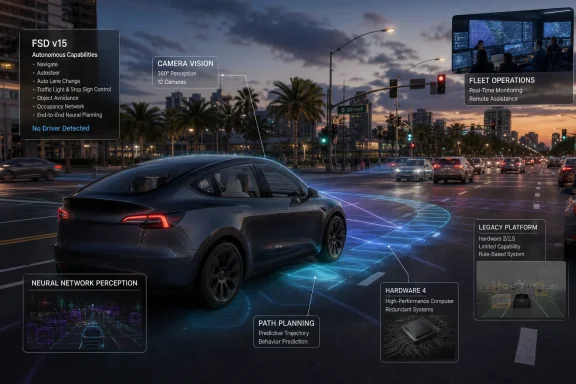 FSD v15 Has Moved From Roadmap to Operations
For Tesla owners, the most important development is not merely that FSD v15 exists internally. Tesla has previously discussed future versions, larger AI models, better planning behavior, and the eventual goal of unsupervised driving. The more consequential news is that early v15 code is already operating in Tesla’s Robotaxi fleet.This is a practical shift in how the company is validating its autonomy software. Instead of limiting the new stack to internal engineering vehicles or controlled employee testing, Tesla is feeding it into a service that must repeatedly complete trips, handle passenger pickup and drop-off, react to traffic, navigate dense urban areas, and recover from unpredictable real-world conditions.
Tesla’s current Robotaxi network relies heavily on retrofitted Model Y vehicles rather than the forthcoming Cybercab. That distinction is important because the Model Y is a familiar consumer platform, not a purpose-built autonomous shuttle with a radically different sensor package or a separate computing architecture.
In other words, the Robotaxi deployment gives Tesla a public validation environment for software that is closely tied to the hardware already present in many newer customer vehicles.
The Seven Improvement Tracks
Elluswamy said Tesla has targeted roughly seven major improvement tracks between FSD v14 and FSD v15. The company has not publicly detailed each track in a comprehensive technical breakdown, so it would be premature to treat them as a finalized public feature list.Tesla did say the work is progressing in parallel rather than serially. That approach suggests v15 is not one isolated upgrade, such as better lane selection or smoother turns, but a broader revision to the driving system’s perception, prediction, planning, control, training, or inference pipeline.
The company says the early Robotaxi builds already include about 40% of those planned improvements, and that internal benchmarks are meeting their objectives. That is an encouraging claim, but owners should be cautious about converting it into a release-date promise or assuming that 40% of internal work translates directly into 40% of a consumer-visible upgrade.
Autonomous driving software does not improve in a neat linear fashion. A change that makes one category of driving dramatically better can introduce regressions elsewhere. The challenge is not simply to make the vehicle more capable in average conditions. It is to make its behavior more predictable, safer, more comfortable, and more robust in the rare edge cases that drivers remember most.
Why Tesla’s Model Y Robotaxi Fleet Matters
Tesla’s Robotaxi service uses vehicles that are far closer to a customer-owned Tesla than the industry’s conventional image of a robotaxi would suggest. The fleet consists of Model Y vehicles equipped with Tesla’s newer Hardware 4, also known internally as AI4, driving with the company’s camera-first autonomy system.That is strategically meaningful.
Competitors in the autonomous vehicle market have generally pursued specialized fleets equipped with combinations of lidar, radar, cameras, high-precision maps, redundant compute systems, and operational support infrastructure. Tesla continues to argue that a camera-based neural-network approach can achieve safe autonomy without the additional sensor stack.
A Real-World Hardware 4 Validation Signal
The presence of FSD v15 in Hardware 4 Model Ys is especially relevant to current Tesla owners. It indicates that Tesla is validating its next-generation software on the same broad hardware generation installed in many newer Model 3, Model Y, Model S, and Model X vehicles.That does not mean every Hardware 4 Tesla will automatically become an unsupervised vehicle. Consumer deployment is a separate question involving software maturity, regulatory approval, insurance, geography, operational support, liability, and product policy.
But it does provide an important technical signal: Tesla is not reserving early FSD v15 solely for a future hardware platform. Hardware 4 is participating in the company’s driverless service effort today.
The Robotaxi Model Ys do appear to include fleet-specific operational equipment. Tesla has not published a complete specification sheet for every retrofit, and external reports have pointed to dedicated communications hardware and practical modifications such as enhanced camera cleaning support. Those additions are understandable for vehicles that operate repeatedly without an onboard driver.
However, the core takeaway remains that the vehicles are not visibly transformed into lidar-heavy experimental machines. Tesla is using a relatively conventional Model Y platform to test a much less conventional operating model.
The Fleet Is Not the Same as a Customer Car
This distinction must remain front and center. A Robotaxi is not simply a privately owned Model Y with a different app setting enabled.Fleet vehicles can operate within carefully defined service zones. They can be monitored by a dedicated operations team. Their software can be deployed selectively, rolled back rapidly, and paired with operational restrictions that consumer vehicles do not have. Tesla can also decide when and where a Robotaxi may operate based on road geometry, mapping confidence, weather, demand, local regulations, and service readiness.
A privately owned vehicle is much harder to constrain. It may be driven on unfamiliar rural roads, through construction zones, in severe weather, on poorly marked streets, or in environments that Tesla has not operationally prepared for.
That is why the Robotaxi fleet running FSD v15 should be viewed as evidence of progress, not proof that a consumer-grade unsupervised driving release is imminent.
What the 380,000 Unsupervised Miles Do — and Do Not — Prove
Tesla’s claim of more than 380,000 unsupervised Robotaxi miles across six cities is a meaningful operational milestone. The company has progressed from limited, closely watched launch activity to a multi-city network spread across two states.The scale also indicates that Tesla is gathering valuable real-world information. Every completed trip can generate data on pedestrian behavior, passenger pickup patterns, unexpected road closures, emergency vehicles, congestion, merging traffic, lane changes, weather effects, and the countless small irregularities that challenge automated driving systems.
The Strength of Operating in Public
A public Robotaxi network exposes an autonomy system to situations that do not appear in a test track or a curated demonstration route. Even within geofenced boundaries, city streets create a high-volume stream of nonstandard events.Those events are central to Tesla’s AI strategy.
Tesla’s approach depends on collecting driving data at scale, identifying difficult scenarios, training new neural-network behavior, validating that behavior, and deploying it through over-the-air software updates. A Robotaxi network provides a concentrated source of high-value operational data because the cars are driving frequently, in urban environments, with a direct service goal.
That feedback loop could help Tesla improve FSD v15 faster than a traditional vehicle development cycle would allow.
The Limits of the Safety Claim
At the same time, 380,000 miles is not enough to settle the safety debate around autonomous driving.Tesla’s “zero notable incidents” statement is a company characterization, and the term “notable” is not a standardized public safety metric. It does not automatically reveal the number of hard braking events, remote interventions, uncomfortable maneuvers, near misses, passenger complaints, roadside assistance events, weather-related service suspensions, or minor operational anomalies.
A meaningful safety assessment needs more than a mileage number. It requires context such as:
- The number of vehicles in active operation
- The number of passenger trips completed
- The proportion of miles driven in dense urban traffic
- The weather and lighting conditions involved
- The size and shape of each operating geofence
- The frequency of remote support or intervention
- The definition of a reportable incident
- A comparison with human-driven ride-hailing vehicles on similar routes
- Independent review of collisions and system performance
The company’s confidence is understandable. Building a driverless ride-hailing network without lidar, radar, or detailed high-definition maps is an enormous technical challenge. Yet confidence must be matched by transparency, particularly as the company seeks wider public deployment.
The Camera-Only Bet Is Becoming More Concrete
Tesla’s Robotaxi program is also a direct test of the company’s long-running thesis that vision-based AI can deliver autonomy with cameras as the primary sensor modality.Tesla argues that humans drive using visual perception, so an AI system should be able to navigate the world through cameras combined with sufficiently capable neural networks and compute hardware. This argument has always been central to Tesla’s autonomy strategy, but the Robotaxi network raises the stakes considerably.
A supervised driver-assistance feature can rely on a human driver as the ultimate fallback. A driverless ride-hailing service cannot.
The Potential Advantages
If Tesla’s camera-first architecture proves capable of operating safely at scale, the advantages could be substantial.- Lower hardware costs: Cameras are less expensive than high-end lidar hardware and associated sensor integration.
- Simpler vehicle design: A system with fewer external sensors may be easier to package and maintain.
- Scalability: Tesla has already produced millions of vehicles with camera systems and onboard AI computers.
- Faster fleet expansion: A Model Y-based Robotaxi fleet could theoretically expand more quickly than a bespoke autonomous vehicle program.
- Shared software foundation: Tesla can train and refine core models across vehicle platforms rather than developing entirely separate stacks.
The Risks of a Narrower Sensor Stack
The counterargument is equally important. Cameras can be affected by glare, heavy rain, fog, dust, darkness, lens contamination, low contrast, and unusual visual conditions. Tesla has made progress in camera placement, image processing, neural-network perception, and camera cleaning, but the physical limitations of visual sensors do not disappear.Lidar and radar can provide different types of environmental information and redundancy. They add complexity and cost, but they can also support detection when cameras are challenged. Tesla’s decision to rely on cameras means its AI system must compensate through software capability, sensor placement, training data, and operational caution.
That makes FSD v15 especially consequential. If the new version delivers a major jump in perception and planning quality, it strengthens Tesla’s case that a vision-first strategy can work. If it encounters persistent challenges in rare but safety-critical conditions, the company may face pressure to rethink how much redundancy is necessary for broader driverless deployment.
Hardware 4 Owners Have a Reason to Pay Attention
Tesla’s use of Hardware 4 Model Ys for FSD v15 Robotaxi testing is the most reassuring aspect of the announcement for newer Tesla owners.Hardware 4 represents a substantial step forward from Tesla’s previous onboard computer generation. It is associated with newer camera hardware, greater processing headroom, and an architecture designed for more demanding neural-network workloads.
FSD v15 is expected to be a larger and more sophisticated system than earlier consumer builds. Tesla and its executives have repeatedly suggested that future autonomy gains will require significantly more capable models and faster edge inference.
Bigger Models Are Not Automatically Better Models
Reports surrounding v15 have suggested a large increase in model parameters relative to today’s software. Tesla has not released a detailed public specification that allows outsiders to verify an exact parameter multiplier, so claims of a precise “10x” increase should be treated as an expectation rather than a confirmed technical specification.Even if the final v15 stack is dramatically larger, parameter count alone does not determine driving quality.
A larger model can improve pattern recognition, scene interpretation, prediction, and behavioral nuance. But it can also require more compute, more memory bandwidth, more power efficiency, and more careful optimization to run quickly in a car. Real-time driving systems cannot tolerate long delays between sensing a hazard and selecting a response.
The better question is whether v15 produces consistently better decisions at road speed. That means smoother behavior, fewer unnecessary slowdowns, more natural interaction with other road users, stronger navigation choices, and safer responses when the environment becomes ambiguous.
The Consumer Release Question
Tesla has not provided a firm public launch date for FSD v15 on privately owned vehicles. Any prediction that it will arrive by a particular season should be viewed cautiously until Tesla publishes release notes, rollout details, or an official schedule.The Robotaxi disclosure makes a consumer release more plausible, but it does not erase the gap between fleet validation and broad over-the-air deployment. Tesla has often used staged releases, early-access testing, and limited geographic exposure before expanding major FSD versions.
For Hardware 4 owners, the most rational interpretation is straightforward: v15 compatibility appears real, but timing and feature scope remain unsettled.
Hardware 3 Faces a More Difficult Future
The outlook is far less certain for Tesla owners using Hardware 3, also referred to as AI3.Tesla has acknowledged that Hardware 3 lacks the capability needed for its unsupervised autonomy ambitions. That does not mean Hardware 3 vehicles are obsolete overnight, and it does not prevent Tesla from improving the supervised FSD experience. But it establishes a hard ceiling on what the older platform can realistically support.
Tesla has begun deploying FSD v14 Lite for Hardware 3 vehicles, a trimmed and optimized version intended to bring some newer software behavior to the legacy fleet. That rollout is meaningful because it gives older owners access to improvements that would otherwise remain exclusive to newer vehicles.
V14 Lite Is a Bridge, Not an Equal Replacement
The word “Lite” is important.A smaller model can be distilled from a larger one, optimized to run within tighter compute limits, and tuned to retain useful driving behavior. This is a common strategy in modern AI: use a larger system as a teacher, then create a smaller student model that can operate more efficiently on constrained hardware.
But compression comes with trade-offs.
Hardware 3 versions may not retain every capability, every model component, or every future improvement available to Hardware 4 vehicles. The software can become better, but the compute, camera, and architecture limitations of the platform remain.
For owners who purchased FSD years ago expecting eventual autonomous capability, that creates a difficult product and value question. Tesla may need to provide a clearer long-term answer on retrofit options, upgrade pricing, eligibility, installation capacity, and whether an older vehicle’s cameras and wiring can support a meaningful transition to newer autonomy hardware.
The Hardware Upgrade Problem
A computer swap is not necessarily a complete solution.If a newer autonomy system depends on improved cameras, revised connectors, different power requirements, additional cooling, or a redesigned vehicle architecture, upgrading an older car can become more complicated than replacing a single circuit board. Tesla has handled hardware retrofits before, but scaling them across a large legacy fleet would be expensive and operationally demanding.
The company therefore faces a delicate balancing act:
- Continue improving Hardware 3 with FSD v14 Lite and related updates.
- Avoid overpromising capabilities that the older platform cannot deliver.
- Define a credible upgrade strategy for owners who expected full autonomy.
- Preserve customer trust while encouraging migration to newer hardware.
Robotaxi Expansion Is Faster Than the Fleet’s Public Details
Tesla’s Robotaxi service has expanded to Austin, Dallas, Houston, Miami, Orlando, and Tampa, creating a six-city footprint across Texas and Florida. The latest Florida launches demonstrate that Tesla is not waiting for the Cybercab to expand its ride-hailing program.The company’s strategy appears to be centered on controlled expansion: establish a limited operating area, use Model Y vehicles, gather data, monitor performance, and expand gradually once the service proves reliable enough.
City Launches Are Not Statewide Autonomy
A city launch should not be confused with unrestricted autonomous operation throughout an entire metro area.Tesla’s Robotaxi service areas remain bounded. In Tampa and Orlando, for example, the operational zones have excluded major areas and key destinations. This is normal for a developing autonomous ride-hailing service. Geofencing gives a company the ability to focus on roads it has tested, avoid certain high-complexity locations, and limit exposure to environments that remain difficult for the software.
The company’s stated ambition is to reduce the time and effort needed to deploy in each new city. Eventually, Tesla wants to move beyond city-by-city launches toward broader coverage.
That is the goal. It is not yet the demonstrated reality.
Scale Requires More Than Better Driving Software
A larger Robotaxi network will depend on several systems working together:- Autonomous driving capability
- Fleet maintenance and cleaning
- Charging and vehicle repositioning
- Customer support
- Remote assistance procedures
- Insurance and legal frameworks
- Local and state regulatory compliance
- Accessibility requirements
- Emergency response coordination
- Service availability during severe weather
- Passenger trust and product reliability
Tesla’s existing vehicle, charging, service, and manufacturing infrastructure gives it a potential advantage. Yet operating a public transportation network introduces a different category of responsibility. The company must build not only capable vehicles but also dependable operational processes around them.
The Most Important Distinction: Supervised FSD vs. Unsupervised Robotaxi
Tesla’s branding has long created confusion because Full Self-Driving in a consumer vehicle does not mean the driver may stop supervising the road.Consumer FSD remains a driver-assistance system in which the human behind the wheel is expected to remain attentive and ready to take control. Tesla itself labels the product FSD (Supervised) to reinforce that requirement.
Robotaxi operation is different because no driver is seated behind the steering wheel. The vehicle is performing the driving task within a controlled service model.
That does not make the two products identical, even if they share software foundations.
Why the Distinction Matters
A consumer Tesla may face virtually any U.S. road environment, at any time, with a driver who may or may not use the system appropriately. A Robotaxi fleet can be limited to specific locations, routes, conditions, vehicle configurations, and operational rules.Tesla can learn from Robotaxi v15 performance and transfer improvements into consumer FSD. But it should not imply that every success in a geofenced fleet immediately authorizes hands-free or unsupervised use in customer vehicles.
For owners, the best expectation is that v15 could improve the quality of supervised driving assistance on compatible hardware. Any future transition to unsupervised personal autonomy would require a far higher evidentiary bar.
A Promising Milestone, Not the Final Autonomy Verdict
Tesla’s confirmation that Robotaxi Model Ys are already running early FSD v15 builds is one of the clearest signs yet that the company’s autonomy roadmap is moving from presentation slides to field deployment.The announcement strengthens the case for Hardware 4 as the central platform for Tesla’s next phase of AI-driven driving. It also suggests that the company is willing to validate its biggest software changes under real commercial conditions before offering them broadly to consumers.
That is a strength. Real-world operation can reveal weaknesses no laboratory test catches, and the Robotaxi network may accelerate Tesla’s ability to refine complex driving behavior.
But the risks are equally clear. Tesla’s reported safety results need more operational context and independent scrutiny. Camera-only autonomy remains a bold technical bet. Hardware 3 owners face a widening gap in future capability. And no early Robotaxi deployment should be mistaken for proof that privately owned Teslas are ready for unrestricted self-driving.
FSD v15 is now more than a rumored update. It is operating in Tesla’s driverless fleet, shaping the company’s Robotaxi expansion, and becoming the clearest indicator yet of where Tesla believes its autonomy technology is headed.
References
- Primary source: Not a Tesla App
Published: 2026-07-23T18:00:00+00:00
Loading…
www.notateslaapp.com - Related coverage: patch.com
Loading…
patch.com - Related coverage: techradar.com
Tesla hails the arrival of its first Cybercab – meanwhile, its Robotaxis are crashing four times more than human drivers | TechRadar
The Robotaxi has clocked up 14 incidents since it launchedwww.techradar.com