

Chick-fil-A is warning affected loyalty customers that an automated login attack may have exposed personal and account information stored in Chick-fil-A One accounts, putting a fresh spotlight on the risks of password reuse across websites, mobile apps, and digital payment services. The incident was not described as a direct compromise of Chick-fil-A’s core systems or a theft of its password database. Instead, attackers reportedly used email-and-password combinations acquired from another source to gain entry to accounts where the same credentials still worked.
The company said suspicious login activity led to an investigation into certain Chick-fil-A One accounts. Its findings indicate that unauthorized parties launched the attack against the company’s website and mobile application from June 17 through June 19, 2026, and that Chick-fil-A determined on July 13, 2026 that the attackers may have accessed information in affected accounts.
For customers, the distinction between a credential-stuffing attack and a conventional corporate breach matters technically, but it does not eliminate the practical risk. If an intruder can successfully sign in as a legitimate customer, that person may see the same profile details, loyalty balances, payment-related metadata, and QR-based account tools available to the real account holder.
Chick-fil-A’s notification describes an automated attack using account credentials obtained from a third-party source. In cybersecurity terms, that strongly indicates credential stuffing: criminals take large collections of leaked usernames, email addresses, and passwords from prior incidents elsewhere and test them at high speed against another company’s sign-in page.
The method relies on one persistent consumer habit: reusing passwords. A password can be complex, long, and difficult to guess, yet still become a liability if it is reused on multiple sites. Once that password appears in an unrelated breach, attackers can automate attempts at retailers, banking portals, streaming services, food delivery platforms, airline rewards programs, and other targets.
That is what makes loyalty accounts particularly appealing. A successful account takeover can provide more than points for a free meal. It can reveal valuable personal data, give access to stored payment options, enable fraudulent purchases, or allow an attacker to drain a rewards balance before the account owner notices.
Chick-fil-A said it has notified potentially impacted Chick-fil-A One members in:
Potentially accessed information includes:
A combination of name, email address, telephone number, address, partial payment information, loyalty details, and birth-date fragments can be useful to fraudsters. Such data can support realistic phishing messages, password-reset scams, social-engineering attempts, and efforts to make fraudulent communications appear legitimate.
If an attacker gains control of an account, the immediate objective may simply be to spend accumulated rewards or transfer value. That is a smaller financial loss than full-scale card fraud, but it can be fast, difficult to reverse, and easy to overlook in accounts that customers do not check frequently.
The broader risk is that account data can help attackers build a convincing profile of the victim. A phishing email that references a real restaurant brand, a recent loyalty program change, a correct partial card number, or a rewards balance can appear far more credible than a generic scam.
That aligns with credential stuffing, an attack in which criminals use already-compromised credentials from breaches, malware infections, underground data markets, or credential-harvesting campaigns. Automated tools then attempt those credentials across many services until they identify matching accounts.
That difference explains why password reuse is the key risk factor. A unique password can still be stolen from one site, but its usefulness is contained if it works nowhere else. A reused password turns an isolated breach into a chain reaction.
That is why effective defenses go beyond the password field. Modern e-commerce security commonly combines:
The company said it:
The restoration of account balances is a positive consumer-protection measure. It recognizes that loyalty points and stored credit have real value, even when they are not equivalent to a direct debit-card charge. Removing stored payment methods also reduces the immediate opportunity for additional misuse inside affected accounts.
There is also no public indication in the available notification language that full payment-card numbers or card verification codes were exposed. Customers should avoid overstating the event as a full card-data breach when the disclosed information points to a more limited set of payment-related details.
At the same time, it would be equally mistaken to dismiss the incident because the attackers allegedly began with credentials from elsewhere. A successful account takeover is still unauthorized access, and the information inside the accessed account can still be exposed.
The longer-term concern is targeted fraud. Attackers who obtain personal details may use them to craft fake alerts that claim a customer must “verify” their account, restore points, confirm a payment card, or unlock a suspended loyalty profile.
These messages may arrive by email, text, direct message, or even phone call. Because the attacker may know the customer uses Chick-fil-A One, the scam can have a level of realism that ordinary spam lacks.
If the same password was used for email, banking, shopping, Microsoft accounts, social media, or another food and retail app, those accounts need attention as well. Email deserves the highest priority because it often controls password resets for other services.
The most important account to protect is often the primary email inbox. If an attacker controls the email address used for password resets, they may be able to reset passwords for multiple unrelated services.
Review saved credentials in the password manager associated with your browser or device ecosystem. Look for duplicated passwords, old accounts that no longer need to exist, and weak credentials that are short, predictable, or based on personal details.
For users signed into Microsoft services, securing the Microsoft account is especially important. A Microsoft account can be tied to Windows sign-in, OneDrive, Outlook, Office apps, Xbox services, recovery options, and other connected experiences.
Users should also ensure that Windows is current, device encryption is enabled where supported, and account recovery details are accurate. Those measures do not stop credential stuffing at a retailer, but they help protect the computer and identity tools used to recover affected accounts.
For companies, the event reinforces the need to assume stolen credentials are already circulating. Security planning cannot rely solely on users choosing strong passwords, because a strong password reused from another service can still be compromised through no direct fault of the retailer being targeted.
For customers, the lesson is equally direct: every important online account needs its own password. The purpose is not just to prevent one account from being hacked. It is to prevent one breach from becoming access to everything else.
The company’s forced logouts, payment-method removals, password resets, restored balances, and added rewards are constructive steps. Yet the most durable protection now depends on customers taking action beyond the Chick-fil-A app: changing reused passwords, protecting email accounts, enabling multi-factor authentication, checking financial activity, and ignoring unsolicited “breach recovery” messages.
Credential stuffing thrives on the weakest link in a person’s password habits. A single unique password for every account remains one of the simplest and most effective defenses against turning an unrelated data leak into a much broader digital security problem.
The company said suspicious login activity led to an investigation into certain Chick-fil-A One accounts. Its findings indicate that unauthorized parties launched the attack against the company’s website and mobile application from June 17 through June 19, 2026, and that Chick-fil-A determined on July 13, 2026 that the attackers may have accessed information in affected accounts.
For customers, the distinction between a credential-stuffing attack and a conventional corporate breach matters technically, but it does not eliminate the practical risk. If an intruder can successfully sign in as a legitimate customer, that person may see the same profile details, loyalty balances, payment-related metadata, and QR-based account tools available to the real account holder.
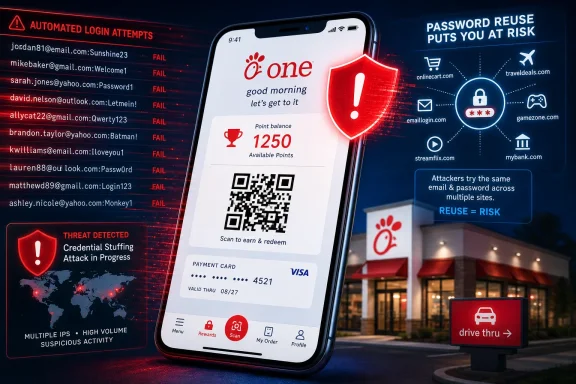 Overview: What Happened to Chick-fil-A One Accounts
Chick-fil-A’s notification describes an automated attack using account credentials obtained from a third-party source. In cybersecurity terms, that strongly indicates credential stuffing: criminals take large collections of leaked usernames, email addresses, and passwords from prior incidents elsewhere and test them at high speed against another company’s sign-in page.The method relies on one persistent consumer habit: reusing passwords. A password can be complex, long, and difficult to guess, yet still become a liability if it is reused on multiple sites. Once that password appears in an unrelated breach, attackers can automate attempts at retailers, banking portals, streaming services, food delivery platforms, airline rewards programs, and other targets.
That is what makes loyalty accounts particularly appealing. A successful account takeover can provide more than points for a free meal. It can reveal valuable personal data, give access to stored payment options, enable fraudulent purchases, or allow an attacker to drain a rewards balance before the account owner notices.
Chick-fil-A said it has notified potentially impacted Chick-fil-A One members in:
- Iowa
- Maryland
- Massachusetts
- New Mexico
- New York
- North Carolina
- Oregon
- Rhode Island
- Vermont
- Washington, D.C.
What Information May Have Been Exposed
The information that may have been accessible depended on what an individual customer kept in their Chick-fil-A One account. Chick-fil-A’s notice indicates that the potentially exposed data can include a mixture of identity details, loyalty program identifiers, payment-related information, and account-value data.Potentially accessed information includes:
- Customer names
- Email addresses
- Chick-fil-A One membership numbers
- Mobile Pay numbers
- QR codes associated with the account
- The last four digits of credit or debit card numbers
- Remaining Chick-fil-A account credit, where applicable
- Phone numbers
- Mailing addresses
- The month and day of birth
- Information connected with saved account settings
A combination of name, email address, telephone number, address, partial payment information, loyalty details, and birth-date fragments can be useful to fraudsters. Such data can support realistic phishing messages, password-reset scams, social-engineering attempts, and efforts to make fraudulent communications appear legitimate.
Why QR Codes and Loyalty Numbers Matter
For many users, a loyalty number or a QR code may sound less sensitive than a bank-account number. In a modern retail ecosystem, however, these identifiers can be directly tied to account balances, transaction histories, rewards, offers, and mobile payment workflows.If an attacker gains control of an account, the immediate objective may simply be to spend accumulated rewards or transfer value. That is a smaller financial loss than full-scale card fraud, but it can be fast, difficult to reverse, and easy to overlook in accounts that customers do not check frequently.
The broader risk is that account data can help attackers build a convincing profile of the victim. A phishing email that references a real restaurant brand, a recent loyalty program change, a correct partial card number, or a rewards balance can appear far more credible than a generic scam.
Why This Looks Like Credential Stuffing, Not a Password Database Theft
The company’s description is central to understanding the incident. Chick-fil-A said attackers used credentials obtained from a third-party source, rather than stating that passwords were stolen from Chick-fil-A itself.That aligns with credential stuffing, an attack in which criminals use already-compromised credentials from breaches, malware infections, underground data markets, or credential-harvesting campaigns. Automated tools then attempt those credentials across many services until they identify matching accounts.
The Mechanics of an Automated Login Attack
A typical credential-stuffing operation follows a repeatable pattern:- Attackers obtain a large list of email-and-password combinations from another compromised service.
- Automated software submits those credentials to a target’s website or mobile app.
- The attacker identifies successful logins.
- The successful accounts are reviewed for loyalty balances, stored payment methods, personal information, or resale value.
- Fraudulent activity may follow, including unauthorized orders, account changes, or targeted phishing.
That difference explains why password reuse is the key risk factor. A unique password can still be stolen from one site, but its usefulness is contained if it works nowhere else. A reused password turns an isolated breach into a chain reaction.
The Security Challenge for Retailers
Retailers and app providers face an uncomfortable reality: a correct password is not always proof that the legitimate customer is logging in. If criminals have acquired a real username-and-password pair, a basic password-only login flow may treat the attacker as authenticated.That is why effective defenses go beyond the password field. Modern e-commerce security commonly combines:
- Multi-factor authentication for account access or high-risk actions
- Rate limiting to slow automated login attempts
- Bot-detection systems
- Device and location risk analysis
- Detection of unusual sign-in velocity
- Monitoring for credential-stuffing patterns
- Challenges or additional verification for suspicious sessions
- Checks against known compromised passwords
- Reauthentication before changing payment details or redeeming account value
Chick-fil-A’s Response: What the Company Says It Did
Chick-fil-A said it took several account-protection steps after discovering the issue. Those actions are meaningful because they aim to cut off active attacker access and reduce the chance that saved account data can be used again.The company said it:
- Forced logouts for affected accounts
- Removed stored payment methods from impacted accounts
- Restored affected Chick-fil-A One account balances
- Reset passwords for impacted customers
- Added rewards to affected accounts
The restoration of account balances is a positive consumer-protection measure. It recognizes that loyalty points and stored credit have real value, even when they are not equivalent to a direct debit-card charge. Removing stored payment methods also reduces the immediate opportunity for additional misuse inside affected accounts.
What Has Not Been Publicly Established
Several important details remain unclear in the reported notification materials. Chick-fil-A has not publicly disclosed an overall number of affected customers, a detailed account-by-account timeline of access, or a complete technical description of how its security systems detected and contained the activity.There is also no public indication in the available notification language that full payment-card numbers or card verification codes were exposed. Customers should avoid overstating the event as a full card-data breach when the disclosed information points to a more limited set of payment-related details.
At the same time, it would be equally mistaken to dismiss the incident because the attackers allegedly began with credentials from elsewhere. A successful account takeover is still unauthorized access, and the information inside the accessed account can still be exposed.
The Real Risk to Affected Customers
The most immediate risk is unauthorized access to a Chick-fil-A One account. Customers may see lost rewards, unexplained purchases, missing credit, altered profile information, or unexpected activity involving stored payment methods.The longer-term concern is targeted fraud. Attackers who obtain personal details may use them to craft fake alerts that claim a customer must “verify” their account, restore points, confirm a payment card, or unlock a suspended loyalty profile.
These messages may arrive by email, text, direct message, or even phone call. Because the attacker may know the customer uses Chick-fil-A One, the scam can have a level of realism that ordinary spam lacks.
Common Follow-On Scams to Watch For
Customers should be skeptical of messages that:- Demand an immediate password reset through an unfamiliar link
- Claim rewards will expire unless the recipient signs in
- Request a full payment-card number to “restore” account access
- Ask for a one-time verification code sent by text or email
- Promise reimbursement in exchange for personal information
- State that a payment method must be re-added immediately
- Use a close imitation of Chick-fil-A branding but send from an unrelated address
What Affected Customers Should Do Now
Anyone who received a notification should change the Chick-fil-A password promptly. More importantly, that password should be checked for reuse elsewhere.If the same password was used for email, banking, shopping, Microsoft accounts, social media, or another food and retail app, those accounts need attention as well. Email deserves the highest priority because it often controls password resets for other services.
A Practical Account-Security Checklist
- Change the Chick-fil-A One password immediately.
Create a password that is unique to Chick-fil-A and not derived from an old password with a predictable variation. - Change the password anywhere else it was reused.
Start with the email account associated with Chick-fil-A One, followed by financial services and other accounts that store payment methods. - Review the Chick-fil-A One profile.
Check the email address, phone number, mailing address, payment settings, reward activity, recent orders, and current account balance. - Inspect payment-card activity.
Watch for unfamiliar restaurant purchases or other small transactions that could indicate fraud testing. Contact the card issuer promptly if suspicious activity appears. - Use multi-factor authentication where available.
Enable it first on email, financial accounts, Microsoft accounts, password managers, and any service that holds payment or identity information. - Do not share verification codes.
A one-time code is an authentication factor. If someone asks for it by text, phone, email, or chat, they may be attempting to take over the account. - Use a password manager.
A password manager can generate and store unique credentials for every service, removing the need to memorize a different long password for every account. - Be cautious with future breach-themed messages.
Attackers often exploit public breach news to send fake remediation emails while consumers are expecting legitimate communications.
Windows Users: Practical Steps to Secure the Wider Digital Identity
Windows users should view this incident as a reminder that account security is not limited to a single mobile app. A compromised or reused password can affect a person’s broader identity across browsers, email clients, cloud storage, online shopping, and device ecosystems.The most important account to protect is often the primary email inbox. If an attacker controls the email address used for password resets, they may be able to reset passwords for multiple unrelated services.
Review Saved Passwords Carefully
Modern browsers can save passwords and automatically fill them into websites. That feature is convenient, but it can also conceal repeated passwords that have been used for years.Review saved credentials in the password manager associated with your browser or device ecosystem. Look for duplicated passwords, old accounts that no longer need to exist, and weak credentials that are short, predictable, or based on personal details.
For users signed into Microsoft services, securing the Microsoft account is especially important. A Microsoft account can be tied to Windows sign-in, OneDrive, Outlook, Office apps, Xbox services, recovery options, and other connected experiences.
Use Windows Hello Where Appropriate
Windows Hello can reduce reliance on typing a password into a Windows PC by using a PIN, fingerprint, or facial recognition method tied to the device. It is not a replacement for securing online accounts individually, but it can improve local sign-in security and reduce exposure to casual password theft on a shared or stolen device.Users should also ensure that Windows is current, device encryption is enabled where supported, and account recovery details are accurate. Those measures do not stop credential stuffing at a retailer, but they help protect the computer and identity tools used to recover affected accounts.
A Broader Lesson for Loyalty Programs and Mobile Payments
The Chick-fil-A incident illustrates why loyalty applications must be treated like financial accounts rather than low-risk marketing tools. A digital rewards profile can hold personal data, payment references, gift-card value, order history, and redeemable benefits. That makes it an attractive target even if the balance in any individual account is modest.For companies, the event reinforces the need to assume stolen credentials are already circulating. Security planning cannot rely solely on users choosing strong passwords, because a strong password reused from another service can still be compromised through no direct fault of the retailer being targeted.
For customers, the lesson is equally direct: every important online account needs its own password. The purpose is not just to prevent one account from being hacked. It is to prevent one breach from becoming access to everything else.
The Bottom Line
Chick-fil-A’s disclosure points to a targeted account takeover and credential-stuffing incident affecting certain Chick-fil-A One users, rather than a confirmed theft of passwords from Chick-fil-A’s own systems. That distinction is technically important, but the potential exposure of names, contact information, loyalty identifiers, partial payment data, QR codes, and account balances makes the event a serious concern for affected customers.The company’s forced logouts, payment-method removals, password resets, restored balances, and added rewards are constructive steps. Yet the most durable protection now depends on customers taking action beyond the Chick-fil-A app: changing reused passwords, protecting email accounts, enabling multi-factor authentication, checking financial activity, and ignoring unsolicited “breach recovery” messages.
Credential stuffing thrives on the weakest link in a person’s password habits. A single unique password for every account remains one of the simplest and most effective defenses against turning an unrelated data leak into a much broader digital security problem.
References
- Primary source: KCRA
Published: 2026-07-23T23:47:00+00:00
- Related coverage: techradar.com
Chick-fil-A reveals data breach — customers warned hackers may have accessed their account info | TechRadar
Thousands of users affected in Texas alonewww.techradar.com - Related coverage: cbsnews.com
- Related coverage: wtop.com
Chick-fil-A alerts DC, Maryland and other customers to data breach - WTOP News
Chick-fil-A rewards program members in D.C., Maryland and eight other states are getting letters warning that hackers may have gained access to partial payment information and other personal data.wtop.com - Related coverage: bleepingcomputer.com
- Related coverage: koco.com