

Consumer hardware projects most often fail when teams mistake product design for styling, specification shopping, or founder taste, rather than treating it as a constrained business system spanning positioning, engineering, supply chain, cost, manufacturing yield, and after-sales risk. That is the blunt lesson behind the latest 36Kr analysis of five recurring hardware-design traps. The examples are familiar—Smartisan, Apple, Xiaomi, Huawei, OPPO, vivo, Tesla—but the pattern is bigger than any one company. In hardware, the market does not forgive bad assumptions simply because the render looked beautiful.
The seductive myth of consumer electronics is that a product begins as a vision. A founder sees a cleaner phone, a more elegant hinge, a more premium material, a more heroic spec sheet, and the company organizes itself around turning that imagined object into something people can buy. That myth survives because it is emotionally satisfying. It is also a dangerous way to spend money.
Software culture has trained a generation of entrepreneurs to believe that launch is the beginning of correction. Ship, measure, patch, repeat. Hardware has feedback loops too, but they are slower, more expensive, and much less merciful. A misjudged PCB layout, antenna compromise, thermal design, tooling decision, or supplier assumption can become hundreds of thousands of physical objects that cannot be patched into profitability.
That is why the five pitfalls outlined in the 36Kr piece matter beyond the Chinese smartphone market. They describe a decision-making disease that appears wherever teams confuse making a product with building a business. Consumer electronics is littered with devices that were clever, beautiful, or impressive in isolation but commercially doomed because the surrounding system could not support them.
The harsh truth is that hardware design is not the art of maximizing desirability. It is the art of choosing which constraints to respect first.
Premium buyers are not merely paying for nicer materials or better components. They are paying for trust. They expect logistics to work, after-sales service to exist, software to be polished, manufacturing tolerances to be invisible, and the brand to absorb inconvenience before the customer ever sees it. A startup rarely has those muscles on day one.
Smartisan’s early smartphone push remains a useful warning because it compressed so many of these risks into one product cycle. The company entered the phone market with design confidence and brand personality, but without the production memory, supplier leverage, and mass-market feedback loops that incumbents had spent years building. The Smartisan T1 was not judged as a charming first attempt. It was judged against Apple, Samsung, Huawei, Xiaomi, and every other device already competing for the same pocket.
That is the trap. A premium price does not buy a startup premium tolerance. It buys premium scrutiny.
Xiaomi’s early path was less glamorous but more structurally sound. Its first phone was aggressive on price, loud on value, and designed to generate volume. Volume gave Xiaomi data, supplier relevance, manufacturing practice, user feedback, and a real community of buyers. The company’s later high-end ambitions did not come from declaring itself premium; they came from accumulating capabilities that made premium devices less absurd.
OPPO and vivo followed a different but equally instructive road. They built massive distribution strength, offline retail discipline, product-definition instincts, and supply-chain confidence through years of mainstream devices. Their eventual flagship efforts rested on a foundation that startups often dismiss as boring. In hardware, boring is frequently where competence is manufactured.
Even Apple’s Vision Pro shows that the high end is not exempt from gravity. Apple launched the headset in February 2024 at $3,499, with extraordinary engineering, a world-class brand, and the best retail operation in consumer technology. Yet the device still ran into the predictable limits of price, weight, app ecosystem depth, and daily-use fit. If Apple cannot bend a new category into mass adoption by sheer prestige, a startup should be extremely skeptical that it can do so with a prettier deck and a smaller bank account.
A beautiful device that breaks radio performance, heat dissipation, battery life, repairability, ergonomics, or safety is not beautiful in any commercially meaningful sense. It is a sculpture pretending to be a tool. Users may admire it for five minutes, but they have to live with it for years.
Smartisan’s T2 is often remembered through this lens. The pursuit of a seamless, symmetrical, visually purified frame created engineering tradeoffs around antenna design and internal space. Those are not minor details in a smartphone. Signal and battery life are two of the most fundamental promises a phone makes to its owner. If the exterior wins at their expense, the product has not achieved elegance; it has merely moved ugliness inside the chassis.
Apple learned a version of the same lesson with the iPhone 4 antenna controversy. The phone’s design remains iconic, and Apple’s broader engineering achievement was substantial. But the episode proved that even elite teams can pay dearly when the physical object’s aesthetic solution collides with the messy biology of actual users holding it in actual hands.
The pop-up-camera era in Android phones is another case study in beauty’s hidden invoices. Devices like the OPPO Find X and vivo NEX delivered the dream of an uninterrupted front display before under-display cameras were ready for prime time. The result was visually striking, but mechanically complicated. Dust, durability, waterproofing, internal space, and long-term failure risk were all part of the bargain.
The industry eventually walked away from that approach not because it lacked imagination, but because it had too much machinery for too little durable advantage. The best hardware ideas are not the ones that win a launch-day photograph. They are the ones that still make sense after being dropped, pocketed, repaired, updated, resold, and used half-asleep in bad lighting.
Tesla’s interior minimalism raises the same argument in automotive form. The Model 3’s sparse cabin and screen-centered controls created a powerful visual identity, but also triggered debate about whether too many routine actions had been moved from tactile controls into menus. In a car, the interface is not just an aesthetic statement. It is part of the safety system.
There is a reason mature hardware teams treat ergonomics, thermals, RF performance, serviceability, and manufacturability as design inputs rather than post-design objections. They understand that users do not experience “design” as a render. They experience it as friction, comfort, reliability, and trust.
The most dangerous cost decisions often arrive disguised as differentiation. A custom glass treatment. A non-standard button. A tricky machining process. A boutique material. A bespoke hinge. Each choice can be defensible alone. Together, they can turn a promising device into a margin bonfire.
Smartisan’s repeated use of customized materials and processes illustrates the spiral. Higher customization raised component and manufacturing costs. Higher costs required higher prices. Higher prices reduced the brand’s reachable market. Lower sales weakened bargaining power with suppliers. Weaker bargaining power kept costs high. That loop is especially brutal for startups because they lack the volume needed to escape it.
The Essential Phone fell into a related trap. Its titanium frame and ceramic back gave it a premium physical presence that many reviewers admired. But admired materials do not guarantee a market, and expensive construction can become a commercial liability when the brand lacks ecosystem lock-in, carrier strength, or mass demand. Essential produced an interesting artifact; it did not produce a durable business.
Microsoft’s Surface Duo is another reminder that cleverness can be expensive in ways the market refuses to reimburse. The dual-screen hinge concept was distinctive, and Microsoft had serious engineering talent behind it. But the product sat awkwardly between phone, tablet, productivity device, and developer curiosity. Complex hardware requires a very clear use case because the customer eventually has to pay for the complexity.
The mature companies are not immune to indulgence, but they usually begin with a colder process. A target price range, margin expectation, shipment goal, channel strategy, and BOM ceiling frame the device before the design language hardens. That does not make the work less creative. It makes the creativity accountable.
This is where many founder-led hardware teams struggle. They treat cost constraints as accountant interference rather than product truth. In reality, the BOM is not a spreadsheet off to the side of the device. It is one of the device’s central design documents.
That distinction is where many hardware products go wrong. A flagship chip without sufficient cooling becomes a throttled chip. A large sensor without image processing discipline becomes inconsistent photography. A huge storage option without a real user need becomes a bragging right with a poor attach rate. A bright display with weak battery life becomes a device that looks best in reviews and disappoints on trains.
The Smartisan Nut R1’s 1TB storage option was memorable because it sounded outrageous at the time. But the existence of a giant configuration did not automatically make the whole product more compelling. If the rest of the system cannot convert the headline spec into daily value, the spec is ornamental.
Xiaomi’s Mi 11 era shows the danger of racing to the latest silicon before the platform is domesticated. The Snapdragon 888 was a flagship part, but many devices built around it faced criticism for heat and power behavior. In the Mi 11 family, overheating complaints and Wi-Fi-related failures became part of the product’s reputation. Winning the “first with the new chip” race is a poor victory if the device becomes known for the consequences of that chip.
Huawei’s P-series camera push offers a more nuanced version of the same point. Multi-camera systems require more than sensors. They require tuning, consistent color science, computational photography, focus behavior, thermal stability, image pipeline discipline, and a clear philosophy about what the photo should look like. If those pieces do not cohere, users experience not abundance but inconsistency.
Nintendo is the counterexample every spec-obsessed hardware executive should be forced to study. The Switch was underpowered compared with contemporary PlayStation and Xbox consoles, yet it matched hardware capability to a clear usage scenario: portable, social, flexible play. The value was not hidden in a benchmark. It was visible in the fact that the product made a different kind of gaming routine possible.
That is the deeper lesson. Great hardware is not the sum of its strongest parts. It is the balance of its weakest dependencies.
For Windows users and PC builders, this should sound familiar. A desktop with an oversized GPU and poor airflow is not a great system. A laptop with a powerful processor and inadequate cooling is not a mobile workstation; it is a fan curve with a keyboard attached. The PC world has spent decades proving that sustained performance, driver maturity, repairability, firmware behavior, and thermals matter as much as the silicon logo on the box.
Startups often run product development as a relay race. Industrial design creates the dream, engineering tries to make it real, procurement hunts for parts, and the factory receives the problem near the end. By then, every risky decision has acquired emotional and political weight. Changing the product feels like retreat.
Mature hardware companies pull manufacturing into the room much earlier. Suppliers, tooling experts, process engineers, quality teams, and contract manufacturers help shape what is possible before the public promise is made. That process can feel slower and less romantic, but it prevents the catastrophic discovery that the hero feature is also the yield killer.
Smartisan’s T1 reportedly suffered from ambitious manufacturing requirements around glass processing and tolerances that were difficult to sustain at scale. Whether every number in the lore is precise matters less than the structural lesson. The market does not care that a tolerance was elegant in CAD. It cares whether units ship on time, work correctly, and can be replaced without bankrupting the company.
Xiaomi’s ceramic-bodied Mi 5 variant is another familiar example. Ceramic offered a premium feel and differentiation, but ceramic manufacturing at phone scale is unforgiving. Low yield and supply bottlenecks can turn a halo feature into a missed sales window. In consumer electronics, timing is not decoration; it is strategy.
First-generation foldables made the same bargain at category scale. Hinges, flexible OLED layers, crease behavior, dust ingress, and durability testing all had to mature in public. Early buyers were effectively participating in an industrywide manufacturing experiment. That can work for enthusiasts, but it is a dangerous foundation for a broad-market promise.
Tesla’s Model 3 production ramp gave the world an automotive version of the same story. The company pushed hard on automation and scale, then ran into the hard limits of process execution. The “production hell” phrase stuck because it captured what hardware veterans already knew: the factory is not a neutral output device for executive ambition.
A hardware company’s real product is not the prototype shown on stage. It is the repeatable process that can make the ten-thousandth unit resemble the hundredth unit at a cost the business can survive.
The founder or product team imagines hardware as an object. Mature companies understand hardware as a system of commitments. Every external promise creates internal obligations: to suppliers, factories, service teams, software teams, channel partners, and customers who will not grade the product on effort.
That is why high-end positioning is so dangerous without accumulation. It commits the company to premium expectations before the operating system of the business can support them. That is why aesthetics can turn destructive. It commits engineering to solve around visual decisions that may not deserve priority. That is why uncontrolled customization breaks startups. It commits the financial model to costs that volume cannot rescue.
The spec-sheet trap is the same error in marketing form. It commits the product to headline claims before the system can deliver them as lived experience. The manufacturing trap is the final reckoning. It reveals whether all those commitments can be reproduced in the physical world.
This is also why postmortems that blame “the market” are often too generous. Markets can be irrational, but many failed hardware products were internally fragile before customers ever saw them. The launch merely exposed the mismatch.
Premium positioning without operational maturity appears whenever a boutique laptop brand promises workstation performance, luxury materials, silent cooling, long battery life, and repairability in the same thin chassis. The render is persuasive. The shipping device then has to obey physics.
Aesthetic obsession appears in ultrathin laptops with too few ports, keyboards compromised for thinness, glossy displays sold as premium despite office glare, and thermal systems that cannot sustain the advertised CPU performance. The Windows ecosystem has improved enormously, but it still contains too many devices designed to look good on a retail table rather than behave well over a three-year deployment.
Cost runaway appears in niche handhelds and creator laptops that chase exotic screens, custom controls, unusual cooling, or limited-run chassis designs without the volume to amortize them. These products may delight enthusiasts, but businesses live or die on repeatability. A device that cannot be serviced affordably or replenished predictably is a poor candidate for serious adoption.
The spec-sheet trap is practically native to the PC market. OEMs advertise peak turbo clocks, AI TOPS, display brightness, refresh rates, and GPU names while burying sustained wattage, memory configuration, SSD quality, BIOS maturity, fan noise, and driver behavior. Anyone who has bought two laptops with the “same” processor and discovered wildly different performance already understands the scam.
Manufacturing risk now matters even more as PC designs become more specialized. Foldable PCs, dual-screen laptops, ARM-based Windows machines, AI accelerators, and handheld gaming systems all depend on tight hardware-software integration. The old PC modularity story does not save a device whose hinge fails, firmware misbehaves, battery swells, or thermals collapse under load.
For IT departments, the lesson is practical. Do not buy the launch narrative. Buy the support model, the second firmware release, the repair channel, the deployment story, and the evidence that the vendor can make the same device consistently at scale.
Restraint means choosing a market segment the company can actually serve. It means letting engineering veto a visual flourish. It means rejecting a component that looks good on a slide but breaks thermals or margins. It means delaying a material until suppliers can manufacture it reliably. It means admitting that a flagship product is not a founder’s self-expression project.
Apple at its best has understood this. Nintendo understands it. Microsoft sometimes understands it in Surface and sometimes forgets it. Xiaomi’s best devices understand it when they balance price, supply, and performance rather than chasing first-place bragging rights. Tesla’s story is more volatile, but even there the difference between visionary product and operational chaos often comes down to restraint.
The irony is that restraint can look unimpressive from the outside. A slightly thicker device with better battery life does not make the same splash as a record-thin design. A mature sensor with excellent tuning may sound less exciting than a larger, newer module. A standard part with high yield may seem less premium than a bespoke component. But customers do not live in press events.
They live with the consequences.
The next wave of hardware—AI PCs, mixed-reality devices, foldables, smart glasses, handheld consoles, robotics, and specialized edge devices—will tempt companies into the same old mistakes with newer vocabulary. The brands that last will not be the ones that promise magic in the first generation. They will be the ones that understand hardware’s oldest rule: once the factory starts building your assumptions, every bad decision becomes inventory.
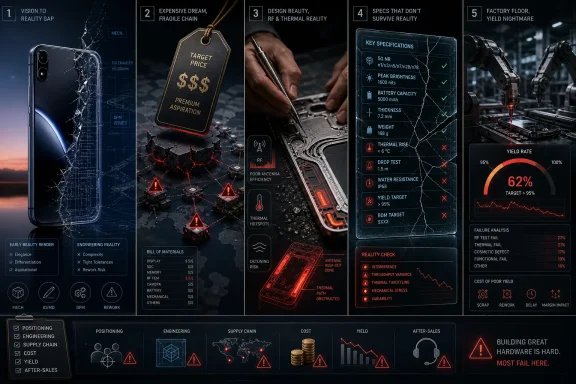 Hardware Does Not Give Founders a Undo Button
The seductive myth of consumer electronics is that a product begins as a vision. A founder sees a cleaner phone, a more elegant hinge, a more premium material, a more heroic spec sheet, and the company organizes itself around turning that imagined object into something people can buy. That myth survives because it is emotionally satisfying. It is also a dangerous way to spend money.Software culture has trained a generation of entrepreneurs to believe that launch is the beginning of correction. Ship, measure, patch, repeat. Hardware has feedback loops too, but they are slower, more expensive, and much less merciful. A misjudged PCB layout, antenna compromise, thermal design, tooling decision, or supplier assumption can become hundreds of thousands of physical objects that cannot be patched into profitability.
That is why the five pitfalls outlined in the 36Kr piece matter beyond the Chinese smartphone market. They describe a decision-making disease that appears wherever teams confuse making a product with building a business. Consumer electronics is littered with devices that were clever, beautiful, or impressive in isolation but commercially doomed because the surrounding system could not support them.
The harsh truth is that hardware design is not the art of maximizing desirability. It is the art of choosing which constraints to respect first.
The Premium Market Is a Reward, Not a Starting Line
The most common startup fantasy in hardware is also the most financially lethal: begin at the high end, charge a premium, sell fewer units, and let margin solve the company’s early fragility. On a spreadsheet, it looks rational. In the real market, it usually means walking directly into the customer segment with the least patience for imperfection.Premium buyers are not merely paying for nicer materials or better components. They are paying for trust. They expect logistics to work, after-sales service to exist, software to be polished, manufacturing tolerances to be invisible, and the brand to absorb inconvenience before the customer ever sees it. A startup rarely has those muscles on day one.
Smartisan’s early smartphone push remains a useful warning because it compressed so many of these risks into one product cycle. The company entered the phone market with design confidence and brand personality, but without the production memory, supplier leverage, and mass-market feedback loops that incumbents had spent years building. The Smartisan T1 was not judged as a charming first attempt. It was judged against Apple, Samsung, Huawei, Xiaomi, and every other device already competing for the same pocket.
That is the trap. A premium price does not buy a startup premium tolerance. It buys premium scrutiny.
Xiaomi’s early path was less glamorous but more structurally sound. Its first phone was aggressive on price, loud on value, and designed to generate volume. Volume gave Xiaomi data, supplier relevance, manufacturing practice, user feedback, and a real community of buyers. The company’s later high-end ambitions did not come from declaring itself premium; they came from accumulating capabilities that made premium devices less absurd.
OPPO and vivo followed a different but equally instructive road. They built massive distribution strength, offline retail discipline, product-definition instincts, and supply-chain confidence through years of mainstream devices. Their eventual flagship efforts rested on a foundation that startups often dismiss as boring. In hardware, boring is frequently where competence is manufactured.
Even Apple’s Vision Pro shows that the high end is not exempt from gravity. Apple launched the headset in February 2024 at $3,499, with extraordinary engineering, a world-class brand, and the best retail operation in consumer technology. Yet the device still ran into the predictable limits of price, weight, app ecosystem depth, and daily-use fit. If Apple cannot bend a new category into mass adoption by sheer prestige, a startup should be extremely skeptical that it can do so with a prettier deck and a smaller bank account.
Beauty Becomes a Liability When It Starts Writing the Engineering Brief
Industrial design matters. Nobody who has watched consumer electronics for the last quarter century can seriously argue otherwise. The problem begins when beauty stops being a discipline inside product development and becomes the organizing religion of the company.A beautiful device that breaks radio performance, heat dissipation, battery life, repairability, ergonomics, or safety is not beautiful in any commercially meaningful sense. It is a sculpture pretending to be a tool. Users may admire it for five minutes, but they have to live with it for years.
Smartisan’s T2 is often remembered through this lens. The pursuit of a seamless, symmetrical, visually purified frame created engineering tradeoffs around antenna design and internal space. Those are not minor details in a smartphone. Signal and battery life are two of the most fundamental promises a phone makes to its owner. If the exterior wins at their expense, the product has not achieved elegance; it has merely moved ugliness inside the chassis.
Apple learned a version of the same lesson with the iPhone 4 antenna controversy. The phone’s design remains iconic, and Apple’s broader engineering achievement was substantial. But the episode proved that even elite teams can pay dearly when the physical object’s aesthetic solution collides with the messy biology of actual users holding it in actual hands.
The pop-up-camera era in Android phones is another case study in beauty’s hidden invoices. Devices like the OPPO Find X and vivo NEX delivered the dream of an uninterrupted front display before under-display cameras were ready for prime time. The result was visually striking, but mechanically complicated. Dust, durability, waterproofing, internal space, and long-term failure risk were all part of the bargain.
The industry eventually walked away from that approach not because it lacked imagination, but because it had too much machinery for too little durable advantage. The best hardware ideas are not the ones that win a launch-day photograph. They are the ones that still make sense after being dropped, pocketed, repaired, updated, resold, and used half-asleep in bad lighting.
Tesla’s interior minimalism raises the same argument in automotive form. The Model 3’s sparse cabin and screen-centered controls created a powerful visual identity, but also triggered debate about whether too many routine actions had been moved from tactile controls into menus. In a car, the interface is not just an aesthetic statement. It is part of the safety system.
There is a reason mature hardware teams treat ergonomics, thermals, RF performance, serviceability, and manufacturability as design inputs rather than post-design objections. They understand that users do not experience “design” as a render. They experience it as friction, comfort, reliability, and trust.
The Bill of Materials Is Where Vision Meets the Hangman
Cost control is not the enemy of ambitious hardware. It is the condition that allows ambitious hardware to survive long enough to improve. A product that cannot be manufactured, priced, distributed, supported, and replenished at a viable margin is not a product. It is a financial event.The most dangerous cost decisions often arrive disguised as differentiation. A custom glass treatment. A non-standard button. A tricky machining process. A boutique material. A bespoke hinge. Each choice can be defensible alone. Together, they can turn a promising device into a margin bonfire.
Smartisan’s repeated use of customized materials and processes illustrates the spiral. Higher customization raised component and manufacturing costs. Higher costs required higher prices. Higher prices reduced the brand’s reachable market. Lower sales weakened bargaining power with suppliers. Weaker bargaining power kept costs high. That loop is especially brutal for startups because they lack the volume needed to escape it.
The Essential Phone fell into a related trap. Its titanium frame and ceramic back gave it a premium physical presence that many reviewers admired. But admired materials do not guarantee a market, and expensive construction can become a commercial liability when the brand lacks ecosystem lock-in, carrier strength, or mass demand. Essential produced an interesting artifact; it did not produce a durable business.
Microsoft’s Surface Duo is another reminder that cleverness can be expensive in ways the market refuses to reimburse. The dual-screen hinge concept was distinctive, and Microsoft had serious engineering talent behind it. But the product sat awkwardly between phone, tablet, productivity device, and developer curiosity. Complex hardware requires a very clear use case because the customer eventually has to pay for the complexity.
The mature companies are not immune to indulgence, but they usually begin with a colder process. A target price range, margin expectation, shipment goal, channel strategy, and BOM ceiling frame the device before the design language hardens. That does not make the work less creative. It makes the creativity accountable.
This is where many founder-led hardware teams struggle. They treat cost constraints as accountant interference rather than product truth. In reality, the BOM is not a spreadsheet off to the side of the device. It is one of the device’s central design documents.
The Spec Sheet Is a Weak Substitute for a Product Point of View
Consumer electronics marketing has trained buyers to compare numbers: megapixels, terabytes, gigahertz, nits, watts, refresh rates, TOPS, cores, sensors, and battery milliamp-hours. Specs are easy to advertise because they are easy to count. Experience is harder because it depends on the relationship between parts.That distinction is where many hardware products go wrong. A flagship chip without sufficient cooling becomes a throttled chip. A large sensor without image processing discipline becomes inconsistent photography. A huge storage option without a real user need becomes a bragging right with a poor attach rate. A bright display with weak battery life becomes a device that looks best in reviews and disappoints on trains.
The Smartisan Nut R1’s 1TB storage option was memorable because it sounded outrageous at the time. But the existence of a giant configuration did not automatically make the whole product more compelling. If the rest of the system cannot convert the headline spec into daily value, the spec is ornamental.
Xiaomi’s Mi 11 era shows the danger of racing to the latest silicon before the platform is domesticated. The Snapdragon 888 was a flagship part, but many devices built around it faced criticism for heat and power behavior. In the Mi 11 family, overheating complaints and Wi-Fi-related failures became part of the product’s reputation. Winning the “first with the new chip” race is a poor victory if the device becomes known for the consequences of that chip.
Huawei’s P-series camera push offers a more nuanced version of the same point. Multi-camera systems require more than sensors. They require tuning, consistent color science, computational photography, focus behavior, thermal stability, image pipeline discipline, and a clear philosophy about what the photo should look like. If those pieces do not cohere, users experience not abundance but inconsistency.
Nintendo is the counterexample every spec-obsessed hardware executive should be forced to study. The Switch was underpowered compared with contemporary PlayStation and Xbox consoles, yet it matched hardware capability to a clear usage scenario: portable, social, flexible play. The value was not hidden in a benchmark. It was visible in the fact that the product made a different kind of gaming routine possible.
That is the deeper lesson. Great hardware is not the sum of its strongest parts. It is the balance of its weakest dependencies.
For Windows users and PC builders, this should sound familiar. A desktop with an oversized GPU and poor airflow is not a great system. A laptop with a powerful processor and inadequate cooling is not a mobile workstation; it is a fan curve with a keyboard attached. The PC world has spent decades proving that sustained performance, driver maturity, repairability, firmware behavior, and thermals matter as much as the silicon logo on the box.
Manufacturing Is Not the Last Step; It Is the First Reality Check
The phrase design for manufacturability sounds like supply-chain jargon, but it is one of the great dividing lines between hardware amateurs and professionals. A design that cannot be manufactured at acceptable yield, cost, consistency, and speed is not finished. It is a theory.Startups often run product development as a relay race. Industrial design creates the dream, engineering tries to make it real, procurement hunts for parts, and the factory receives the problem near the end. By then, every risky decision has acquired emotional and political weight. Changing the product feels like retreat.
Mature hardware companies pull manufacturing into the room much earlier. Suppliers, tooling experts, process engineers, quality teams, and contract manufacturers help shape what is possible before the public promise is made. That process can feel slower and less romantic, but it prevents the catastrophic discovery that the hero feature is also the yield killer.
Smartisan’s T1 reportedly suffered from ambitious manufacturing requirements around glass processing and tolerances that were difficult to sustain at scale. Whether every number in the lore is precise matters less than the structural lesson. The market does not care that a tolerance was elegant in CAD. It cares whether units ship on time, work correctly, and can be replaced without bankrupting the company.
Xiaomi’s ceramic-bodied Mi 5 variant is another familiar example. Ceramic offered a premium feel and differentiation, but ceramic manufacturing at phone scale is unforgiving. Low yield and supply bottlenecks can turn a halo feature into a missed sales window. In consumer electronics, timing is not decoration; it is strategy.
First-generation foldables made the same bargain at category scale. Hinges, flexible OLED layers, crease behavior, dust ingress, and durability testing all had to mature in public. Early buyers were effectively participating in an industrywide manufacturing experiment. That can work for enthusiasts, but it is a dangerous foundation for a broad-market promise.
Tesla’s Model 3 production ramp gave the world an automotive version of the same story. The company pushed hard on automation and scale, then ran into the hard limits of process execution. The “production hell” phrase stuck because it captured what hardware veterans already knew: the factory is not a neutral output device for executive ambition.
A hardware company’s real product is not the prototype shown on stage. It is the repeatable process that can make the ten-thousandth unit resemble the hundredth unit at a cost the business can survive.
The Five Traps All Come From the Same Founder Error
The five pitfalls look separate at first glance. Bad positioning is a strategy problem. Aesthetic obsession is a design problem. Cost runaway is a finance problem. Spec-sheet competition is a product problem. Manufacturing risk is an operations problem. But in practice, they usually emerge from the same faulty mental model.The founder or product team imagines hardware as an object. Mature companies understand hardware as a system of commitments. Every external promise creates internal obligations: to suppliers, factories, service teams, software teams, channel partners, and customers who will not grade the product on effort.
That is why high-end positioning is so dangerous without accumulation. It commits the company to premium expectations before the operating system of the business can support them. That is why aesthetics can turn destructive. It commits engineering to solve around visual decisions that may not deserve priority. That is why uncontrolled customization breaks startups. It commits the financial model to costs that volume cannot rescue.
The spec-sheet trap is the same error in marketing form. It commits the product to headline claims before the system can deliver them as lived experience. The manufacturing trap is the final reckoning. It reveals whether all those commitments can be reproduced in the physical world.
This is also why postmortems that blame “the market” are often too generous. Markets can be irrational, but many failed hardware products were internally fragile before customers ever saw them. The launch merely exposed the mismatch.
Windows Hardware Should Read This as a Warning, Not a Smartphone Story
It would be easy for PC readers to treat this as a phone-industry morality play. That would be a mistake. The same traps are visible across Windows laptops, handheld gaming PCs, mini-PCs, docks, monitors, peripherals, AI PCs, and the expanding universe of hybrid devices trying to find a reason to exist.Premium positioning without operational maturity appears whenever a boutique laptop brand promises workstation performance, luxury materials, silent cooling, long battery life, and repairability in the same thin chassis. The render is persuasive. The shipping device then has to obey physics.
Aesthetic obsession appears in ultrathin laptops with too few ports, keyboards compromised for thinness, glossy displays sold as premium despite office glare, and thermal systems that cannot sustain the advertised CPU performance. The Windows ecosystem has improved enormously, but it still contains too many devices designed to look good on a retail table rather than behave well over a three-year deployment.
Cost runaway appears in niche handhelds and creator laptops that chase exotic screens, custom controls, unusual cooling, or limited-run chassis designs without the volume to amortize them. These products may delight enthusiasts, but businesses live or die on repeatability. A device that cannot be serviced affordably or replenished predictably is a poor candidate for serious adoption.
The spec-sheet trap is practically native to the PC market. OEMs advertise peak turbo clocks, AI TOPS, display brightness, refresh rates, and GPU names while burying sustained wattage, memory configuration, SSD quality, BIOS maturity, fan noise, and driver behavior. Anyone who has bought two laptops with the “same” processor and discovered wildly different performance already understands the scam.
Manufacturing risk now matters even more as PC designs become more specialized. Foldable PCs, dual-screen laptops, ARM-based Windows machines, AI accelerators, and handheld gaming systems all depend on tight hardware-software integration. The old PC modularity story does not save a device whose hinge fails, firmware misbehaves, battery swells, or thermals collapse under load.
For IT departments, the lesson is practical. Do not buy the launch narrative. Buy the support model, the second firmware release, the repair channel, the deployment story, and the evidence that the vendor can make the same device consistently at scale.
Restraint Is the Most Underrated Hardware Feature
The consumer electronics industry worships breakthroughs, but most successful hardware is built from restraint. The hard calls are rarely about what a team can add. They are about what it has the discipline to leave out.Restraint means choosing a market segment the company can actually serve. It means letting engineering veto a visual flourish. It means rejecting a component that looks good on a slide but breaks thermals or margins. It means delaying a material until suppliers can manufacture it reliably. It means admitting that a flagship product is not a founder’s self-expression project.
Apple at its best has understood this. Nintendo understands it. Microsoft sometimes understands it in Surface and sometimes forgets it. Xiaomi’s best devices understand it when they balance price, supply, and performance rather than chasing first-place bragging rights. Tesla’s story is more volatile, but even there the difference between visionary product and operational chaos often comes down to restraint.
The irony is that restraint can look unimpressive from the outside. A slightly thicker device with better battery life does not make the same splash as a record-thin design. A mature sensor with excellent tuning may sound less exciting than a larger, newer module. A standard part with high yield may seem less premium than a bespoke component. But customers do not live in press events.
They live with the consequences.
The Devices That Survive Are the Ones That Respect Their Constraints
The clearest lesson from these failures is not that hardware companies should avoid ambition. It is that ambition must be routed through the realities of manufacturing, cost, user behavior, and support. A device can be beautiful, powerful, and premium, but only after it has earned the right to be reliable.- A premium price should follow accumulated capability, not substitute for it.
- Aesthetic decisions should improve daily use instead of forcing engineering to hide the damage.
- Custom materials and processes should be justified by user value, not founder taste.
- Leading specifications should be treated as ingredients, not as proof of a superior product.
- Supply-chain and manufacturability reviews should begin before the design becomes emotionally untouchable.
- A hardware startup should define the business boundary before it falls in love with the object.
The next wave of hardware—AI PCs, mixed-reality devices, foldables, smart glasses, handheld consoles, robotics, and specialized edge devices—will tempt companies into the same old mistakes with newer vocabulary. The brands that last will not be the ones that promise magic in the first generation. They will be the ones that understand hardware’s oldest rule: once the factory starts building your assumptions, every bad decision becomes inventory.
References
- Primary source: 36Kr
Published: 2026-06-30T01:03:11.841536
Loading…
eu.36kr.com