

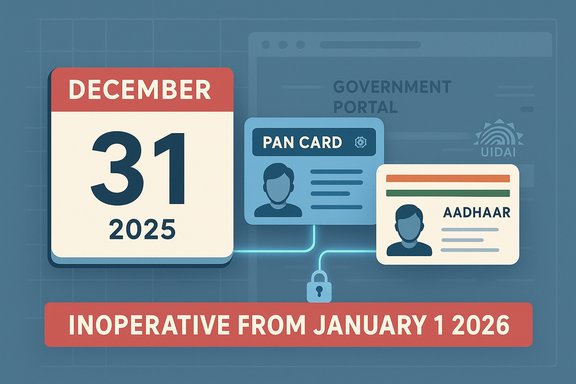
December 31, 2025 is the hard stop for a narrowly defined — but consequential — group of PAN holders to replace any Aadhaar Enrolment ID recorded against their PAN with the actual 12‑digit Aadhaar number; failure to do so risks the PAN being marked inoperative from January 1, 2026 and could immediately disrupt tax filings, refunds, banking and many investment transactions.
India’s income‑tax and identity systems have required progressive alignment between the Permanent Account Number (PAN) and Aadhaar for several years. A large majority of taxpayers already linked their PAN to Aadhaar under earlier deadlines; however, the Central Board of Direct Taxes (CBDT) issued a narrow, targeted set of amendments in April 2025 that created a specific deadline — December 31, 2025 — for the group of PANs that were issued on the basis of an Aadhaar Enrolment ID (AEID) rather than a final Aadhaar number. The CBDT inserted a new sub‑rule into Rule 114 of the Income‑tax Rules, 1962 requiring those PAN holders to “intimate” their Aadhaar number to the income‑tax systems on or before that date. This is not a blanket re‑opening of the original 2023 linking mandate. The broad linking exercise — with its June 30, 2023 deadline and the consequence that many unlinked PANs became inoperative on July 1, 2023 — is separate and remains the primary compliance milestone for most taxpayers. The April 2025 notifications specifically target the subset of PANs that were issued using an AEID because those records may still contain only the enrolment reference and not the permanent Aadhaar number. As of December 26, 2025 there are five calendar days remaining to meet the December 31, 2025 deadline. The count is absolute: the date to act is December 31, 2025 (midnight IST), and the administrative consequence called out by government notices is that affected PANs may be treated as inoperative from January 1, 2026.
Source: ET Now Aadhaar-PAN linking deadline: Final call! Only 6 days left to prevent PAN deactivation
 Background / Overview
India’s income‑tax and identity systems have required progressive alignment between the Permanent Account Number (PAN) and Aadhaar for several years. A large majority of taxpayers already linked their PAN to Aadhaar under earlier deadlines; however, the Central Board of Direct Taxes (CBDT) issued a narrow, targeted set of amendments in April 2025 that created a specific deadline — December 31, 2025 — for the group of PANs that were issued on the basis of an Aadhaar Enrolment ID (AEID) rather than a final Aadhaar number. The CBDT inserted a new sub‑rule into Rule 114 of the Income‑tax Rules, 1962 requiring those PAN holders to “intimate” their Aadhaar number to the income‑tax systems on or before that date. This is not a blanket re‑opening of the original 2023 linking mandate. The broad linking exercise — with its June 30, 2023 deadline and the consequence that many unlinked PANs became inoperative on July 1, 2023 — is separate and remains the primary compliance milestone for most taxpayers. The April 2025 notifications specifically target the subset of PANs that were issued using an AEID because those records may still contain only the enrolment reference and not the permanent Aadhaar number. As of December 26, 2025 there are five calendar days remaining to meet the December 31, 2025 deadline. The count is absolute: the date to act is December 31, 2025 (midnight IST), and the administrative consequence called out by government notices is that affected PANs may be treated as inoperative from January 1, 2026. Who is affected — the precise scope
The narrow class covered by the April 2025 notification
- Individuals whose PAN was allotted on the basis of an Aadhaar Enrolment ID recorded with their PAN application, and
- Where that AEID corresponds to an Aadhaar application filed before October 1, 2024.
These taxpayers are required by the Income‑tax (Ninth Amendment) Rules, 2025 (Notification No. 25/2025) and the corresponding government notification (No. 26/2025) to intimate their final Aadhaar number to the tax authorities by December 31, 2025.
Who is not targeted by this specific deadline
- Taxpayers who already linked their PAN and Aadhaar under previous rounds of compliance (including the 2023 process).
- PAN holders who were issued PAN on the basis of a final Aadhaar number (i.e., not an AEID).
- The longstanding statutory exceptions (for certain residents of Assam, Jammu & Kashmir, and Meghalaya, and specific non‑resident categories) continue to operate under the Income‑tax Act and earlier rules and are not broadly changed by April 2025’s AEID‑centric amendment.
What happens if you don’t act (immediate consequences)
- PAN may be marked inoperative from January 1, 2026 for the affected group. An inoperative PAN blocks routine tax interactions: it can prevent processing of refunds, invalidate tax return submissions tied to that PAN, and may trigger higher TDS/TCS rates where PAN is required for concessional withholding.
- There is a standard mechanism to make an inoperative PAN operative again, but that process has previously required a fee (commonly cited at ₹1,000) and administrative steps; treat claims about fee waivers cautiously — the April 2025 notification mandates intimation but does not explicitly list a blanket fee waiver within the text itself. Several tax‑advisory outlets and practitioner blogs interpret the amendment as effectively allowing members of the AEID cohort to complete the linking before December 31, 2025 without paying the late‑link fee, but that interpretation is not spelled out in the short government notification itself and should be verified on the Income‑tax e‑filing portal or via formal CBDT guidance. Flagging this as partly‑verified is important: do not rely solely on secondary summaries when money and identity are at stake.
How to check your Aadhaar‑PAN link status (quick, authoritative checks)
You should first verify whether your PAN is already linked to Aadhaar using the Income‑tax e‑filing portal; there are two simple ways:- Without logging in: visit the e‑Filing home page, choose Link Aadhaar Status (under Quick Links), enter your PAN and Aadhaar number and click View Link Aadhaar Status. The page immediately displays whether the PAN is linked, not linked, or if a request is pending validation.
- After login: once authenticated on the e‑filing portal you can check Dashboard → Link Aadhaar Status or My Profile → Link Aadhaar Status. If the Aadhaar is already seeded, the number should be visible and the status will read “linked.”
Step‑by‑step: how to link Aadhaar with PAN (online and offline options)
The Income‑tax Department offers multiple channels to seed your Aadhaar with PAN. Use the official e‑filing route if you have online access and a mobile number linked to Aadhaar.- Online (recommended, fastest if details match)
- Go to incometax.gov.in (Income‑tax e‑filing portal) and click Link Aadhaar under Quick Links.
- Enter PAN, Aadhaar number and the name as on Aadhaar; confirm date of birth and gender as required.
- If the portal asks for validation, you will receive an OTP on the mobile number registered with Aadhaar. Enter the OTP to validate.
- If the system accepts, the portal will confirm the link; the e‑filing portal and UIDAI systems complete background verification within a short period.
- SMS (useful when details match exactly and you cannot access the portal)
- Send an SMS from the mobile number registered with Aadhaar to the designated numbers (as previously published by the Income‑tax Department) in the format stipulated by the portal (typically UIDPAN<12‑digit Aadhaar><10‑digit PAN>). Confirm via the bounce/confirmation messages. Wait 24–48 hours for status update.
- NSDL / UTIITSL service centres (for mismatch cases)
- If demographic details differ between PAN and Aadhaar (name spellings, DOB differences), use the PAN service provider portals (NSDL / Protean / UTIITSL) or visit a facilitation centre for biometric/demographic reconciliation. This route can support offline verification and is recommended when automatic OTP linking fails.
- Payment step (if applicable)
- For taxpayers who missed earlier deadlines and do not qualify under any special AEID relaxation, the portal historically required a fee (₹1,000) to restore an inoperative PAN — the e‑filing portal’s e‑Pay Tax/payment step handles this; after payment, return to the link page to complete the process. For the AEID cohort, secondary sources indicate a potential waiver if linkage is completed by Dec 31, 2025, but the notification itself must be read alongside e‑filing guidance to confirm whether any fee is being applied automatically or waived. If in doubt, check the portal or contact the Income‑tax helpdesk.
Troubleshooting: common reasons linking fails and remedies
- Name mismatch (spellings, initials, order): the name on PAN and Aadhaar must match exactly or in an acceptable normalized form. If not, either update the name on Aadhaar (UIDAI) or apply for PAN correction depending on which document has the correct data. Biometric reconciliation at a service centre can sometimes bridge small mismatches.
- Date of birth differences: date of birth is a strict match field. If Aadhaar was enrolled with approximate DOB or the PAN has a different DOB entry, update the Aadhaar DOB (if correct) or correct the PAN record. UIDAI and PAN‑service portals provide correction routes.
- Mobile number not linked to Aadhaar: OTP verification requires that the mobile number used for OTP is the one registered with UIDAI; if the mobile is not linked, update it at UIDAI (this may involve in‑person validation) or use an alternate mode of verification at a facilitation centre.
- Payment not reflected: if you paid the ₹1,000 (where applicable) and the e‑filing portal doesn’t show payment confirmation, wait 4–5 working days and then check the challan status; if still not reflected, contact the e‑filing helpdesk with transaction details.
- Pending validation message: sometimes the portal will show “Request sent to UIDAI for validation” — this is normal and may take a few hours to a few days. Do not resubmit immediately; check status after 24–48 hours.
Fees, penalties and a caution on the “free linking” narrative
- The now‑familiar ₹1,000 charge for restoring an inoperative PAN after the June 2023 linkage deadline remains part of the administrative toolkit used by the department in many documented instances. If your PAN is already inoperative because of prior non‑linking, expect the portal to show the steps and payment head for “fee for delay” — historically handled under AY classification and the e‑Pay Tax flow.
- Multiple practitioner blogs, tax advisory sites and some news outlets have reported that the April 2025 AEID‑targeted amendment effectively allows those who obtained PAN using an AEID before October 1, 2024 to link their Aadhaar by December 31, 2025 without paying the late fee, provided they complete the linkage by that date. This interpretation appears repeatedly in the press, but the April notifications themselves insert the intimation requirement without an explicit clause that expressly says “fee waiver.” Because that distinction matters financially, treat the fee‑waiver claims as partly verified by secondary reporting but not explicitly declared in the short notification text — confirm on the e‑filing portal before making payments. If the portal still insists on payment, screenshot the screen and raise a helpdesk ticket; do not send payment to third‑party agents offering to “fix” the problem for you without verifying the official process.
Security and fraud risks — a practical checklist
Linking PAN and Aadhaar involves sensitive identity flows; scammers and phishing actors exploit the urgency of deadlines. Follow these safeguards:- Use only official government portals (incometax.gov.in or uidai.gov.in) for checks and linking. Avoid clicking links sent in unsolicited emails, social posts or WhatsApp messages. Official portal flows are the only reliable path.
- Do not share OTPs with anyone. The Aadhaar OTP and e‑filing OTP are the key authentication tokens; no legitimate agency will request OTPs over phone or chat.
- If you receive calls promising to “save” your PAN from deactivation in exchange for a fee or personal information, treat these as probable fraud and report them to local cybercrime or the Income‑tax helpdesk.
- Keep screenshots or transaction receipts of any payments or submissions; they can be essential if the portal behaves unexpectedly or if a helpdesk escalation is needed.
If your PAN becomes inoperative — stepwise recovery
- Confirm status on the e‑filing portal and gather the error/response message displayed.
- If the portal requires a late‑link fee and you are not in the AEID cohort, follow the e‑Pay Tax flow, pay the prescribed fee under the appropriate payment head, and then resubmit the linking request. Keep the challan reference.
- If you believe your PAN has been wrongly marked inoperative (for example, you already linked Aadhaar), submit an e‑filing grievance, attach evidence and contact the Income‑tax helpdesk. The department has processes to review and restore operative status where appropriate.
Critical analysis — strengths, shortcomings and risks in the April 2025 approach
Strengths and practical benefits
- The April 2025 amendments are narrowly targeted and pragmatic: they fix a specific data‑quality problem — PANs issued on AEID references that never migrated to final Aadhaar numbers — without reopening the full universe of PAN holders to another blanket deadline. That reduces disruption risk while finishing a long‑running cleanup exercise.
- A clear, short deadline provides finality for administrative systems and prepares the tax database for cleaner automated processing, refund flows and dematerialised KYC for financial services in 2026 and beyond. This clarity benefits payroll administrators, banks and brokerage houses that rely on accurate PAN↔Aadhaar mapping.
Shortcomings and operational risks
- The notification’s brevity invites interpretational gaps — notably whether the AEID cohort is exempted from the usual late‑link fee. That absence of explicit language creates ambiguity and risks inconsistent treatment across the e‑filing portal, service centers, and frontline call centers. Secondary sources filling that gap help but cannot substitute for formal, written clarification from CBDT or Income‑tax systems. This is an avoidable operational risk at scale.
- Communications and change management: the AEID cohort is a technical subset that many ordinary taxpayers may not recognise; public messaging must therefore be concrete (exact dates, exactly who should act, and where to act) to avoid panic, late payments, or exploitation by intermediaries. Some mainstream coverage simplified the message into a “link Aadhaar with PAN by Dec 31, 2025” headline without highlighting the AEID‑only scope, raising risks of confusion.
- Digital‑divide friction: taxpayers with mismatched records, inactive mobile numbers, or no easy access to facilitation centres may be disenfranchised by the compressed deadline. Authorities should (and in previous rounds have) provide assisted‑service counters and helplines; taxpayers close to the deadline should prioritise those channels if online steps fail.
Practical checklist — what to do now (five‑day action plan)
- Immediately check your PAN↔Aadhaar status on the Income‑tax e‑filing portal (no login required). If it reads “linked”, stop — you are done.
- If not linked and you remember applying for Aadhaar but the PAN record shows an AEID, prioritize linking today or tomorrow. Use the e‑filing online link flow (OTP) if your Aadhaar‑mobile is active.
- If you face data mismatches, visit an NSDL/UTIITSL facilitation centre or PAN service provider for reconciliation; allow lead time for biometric/ADHAAR updates.
- Do not pay to third‑party agents to “expedite” the link unless they are registered PAN intermediaries or authorised agents; insist on receipts and confirmation pages from official portals for any payment.
- If the portal demands the ₹1,000 fee yet you believe you belong to the AEID cohort, preserve evidence (screenshots) and immediately raise an e‑filing grievance or contact the Income‑tax helpline to request an adjudication or clarifying instruction.
Conclusion
The December 31, 2025 deadline is a sharp, last‑mile compliance requirement aimed at closing a specific data gap: PANs issued using Aadhaar Enrolment IDs must be updated with the final Aadhaar number or risk inoperative status from January 1, 2026. The amendment is administratively sensible but legally terse; secondary reporting suggests a practical fee relief for the AEID group if they comply by the deadline, yet the notification text does not explicitly spell out a waiver — taxpayers should therefore treat fee‑waiver claims as provisional until verified on the Income‑tax portal. Act now: check your linking status through the official e‑filing portal, resolve mismatches at the nearest facilitation counter, and preserve evidence of any payments or correspondence. This narrow, time‑bound task is straightforward to complete for most people — but the small cohort that remains unlinked must move fast and use only official channels to avoid both financial and identity‑theft risks.Source: ET Now Aadhaar-PAN linking deadline: Final call! Only 6 days left to prevent PAN deactivation
