

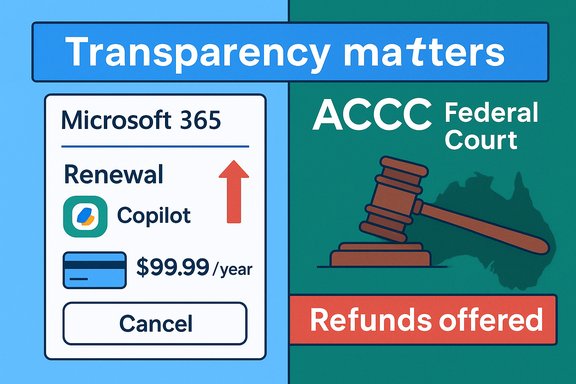
Microsoft’s apology and refund offer to roughly 2.7 million Australian Microsoft 365 subscribers follows a formal legal challenge by the Australian Competition and Consumer Commission (ACCC), which alleges the company misled customers about subscription choices after integrating its Copilot AI assistant — and has turned what began as a pricing update into a regulatory test of how tech companies communicate AI upgrades and price changes.
The dispute traces to the integration of Copilot into consumer editions of Microsoft 365 and the way that integration was communicated to long-standing subscribers. On 31 October 2024 Microsoft rolled Copilot into its consumer-tier offerings; shortly thereafter, the annual price for Microsoft 365 Personal rose from A$109 to A$159 (a 45% increase) and Microsoft 365 Family increased from A$139 to A$179 (about 29%). The ACCC says the pricing changes and communications around them are central to its case. The ACCC commenced Federal Court proceedings alleging that Microsoft told subscribers with auto-renewal enabled that to keep their subscriptions they “must accept the integration of Copilot and pay higher prices for their plan, or, alternatively, cancel their subscription.” The commission says this statement was misleading because Microsoft had quietly published a third option — Microsoft 365 Personal/Family Classic — that preserved the pre-integration features and pricing but was not disclosed in the renewal emails or the blog post. Instead, it was only revealed during the cancellation flow after subscribers selected “Cancel subscription.” The regulator argues that hiding the Classic option in the cancellation journey deprived consumers of an informed choice. The ACCC estimates that approximately 2.7 million Australians were affected by the alleged conduct, and it is seeking remedies including penalties, redress, injunctions and legal costs. The maximum statutory penalties for breaches of Australian Consumer Law can be substantial — up to A$50 million per contravention or higher if certain alternative calculations apply. The ACCC has framed this as a consumer-rights case about disclosure and choice, not about the appropriateness of raising prices or offering new AI features per se.
From a product design and compliance standpoint, three elements are relevant:
Source: Brisbane Times Microsoft apologises, offers refunds to 2.7 million Australians
 Background
The dispute traces to the integration of Copilot into consumer editions of Microsoft 365 and the way that integration was communicated to long-standing subscribers. On 31 October 2024 Microsoft rolled Copilot into its consumer-tier offerings; shortly thereafter, the annual price for Microsoft 365 Personal rose from A$109 to A$159 (a 45% increase) and Microsoft 365 Family increased from A$139 to A$179 (about 29%). The ACCC says the pricing changes and communications around them are central to its case. The ACCC commenced Federal Court proceedings alleging that Microsoft told subscribers with auto-renewal enabled that to keep their subscriptions they “must accept the integration of Copilot and pay higher prices for their plan, or, alternatively, cancel their subscription.” The commission says this statement was misleading because Microsoft had quietly published a third option — Microsoft 365 Personal/Family Classic — that preserved the pre-integration features and pricing but was not disclosed in the renewal emails or the blog post. Instead, it was only revealed during the cancellation flow after subscribers selected “Cancel subscription.” The regulator argues that hiding the Classic option in the cancellation journey deprived consumers of an informed choice. The ACCC estimates that approximately 2.7 million Australians were affected by the alleged conduct, and it is seeking remedies including penalties, redress, injunctions and legal costs. The maximum statutory penalties for breaches of Australian Consumer Law can be substantial — up to A$50 million per contravention or higher if certain alternative calculations apply. The ACCC has framed this as a consumer-rights case about disclosure and choice, not about the appropriateness of raising prices or offering new AI features per se. What Microsoft has said: apology, explanation and refunds
In a public statement posted to its regional communications channel, Microsoft acknowledged that it “fell short” in how it communicated subscription alternatives when it changed pricing in October 2024. The company said it began contacting affected Microsoft 365 Personal and Family subscribers in Australia to outline a “subscription alternative” — the Classic plans — and offered to refund the price difference for eligible customers who switch to Classic by a stated deadline. The announcement described the Classic plans as preserving core apps and security updates but excluding Copilot and some new feature updates. Microsoft’s message to subscribers broke the options into three clear choices: stay on the Copilot-integrated Microsoft 365 [Personal/Family] at the higher renewal price; switch to Microsoft 365 [Personal/Family] Classic and receive a refund covering the difference; or cancel the subscription entirely. The company set a date by which subscribers needed to move to Classic to qualify for refunds and outlined a 30-day processing window for refund payments to the subscriber’s payment method. The statement expressed contrition and framed the move as part of a commitment to clarity and trust in Australia.Timeline and the UX mechanics at the centre of the dispute
Timeline highlights
- 31 October 2024 — Copilot integrated into Microsoft 365 consumer plans; price increases announced for auto-renewing subscribers.
- January 2025 — Copilot integration extended globally with varying price changes by jurisdiction.
- 27 October 2025 — The ACCC filed proceedings in the Federal Court alleging misleading conduct affecting about 2.7 million Australians.
- Early November 2025 — Microsoft issued an apology and began emailing affected subscribers with a refund offer and directions to switch to the Classic plans.
The cancellation flow and the “hidden” option
The ACCC’s contention focuses on a specific user experience pattern: subscribers were told via email and a blog post that their choices were to accept the new, AI-integrated plans at the higher price or cancel. The Classic option was not mentioned in the outbound communications; users only saw it after initiating the cancellation sequence inside their Microsoft account. The ACCC says that disclosure practice effectively hid the lower-priced non-AI option, biasing users toward the pricier Copilot plans. Screenshots supplied by the regulator show the Classic option presented as a step in the cancellation process rather than as a plainly communicated alternative in renewal notices. From a user-interface perspective, this is textbook dark-pattern territory: placing the cheaper alternative inside a path designed to stop users from leaving (the cancellation flow) rather than promoting it in the renewal communication materially affects user decision-making. Microsoft disputes the characterisation in public comments that it deliberately concealed options, but has conceded its communications could have been clearer and is offering refunds to address consumer harm.The legal and regulatory stakes
The ACCC’s complaint turns on the Australian Consumer Law prohibition against misleading and deceptive conduct. The commission is not challenging Microsoft’s right to update products, restructure plans or raise prices; rather, it alleges that Microsoft misled consumers by failing to disclose all available options and by conveying an incomplete set of choices. The ACCC has asked the Federal Court for penalties, redress for affected consumers, and other orders that could include payments back to customers. The potential penalties are significant. For corporations, the maximum civil penalties under the consumer law are the greater of A$50 million, three times the value of the benefit obtained from the conduct, or 30% of adjusted turnover during the relevant period if the benefit cannot be calculated — making the financial exposure potentially material even for very large consumer software vendors. The ACCC’s case could also produce injunctive relief that forces changes to digital communications and UX flows in Australia. Beyond monetary penalties, the litigation presents reputational and operational risks. A finding against Microsoft would be a high-profile regulatory rebuke at a time when global regulators are increasingly scrutinising how tech platforms present AI features, subscription changes and consent mechanics. The case may be cited in future enforcement actions and could prompt rewrites of industry best practices for how AI upgrades are commercialised and disclosed to consumers.Why the Classic option matters — and why choice architecture is not neutral
At the core of the dispute is a simple proposition: consumers must be able to make informed choices about services they pay for. That requires companies to provide clear, timely, and prominent disclosure of available plans and prices — not burying alternatives behind a path that only users intent on cancelling will discover. The Classic option was, by design or accident, presented in a way that the ACCC says denied subscribers a fair chance to choose it.From a product design and compliance standpoint, three elements are relevant:
- Visibility: alternatives should be visible at the point of renewal or in renewal notices — not only after initiating cancellation.
- Clarity: communications must accurately and fully describe differences between plans, including which features are omitted (for example, the absence of Copilot and potential lack of feature updates in Classic).
- Accessibility: switching to alternative plans should be straightforward and not require users to take counterintuitive steps.
Consumer impact: who benefits, who qualifies, and how much money is at stake
Microsoft estimated that around 2.7 million Australian subscribers were exposed to the communications at issue; the ACCC uses the same headline number in its court filings. The size of the monetary redress depends on how many customers actually paid the higher price after the Copilot integration and then elect to switch to Classic within the window Microsoft specified. Microsoft’s communicated refund mechanism reportedly covers the price difference from renewals after 30 November 2024 for subscribers who switch to Classic by the stated deadline, with refunds processed to the payment method used within 30 days of the switch. Practical points for affected subscribers:- Refund eligibility is limited to subscribers who receive Microsoft’s outreach and who switch to Classic within the company’s declared timeframe.
- Refunds are calculated as the price difference between Copilot-integrated plans and Classic plans from the first renewal date after 30 November 2024.
- Microsoft said it will process refunds to the payment method on file and expects to complete refunds within 30 days of a successful plan switch.
Wider implications for AI rollouts, subscriptions and regulatory scrutiny
This episode is a bellwether for how regulators and consumers will treat subscription-based AI rollouts. Several themes are emerging:- Disclosure obligations are intensifying. Regulators expect clarity when companies repackage existing services with AI and charge a premium for AI-enabled tiers.
- Design practices are under microscope. UX patterns that nudge users toward higher-priced plans — especially in renewal and cancellation flows — will attract scrutiny as potential anti-consumer behaviour.
- Precedent for global enforcement. A Federal Court outcome in Australia could inform regulators elsewhere about what constitutes acceptable disclosure when monetising AI features within consumer software.
Strengths and weaknesses of Microsoft’s approach
Notable strengths
- Rapid remediation: Microsoft moved quickly to contact customers and offer refunds, which helps limit consumer outcry and shows responsiveness.
- Clarity in the follow-up: The subsequent communications laid out options more plainly than the original renewal notices, including concrete prices for Copilot bundles and Classic plans.
- Operational simplicity: Offering refunds to the payment method on file and automating the process — if executed smoothly — reduces friction for eligible subscribers.
Potential weaknesses and risks
- Timing and scope of the remediation: The refund window and the requirement to switch by a specific date could leave some eligible customers unaware or unable to claim refunds, undermining the remedy’s reach.
- Perception of intent: Even if the withholding of the Classic option was a design oversight, the optics of burying the lower-cost choice in a cancellation flow creates a perception of deliberate obfuscation.
- Legal exposure remains: Microsoft’s voluntary refunds do not negate potential court-imposed penalties, and the ACCC is pursuing an enforcement outcome that could extend beyond individual refunds.
Practical guidance for subscribers and digital businesses
For Microsoft 365 subscribers in Australia
- Check email inboxes and Microsoft account renewal notices for any direct communications from Microsoft about plan options.
- If you received Microsoft’s outreach, evaluate whether you prefer to: remain on the Copilot-enabled plan, switch to Classic and accept the refund option, or cancel entirely.
- Document transactions and keep screenshots of communications and receipts. If you switch and expect a refund, note the date of the switch and the refund processing timeline.
- If dissatisfaction remains after following Microsoft’s remedies, consider contacting the ACCC or a consumer advocacy organisation to explore statutory remedies under Australian Consumer Law.
For product teams and businesses offering subscription upgrades
- Publish all pricing options prominently at the point of renewal and in renewal emails.
- Avoid burying cheaper or older plans inside cancellation flows; make alternative pathways clear and accessible.
- Coordinate legal, compliance and UX teams pre-launch to ensure disclosures meet both regulatory expectations and consumer fairness norms.
- Implement audit trails for communications so remedial actions and regulatory reviews can be supported by clear evidence.
What to watch next
The Federal Court proceedings will parse the line between poor communication and misleading conduct. The ACCC’s concise court statement and Microsoft’s subsequent remedial offers will both be material to the Court’s assessment of whether consumer law was breached and what relief is appropriate. Regulators and other jurisdictions will be watching the outcome as a potential guide for enforcement of AI monetisation practices. Key milestones to monitor:- Court filings and any directions hearings that set the timetable for evidence and submissions.
- Microsoft’s execution of its refund program and any reported issues with processing or eligibility.
- Any interim injunctions or court commentary that signal how the regulator’s legal theory is being received.
Conclusion
The ACCC’s case and Microsoft’s apology together illustrate the hazards of combining product redesigns, AI feature rollouts, and subscription pricing without transparent, consumer-first communications. The legal challenge tests whether a design choice in the renewal and cancellation experience can amount to misleading conduct under consumer law when it materially affects millions of subscribers. Microsoft’s offer of refunds and clearer option descriptions reduces immediate consumer harm, but it does not eliminate legal exposure or the reputational costs of the episode. As regulators sharpen scrutiny of AI monetisation and UX design, companies will need to treat consumer disclosure with the same rigour they give to engineering and marketing — because how choices are presented now matters as much as what is offered.Source: Brisbane Times Microsoft apologises, offers refunds to 2.7 million Australians
