

The half‑day Accelerating AI conference in Milton Keynes has emerged as a practical, regionally rooted success story for SME-focused AI adoption — and organisers say the event will be back, with plans to expand into a more hands‑on format for 2026, even as some specifics remain to be confirmed.
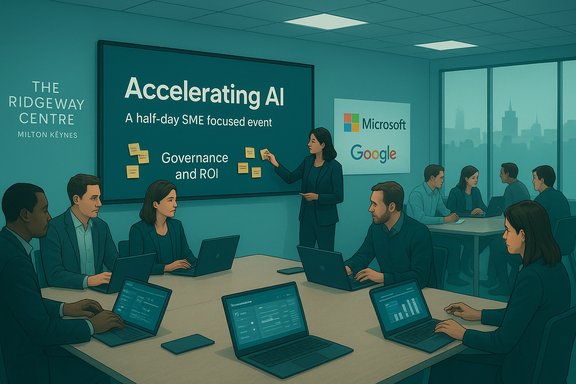
Accelerating AI began as a locally organised effort to demystify artificial intelligence for small and medium‑sized enterprises and, in 2025, staged a well‑attended edition at The Ridgeway Centre as part of Milton Keynes Tech Week. The event combined speaker keynotes, real‑world case studies and live demonstrations designed to move attendees from curiosity about generative AI into practical pilot activity. Local partners on the day included the South Midlands Growth Hub, Business MK and Business Times, with a confirmed speaker line‑up that featured Microsoft and Google representatives alongside regional AI practitioners. The programme focused squarely on business‑ready topics: generative AI in practice, AI agents, AI‑powered marketing, Microsoft Copilot in the workplace and regional funding and support options. Organisers positioned the conference as a pragmatic, SME‑oriented companion to larger, more technical AI gatherings — an approachable, practical introduction to tools and governance considerations for people running real businesses.
From a communications standpoint, mixing global platform credibility (Microsoft, Google) with local case studies is an effective strategy for converting senior leaders who need assurance that tools are both powerful and manageable. That approach is visible across the event’s PR and partner statements.
Accelerating AI demonstrated that regional tech events can be more than promotional theatre: when designed around immediate business outcomes, with funding and governance partners on site, they become a low‑friction route into AI for organisations that need it most. The coming months should clarify whether the 2026 iteration will deliver on the organisers’ ambition for deeper, hands‑on adoption — and whether Milton Keynes can scale a repeatable model for responsible AI adoption across the SME landscape.
Source: Business MK Accelerating AI: Milton Keynes conference celebrates success and confirms 2026 return - Business MK
 Background / Overview
Accelerating AI began as a locally organised effort to demystify artificial intelligence for small and medium‑sized enterprises and, in 2025, staged a well‑attended edition at The Ridgeway Centre as part of Milton Keynes Tech Week. The event combined speaker keynotes, real‑world case studies and live demonstrations designed to move attendees from curiosity about generative AI into practical pilot activity. Local partners on the day included the South Midlands Growth Hub, Business MK and Business Times, with a confirmed speaker line‑up that featured Microsoft and Google representatives alongside regional AI practitioners. The programme focused squarely on business‑ready topics: generative AI in practice, AI agents, AI‑powered marketing, Microsoft Copilot in the workplace and regional funding and support options. Organisers positioned the conference as a pragmatic, SME‑oriented companion to larger, more technical AI gatherings — an approachable, practical introduction to tools and governance considerations for people running real businesses. What happened at the 2025 event
Venue, scale and format
The 2025 conference took place on Thursday 25 September at The Ridgeway Centre in Milton Keynes and ran as a half‑day event from the morning into early afternoon. Organisers expected roughly 150 attendees for this edition, positioning it as an intimate, high‑value day for senior decision‑makers in the South Midlands region. That figure is consistent across multiple event listings and the local press ahead of the conference. There is a small but notable discrepancy in promotional material about historical reach: the event website references “400+ previous attendees” while regional coverage and event pages describe prior editions as having drawn “more than 200 delegates.” Both claims speak to sustained local interest, but they are not numerically identical — a reminder to treat promotional round‑ups with a degree of verification when making operational plans based on past attendance.Speakers and agenda highlights
The speaker roster intentionally mixed global platform voices with local implementers:- Microsoft representation focused on Copilot and workplace productivity, with David Bowen listed as a Microsoft speaker; Dragon IS (a local Microsoft partner) illustrated Copilot and agent scenarios.
- Google Cloud was represented in retail use‑cases for AI.
- Local agencies and founders — notably Andy Paul (Fliweel.tech), Lionel Naidoo (Dragon IS) and Matthew Rigby‑White (Qoob) — offered pragmatic demos and marketing‑facing case studies showing how generative tools and agents are being used in SMEs.
Reactions and rapid adoption
Organisers and some delegates reported immediate practical follow‑through. Event hosts emphasised that attendees left with pilot ideas and vendor contacts, and the conference received positive coverage in regional outlets. Qoob’s leadership — one of the organising agencies — framed the objective as moving SMEs from concept to operational use, and local press quoted organisers and partner directors to the same effect. These on‑the‑ground outcomes were repeatedly described in post‑event reporting.Why this matters for SMEs and the Milton Keynes tech ecosystem
Localised, practical focus beats generic hype
Big conferences tend to be either highly technical or high level and marketing heavy. Accelerating AI’s value proposition is the opposite: focused on day‑one usefulness for business leaders with limited technical capacity. By centring sessions on use‑cases — marketing automation, Copilot in knowledge worker flows, AI agents for routine tasks — the day made adoption less abstract and more accessible for local SMEs. Multiple partner listings and media previews emphasised this pragmatic angle. Practical, regionally tailored programming helps reduce two common SME adoption barriers: uncertainty about ROI and lack of local support. With the South Midlands Growth Hub present to explain grants and coaching, attendees could immediately link workshop outputs to actionable next steps and potential funding pathways.Local partner ecosystem and skills uplift
Milton Keynes Tech Week framed the conference in the wider ecosystem of city‑wide sessions, robotics competitions, and industry showcases. This cluster approach — training, funding clinics, and vendor demonstrations — helps embed AI capability in the regional supply chain rather than leaving it as a one‑off taste of novelty. For SMEs, the network effect matters: local vendors and partners become trusted suppliers and trainers, reducing friction and risk when piloting AI.What organisers promised for 2026 — and what is verified
Organisers publicly signalled a return for Accelerating AI in 2026, promising an expanded, more hands‑on format that will emphasise workshops, real‑world business stories and networking with practitioners shaping AI‑driven business. Event pages and the organisers’ own communications encourage businesses to register interest for future dates. Caveat and verification note: while the programme framework for 2026 has been described (more workshops, more practical sessions, and additional networking opportunities), a firm Spring 2026 date or detailed agenda is not yet published at the time of the available coverage. The official Accelerating AI website lists event details as “to be confirmed” and focuses on a registration‑of‑interest funnel rather than publishing a definitive Spring 2026 timetable. Until the organisers publish a confirmed date and agenda, the commitment should be viewed as an announced intention rather than a fully scheduled, ticketed event.Strengths: what Accelerating AI delivered well
- Actionable learning: The event prioritised practical sessions that show SMEs how to move from pilot to production‑lite experiments — not theoretical talks that offer no next steps. This design lowers the activation energy for adoption.
- Mixed speaker mix: Blending platform incumbents (Microsoft, Google) with local implementers and marketing agencies meant attendees heard global product signals and local, implementable tactics on the same stage. That mix is effective for ground‑level adoption.
- Local partnerships for support and funding: Bringing the South Midlands Growth Hub on site to provide funding and coaching clinics is an operationally useful move — it helps attendees turn ideas into funded pilot programmes.
- Ecosystem building within MK Tech Week: Positioning the conference inside a broader Tech Week made it easier for attendees to layer events — from STEM outreach to investor panels — which strengthens the city’s tech cluster narrative.
- Media amplification: Local press and trade outlets covered the conference in advance and after the event, increasing visibility for regional AI adoption and signalling that the city is serious about building a practical AI ecosystem.
Risks, blind spots and governance considerations
No single practical day can eliminate systemic adoption risks. Several areas need deliberate follow‑through:- Vendor lock‑in and platform dependence. Workshops that focus heavily on a dominant vendor’s tools (for example, Microsoft Copilot demonstrations) are useful in the short term but can encourage fast, vendor‑specific pilots without an architecture to preserve portability or multi‑cloud options. Buyers should insist on exit and interoperability plans.
- Governance and auditing gaps. Short workshops can teach how to use models without embedding robust verification, auditing and governance steps into pilots. Without these, organisations risk data leakage, regulatory violations and undetected hallucination‑driven errors. Post‑event governance playbooks and admin tracks are essential.
- Skills versus tooling mismatch. Tools are often easier to buy than the human and process work required to manage them. SMEs need practical upskilling, ongoing mentoring and operations support — not just one‑off demos — to sustain value. The Growth Hub clinics help, but longer learning pathways will produce more durable outcomes.
- Cost and complexity escalation. Pilots can quickly expand into costly projects if organisations conflate proof‑of‑concept outputs with production requirements (data governance, SRE processes, cost controls). SMEs should begin with small, measurable pilots that include budget‑capped guardrails.
- Measurement and ROI clarity. Practical adoption must include metrics at the start: what will a successful pilot deliver? Many SMEs adopt AI for “productivity” without defining specific, measurable outcomes that justify further investment. Conference follow‑ups should emphasise KPIs and short evaluation cycles.
Practical advice for SMEs drawing on the conference model
- Start with a single, high‑value process to pilot (customer emails, marketing content generation, or meeting summarisation).
- Assemble a cross‑functional pilot team — include an operations contact, legal/compliance and a business owner.
- Define measurable success metrics (time saved, conversion uplift, error reduction).
- Use vendor tools for rapid prototyping, but insist on exportable data and a migration path.
- Build a governance checklist: data classification, PII handling, logging and human verification steps.
Organiser voices and attendee sentiment
Organisers and local contributors framed the conference as a practical accelerator rather than a speculative showcase. Matthew Rigby‑White of Qoob — one of the event organisers — welcomed the outcome as evidence that SMEs were moving from interest to action, and Qoob’s own commentary reiterated the intention to keep programming practical and locally relevant. Meanwhile, media partners emphasised that regional businesses are hungry for accessible, actionable AI training. These perspectives appear both in the organisers’ blog posts and in local press coverage prior to and following the conference. Attendee reaction in post‑event coverage and social media highlights suggested a mix of inspiration and immediate follow‑up tasks: teams left with pilot ideas, vendor contacts and (in some cases) offers of 1:1 support from Growth Hub advisors. That kind of momentum is what the organisers pitched as the primary objective of the initiative.The marketing and messaging angle: why the conference story matters
For local economies, an event like Accelerating AI does two important things. First, it demystifies emerging technology for decision‑makers who otherwise rely on high‑level media narratives. Second, it concentrates the pieces SMEs need — training, funding signposting and vendor access — in one place so that the path to pilot can be short and visible.From a communications standpoint, mixing global platform credibility (Microsoft, Google) with local case studies is an effective strategy for converting senior leaders who need assurance that tools are both powerful and manageable. That approach is visible across the event’s PR and partner statements.
What to watch next: verification checklist for the 2026 promise
Organisers have said they plan an expanded, hands‑on Accelerating AI in 2026; however, the public materials available at the time of reporting are preliminary. Here’s a short checklist for readers who want to track the organisers’ commitments effectively:- Confirm the date and venue once the Accelerating AI website posts an official event notice. Current site copy asks visitors to register interest and lists details as “to be confirmed.”
- Look for a published agenda showing hands‑on workshops and follow‑up clinics — a true shift from talk formats to implementation labs.
- Verify any capacity claims (planned attendees vs. earlier attendance numbers) and reconcile promotional figures (e.g., 150, 200+, 400+) before assuming the same scale for your team’s planning.
- Check whether the Growth Hub and media partners remain confirmed, since those partners materially influence the event’s practical support offering.
Assessment: strategic value versus practical caveats
Accelerating AI’s model — a compact, locally focused conference that prioritises pilots and funded follow‑through — is a strong blueprint for regional AI capability building. It addresses real SME barriers: lack of local expertise, uncertain ROI and the difficulty of finding neutral, practical guidance. The presence of the South Midlands Growth Hub is a tangible differentiator that elevates the event above pure marketing. However, the event’s impact will depend on the persistence of follow‑on support. One half‑day does not create an enterprise governance function, nor does it replace the operational lift required to move pilots into production. The organisers’ promise to deliver more workshops and hands‑on labs for 2026 is a sensible next step, but it must be accompanied by post‑event mentoring, measurement frameworks and funding pathways to make the promise durable.Final verdict: local momentum with pragmatic limits
Accelerating AI 2025 successfully delivered a local, practical road‑map for SMEs to start AI pilots — and it did so by combining platform voices, local implementers and regional funding advisors. That mix is its greatest strength and fits Milton Keynes’ broader Tech Week strategy to position the city as a pragmatic innovation hub. The announced plan to return with a more hands‑on 2026 format is promising — but readers should treat the timeline and exact format as indicative until organisers publish a confirmed date and a detailed agenda. Registration‑of‑interest pages are live, and local partners continue to encourage bookings and early engagement. For SME leaders thinking about next steps: treat the conference as a practical entry point, follow the Growth Hub advice for funding and governance, and insist on measurable pilot outcomes and clear exit or migration plans when adopting vendor tools such as Microsoft Copilot. Those concrete safeguards will make the difference between a short‑lived experiment and a steady productivity gain.Accelerating AI demonstrated that regional tech events can be more than promotional theatre: when designed around immediate business outcomes, with funding and governance partners on site, they become a low‑friction route into AI for organisations that need it most. The coming months should clarify whether the 2026 iteration will deliver on the organisers’ ambition for deeper, hands‑on adoption — and whether Milton Keynes can scale a repeatable model for responsible AI adoption across the SME landscape.
Source: Business MK Accelerating AI: Milton Keynes conference celebrates success and confirms 2026 return - Business MK
