

Anthropic’s answer to cautious corporate buyers is blunt and strategic: outsource the heavy lifting to a global consultancy that already lives inside the enterprise — and let its 30,000 trained engineers do the selling, embedding, and measurement.
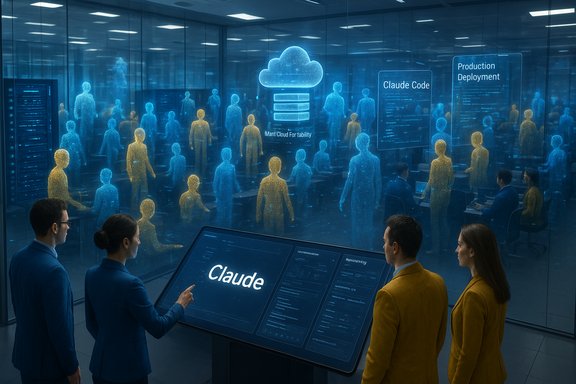
Anthropic and Accenture announced a major expansion of their partnership in December, creating an "Accenture Anthropic Business Group" and committing to a multi-year commercial and delivery arrangement that will train roughly 30,000 Accenture professionals on Anthropic’s Claude models and roll Claude Code into tens of thousands of developer workflows. The pact is explicitly aimed at turning pilots into production at scale — with initial targeting of heavily regulated industries such as financial services, life sciences, healthcare, and public-sector organizations. The timing and scale of the move matter: Anthropic has been racing OpenAI and other labs for corporate budgets while also forging distribution deals with hyperscalers and systems vendors. The Accenture tie-up gives Anthropic an entrenched route to enterprise procurement and execution muscle — and gives Accenture an alternative supplier to meet client demand for model choice. Observers should read this as more than a reseller agreement: it’s a delivery-and-outcomes pact that bundles models, engineering, and a trained frontline of embedded consultants.
Anthropic and Accenture have created an execution fabric designed to get Claude into production faster. Whether that fabric produces durable, auditable business value — rather than merely displacing pilot costs into larger consulting invoices — will be the defining test for CIOs and the companies involved over the next 12–36 months.
Conclusion
This partnership is a clear signal that the enterprise phase of the AI cycle has entered a delivery and accountability era. Models and benchmarks alone do not make a deployment; people, processes, measurement, and governance do. Accenture’s scale and Anthropic’s model performance — reinforced by third‑party benchmarks — create a plausible path to production. But the real value will be earned with disciplined pilots, transparent SLAs, and verifiable outcomes that survive the scrutiny of compliance teams and CFOs alike.
Source: Fudzilla.com Anthropic leans on Accenture to flog AI to cautious corporates
 Overview
Anthropic and Accenture announced a major expansion of their partnership in December, creating an "Accenture Anthropic Business Group" and committing to a multi-year commercial and delivery arrangement that will train roughly 30,000 Accenture professionals on Anthropic’s Claude models and roll Claude Code into tens of thousands of developer workflows. The pact is explicitly aimed at turning pilots into production at scale — with initial targeting of heavily regulated industries such as financial services, life sciences, healthcare, and public-sector organizations. The timing and scale of the move matter: Anthropic has been racing OpenAI and other labs for corporate budgets while also forging distribution deals with hyperscalers and systems vendors. The Accenture tie-up gives Anthropic an entrenched route to enterprise procurement and execution muscle — and gives Accenture an alternative supplier to meet client demand for model choice. Observers should read this as more than a reseller agreement: it’s a delivery-and-outcomes pact that bundles models, engineering, and a trained frontline of embedded consultants. Background: why this partnership landed now
Enterprises want outcomes, not experiments
Enterprise spending on generative AI has surged year-on-year, but CIOs and procurement teams remain skeptical about where value actually lands. Early projects frequently stall at pilot stage because of governance, integration complexity, and unclear return-on-investment measurement. Consulting firms promised to bridge the gap, but many large organizations report that early consultancy engagements produced exploratory reports rather than measurable automation and cost reductions. The Accenture–Anthropic deal is explicitly positioned to address that gap by embedding trained engineers inside customer organizations and offering packaged vertical plays.Model differentiation and enterprise choice
Anthropic’s Claude family has matured into a set of models that the company presents as enterprise-optimized, including purpose-built variants for coding (Claude Code) and agentic workflows. Benchmarks that focus on finance, law, and coding tasks have recently favored Claude variants on several independent leaderboards, making the model more attractive for regulated and knowledge-intensive verticals. That performance narrative has helped Anthropic win shelf space across cloud marketplaces and enterprise product suites.Consulting firms are re-stacking their offerings
Big consultancies are racing to put operationalized AI in front of clients. Accenture’s move follows other recent partnerships — including Accenture’s earlier deals with other model suppliers and Anthropic’s engagements with Deloitte and Cognizant — and reflects a broader shift: consultancies are no longer only strategy boutiques but execution partners expected to deliver measurable productivity gains. The Accenture Anthropic Business Group is an example of this strategy in practice: dedicated personnel, productized offerings, and embedded engineering teams.What the deal actually is — the facts that matter
- Accenture and Anthropic are launching the Accenture Anthropic Business Group to accelerate enterprise adoption and measure AI value.
- Approximately 30,000 Accenture professionals will be trained on Claude; tens of thousands of Accenture developers will get access to Claude Code.
- The partnership is framed as multi‑year by vendor releases, while some outlets report it as a three‑year pact; public materials use both phrasings. Readers should note the difference between a vendor’s “multi‑year” framing and an article’s more precise “three‑year” wording.
- The two firms are explicitly targeting regulated sectors (finance, life sciences, healthcare, public sector) where governance and data residency are deciding factors for adoption.
- Anthropic will pair its Applied AI specialists with Accenture’s forward‑deployed (reinvention) engineers to embed solutions inside client organizations; Anthropic expects to supply core expertise while Accenture provides scale.
Who gains — and who risks losing — from this deal
Anthropic: scale, credibility, and route to revenue
- Immediate benefits: Access to Accenture’s go‑to‑market muscle and an army of trained engineers accelerates enterprise trials and shortens procurement friction. For Anthropic this converts interest into measurable deployments and revenue potential.
- Commercial validation: Being named among Accenture’s select strategic partners increases Claude’s enterprise credibility, especially for regulated industries that demand vendor maturity and compliance assurance.
- Risk: Deep delivery ties increase interdependence with a small number of partners. If Accenture rebalances its strategic alliances or if deployments fail to meet expectations, Anthropic could face reputational and revenue exposure. Also, Anthropic’s market-share claims come primarily from investor‑backed reports and third‑party benchmarks, which should be read cautiously.
Accenture: productization and differentiation
- Immediate benefits: Accenture secures an alternative frontier model supplier to pair with its OpenAI, Cohere, and other relationships. Training 30,000 people on Claude adds a replicable, vendor‑tied competency Accenture can deploy into client engagements.
- Commercial upside: Accenture’s pitch is outcomes — reduce pilot wastage and accelerate value capture. If Accenture can show measurable ROI for clients, the consultancy will command higher margins on “AI reinvention” programs.
- Risk: Large engagements can be costly and require tight outcome‑based contracting. Clients are already vocal about consultants delivering playbooks rather than production outcomes; Accenture must avoid long discovery phases without measurable results.
Enterprises and CIOs: faster adoption, but caveats apply
- Pros: Faster access to Claude inside engineering teams, pre‑built vertical playbooks, and embedded engineers who can accelerate deployment and operationalize governance.
- Cons: Potential vendor concentration, unclear total cost of ownership (TCO) in long‑term consumption contracts, and the need to maintain internal capabilities to validate outputs and manage governance. Enterprises must insist on SLAs, explainability, provenance, and audit logs for model outputs.
Technical and performance claims — verified benchmarks and caveats
Anthropic has leaned on third‑party benchmarks to substantiate Claude’s business readiness. One such source, Vals AI, runs industry‑focused leaderboards that explicitly weight finance, legal, and coding tasks and has ranked Claude Sonnet 4.5 among the top performers in the Vals Index and in specific finance benchmarks. This bench‑level evidence strengthens Anthropic’s vertical narrative for regulated industries. But benchmarks come with several important caveats:- Benchmarks reflect the tasks, datasets, and evaluation methodology chosen by the benchmarker. Performance on a closed Finance Agent test does not guarantee identical outcomes on proprietary, institution‑specific datasets.
- Independent testing (including Vals AI studies) shows that even the best models still make mistakes on complex financial tasks. High accuracy on benchmark items often requires careful prompt engineering, tool access, and retrieval/agent orchestration. Enterprises must plan for human oversight in production workflows.
- Different market‑share estimates exist. Menlo Ventures reports a large Anthropic enterprise share in its industry report, but other trackers and analysts report lower percentages. Market‑share figures are useful directional signals but vary by definition (spend vs. usage vs. production deployments), method, and sponsor. Treat headline market‑share numbers as estimates, not audited market facts.
The competitive map: Claude, OpenAI, Microsoft and the hyperscaler dynamics
The Accenture–Anthropic partnership comes against a backdrop of fierce competition and deep hyperscaler relationships. Anthropic has distribution relationships across major clouds, and Claude variants have been surfaced in Microsoft’s Copilot family — a notable move given Microsoft’s longstanding relationship with OpenAI. The result is a multi‑vendor, multi‑cloud landscape where model choice is becoming a procurement lever for enterprise customers. At the same time, the industry’s infrastructure layer (chips, racks, cloud) is consolidating fast: large compute commitments and co‑engineering deals between model developers, NVIDIA, and hyperscalers are now a central part of commercial strategy. That shifts competition from pure model performance to a product-of-products playbook combining model, accelerators, cloud pricing, and packaged consultancy delivery.The hidden work: embedding, measurement and governance
The partnership emphasizes embedding — physically placing “reinvention deployed engineers” inside client organizations and pairing them with Anthropic’s Applied AI specialists. That delivery model answers a practical truth: enterprise AI demands more change management, data integration, and governance work than consumer chat experiences suggest. Success depends on four operational pillars:- Provenance and telemetry: Tag every inference with model version, provenance, tools used, and input datasets so that legal, audit, and quality teams can trace outputs.
- Human-in-the-loop controls: For high‑risk decisions (credit, clinical, regulatory filings), maintain human approval gates and measurable edit‑rates as acceptance metrics.
- Outcome‑based contracting: Move from time-and-materials or discovery-style engagements to milestone‑driven, KPI‑anchored agreements that pay for measurable outcomes (time saved, accuracy gains, compliance improvements).
- Model escape hatches and portability: Ensure contractual portability clauses and escape hatches so that clients can switch models or host on alternative clouds without losing access to their curated knowledge graphs and integration work. This protects against vendor concentration risk.
Regulatory, security and ethical lens
Targeting finance, healthcare, and government sectors brings immediate regulatory scrutiny. Enterprises should expect:- Stricter contractual demands on data residency, processing, and breach notifications. Vendors must specify whether tenant data leaves client clouds and under what protections.
- Audit and explainability requirements for decisions that materially affect people (credit, benefits, clinical decisions). Benchmarks and marketing claims are not a substitute for verifiable audit trails and certification steps.
- Supply‑chain and concentration risk concerns for national security and critical infrastructure jurisdictions: deep ties among model vendors, hyperscalers, and chipmakers invite regulatory attention. Enterprises doing cross-border deployments will need legal and compliance sign‑offs.
Practical playbook for CIOs and IT leaders
- Start with a measurable pilot that mirrors production data and workflows, not canned vendor demos. Require a pre-registered dataset and a success metric (e.g., reduce document review time by X% while maintaining Y% accuracy).
- Insist on telemetry and model metadata for every inference: model name, version, toolchain, and dataset references. This is non‑negotiable in regulated environments.
- Stage governance: business approvals for low‑risk tasks, legal review for any personally identifiable or regulated data, and a risk committee for high‑impact use cases.
- Negotiate outcome‑based SLAs with clear remediation paths and portability clauses. Avoid open‑ended “consumption” terms without caps, cost forecasting tools, and escape clauses.
- Maintain multi‑model testing: benchmark Claude, OpenAI, Google (and any in‑house models) on your workloads to understand cost/performance tradeoffs before committing. Use third‑party benchmarks and in‑house tests.
Strengths and strategic upside of the arrangement
- Operational scale: Training 30,000 professionals creates a reproducible, deployable talent pool. That’s a major differentiator in delivering rapid pilots and scaled roll‑outs.
- Vertical focus: Packaging regulated‑industry playbooks reduces legal and compliance friction — a common blocker for enterprise rollout.
- Model performance narrative: Independent benchmarks that weight finance, law, and coding favor Claude variants in many tasks, supporting Anthropic’s enterprise case.
Risks and unresolved questions
- Delivery vs. promise gap: Professional services firms have historically struggled to convert strategy into sustained, measurable value for some clients. Accenture must prove it can deliver outcomes, not just pilots and decks.
- Market‑share claims vary: Menlo Ventures and other trackers produce different market‑share figures for Anthropic and OpenAI; Menlo’s report shows a large Anthropic lead, but independent trackers and analysis vary widely. Interpret these numbers as directional, not definitive.
- Vendor concentration and lock‑in: Heavy embedding of Accenture engineers with Claude workflows may create switching costs that hurt clients long term unless contracts enforce portability.
- Benchmark overhang: Benchmarks are useful, but they can overstate production readiness. Real‑world finance and legal tasks still demand human supervision and specialized retrieval pipelines to achieve acceptable error rates.
Bottom line and strategic read for Windows‑centric enterprise IT
The Accenture–Anthropic partnership is a pragmatic, delivery‑focused response to a core enterprise problem: converting pilot enthusiasm into measurable production outcomes. For Windows‑centric and Microsoft‑aligned customers, the practical upside is faster experimentation inside familiar productivity stacks (including Copilot surfaces where Claude is now a selectable option), backed by an army of trained engineers who can integrate models with corporate identity, security, and data platforms. However, the arrangement raises the perennial tradeoffs of enterprise IT at scale: speed vs. governance, scale vs. vendor concentration, and payoff vs. cost. CIOs should treat Accenture–Anthropic as a credible and potentially powerful option — but one that must be bounded by outcome‑based contracts, portability guarantees, rigorous telemetry, and staged rollout plans that preserve multi‑model flexibility.Anthropic and Accenture have created an execution fabric designed to get Claude into production faster. Whether that fabric produces durable, auditable business value — rather than merely displacing pilot costs into larger consulting invoices — will be the defining test for CIOs and the companies involved over the next 12–36 months.
Conclusion
This partnership is a clear signal that the enterprise phase of the AI cycle has entered a delivery and accountability era. Models and benchmarks alone do not make a deployment; people, processes, measurement, and governance do. Accenture’s scale and Anthropic’s model performance — reinforced by third‑party benchmarks — create a plausible path to production. But the real value will be earned with disciplined pilots, transparent SLAs, and verifiable outcomes that survive the scrutiny of compliance teams and CFOs alike.
Source: Fudzilla.com Anthropic leans on Accenture to flog AI to cautious corporates
