
Adactin’s new AFIVE platform is a timely sign that enterprise AI is moving beyond chatbot novelty and into the harder, more valuable territory of knowledge operations. Built to find, manage, and use information across fragmented systems, the platform combines Azure OpenAI, Azure AI Foundry, LangChain, and a retrieval-augmented generation (RAG) approach to turn scattered content into something closer to a governed decision engine. The headline is not just that Adactin launched another AI product, but that it is packaging a familiar stack into a business-ready layer aimed at productivity, collaboration, and access control. In a market where many AI tools still struggle with trust, provenance, and enterprise guardrails, that positioning matters.
The launch of AFIVE lands at a moment when enterprise buyers are increasingly skeptical of “AI-powered” claims that are not matched by dependable security and integration. The pitch has evolved from generic generative AI assistants to systems that can actually work with corporate content under real-world governance constraints. Adactin’s framing reflects that shift: the platform is described as an intelligent decision-support system that can synthesize information from multiple silos rather than merely answer questions in isolation.
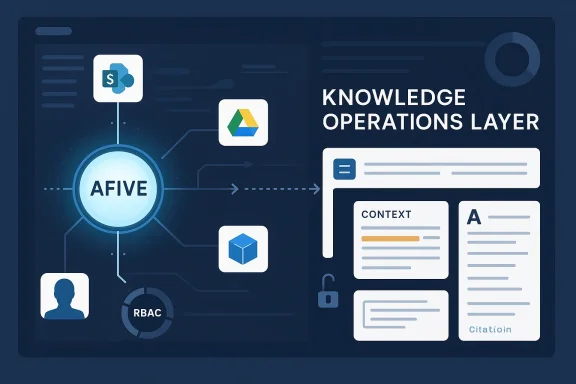
That matters because most organizations are still sitting on a messy knowledge landscape. Important material lives in SharePoint, Google Drive, Azure Blob Storage, and Dropbox, often split across business units and protected by different policies. The challenge is less about generating text and more about finding the right source, understanding it in context, and ensuring that the right person sees the right information at the right time.
AFIVE’s architecture mirrors a broader industry movement toward RAG as the default pattern for enterprise knowledge assistants. Rather than asking a model to “know” everything, RAG systems retrieve relevant internal documents first, then generate answers grounded in those sources. Microsoft’s own guidance for Azure and Foundry emphasizes this blend of retrieval and generation as the basis for more reliable enterprise AI, especially when it is paired with identity controls and managed access.
The timing is also notable because Microsoft has spent the past year tightening the story around Azure AI Foundry, security, and identity-driven access. The company has positioned Foundry as a unified environment for developing enterprise AI, with role-based access control, Entra ID integration, and secure secret management as central themes. In other words, Adactin is not just adopting Microsoft tooling; it is leaning into a platform narrative that Microsoft itself has been actively reinforcing.
AFIVE therefore sits at the intersection of three trends: the rise of enterprise RAG, the push for identity-first AI security, and the increasing demand for practical knowledge systems that can traverse multiple repositories without exposing sensitive data. That combination is what gives the launch its significance. It is not a consumer AI announcement dressed up in enterprise clothing; it is an attempt to make internal information usable at scale.
The platform’s core promise is that it can interpret and contextualize enterprise data rather than simply search it. That distinction is important. Traditional enterprise search helps users locate documents, but it often leaves them to do the mental work of reconciling conflicting versions, reading long files, or inferring the answer from multiple sources. AFIVE is trying to automate that last mile.
AFIVE also benefits from the credibility of a familiar stack. By aligning with Microsoft cloud services and common open-source orchestration patterns, Adactin is signaling that the platform is meant to fit into existing enterprise architectures rather than replace them wholesale. That is often the difference between a demo and a deployable product.
Adactin’s choice to anchor AFIVE in Azure is therefore as much about governance as it is about model quality. Microsoft’s own guidance repeatedly emphasizes identity, access control, and secure deployment patterns for AI services. The official recommendations highlight Microsoft Entra ID, RBAC, keyless authentication, and least-privilege access as the preferred way to protect AI workloads and the data they touch.
That matters because enterprise AI deployments can fail for reasons that have nothing to do with model intelligence. If security teams cannot clearly explain who can access data, where credentials are stored, or how retrieval is isolated, the project can stall before it ever reaches users. Azure’s value proposition is that it reduces that friction by making AI a controlled extension of the existing identity plane.
Still, RAG is not a magic fix. The quality of the output depends heavily on the quality of retrieval, the chunking strategy, the freshness of source data, and the metadata attached to documents. If the retrieval layer surfaces the wrong file or misses the latest version, the model can still produce a polished but misleading answer. That is why “intelligent” systems need more than a large language model; they need disciplined information architecture.
Adactin’s use of LangChain suggests it is trying to orchestrate these moving parts in a modular way. Microsoft’s own documentation and partner ecosystem show that LangChain is now a standard integration layer for Azure-based AI applications, including use cases involving Azure AI Foundry and Azure OpenAI. That makes the technical approach familiar, but also relatively dependent on careful implementation.
This is more than marketing fluff. Microsoft’s security guidance for Foundry and related services explicitly recommends Entra ID for authentication, RBAC for authorization, and managed secret handling through secure services such as Key Vault. Microsoft also frames network isolation as part of the secure deployment baseline for AI workloads.
The reason this matters is that AI tools often fail when they are treated as separate from the identity and policy systems that already govern enterprise software. If an assistant can query sensitive documents, the organization needs to know whether access is inherited from the user, the group, the project, or the service principal. Without that clarity, the risk profile becomes unacceptable.
That architecture matters because AI systems are increasingly being asked to answer questions that cross organizational boundaries. Finance, legal, HR, sales, and engineering may all be in the same platform, but they cannot all have the same visibility. AFIVE’s security story suggests the platform is designed to respect those boundaries rather than flatten them.
For enterprise buyers, the appeal is straightforward. They want a system that reduces search friction, speeds up decision-making, and avoids the usual security compromises that come with ad hoc AI experiments. A platform like AFIVE could fit into internal service desks, policy lookup, project delivery, compliance workflows, and executive briefing generation.
The broader market implication is that AI knowledge platforms are moving closer to the category once occupied by enterprise search and knowledge management suites. The difference is that the new generation is expected to answer questions, not just index files. That raises the bar significantly for rivals, because the product must be useful, trustworthy, and governable all at once.
That middle position can be powerful if it delivers faster time to value. Many enterprises do not want to assemble an AI stack from scratch, even if the components are available. They want a guided deployment with clear outcomes, security controls, and an implementation partner who can own the messy parts. AFIVE looks designed for exactly that buyer profile.
Microsoft’s ecosystem evolution strengthens this market path. Foundry, Azure OpenAI, and the surrounding security tooling are making it easier for partners to build enterprise knowledge layers on top of Microsoft infrastructure. That means the competitive advantage increasingly lies in domain understanding, workflow design, and integration quality rather than in owning the underlying model.
Adactin’s framing suggests it understands that distinction. By talking about productivity, collaboration, and enterprise decision-making, the company is translating AI into business outcomes rather than technical features. That is the right move if it wants to avoid being seen as another vendor making generic generative AI claims.
The launch also reinforces the idea that AI products need an operating model, not just model access. Without identity, routing, retention, access policy, and data-source governance, a knowledge platform becomes a liability. With those controls, it becomes a productivity layer that can scale across departments.
The next phase will likely be shaped by adoption patterns rather than feature announcements. If Adactin can place AFIVE into environments where knowledge retrieval is already painful — such as legal, service operations, regulated industries, or multi-team delivery organizations — the platform could earn a real foothold. If it remains a showcase for modern AI architecture, it may be admired more than it is used.
Source: ARNnet Adactin launches AI-powered knowledge platform AFIVE - ARN
 Background
The launch of AFIVE lands at a moment when enterprise buyers are increasingly skeptical of “AI-powered” claims that are not matched by dependable security and integration. The pitch has evolved from generic generative AI assistants to systems that can actually work with corporate content under real-world governance constraints. Adactin’s framing reflects that shift: the platform is described as an intelligent decision-support system that can synthesize information from multiple silos rather than merely answer questions in isolation.That matters because most organizations are still sitting on a messy knowledge landscape. Important material lives in SharePoint, Google Drive, Azure Blob Storage, and Dropbox, often split across business units and protected by different policies. The challenge is less about generating text and more about finding the right source, understanding it in context, and ensuring that the right person sees the right information at the right time.
AFIVE’s architecture mirrors a broader industry movement toward RAG as the default pattern for enterprise knowledge assistants. Rather than asking a model to “know” everything, RAG systems retrieve relevant internal documents first, then generate answers grounded in those sources. Microsoft’s own guidance for Azure and Foundry emphasizes this blend of retrieval and generation as the basis for more reliable enterprise AI, especially when it is paired with identity controls and managed access.
The timing is also notable because Microsoft has spent the past year tightening the story around Azure AI Foundry, security, and identity-driven access. The company has positioned Foundry as a unified environment for developing enterprise AI, with role-based access control, Entra ID integration, and secure secret management as central themes. In other words, Adactin is not just adopting Microsoft tooling; it is leaning into a platform narrative that Microsoft itself has been actively reinforcing.
AFIVE therefore sits at the intersection of three trends: the rise of enterprise RAG, the push for identity-first AI security, and the increasing demand for practical knowledge systems that can traverse multiple repositories without exposing sensitive data. That combination is what gives the launch its significance. It is not a consumer AI announcement dressed up in enterprise clothing; it is an attempt to make internal information usable at scale.
What Adactin Is Actually Launching
AFIVE is being presented as a platform for discovering, organizing, and leveraging enterprise information through natural language interaction. Users can ask questions, receive synthesized answers, and trigger workflows that draw on content spread across several storage and collaboration systems. That makes it less of a point solution and more of a knowledge access layer.The platform’s core promise is that it can interpret and contextualize enterprise data rather than simply search it. That distinction is important. Traditional enterprise search helps users locate documents, but it often leaves them to do the mental work of reconciling conflicting versions, reading long files, or inferring the answer from multiple sources. AFIVE is trying to automate that last mile.
The platform’s functional shape
At a practical level, AFIVE appears to combine ingestion, retrieval, synthesis, and action in one flow. That means it is not just about answering “what is in the document?” but about helping users move from “what do I need to know?” to “what should I do next?”- It consolidates content from multiple repositories.
- It uses natural language prompts as the primary interface.
- It aims to turn unstructured material into actionable outputs.
- It supports workflow automation as part of the experience.
- It frames itself as a decision-support system, not just a search tool.
AFIVE also benefits from the credibility of a familiar stack. By aligning with Microsoft cloud services and common open-source orchestration patterns, Adactin is signaling that the platform is meant to fit into existing enterprise architectures rather than replace them wholesale. That is often the difference between a demo and a deployable product.
Why Azure Matters Here
Microsoft’s Azure OpenAI and Azure AI Foundry are increasingly central to how enterprises think about production-grade AI. Azure OpenAI is positioned as an environment for building custom AI agents and applications on top of Microsoft-hosted models, while Foundry provides a broader developer and governance layer around those capabilities. That makes Azure a natural foundation for platforms that must combine model access with enterprise controls.Adactin’s choice to anchor AFIVE in Azure is therefore as much about governance as it is about model quality. Microsoft’s own guidance repeatedly emphasizes identity, access control, and secure deployment patterns for AI services. The official recommendations highlight Microsoft Entra ID, RBAC, keyless authentication, and least-privilege access as the preferred way to protect AI workloads and the data they touch.
That matters because enterprise AI deployments can fail for reasons that have nothing to do with model intelligence. If security teams cannot clearly explain who can access data, where credentials are stored, or how retrieval is isolated, the project can stall before it ever reaches users. Azure’s value proposition is that it reduces that friction by making AI a controlled extension of the existing identity plane.
The Microsoft ecosystem advantage
AFIVE appears to benefit from the broader maturity of Microsoft’s enterprise AI stack. Microsoft documentation now treats secure knowledge retrieval, agent orchestration, and access control as foundational rather than optional. That is a big deal for customers that want AI benefits without creating a shadow data layer outside their existing governance model.- Entra ID helps tie access to enterprise identities.
- RBAC allows permissions to be scoped and auditable.
- Keyless auth reduces reliance on static secrets.
- Foundry provides a unified build environment.
- Private networking and isolation patterns support more controlled deployments.
The RAG Advantage and Its Limits
RAG is the intellectual engine behind AFIVE, and it is also the reason the platform feels more credible than a generic AI wrapper. In an enterprise context, RAG allows the system to ground responses in actual files and documents rather than model memory alone. That improves relevance, traceability, and the odds that an answer is anchored in current internal information.Still, RAG is not a magic fix. The quality of the output depends heavily on the quality of retrieval, the chunking strategy, the freshness of source data, and the metadata attached to documents. If the retrieval layer surfaces the wrong file or misses the latest version, the model can still produce a polished but misleading answer. That is why “intelligent” systems need more than a large language model; they need disciplined information architecture.
Adactin’s use of LangChain suggests it is trying to orchestrate these moving parts in a modular way. Microsoft’s own documentation and partner ecosystem show that LangChain is now a standard integration layer for Azure-based AI applications, including use cases involving Azure AI Foundry and Azure OpenAI. That makes the technical approach familiar, but also relatively dependent on careful implementation.
What good RAG can do
The strongest enterprise RAG systems do three things well. They fetch the right sources, summarize them accurately, and preserve enough context that users can verify the answer. AFIVE’s promise appears to be that it can do all three while spanning multiple repositories.- Reduce time spent hunting across shared drives and portals.
- Surface answers from distributed content without manual stitching.
- Improve consistency in internal knowledge access.
- Lower the burden on subject-matter experts.
- Create a more searchable corporate memory.
Security by Design Is the Real Story
The most enterprise-relevant part of AFIVE may be the security framing rather than the generative AI feature set. Adactin says the platform uses network isolation, encrypted credential management, and role-based access via Microsoft Entra ID. Those controls are exactly the sort of language procurement, security, and compliance teams want to hear before they approve anything with broad data access.This is more than marketing fluff. Microsoft’s security guidance for Foundry and related services explicitly recommends Entra ID for authentication, RBAC for authorization, and managed secret handling through secure services such as Key Vault. Microsoft also frames network isolation as part of the secure deployment baseline for AI workloads.
The reason this matters is that AI tools often fail when they are treated as separate from the identity and policy systems that already govern enterprise software. If an assistant can query sensitive documents, the organization needs to know whether access is inherited from the user, the group, the project, or the service principal. Without that clarity, the risk profile becomes unacceptable.
Identity, authorization, and trust
Adactin’s decision to highlight Microsoft Entra ID is therefore strategically smart. Entra is not just a login layer; it is the control plane that makes fine-grained access possible across users, groups, and service identities. Microsoft’s own documentation emphasizes tenant isolation, RBAC, and secure identity management as core elements of enterprise-grade access control.That architecture matters because AI systems are increasingly being asked to answer questions that cross organizational boundaries. Finance, legal, HR, sales, and engineering may all be in the same platform, but they cannot all have the same visibility. AFIVE’s security story suggests the platform is designed to respect those boundaries rather than flatten them.
How This Affects the Enterprise Market
AFIVE enters a crowded but still immature market for enterprise knowledge platforms. Many vendors can ingest documents and generate summaries, but fewer can combine cross-repository access, governance, and business workflow in a way that feels operationally credible. That creates room for Adactin to differentiate itself, especially if it can demonstrate real productivity gains rather than abstract AI value.For enterprise buyers, the appeal is straightforward. They want a system that reduces search friction, speeds up decision-making, and avoids the usual security compromises that come with ad hoc AI experiments. A platform like AFIVE could fit into internal service desks, policy lookup, project delivery, compliance workflows, and executive briefing generation.
The broader market implication is that AI knowledge platforms are moving closer to the category once occupied by enterprise search and knowledge management suites. The difference is that the new generation is expected to answer questions, not just index files. That raises the bar significantly for rivals, because the product must be useful, trustworthy, and governable all at once.
Enterprise versus consumer value
AFIVE is clearly aimed at enterprise use cases, and that separation matters. Consumer AI tools are judged by convenience and novelty, while enterprise systems are judged by access control, auditability, integration, and risk management. If a platform cannot pass those tests, it may still impress users but never reach production.- Consumer tools prioritize speed and general usefulness.
- Enterprise tools prioritize policy, provenance, and permissioning.
- Enterprise buyers also care about deployment control.
- Security reviews can be more important than feature breadth.
- Procurement decisions are often driven by compliance confidence.
The Competitive Landscape
The competitive pressure around AFIVE comes from two directions. On one side are hyperscaler-native offerings that bundle retrieval, model access, and identity into a single cloud ecosystem. On the other are systems integrators and software vendors that build custom knowledge assistants on top of those same services. Adactin appears to sit in the middle: not a cloud platform vendor, but a services-led company packaging cloud capabilities into a business product.That middle position can be powerful if it delivers faster time to value. Many enterprises do not want to assemble an AI stack from scratch, even if the components are available. They want a guided deployment with clear outcomes, security controls, and an implementation partner who can own the messy parts. AFIVE looks designed for exactly that buyer profile.
Microsoft’s ecosystem evolution strengthens this market path. Foundry, Azure OpenAI, and the surrounding security tooling are making it easier for partners to build enterprise knowledge layers on top of Microsoft infrastructure. That means the competitive advantage increasingly lies in domain understanding, workflow design, and integration quality rather than in owning the underlying model.
Where rivals may struggle
Competitors can certainly match the feature checklist, but they may struggle to match the combination of Microsoft-native security and multi-source knowledge access. The hard part is not storing vector embeddings; it is making the output trustworthy enough to act on.- Many products can summarize documents.
- Fewer can enforce granular enterprise permissions.
- Fewer still can span heterogeneous storage systems.
- The best products reduce implementation complexity.
- The strongest vendors make governance visible, not hidden.
What the Launch Says About AI Product Strategy
AFIVE is an example of a larger shift in AI product strategy: the market is moving from horizontal capability to vertical usefulness. The novelty of a general-purpose assistant fades quickly. What lasts is a system that solves a persistent business problem better than the existing workflow does.Adactin’s framing suggests it understands that distinction. By talking about productivity, collaboration, and enterprise decision-making, the company is translating AI into business outcomes rather than technical features. That is the right move if it wants to avoid being seen as another vendor making generic generative AI claims.
The launch also reinforces the idea that AI products need an operating model, not just model access. Without identity, routing, retention, access policy, and data-source governance, a knowledge platform becomes a liability. With those controls, it becomes a productivity layer that can scale across departments.
The role of workflow automation
The mention of automated workflows is especially important. A knowledge platform becomes much more valuable when it can do something with the answer, not merely display it. That means the platform may eventually become embedded in approval chains, onboarding processes, escalation paths, and task orchestration.- Answers become actions.
- Search becomes process support.
- Document access becomes workflow trigger.
- Knowledge retrieval becomes operational execution.
- AI becomes part of the business system, not an add-on.
Strengths and Opportunities
AFIVE’s strongest opportunity is to turn fragmented enterprise knowledge into a usable asset without forcing organizations to rebuild their content systems from scratch. Its combination of Microsoft cloud services, RAG orchestration, and security controls gives it a credible path into regulated and data-sensitive environments. If Adactin can prove consistent retrieval quality and measurable time savings, the platform could become a valuable reference architecture for Microsoft-centric enterprises.- Security-by-design is a major selling point for cautious buyers.
- Microsoft Entra ID integration aligns with existing enterprise identity practices.
- Cross-repository retrieval addresses a real and persistent pain point.
- RAG grounding can improve trust versus generic model answers.
- Workflow automation opens the door to operational use, not just Q&A.
- Azure alignment reduces integration friction for Microsoft customers.
- Decision-support positioning makes the platform more strategic than a simple chatbot.
Risks and Concerns
The biggest risk is that AFIVE could inherit the weaknesses of every enterprise RAG system if retrieval quality, permissions, or content freshness are not tightly managed. A polished answer that cites stale or incomplete internal material can damage trust faster than no answer at all. There is also a danger that users will assume the platform is more authoritative than it really is, especially when it synthesizes multiple sources into a single response.- Bad retrieval can produce confidently wrong answers.
- Permission mistakes could expose sensitive content.
- Content drift may make answers stale quickly.
- Adoption risk grows if users cannot verify the source.
- Integration complexity can slow deployment across systems.
- Governance burden may increase as the platform scales.
- AI expectation inflation could outpace real-world performance.
Looking Ahead
The key question for AFIVE is whether it can move beyond launch language and demonstrate durable operational value. Enterprises will want to see not just nice demos, but measurable improvements in search time, decision speed, and compliance confidence. They will also want evidence that the platform can preserve context, respect access boundaries, and avoid hallucinated synthesis when source material is incomplete.The next phase will likely be shaped by adoption patterns rather than feature announcements. If Adactin can place AFIVE into environments where knowledge retrieval is already painful — such as legal, service operations, regulated industries, or multi-team delivery organizations — the platform could earn a real foothold. If it remains a showcase for modern AI architecture, it may be admired more than it is used.
What to watch next
- Whether Adactin publishes concrete customer outcomes or case studies.
- How AFIVE handles permissions across mixed-content repositories.
- Whether the platform expands beyond Azure-centric environments.
- If workflow automation becomes a core differentiator.
- Whether buyers treat AFIVE as a product, a solution accelerator, or both.
Source: ARNnet Adactin launches AI-powered knowledge platform AFIVE - ARN
