

Abstaining from AI is becoming an impractical option for most legal practices, and the question has shifted from whether to use artificial intelligence to how to use it safely, ethically, and competitively in a regulated profession. The Wisconsin Lawyer column “Abstaining from AI: Is Resistance Futile?” captures that shift: lawyers across practice areas report measurable time savings and workflow gains from generative AI, while judges and regulators warn that unchecked use can produce missteps that carry professional and legal consequences. The piece frames AI not as an all‑consuming overlord but as the next ubiquitous productivity tool—like email or the internet—that demands governance, human oversight, and institutional controls.
AI’s rapid integration into daily software has pushed it from optional specialty to built‑in feature. Major platform vendors are embedding assistants into operating systems and productivity suites, and the result is a landscape in which refusing AI means accepting a growing competitive disadvantage.
Source: WisBar Abstaining from AI: Is Resistance Futile?
 Background / Overview
AI’s rapid integration into daily software has pushed it from optional specialty to built‑in feature. Major platform vendors are embedding assistants into operating systems and productivity suites, and the result is a landscape in which refusing AI means accepting a growing competitive disadvantage.- The Federal Bar Association’s Legal Industry Report 2025 found that 31% of legal professionals report using generative AI at work (up from 27% the prior year) and that most users report time savings—65% saved 1–5 hours per week and a minority saved substantially more. The survey also shows AI use concentrated in drafting correspondence, brainstorming, and general research.
- Microsoft has moved aggressively to make Copilot a standard part of Microsoft 365, expanding access for Personal and Family subscribers while offering premium tiers (Copilot Pro and Copilot for Microsoft 365 / Copilot for Business) for heavier users and enterprises; pricing and quota changes reflect a shift from “free trial” to monetized AI features.
- The legal domain has already seen concrete harms from unverified AI output: courts have sanctioned attorneys for filing motions that cited fabricated cases generated by chatbots, and appellate guidance is clarifying the limits on originality and authorship for AI‑produced creative works. These are not hypotheticals; they are active precedents shaping practice risk.
AI in the Legal Industry: Adoption, Productivity and the Tradeoffs
What the numbers really say
The Federal Bar Association’s report is useful because it moves beyond breathless headlines to actual usage patterns: adoption is rising, and for active users the productivity benefits are tangible. The most important statistics are:- 31% of legal professionals reported using generative AI at work (2025), up from 27% the prior year.
- Among adopters, 65% saved 1–5 hours weekly; 12% saved 6–10 hours; 7% saved 11+ hours.
- Common use cases: drafting correspondence (54%), brainstorming (47%), general research (46%).
Deskilling and reliance: real risks, real mitigations
There is a well documented risk of "deskilling"—overreliance on AI for cognitive work that erodes human judgment and verification skills over time. For lawyers, the stakes of an inaccuracy are high: a fabricated citation or misinterpreted statute can lead to sanctions, lost cases, and reputational harm. Courts have already begun to penalize careless reliance on hallucinated outputs. Mitigation steps are straightforward and necessary:- Treat AI outputs as drafts, not finished work products. Always require human verification before filing or client delivery.
- Build formal workflows that require documented verification and sign‑off for any AI‑assisted submission. That human‑in‑the‑loop guardrail is nonnegotiable.
Microsoft Copilot and the Desktop Ecosystem: Ubiquity, Pricing, and Control
Copilot’s reach: from Word to Windows
Microsoft has re‑engineered its product strategy around Copilot. The assistant is now embedded across Office apps (Word, Excel, PowerPoint, Outlook, OneNote) and surfaced in Windows as Copilot features and voice interfaces. For many Windows and Microsoft 365 users, Copilot is not optional—the assistant is integrated into the default experience, with admin controls for enterprise tenants. Key points to verify:- Microsoft added Copilot to Microsoft 365 Personal and Family tiers and is offering Copilot Pro for more intensive consumers and Microsoft 365 Copilot (enterprise) billed per user (Copilot for Microsoft 365 commonly shown at $30/user/month for business). For a period in 2025 Microsoft also consolidated consumer AI features into paid tiers and added monthly AI credits for Personal and Family subscribers; heavy users are expected to upgrade to Pro or the premium bundle.
- Microsoft provides admin and privacy controls (tenant grounding, policies, DLP integration), but the level of contractual protection (e.g., no‑retrain clauses, deletion guarantees) depends on negotiation and licensing.
Control vs. convenience: governance choices for firms
Firms and solo practitioners face tradeoffs:- Shallow adoption (dictation tools, grammar checks) yields immediate gains with limited risk. Tools like Dictanote/AudioScribe illustrate practical, localized productivity lifts when used for first drafts and later verification.
- Deep integration (letting Copilot access matter data, connecting to firm email or client documents) increases productivity but multiplies risk exposure—data exfiltration, unknown retention, and regulatory noncompliance are real dangers without contractual and technical safeguards. Firms should enforce least‑privilege connectors, tenant grounding, Endpoint DLP, and centralized logging before permitting matter‑level ingestion.
Human‑in‑the‑Loop: Why Oversight Is Not Optional
Hallucinations and professional duty
AI hallucinations—plausible but false outputs—are the most visible immediate risk. Courts have sanctioned attorneys for relying on such output, and judges have warned that when adjudicators adopt faulty AI results, the consequences are more consequential than an attorney's error. The legal profession’s ethical and competence obligations require that lawyers verify facts and authority; using AI does not change that duty.Practical governance checklist
- Mandatory human verification gate for any AI‑assisted draft that will be filed, published, or relied upon.
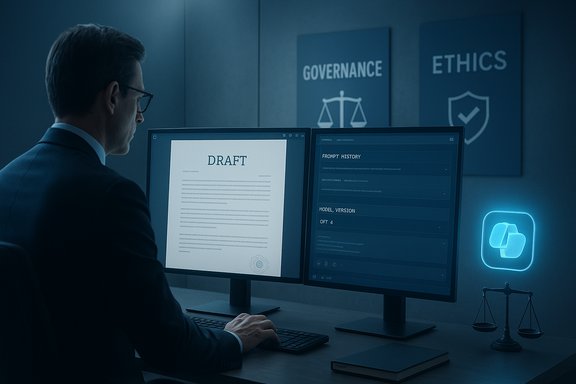
- Audit trail: log prompts, model version, date/time, and any sources used for high‑stakes outputs.
- Technical controls: Endpoint DLP, tenant grounding, Conditional Access, MFA, and least‑privilege connectors.
- Procurement terms: deletion and egress guarantees, no‑retrain clauses unless explicitly negotiated, SOC / ISO attestations.
- Training and competency: role‑based modules on prompt hygiene, hallucination detection, and ethical use; require attestations for staff who may sign off on AI‑assisted work.
Standards, Detection, and Third‑Party Oversight
NIST, detection challenges and provenance
Government research and standards efforts aim to make detection and governance practical. The National Institute of Standards and Technology (NIST) launched GenAI challenges to measure system behavior and improve methods for detecting synthetic content—text and images—recognizing the need for tools that can help practitioners and courts distinguish human‑authored from machine‑generated artifacts. Those efforts matter to legal practice because courts and regulators will demand provenance and traceability when the stakes are high.What firms should expect from standards
- Improved detection tools (e.g., model‑level watermarks, provenance metadata) will help but will not be foolproof for legal evidentiary burdens. Detection tools will be useful for triage and flagging, not definitive adjudication.
- Expect standards to require machine‑readable provenance and publishing of audit artifacts when AI materially contributes to a filed work. Policy, litigation, and procurement will move to favor vendors that provide verifiable lineage.
Practical Options for Minimizing AI Use (and Disabling Features)
For practitioners who want to limit or avoid AI features, several pragmatic steps are available:- At the application level, Microsoft and other vendors provide toggles to disable Copilot features in Word, Excel, and Windows; enterprises can centrally manage and restrict Copilot access. Individual users can also opt out of AI credits and downgrade plans in some windows of time.
- Use privacy‑focused alternatives for search and browsing (e.g., DuckDuckGo) and avoid agents that automatically surface AI‑generated summaries if you prefer raw search results. Microsoft’s and other vendors’ settings allow disabling Copilot chat and voice on managed devices.
- For legal research, rely on purpose‑built legal AI tools from providers that expose provenance and integrate with official databases (Westlaw, LexisNexis, specialized legal models) rather than free general‑purpose chatbots. These tools are often contractually auditable and designed for law practice workflows.
Strengths and Limits of the “Adopt Quickly” Argument
Strengths — what the WisBar piece and broader reporting get right
- Efficiency gains are real and measurable. For many lawyers, AI reduces mundane drafting time and accelerates ideation and administrative tasks. Surveys show consistent time savings among active users.
- Market pressure makes cautious abstention costly. Clients and opposing counsel will expect faster turnarounds, and firms that refuse AI outright risk slower throughput and price pressure. The practical recommendation is not “use everything” but “use what you can govern.”
- The human‑in‑the‑loop principle is the right default. It preserves professional responsibility while allowing productivity gains.
Limits and real dangers
- Hallucinations and provenance failures create immediate ethical and legal liabilities. Sanctions and reputational damage have already occurred when AI was used carelessly.
- Vendor defaults and monetization of copilot features mean that organizations must be proactive: the ability to disable a feature on a single device is not sufficient if corporate tenants are not configured correctly; unmanaged or poorly negotiated deployments can leak sensitive client data. Technical and contractual defenses must be aligned.
- Standards and law lag capability. The appeals court rulings that deny copyright for purely AI‑generated works clarify some legal boundaries but leave open many nuanced questions about human authorship, derivative works, and fair use. Firms should treat those areas as legally unsettled and plan conservatively.
A Practical Playbook for Law Firms and Windows Admins
Short‑term (30–90 days)
- Inventory: Identify who in the firm uses AI features and for what tasks; list all agents, connectors, and Copilot seat assignments.
- Lockdown baseline: Enforce Conditional Access, endpoint DLP, and tenant grounding before enabling Copilot on matter data; restrict connectors to non‑sensitive mailboxes until controls and contract terms are in place.
- Training: Run short role‑based training modules on prompt hygiene, hallucination recognition, and mandatory verification workflows.
Medium term (3–12 months)
- Contract hardening: Require deletion guarantees and no‑retrain language for matter data; insist on auditable logs and versioning for models used.
- Policy rollout: Publish an AI use policy that defines permitted and prohibited workflows, required sign‑offs, and sanctions for noncompliance.
- Pilot governance: Run confined pilots with metrics (error rate, time saved, client satisfaction) and establish KPIs that measure quality as well as throughput.
Long term (12+ months)
- Standards alignment: Seek vendors that commit to machine‑readable provenance, independent audits, and interoperability for forensic traceability.
- Continuous auditing and red‑teaming: Maintain an independent review cadence for AI features and require third‑party red‑team results for any assistant used in sensitive workflows.
Where the Evidence Is Thin — and What to Watch
A few claims remain projections rather than settled facts and should be treated cautiously:- Predictions about “complete deskilling” or catastrophic failure modes are scenario‑driven forecasts. They warrant planning and mitigation but are not deterministic outcomes.
- Timeline predictions for when specific regulatory frameworks will take effect (or whether international agreements will coordinate on inspection and enforcement) are uncertain. Firms should prepare for incremental regulation rather than a single global regime.
- Judicial rulings that define admissibility and required provenance for AI‑assisted exhibits and filings.
- Vendor contract norms that emerge around retention/no‑retrain clauses and evidence‑grade logging.
- NIST and standards bodies releasing detection benchmarks and provenance frameworks that are practically usable in court.
Conclusion: Resistance Isn’t Futile — It’s Strategic
The Wisconsin Lawyer article’s central refrain is accurate and actionable: abstaining from AI as a long‑term posture is becoming impractical, but indiscriminate adoption is equally reckless. The right strategic response for legal practitioners is rigorous, staged adoption paired with enforced human oversight, contractual protections, and technical controls.- AI can and will improve productivity for lawyers who treat it as a tool—not an oracle. The Federal Bar Association data shows measurable time savings; the operational task is to make those gains defensible under rules of professional responsibility.
- Microsoft’s Copilot is now infrastructure for many Windows and Microsoft 365 users; governance decisions happen at the tenant and procurement levels, not just the individual seat. Technical guardrails—Conditional Access, Endpoint DLP, tenant grounding, and auditable logs—must be prerequisites for matter‑level use.
- Human‑in‑the‑loop is more than a slogan. It is the legal profession’s duty and the key to reaping AI’s benefits while avoiding ethical and professional peril. Courts have already punished misuse; standards bodies and government initiatives will aim to make provenance and detection practical—watch those developments and align vendor contracts accordingly.
Source: WisBar Abstaining from AI: Is Resistance Futile?
