

ChatGPT, Grammarly, Canva AI, Google Gemini, and Microsoft Copilot are the five AI tools Tribune Online identified on May 16, 2026, as gaining broad attention across Africa, where students, freelancers, small businesses, marketers, and office workers are folding generative software into everyday work. The list is not a scientific ranking, and that matters. Its value is less in declaring a winner than in showing what mainstream AI adoption actually looks like when it reaches ordinary users. Africa’s AI moment, at least in this snapshot, is not being led by exotic frontier systems; it is being built on familiar apps that already sit inside writing, design, search, and office workflows.
The most revealing thing about the list is how unsurprising it is. ChatGPT writes and reasons. Grammarly edits. Canva AI designs. Gemini searches, summarizes, and generates. Copilot sits inside Microsoft’s productivity suite. These are not niche systems built specifically for African markets, nor are they specialist platforms for machine learning engineers.
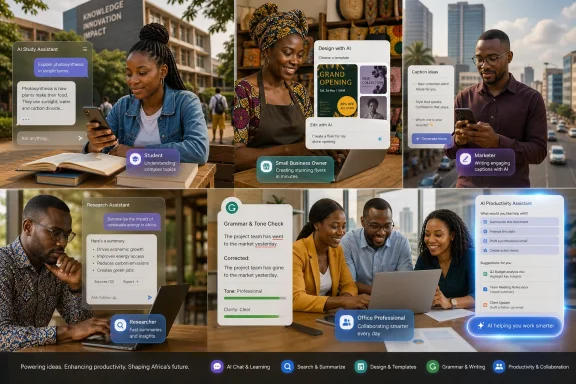
That is precisely the point. The tools gaining attention are the ones that reduce friction for people who already have work to do. A student wants cleaner essays. A small business owner wants a flyer before the weekend. A digital marketer wants captions, campaign ideas, and quick drafts. An office worker wants Excel, Outlook, and Word to stop feeling like a daily obstacle course.
For years, AI in Africa was often discussed through the language of development labs, national strategies, ethics panels, and startup ecosystems. Those conversations still matter, but the everyday adoption curve is moving somewhere more practical. AI is becoming a layer over tasks that already existed.
That is why the list feels less like a ranking of “best” tools and more like a map of where demand is strongest: writing, design, research, coding help, communication, and productivity. In markets where time, cost, bandwidth, and training remain constraints, the winning tool is often the one that lets a user produce something useful now.
That flexibility is the product’s strength and its risk. ChatGPT can help draft emails, explain code, summarize a topic, brainstorm content, translate tone, generate lesson outlines, and troubleshoot technical problems. But because it can sound confident even when it is wrong, it also requires judgment from users who may not always have the time or subject expertise to verify every answer.
For students, the attraction is obvious. It can turn a blank page into a draft, simplify dense material, and act like a patient tutor that never gets tired of follow-up questions. For freelancers and small businesses, it can perform the early-stage labor of content creation: outlines, proposals, captions, replies, scripts, and product descriptions.
The more interesting adoption story is not that people use ChatGPT to “write.” It is that people use it to avoid being stuck. In economies where many digital workers are self-taught, juggling multiple jobs, or competing in global freelance markets, the assistant role matters as much as the author role. ChatGPT gives users a second pair of hands, even if those hands still need supervision.
Writing confidence is economic infrastructure. A job application, client pitch, scholarship essay, procurement email, or business proposal can turn on clarity and tone. Grammarly’s appeal is that it lowers the fear of sounding unprofessional, especially for users writing in a second or third language.
The tool also fits a pattern that matters across the continent: AI is often adopted first where it feels like assistance rather than replacement. Grammarly does not ask users to reinvent their workflow. It sits beside what they are already doing and nudges the output toward cleaner communication.
That makes it less glamorous than a chatbot, but arguably more trusted. A grammar correction is easier to evaluate than a generated research answer. A sentence-level suggestion is less intimidating than a blank prompt box. For many users, that is the gateway to broader AI use.
Canva solved part of that problem with templates. Its AI features push the model further by helping users generate designs, rewrite copy, remove backgrounds, create presentations, and produce visual assets faster. For entrepreneurs working from phones or low-cost laptops, that matters.
The platform’s strength is not that it replaces design expertise. It is that it gives non-designers a good-enough production system. In social commerce, speed and consistency can matter as much as originality. A business that can produce a clean advert in 20 minutes has an advantage over one waiting days for external help.
This is also where AI adoption becomes highly local, even when the platform is global. A Nigerian fashion seller, a Kenyan tutor, a Ghanaian church media team, and a South African township food brand may all use the same tool, but their outputs reflect local languages, colors, cultural references, and business rhythms. Canva AI gives them machinery; the market supplies the context.
For African users, Gemini’s appeal is tied to Google’s existing footprint. Android phones, Gmail, Google Docs, YouTube, Search, and Chrome already structure much of the digital experience across the continent. If AI appears inside that ecosystem, adoption does not require a new mental model from scratch.
The use cases Tribune describes — summarizing information, answering questions, generating ideas, and supporting productivity — are exactly where Gemini can become sticky. It is not just a chatbot competing in isolation. It is an assistant attached to an information empire.
The strategic question is whether users see Gemini as a better way to search or merely another AI tab to try. ChatGPT has the cultural lead in general-purpose AI conversation, but Google has distribution. In emerging digital markets, distribution can be destiny.
Word, Excel, Outlook, Teams, and Windows remain deeply embedded in businesses, schools, governments, and NGOs. If AI arrives inside those tools, it does not need to win a popularity contest one download at a time. It can become part of the workday through procurement, licensing, and organizational habit.
That makes Copilot especially relevant for IT administrators and managers. Unlike consumer AI tools used informally by staff, Copilot raises questions about governance, data access, identity management, document permissions, compliance, and cost control. The promise is productivity. The administrative reality is more complicated.
For African organizations, the calculus may be sharper. Many businesses want the productivity gains of AI but cannot afford sprawling software stacks or unmanaged data leakage. Copilot’s pitch is that AI can be brought into a familiar enterprise environment. Whether that pitch works depends on pricing, training, connectivity, and the maturity of each organization’s Microsoft deployment.
A student with a smartphone and free ChatGPT access is technically an AI user. But that is not the same as a student with stable broadband, a laptop, paid subscriptions, trained teachers, and a curriculum that teaches verification and responsible use. The same gap applies to businesses.
Small firms may use Canva AI and ChatGPT daily while still lacking data policies, cybersecurity controls, or clear rules for client confidentiality. Media teams may generate content faster while struggling to verify claims. Public institutions may talk about AI transformation while still fighting basic digitization problems.
This is why the Tribune list is useful but incomplete. It shows what is popular, not what is mature. Adoption is happening; capacity is uneven. The next phase will be less about whether Africans use AI and more about whether institutions, schools, and businesses can use it safely, competitively, and on their own terms.
But “free” tools come with trade-offs. Users may face usage limits, weaker privacy guarantees, less control over data, or pressure to upgrade once the tool becomes essential. When a business builds its workflow around a platform it does not control, convenience can become dependency.
There is also the question of whose languages, markets, and assumptions are best served. Global AI platforms are trained and optimized at massive scale, but their strongest performance often reflects the data-rich environments that shaped them. African users may receive impressive help in English while seeing weaker performance in local languages or culturally specific contexts.
That does not make the tools useless. It means users and policymakers should resist treating imported AI platforms as neutral infrastructure. They are commercial systems with incentives, defaults, and blind spots.
That stack cuts across education, commerce, media, administration, and freelancing. It is not about replacing entire professions overnight. It is about compressing the distance between idea and output.
The danger is that compressed workflows can also compress thinking. If users generate faster than they verify, misinformation scales. If students outsource too much of the learning process, fluency can mask shallow understanding. If businesses flood social feeds with AI-made sameness, attention becomes harder to win.
Still, the productivity argument is powerful. In many African economies, digital workers are competing not only locally but globally. Tools that help them write better, design faster, research more efficiently, and handle administrative work can expand opportunity. The challenge is to make sure the efficiency gains do not come at the cost of trust, originality, or user control.
The more durable lesson is that the best AI users are not simply the people with the most tools. They are the people who know which tool to use, when to distrust it, and how to combine machine output with human context. That is a skill, not a subscription.
For schools, this means teaching prompt use alongside source checking, writing discipline, and academic honesty. For businesses, it means setting rules about data, customer communication, brand voice, and human review. For freelancers, it means using AI to raise output quality without becoming indistinguishable from every other AI-assisted competitor.
Africa’s AI opportunity will not be measured only by adoption numbers. It will be measured by whether users can turn access into capability.
Source: Tribune Online https://tribuneonlineng.com/top-5-ai-tools-in-africa-in-2026/
 Africa’s AI Boom Is Being Won by the Boring Tools
The most revealing thing about the list is how unsurprising it is. ChatGPT writes and reasons. Grammarly edits. Canva AI designs. Gemini searches, summarizes, and generates. Copilot sits inside Microsoft’s productivity suite. These are not niche systems built specifically for African markets, nor are they specialist platforms for machine learning engineers.That is precisely the point. The tools gaining attention are the ones that reduce friction for people who already have work to do. A student wants cleaner essays. A small business owner wants a flyer before the weekend. A digital marketer wants captions, campaign ideas, and quick drafts. An office worker wants Excel, Outlook, and Word to stop feeling like a daily obstacle course.
For years, AI in Africa was often discussed through the language of development labs, national strategies, ethics panels, and startup ecosystems. Those conversations still matter, but the everyday adoption curve is moving somewhere more practical. AI is becoming a layer over tasks that already existed.
That is why the list feels less like a ranking of “best” tools and more like a map of where demand is strongest: writing, design, research, coding help, communication, and productivity. In markets where time, cost, bandwidth, and training remain constraints, the winning tool is often the one that lets a user produce something useful now.
ChatGPT Remains the General-Purpose Workbench
ChatGPT’s place on the list is the least surprising. It remains the default name many users reach for when they mean “AI,” in the same way “Google” became a verb for search. Across African campuses, small businesses, media shops, and freelancer communities, its broad appeal comes from being flexible enough to handle messy, everyday requests.That flexibility is the product’s strength and its risk. ChatGPT can help draft emails, explain code, summarize a topic, brainstorm content, translate tone, generate lesson outlines, and troubleshoot technical problems. But because it can sound confident even when it is wrong, it also requires judgment from users who may not always have the time or subject expertise to verify every answer.
For students, the attraction is obvious. It can turn a blank page into a draft, simplify dense material, and act like a patient tutor that never gets tired of follow-up questions. For freelancers and small businesses, it can perform the early-stage labor of content creation: outlines, proposals, captions, replies, scripts, and product descriptions.
The more interesting adoption story is not that people use ChatGPT to “write.” It is that people use it to avoid being stuck. In economies where many digital workers are self-taught, juggling multiple jobs, or competing in global freelance markets, the assistant role matters as much as the author role. ChatGPT gives users a second pair of hands, even if those hands still need supervision.
Grammarly Shows That AI Adoption Often Starts With Confidence
Grammarly’s inclusion is a reminder that not all AI adoption looks like science fiction. Before the current generative AI wave, millions of users were already comfortable with software that corrected grammar, suggested clearer phrasing, and polished written communication. In many African countries where English is widely used in education, business, government, and cross-border work, that kind of support is not cosmetic.Writing confidence is economic infrastructure. A job application, client pitch, scholarship essay, procurement email, or business proposal can turn on clarity and tone. Grammarly’s appeal is that it lowers the fear of sounding unprofessional, especially for users writing in a second or third language.
The tool also fits a pattern that matters across the continent: AI is often adopted first where it feels like assistance rather than replacement. Grammarly does not ask users to reinvent their workflow. It sits beside what they are already doing and nudges the output toward cleaner communication.
That makes it less glamorous than a chatbot, but arguably more trusted. A grammar correction is easier to evaluate than a generated research answer. A sentence-level suggestion is less intimidating than a blank prompt box. For many users, that is the gateway to broader AI use.
Canva AI Is the Small-Business Design Department
Canva AI’s rise is tied to one of the most visible parts of Africa’s digital economy: the constant need for visual content. Small businesses, churches, schools, event organizers, creators, restaurants, beauty brands, real estate agents, and online vendors all need flyers, banners, videos, pitch decks, logos, menus, thumbnails, and social posts. Most cannot hire a professional designer for every campaign.Canva solved part of that problem with templates. Its AI features push the model further by helping users generate designs, rewrite copy, remove backgrounds, create presentations, and produce visual assets faster. For entrepreneurs working from phones or low-cost laptops, that matters.
The platform’s strength is not that it replaces design expertise. It is that it gives non-designers a good-enough production system. In social commerce, speed and consistency can matter as much as originality. A business that can produce a clean advert in 20 minutes has an advantage over one waiting days for external help.
This is also where AI adoption becomes highly local, even when the platform is global. A Nigerian fashion seller, a Kenyan tutor, a Ghanaian church media team, and a South African township food brand may all use the same tool, but their outputs reflect local languages, colors, cultural references, and business rhythms. Canva AI gives them machinery; the market supplies the context.
Gemini Is Google’s Bid to Keep Search From Becoming Yesterday’s Habit
Google Gemini’s place in the list reflects a larger shift in how users expect to find and process information. Traditional search asks users to click, compare, and synthesize. AI assistants promise to summarize, explain, and generate from a single prompt. That is a direct challenge to the web habits Google helped create.For African users, Gemini’s appeal is tied to Google’s existing footprint. Android phones, Gmail, Google Docs, YouTube, Search, and Chrome already structure much of the digital experience across the continent. If AI appears inside that ecosystem, adoption does not require a new mental model from scratch.
The use cases Tribune describes — summarizing information, answering questions, generating ideas, and supporting productivity — are exactly where Gemini can become sticky. It is not just a chatbot competing in isolation. It is an assistant attached to an information empire.
The strategic question is whether users see Gemini as a better way to search or merely another AI tab to try. ChatGPT has the cultural lead in general-purpose AI conversation, but Google has distribution. In emerging digital markets, distribution can be destiny.
Copilot Is the Enterprise Play Hiding in Plain Sight
Microsoft Copilot appears on the list as a tool “gradually becoming more visible” among professionals and office workers. That phrasing captures its current position well. Copilot may not have the same consumer buzz as ChatGPT, but it has something Microsoft has spent decades building: default presence inside office life.Word, Excel, Outlook, Teams, and Windows remain deeply embedded in businesses, schools, governments, and NGOs. If AI arrives inside those tools, it does not need to win a popularity contest one download at a time. It can become part of the workday through procurement, licensing, and organizational habit.
That makes Copilot especially relevant for IT administrators and managers. Unlike consumer AI tools used informally by staff, Copilot raises questions about governance, data access, identity management, document permissions, compliance, and cost control. The promise is productivity. The administrative reality is more complicated.
For African organizations, the calculus may be sharper. Many businesses want the productivity gains of AI but cannot afford sprawling software stacks or unmanaged data leakage. Copilot’s pitch is that AI can be brought into a familiar enterprise environment. Whether that pitch works depends on pricing, training, connectivity, and the maturity of each organization’s Microsoft deployment.
The Real Divide Is Not AI Versus No AI
The familiar phrase “digital divide” can make AI adoption sound binary: some people have access, others do not. The reality is more layered. Many African users already have access to AI tools, especially free or freemium services. The divide now includes quality of access, depth of skills, language support, payment ability, device performance, and institutional readiness.A student with a smartphone and free ChatGPT access is technically an AI user. But that is not the same as a student with stable broadband, a laptop, paid subscriptions, trained teachers, and a curriculum that teaches verification and responsible use. The same gap applies to businesses.
Small firms may use Canva AI and ChatGPT daily while still lacking data policies, cybersecurity controls, or clear rules for client confidentiality. Media teams may generate content faster while struggling to verify claims. Public institutions may talk about AI transformation while still fighting basic digitization problems.
This is why the Tribune list is useful but incomplete. It shows what is popular, not what is mature. Adoption is happening; capacity is uneven. The next phase will be less about whether Africans use AI and more about whether institutions, schools, and businesses can use it safely, competitively, and on their own terms.
Free Tools Are Driving the Market, but Free Is Not Neutral
One reason these tools spread quickly is that many offer free tiers or low-friction entry points. That matters in price-sensitive markets. A freelancer can experiment without a procurement process. A student can test an essay outline without paying upfront. A small business can generate social content before deciding whether a subscription is worth it.But “free” tools come with trade-offs. Users may face usage limits, weaker privacy guarantees, less control over data, or pressure to upgrade once the tool becomes essential. When a business builds its workflow around a platform it does not control, convenience can become dependency.
There is also the question of whose languages, markets, and assumptions are best served. Global AI platforms are trained and optimized at massive scale, but their strongest performance often reflects the data-rich environments that shaped them. African users may receive impressive help in English while seeing weaker performance in local languages or culturally specific contexts.
That does not make the tools useless. It means users and policymakers should resist treating imported AI platforms as neutral infrastructure. They are commercial systems with incentives, defaults, and blind spots.
The Five-Tool Stack Reveals the Shape of Everyday AI
Seen together, the list describes a practical AI stack for the average digital worker. ChatGPT is the open-ended assistant. Grammarly polishes communication. Canva AI turns ideas into visuals. Gemini supports information work. Copilot embeds AI into formal office productivity.That stack cuts across education, commerce, media, administration, and freelancing. It is not about replacing entire professions overnight. It is about compressing the distance between idea and output.
The danger is that compressed workflows can also compress thinking. If users generate faster than they verify, misinformation scales. If students outsource too much of the learning process, fluency can mask shallow understanding. If businesses flood social feeds with AI-made sameness, attention becomes harder to win.
Still, the productivity argument is powerful. In many African economies, digital workers are competing not only locally but globally. Tools that help them write better, design faster, research more efficiently, and handle administrative work can expand opportunity. The challenge is to make sure the efficiency gains do not come at the cost of trust, originality, or user control.
The Winners Will Be the Users Who Build Judgment Around the Tools
The article’s list should not be read as a permanent top five. AI product rankings age quickly. Models change, pricing shifts, regulators intervene, and user habits migrate. What looks dominant in 2026 may feel ordinary by 2027.The more durable lesson is that the best AI users are not simply the people with the most tools. They are the people who know which tool to use, when to distrust it, and how to combine machine output with human context. That is a skill, not a subscription.
For schools, this means teaching prompt use alongside source checking, writing discipline, and academic honesty. For businesses, it means setting rules about data, customer communication, brand voice, and human review. For freelancers, it means using AI to raise output quality without becoming indistinguishable from every other AI-assisted competitor.
Africa’s AI opportunity will not be measured only by adoption numbers. It will be measured by whether users can turn access into capability.
A Practical Reading of Tribune’s 2026 AI Shortlist
This list is most useful when treated as a snapshot of ordinary adoption rather than a definitive ranking of technical superiority. The concrete message is that AI is entering Africa through familiar work habits first.- ChatGPT remains the broadest general-purpose assistant for writing, learning, brainstorming, coding support, and everyday problem solving.
- Grammarly’s continued popularity shows that communication quality is one of the most practical entry points for AI adoption.
- Canva AI is becoming essential for creators and small businesses that need affordable, fast, and decent-looking visual content.
- Google Gemini benefits from Google’s existing ecosystem and is positioned around search, summarization, productivity, and idea generation.
- Microsoft Copilot matters most where formal office work, enterprise software, documents, spreadsheets, email, and organizational controls shape daily productivity.
Source: Tribune Online https://tribuneonlineng.com/top-5-ai-tools-in-africa-in-2026/