

First Distribution’s recent webinar with ITWeb and Microsoft framed a clear, pragmatic argument: African businesses can and should adopt generative AI tools like Microsoft Copilot — but only when adoption is preceded by rigorous readiness assessments, strong governance and identity controls, and partner-led training that closes the “shadow AI” gap.
The rapid rollout of generative AI across workplaces has delivered tangible productivity gains, but it has also created fresh attack surfaces and compliance headaches for organisations that lack formal policies, monitoring and technical controls. First Distribution, a leading Microsoft Cloud Solution Provider (CSP) distributor in Africa, used a joint webinar with ITWeb to explain how partners can help customers adopt Microsoft 365 Copilot safely and extract measurable value while limiting risk. The webinar outlined enterprise-grade controls from Microsoft — notably Microsoft Purview, Microsoft Defender for Cloud and Microsoft Entra — and showcased First Distribution’s own services: readiness assessments, security workshops, and user training to govern Copilot usage. This article summarizes the key claims from the webinar, validates major statistics against independent reports, analyses the practical strengths and weaknesses of the approach, and provides an actionable, security-first roadmap for African organisations and channel partners that want to adopt Copilot and generative AI at scale.
There are measurable risks: public scans and surveys indicate many consumer AI platforms have poor technical hygiene and that employees often use consumer AI channels to process work content. These realities transform AI from a theoretical risk into an operational one. Microsoft’s platform controls (Purview, Defender for Cloud, Entra) provide a realistic toolkit to address these problems — but they require the right configuration, monitoring and human processes. In short: African organisations should not delay AI adoption because the technology is valuable and in many cases directly increases productivity. But they must not rush adoption without proper governance. The safest path is measured: run readiness assessments, start small with clear KPIs, configure Purview/Defender/Entra guardrails, and bring experienced channel partners (like First Distribution and certified CSP partners) to run training and policy management. Doing so turns AI from a liability into a durable, auditable advantage.
Conclusion
First Distribution’s webinar distilled a pragmatic blueprint for African businesses: embrace Copilot and generative AI where it brings clear value, but do so only after running readiness checks, implementing data governance and identity controls, and equipping users with the policies and training they need. Independent scans and industry reports confirm the threat picture is real — from breached AI tools to AI-assisted phishing — but Microsoft’s platform controls, combined with partner-led implementation, provide an actionable route to safe adoption. Prioritise micro‑use cases, track KPIs, and keep governance iterative: that is the most reliable way to harness AI’s upside while containing its risk.
Source: ITWeb First Distribution helps African businesses harness AI without the risk
 Background / Overview
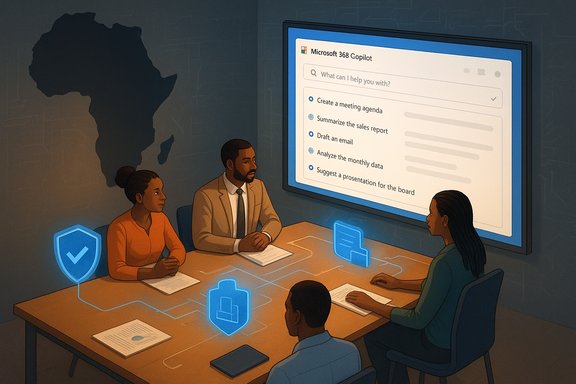
The rapid rollout of generative AI across workplaces has delivered tangible productivity gains, but it has also created fresh attack surfaces and compliance headaches for organisations that lack formal policies, monitoring and technical controls. First Distribution, a leading Microsoft Cloud Solution Provider (CSP) distributor in Africa, used a joint webinar with ITWeb to explain how partners can help customers adopt Microsoft 365 Copilot safely and extract measurable value while limiting risk. The webinar outlined enterprise-grade controls from Microsoft — notably Microsoft Purview, Microsoft Defender for Cloud and Microsoft Entra — and showcased First Distribution’s own services: readiness assessments, security workshops, and user training to govern Copilot usage. This article summarizes the key claims from the webinar, validates major statistics against independent reports, analyses the practical strengths and weaknesses of the approach, and provides an actionable, security-first roadmap for African organisations and channel partners that want to adopt Copilot and generative AI at scale.Why the urgency? The numbers that matter
Kejendree Pillay of First Distribution highlighted alarming usage and exposure trends that have become central to the Copilot conversation. Independent research supports the core concern: uncontrolled AI adoption is already a security and compliance problem.- A widely-circulated cybersecurity analysis found that a large fraction of popular AI tools have suffered breaches during 2024–2025; the Business Digital Index analysis reported that roughly 84% of the AI tools they scanned had experienced at least one data breach. That study examined technical hygiene (SSL/TLS, hosting vulnerabilities) across a sample of widely accessed AI web tools.
- Large-scale trust and usage studies show that employee use of AI at work is pervasive — about three in five employees report using AI at work — and a significant share admit to using it in ways that contravene company policy, including pasting company data into public AI tools. The KPMG/University of Melbourne global study reported around 58% of employees intentionally using AI at work, and found many employees uploaded sensitive company information into consumer AI tools. This highlights the governance gap Pillay referenced.
- Fraud and phishing are being turbocharged by generative AI. Multiple fraud and trust reports (including Sift’s Digital Trust Index) indicate that over 80% of phishing content seen in 2025 was aided by AI — a rate that undermines traditional signature-based defences and makes human-targeted social engineering far more scalable.
The core message from First Distribution
What First Distribution is offering
First Distribution framed its role as a Microsoft CSP distributor that goes beyond licensing to provide enablement and governance: readiness assessments, pre-sales and post-sales workshops, Copilot optimisation, security assessments, and training that spans from basic prompting to technical policy management. Their pitch is pragmatic: many employees will use Copilot (and other AI tools) whether IT mandates it or not, so channel partners must help organisations operationalise safe usage.Why Copilot matters to African customers
According to Pillay and other First Distribution spokespeople, Copilot is already used in practical, productivity-first scenarios across sectors:- Meeting notes and email summaries for knowledge workers;
- Proposal drafting and tender summarisation for professional services and legal teams;
- Analytical agents for agritech customers to correlate weather, irrigation and inputs with crop output;
- Archival search and legal research for law firms.
Microsoft’s controls: what they do and where they help
First Distribution recommended, and Microsoft’s documentation confirms, that these three Microsoft technologies form a practical defence-in-depth to govern and secure AI in enterprise settings:Microsoft Purview — data governance for AI
Microsoft Purview now contains dedicated features to govern generative AI interactions: Data Security Posture Management (DSPM) for AI, Copilot DLP controls, sensitivity labeling and policy enforcement for prompts and agent responses, and audit/logging for AI interactions. Purview can detect sensitive information in prompts, block or restrict processing of labeled content by Copilot, and provide lifecycle management and retention for AI interactions — all useful for compliance and post-incident forensics. These capabilities make Purview a central control plane for governing data flows into and out of enterprise AI.Microsoft Defender for Cloud — protecting AI workloads
Defender for Cloud (and the Defender AI security plans) extends the organisation’s cloud workload security model to AI pipelines. It provides posture management (CSPM), runtime detection for AI-specific threats (prompt injection, model misuse, data exposure), attack-path analysis, and integrates with Microsoft Defender XDR and Security Copilot for rapid investigation and triage. Defender’s AI workload protections are designed to identify suspicious access patterns and mitigate exfiltration or misuse of model endpoints.Microsoft Entra — identity and access governance
Identity remains the single most effective control for reducing AI risk. Microsoft Entra (Azure AD) enables Conditional Access, Privileged Identity Management (PIM), role- and rule-based access controls, managed identities for workloads, and integration with Purview and Defender telemetry. Entra’s conditional policies can enforce where and how Copilot or AI services are accessed (for example, disallowing the use of external accounts, requiring MFA, and limiting access to compliant devices). Entra also supports automated group membership and entitlement management, essential for least-privilege access to datasets used in AI workloads.What works: strengths of the First Distribution approach
- Practical, vendor-aligned controls: Combining Purview + Defender for Cloud + Entra creates a defensible architecture that links data governance, runtime protection, and identity — the three pillars security teams need to protect AI pipelines. Microsoft’s product docs and guidance explicitly position these components for AI use cases.
- Channel-led enablement addresses the biggest gap: Many breaches and risky behaviours happen because employees lack guidance or are simply more productive when they use consumer AI. First Distribution’s emphasis on training, change management, and Copilot optimisation targets the human element — often the weakest link in security. Their regional presence and partner programs make it more likely that solutions will be localised and supported.
- Use-case-first adoption: Encouraging micro‑use cases (meeting notes, tender summaries, legal research) helps organisations measure ROI quickly while exposing only the necessary datasets. This reduces blast radius and makes governance and FinOps manageable.
- Alignment with industry reality: Independent studies showing widespread AI tool breaches and increasing AI‑enabled phishing reinforce First Distribution’s message that governance and technical controls are urgent and practicable.
Risks and blind spots to watch
- Inconsistent external statistics: The media and vendor ecosystem publish different percentages depending on scope and method. For example, “84% of tools breached” comes from a public scan of 52 popular AI tools and is representative of that sample; it does not necessarily mean every AI vendor or private deployment is equally vulnerable. Treat such headline figures as directional and validate with vendor-specific security audits and penetration tests.
- Shadow AI and personal accounts: Studies report that a substantial share of sensitive prompts are entered via personal AI accounts (figures vary by survey). This behaviour undermines corporate DLP unless organisations detect and block egress to consumer AI sites or provide approved, enterprise-grade alternatives. Blocking consumer sites alone is not enough — organisations must provide usable, approved tools and training.
- Operational complexity and cost: Enabling Purview DSPM, configuring Defender for Cloud’s AI protections, and building conditional access policies require skilled staff or skilled partners. Organisations that lack these capabilities risk misconfiguration, incomplete coverage, or excessive false positives that frustrate users.
- Data residency and regulatory concerns: In jurisdictions with strict data residency or sector-specific rules (finance, health), organisations must carefully review where model inputs and outputs are processed and whether enterprise Copilot features meet regulatory obligations. Purview helps, but legal and compliance review are still essential.
- Over-reliance on vendor defaults: Microsoft offers strong tooling, but enterprise safety requires layered controls, regular audits, and human-in-the-loop review. Do not assume any single product is a silver bullet.
Recommended playbook for African organisations (practical, step-by-step)
- Conduct a Copilot / GenAI Readiness Assessment
- Inventory current AI usage (approved and shadow), data sources, and user groups.
- Map high-risk datasets (PII, IP, regulated data) and where they’re stored.
- Use Microsoft’s Copilot Optimization Assessment templates or partner-run workshops to standardise the intake.
- Start with 2–3 micro‑use cases
- Pick one high-value, low-risk use case (meeting notes, e-mail summarisation) and one medium-risk case (tender summarisation), then pilot for 60–90 days.
- Define KPIs and success gates (time saved, error reduction, data exposures avoided).
- Implement technical guardrails
- Purview: enable DSPM for AI, classify sensitive assets, and create DLP policies that exclude or control sensitive content from Copilot processing. Turn on audit logging for AI interactions.
- Entra: configure Conditional Access to ensure MFA, restrict access to managed devices, and enforce least privilege for AI datasets.
- Defender for Cloud: enable the AI workloads plan to detect prompt injection, suspicious endpoint access and data exfiltration patterns. Integrate alerts into a central SOC process.
- Build people and process controls
- Training: mandatory employee training on the art of prompting, what is sensitive to paste, and when to use Copilot vs. internal tools. First Distribution recommends tiered training: basic user prompting, plus technical workshops for policy administrators.
- Policies: publish clear generative AI acceptable-use policies, plus escalation paths and incident playbooks.
- Monitoring: define the logs and telemetry required for audits and incident response; ensure retention policies meet regulatory needs.
- Use secure alternatives for high-risk workloads
- Where sensitive data or regulated processing is required, use private model hosting (Azure OpenAI in a locked-down tenant, isolated VNETs, or private managed inference) and ensure encryption with customer-managed keys. Defender for Cloud and Purview can be applied across these workloads.
- Iterate, measure and scale
- Use pilot KPIs to assess ROI and operational burden.
- Add use cases only when governance, training and security telemetry are stable.
- Use partner-managed service models where internal expertise is limited.
Channel and partner considerations: what to ask First Distribution or any MSP
- Do you run a Copilot optimisation assessment and can you show a repeatable playbook?
- How do you handle pre-sales security assessments and post-sales policy management?
- Can you deliver tailored training (end‑user + technical) and run simulated threat exercises (phishing with AI content)?
- What SLAs cover rollout, incident response and remediation for AI-related incidents?
- Do you provide FinOps visibility for Copilot usage and forecasting for at-scale deployments?
Practical checklist: minimum controls before enabling Copilot broadly
- Data classification completed for all Microsoft 365 repositories.
- Purview DSPM and DLP policies covering AI interactions enabled and tested.
- Entra Conditional Access with MFA and device compliance enforced.
- Defender for Cloud AI workload protections activated for training/inference endpoints.
- Mandatory user training and an approved AI acceptable use policy published.
- A 60–90 day pilot with measurable KPIs and a named business sponsor.
- Incident response playbook includes AI prompt/response retention and forensic steps.
Final analysis: balancing opportunity with caution
Generative AI is already embedded in daily workflows across organisations in Africa and globally. Tools like Microsoft 365 Copilot deliver immediate productivity wins in areas that matter for small and medium enterprises as well as large organisations. First Distribution’s message — that adoption must be anchored in readiness, governance and partner-led enablement — is both pragmatic and necessary.There are measurable risks: public scans and surveys indicate many consumer AI platforms have poor technical hygiene and that employees often use consumer AI channels to process work content. These realities transform AI from a theoretical risk into an operational one. Microsoft’s platform controls (Purview, Defender for Cloud, Entra) provide a realistic toolkit to address these problems — but they require the right configuration, monitoring and human processes. In short: African organisations should not delay AI adoption because the technology is valuable and in many cases directly increases productivity. But they must not rush adoption without proper governance. The safest path is measured: run readiness assessments, start small with clear KPIs, configure Purview/Defender/Entra guardrails, and bring experienced channel partners (like First Distribution and certified CSP partners) to run training and policy management. Doing so turns AI from a liability into a durable, auditable advantage.
Conclusion
First Distribution’s webinar distilled a pragmatic blueprint for African businesses: embrace Copilot and generative AI where it brings clear value, but do so only after running readiness checks, implementing data governance and identity controls, and equipping users with the policies and training they need. Independent scans and industry reports confirm the threat picture is real — from breached AI tools to AI-assisted phishing — but Microsoft’s platform controls, combined with partner-led implementation, provide an actionable route to safe adoption. Prioritise micro‑use cases, track KPIs, and keep governance iterative: that is the most reliable way to harness AI’s upside while containing its risk.
Source: ITWeb First Distribution helps African businesses harness AI without the risk
