

Medianews.az’s short bulletin relays a straightforward public-health message from the Azerbaijan Food Safety Institute (AFSI): break the fast gradually—begin with warm water, move on to dates, olives and salad, pause for 15–20 minutes, then continue with soup and the main meal—to protect the gastrointestinal tract and make iftar more comfortable. (medianews.az)
Ramadan and other religious or voluntary fasting practices are both spiritual and physiological events: long daytime abstention from food and drink shifts hydration, glucose stores and digestive readiness. Local public-health bodies in Azerbaijan—from the Azerbaijan Food Safety Institute (AFSI) to the national Food Safety Agency (AQTA)—have been actively publishing guidance each Ramadan to help people preserve health while observing the fast. AFSI’s guidance appears on national platforms and is echoed by the country’s food-safety and health agencies. (afsi.gov.az)
This article unpacks the AFSI-reported advice published by Medianews.az, verifies claims against international nutrition guidance, explains the physiology behind the recommendations, highlights when to adapt the rules for people with medical needs, and offers practical iftar planning tips you can use tonight. Where a recommendation is local practice rather than a universal clinical standard, this piece flags that clearly.
Two important cross-checks:
However, a few cautions matter:
Source: Medianews.az How to break the fast Is it more correct?
 Background
Ramadan and other religious or voluntary fasting practices are both spiritual and physiological events: long daytime abstention from food and drink shifts hydration, glucose stores and digestive readiness. Local public-health bodies in Azerbaijan—from the Azerbaijan Food Safety Institute (AFSI) to the national Food Safety Agency (AQTA)—have been actively publishing guidance each Ramadan to help people preserve health while observing the fast. AFSI’s guidance appears on national platforms and is echoed by the country’s food-safety and health agencies. (afsi.gov.az)This article unpacks the AFSI-reported advice published by Medianews.az, verifies claims against international nutrition guidance, explains the physiology behind the recommendations, highlights when to adapt the rules for people with medical needs, and offers practical iftar planning tips you can use tonight. Where a recommendation is local practice rather than a universal clinical standard, this piece flags that clearly.
What Medianews.az and AFSI recommend (short summary)
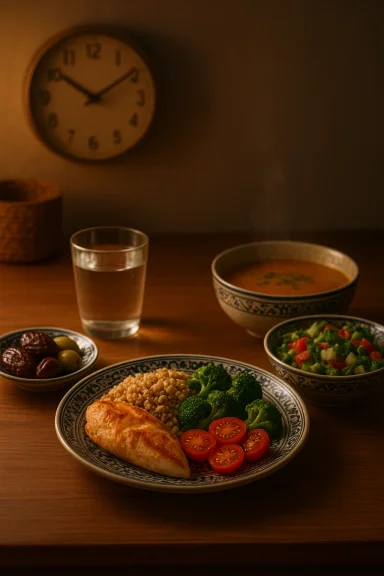
Medianews.az reports the AFSI recommendation to break the fast in stages, with these practical steps: (medianews.az)- Start with warm water to gently rehydrate the stomach.
- Continue with dates, olives, salad and greens—light, hydrating and easy-to-digest items.
- Take a 15–20 minute break after these starters, then proceed to the main meal.
- Preferably begin main eating with soup (a fluid-rich, gentle starter).
How these recommendations line up with international expert guidance
Short answer: AFSI’s practical, staged approach aligns well with major public-health organizations’ advice. Global and national health bodies emphasize hydration, gentle starters (dates, soup, fruit), limiting sugary/fried foods, and eating slowly after a long fast. Representative guidance includes the World Health Organization and established nutrition services in Europe and the UK. These sources recommend starting with water or small hydrating foods, using dates or fruit for a quick glucose boost, choosing soups and fiber-rich vegetables, and avoiding heavy, fatty or fried meals immediately after breaking the fast.Two important cross-checks:
- WHO lists dates, fluid-rich foods and soups as appropriate initial choices at iftar, and stresses hydration and avoiding excessive sugars and fried foods.
- UK nutrition guidance (NHS / British Nutrition Foundation) recommends water first, small portions, soups and fiber-rich foods, and warns against overeating or high-fat, high-salt foods at iftar.
Why staged breaking of the fast helps: the physiology explained
Understanding the physiology explains why these steps make sense.- Dehydration and fluid balance: After many daylight hours without fluid intake, the body is mildly to moderately dehydrated. Rehydration with water first helps restore plasma volume and reduces the risk of dizziness, headache and concentrated urine. Drinking water before energy-dense foods also reduces the chance of rapidly consuming high-sugar beverages that spike blood glucose. WHO and national guidance emphasize water as the first and primary rehydrating strategy.
- Glycogen depletion and quick glucose: The liver’s glycogen stores fall during a long fast. Small, easily absorbed carbohydrate sources—like dates or fruit—provide an immediate and gentle glucose boost that is preferable to high-sugar processed desserts or sodas. Dates also supply potassium and fiber, helping to stabilize a post-fast glucose rise. International nutrition bodies list dates and dried fruit as sensible traditional starters.
- Gastric load and digestive enzymes: The stomach and gastrointestinal tract reduce secretion and motility during long fasting periods. Suddenly overloading an empty stomach with fatty, fried or very spicy meals can cause reflux, cramping or nausea. Starting with a light, warm liquid (water or soup) followed by a small solid starter gives gastric secretions a chance to resume and reduces postprandial discomfort. This is the physiological rationale behind the staged approach.
- Osmotic and electrolyte balance: Consuming large amounts of very salty or sugary foods immediately after fasting can worsen thirst and disturb electrolyte balance. A measured, fluid-first approach protects this balance. WHO and other agencies explicitly warn against salty and heavily processed foods at iftar.
What the evidence says — strengths and limits
Strengths- Empirical consistency: The staged advice (water → dates/fruit → soup/salad → wait → main meal) matches recommendations from WHO and national health services because it directly addresses dehydration, glycemic control and digestive comfort.
- Cultural fit: Dates and soups are culturally embedded in many iftar traditions; using them as a medical recommendation improves adherence and acceptability.
- Low risk and high yield: The steps are safe for the general population, inexpensive, and easy to implement.
- Sparse randomized trials: There are few randomized controlled trials that test exact sequences (e.g., the precise benefit of a 15–20 minute pause) or that compare minute-by-minute timing strategies. Most guidance is physiologically plausible and expert consensus-based rather than trial-proven.
- Individual variation: People with diabetes, kidney disease, pregnancy, gastrointestinal disorders, or post-bariatric surgery needs require tailored advice. The universal sequence must be adapted for these groups and, when needed, supervised by a clinician. Clinical guidelines for diabetes and special medical conditions often require medication adjustments and individual monitoring.
- Local vs. global authority: Medianews.az credits the AFSI (Azerbaijan Qida Təhlükəsizliyi İnstitutu) for the recommendation. AFSI and the national Food Safety Agency publish complementary guidance, but their guidance may emphasize culturally specific meals (olives, particular salads) that differ by region. For universal clinical decisions, consult national healthcare providers or international medical bodies. (medianews.az)
Practical iftar plan: step-by-step (what to eat, when)
Below is a practical, evidence-aligned iftar sequence that mirrors AFSI’s advice while incorporating international recommendations. Use it as a template and modify for elders, children, or people with medical conditions.- Immediately at the call to break the fast:
- Warm water (150–250 ml). This rehydrates without sugar or excess calories. Warm water is soothing for some and may be helpful to start gastric secretions. (medianews.az)
- Next (within 1–3 minutes):
- 1–3 dates or a small portion of fresh fruit (watermelon, grapes) for a gentle glucose lift and potassium. Dates are traditional and nutritionally useful.
- Optional small savory nibble: an olive or small portion of lightly dressed greens—this provides fats in moderation and electrolytes.
- Pause for ~15–20 minutes (recommended by AFSI; if you prefer, 10–30 minutes is reasonable):
- Use this time to pray, converse or prepare soup. The pause gives your stomach a chance to begin digesting the initial intake and can blunt the impulse to overeat. Medianews.az cites AFSI’s 15–20 minute break specifically; international guidance recommends pacing and eating slowly rather than a strict time. (medianews.az)
- After the pause:
- Begin the main meal with a bowl of soup (lentil, vegetable or chicken broth-based). Soup supplies fluids, electrolytes, and small carbohydrates while being gentle on the stomach.
- Main plate strategy:
- Aim for balance: lean protein (fish, poultry, legumes), whole-grain/carbohydrate (brown rice, whole-wheat bread, bulgur), and lots of vegetables or salad. Avoid oversized portions and deep-fried items.
- Post-meal:
- Keep drinking water between iftar and suhoor. Avoid large sugary drinks, especially immediately after the meal. Consider a light walk after 30–60 minutes to help digestion.
- Break sweets into small portions across several nights rather than one large dessert binge.
- Use herbs and lemon in salads to reduce salt reliance.
- For children and elderly, prioritize fluids and small, frequent nutrient-dense items.
Menus and swaps: healthier iftar choices
- Instead of fried samosas or pakora, try oven-baked vegetable fritters or stuffed vine leaves.
- Swap sweetened juices for infused water, unsweetened milk-based drinks or a single small glass of natural fruit juice.
- Use lentil or chicken broth soups with vegetables and a little bulgur or small pasta for satiety without heavy fats.
- For dessert, choose fruit, yogurt with nuts, or a small portion of a traditional sweet to satisfy the cultural ritual without excess sugar.
Special populations: how to adapt the staged approach
People with diabetes- Breaking the fast requires careful blood glucose monitoring and possible medication adjustments. For those on insulin or sulfonylureas, the timing and composition of iftar and suhoor meals must be discussed with a clinician. The NHS and diabetes services recommend planning 6–8 weeks before Ramadan for medication review. A staged iftar (water → small carb like dates → pause → soup → main meal) helps moderate glucose spikes, but individualization is essential.
- Pregnant or breastfeeding people should consult their obstetrician. If medically permitted to fast, prioritize hydration, nutrient-dense suhoor, and careful meal pacing at iftar.
- The elderly may tolerate smaller portions better and benefit from warm water and soups. Those with reflux or peptic disease should avoid heavy spicy or fatty foods immediately after breaking the fast.
- Post-bariatric patients have reduced stomach capacity and must follow strict staged meal plans; many bariatric programs recommend breaking the fast with water and a very small portion of dates or soup, then waiting before the main meal—medical supervision is mandatory. Chelsea & Westminster’s guidance aligns with starting with water, dried fruit or soup and then a balanced meal later.
Risks and red flags: when staged iftar isn’t enough
The staged approach reduces common problems (bloating, reflux, indigestion), but there are situations where more urgent action or medical care is needed:- Severe dehydration symptoms: fainting, persistent dizziness, confusion, very low urine output—seek immediate medical attention. WHO advises replacing fluids and seeking help for severe dehydration.
- Hypoglycemia (in diabetics): shakiness, sweating, palpitations or unconsciousness—treat immediately and consider breaking the fast. Diabetes guidance explicitly warns that some patients may be medically exempt from fasting.
- Severe abdominal pain, persistent vomiting or bloody diarrhea after eating—seek urgent care.
- For people on multiple medications (antihypertensives, diuretics, anticoagulants), fasting can alter pharmacodynamics; clinical review is recommended before Ramadan.
Cultural notes and practical household organization
- The staged approach fits many cultural practices: dates followed by prayer, then a larger meal is common in Middle Eastern and South Asian communities. Using culturally familiar foods (dates, olives, yogurt soup) increases adherence and satisfaction while retaining medical safety.
- Household logistics: if several family members are fasting with different energy needs (children, pregnant women, elderly), prepare staged platters so everyone can take small starters and then a tempered main course.
- Community iftars: organize portion control and avoid buffet-style arrangements that encourage overeating. Encourage volunteers to prepare more soups, salads and fruit platters rather than primarily fried items.
Practical checklist before you break the fast
- Have a glass of water warmed to comfortable temperature ready.
- Place 1–3 dates or a small bowl of fresh fruit and a small portion of olives/greens on each plate.
- Prepare a simple, low-fat soup (lentil or vegetable) to serve after the starter pause.
- Set a gentle timer or use prayer time as the natural pause—don’t rush into the heavy main dish.
- Keep a jug of filtered water on the table for sipping between courses and after the meal.
Final analysis: is AFSI’s guidance “more correct”?
AFSI’s staged-if tar advice, as presented by Medianews.az—starting with warm water, moving to dates/olives/salad, pausing ~15–20 minutes, then beginning main eating with soup—is broadly consistent with evidence-based international guidance from WHO and national nutrition services. That makes it a sound, practical public-health recommendation for the general population: it addresses dehydration, glucose recovery, and the risk of overloading an empty stomach. (medianews.az)However, a few cautions matter:
- The specific “15–20 minute” interval is a practical rule-of-thumb rather than a universally evidence-based mandate. International guidance stresses pacing rather than a fixed minute count; some individuals may find a shorter or longer pause works better. When in doubt, eat slowly and listen to your body. (medianews.az)
- For people with chronic medical conditions (diabetes, kidney disease, post-bariatric surgery, pregnancy), the staged approach must be adapted with clinical oversight. In some cases, fasting itself may be medically inadvisable.
- Public-health advice must be culturally adaptable: AFSI and AQTA messages are valuable at a national level, but where available, combine local guidance with international clinical guidance when managing complex cases. (afsi.gov.az)
Quick reference (printer-friendly)
- First sip: warm water. (medianews.az)
- Small starter: 1–3 dates, olives, small salad or fruit. (medianews.az)
- Pause: ~15–20 minutes (AFSI recommendation); if impractical, eat slowly. (medianews.az)
- Next: a soup to gently continue digestion.
- Main: balanced plate—lean protein, whole grains, vegetables; avoid large fried/spicy portions.
- Hydration: sip water frequently between iftar and suhoor; limit sugary drinks.
Conclusion
The AFSI-endorsed sequence reported by Medianews.az—warm water, dates/olives/salad, a short rest, followed by soup and the main meal—is a practical, low-risk pattern for breaking a long fast. It reflects core public-health principles: rehydrate first, provide quick energy in a controlled way, and pace the meal to protect the gastrointestinal system and metabolic balance. International health authorities and national nutrition services back the same broad approach, though they emphasize individualized adjustments for people with medical conditions and do not universally mandate an exact minute-based pause. Follow the staged plan as a sound default, adapt for special medical needs with professional advice, and prioritize hydration, gentle starters and moderation at every iftar. (medianews.az)Source: Medianews.az How to break the fast Is it more correct?