

Microsoft’s succinct February post — a conversation between Ryan Cunningham, Corporate VP for Power Platform, and analyst Daniel Newman — captures a decision every CIO, platform lead, and product manager should already be making: enterprise applications are not being incrementally improved by AI; they are being reimagined around agents and human‑agent teams. This is more than marketing language. It’s a design and operating model that moves intent to action through managed, auditable pipelines that blend low‑code makers, professional developers, and domain experts in finance, HR, supply chain, and customer service. (microsoft.com)
The Microsoft position is straightforward: the scope of what can be built has dramatically expanded because AI agents can monitor, reason, and act, and at the same time the set of people who must participate in shaping those systems has widened to include the subject‑matter experts doing the daily work. That dual expansion — capability and stakeholders — is the defining shift in enterprise software design today. The Power Platform post frames this as an “agent‑first” philosophy: agents automate orchestration and repetitive steps, while humans provide intent, oversight, and judgment. (microsoft.com)
This isn’t theoretical. Microsoft’s product waves over 2024–2026 have delivered concrete primitives for agentic systems: Copilot Studio for authoring and publishing agents, Power Platform integration points (Power Apps, Power Automate, Dataverse) for business data and workflow, and platform‑level standards like the Model Context Protocol (MCP) intended to let agents discover and invoke tools safely. The vendor narrative is consistent — agents are the new surface for enterprise automation, and platforms must provide identity, telemetry, and governance as first‑class controls.
Independent vendors and consultancies are building similar “refund orchestrator” patterns that combine micro‑agents, unified decisioning layers, and human‑in‑the‑loop checkpoints — confirming that the approach is not limited to a single vendor story but is emerging as a cross‑industry pattern. These orchestrators also incorporate continuous feedback loops so decisions improve over time without compromising required oversight.
Microsoft’s product roadmap and community guidance supply many of the ingredients enterprises need — Copilot Studio for authoring, Power Platform primitives for business data and automation, and protocol work like MCP to enable interoperability. But the technical primitives alone aren’t sufficient. Successful adoption demands disciplined architecture, strong change management, cost and compliance controls, and explicit human‑agent boundaries. For teams willing to invest in those disciplines, the agent era promises faster outcomes, more direct business ownership of software, and a fundamentally different relationship between people and the systems they rely on. (microsoft.com)
Source: Microsoft Inside the shift to agent‑first enterprise solutions - Microsoft Power Platform Blog
 Background / Overview
The Microsoft position is straightforward: the scope of what can be built has dramatically expanded because AI agents can monitor, reason, and act, and at the same time the set of people who must participate in shaping those systems has widened to include the subject‑matter experts doing the daily work. That dual expansion — capability and stakeholders — is the defining shift in enterprise software design today. The Power Platform post frames this as an “agent‑first” philosophy: agents automate orchestration and repetitive steps, while humans provide intent, oversight, and judgment. (microsoft.com)This isn’t theoretical. Microsoft’s product waves over 2024–2026 have delivered concrete primitives for agentic systems: Copilot Studio for authoring and publishing agents, Power Platform integration points (Power Apps, Power Automate, Dataverse) for business data and workflow, and platform‑level standards like the Model Context Protocol (MCP) intended to let agents discover and invoke tools safely. The vendor narrative is consistent — agents are the new surface for enterprise automation, and platforms must provide identity, telemetry, and governance as first‑class controls.
Why “agent‑first” matters: two simultaneous revolutions
1) What the software can do is changing
Agents go beyond single‑turn assistance. They can execute multi‑step workflows, call services, and be autonomous within bounded scopes. That capability lets organizations rethink manual, slow processes (for example, refunds, fraud review, and supply‑chain exception handling) as orchestrated, policy‑bounded workflows that scale. Microsoft’s solution guidance for ticketing and refunds shows a practical pattern: an agent receives intent, consults Dataverse, triggers Power Automate flows (including desktop RPA where legacy UIs are required), and writes outcomes back to governed stores — with secrets guarded in Azure Key Vault and actions visible in monitoring dashboards. That blueprint turns expensive human routing into efficient, auditable orchestration.2) Who builds and governs software is changing
The second, equally important revolution is organizational. Historically, business apps were delivered by centralized IT or dev teams. Agent‑first systems ask domain experts (product owners, finance managers, HR leads) to participate in authoring intent, rules, and verification points. The result is not “no code” fantasy but role‑aware building: business teams define outcomes and constraints; makers and engineers implement resilient pipelines and observability. Microsoft’s commentary highlights this human‑centric transformation: agents reduce wiring tasks and let domain experts contribute higher‑value architecture decisions. (microsoft.com)Anatomy of an agentic enterprise system
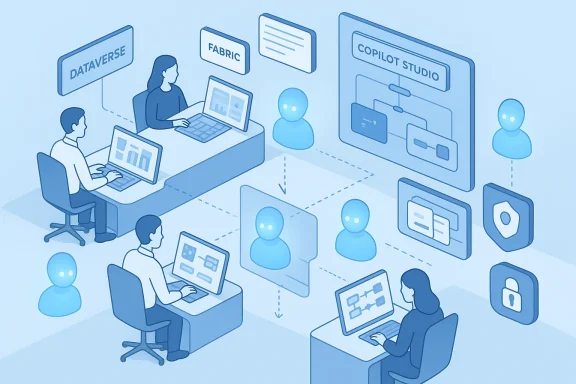
To make the change concrete, it helps to break the stack down into components most organizations now need to plan and build:- Data fabric and entity models (Dataverse, Fabric) — canonical business entities and consistent RBAC.
- Authoring surfaces (Copilot Studio, Power Apps) — where agents and interfaces are composed, tuned, and published.
- Orchestration and automation (Power Automate, Azure AI Foundry) — flows, RPA, serverless actions, and multi‑agent choreography.
- Identity and access (Microsoft Entra ID / Azure AD) — agent identities, least‑privilege, and delegated consent.
- Secrets management and runtime safety (Azure Key Vault, policy engines).
- Observability and audit (agent telemetry, action tracing, cost & safety metrics).
- Protocols for tooling interoperability (MCP, NLWeb) — how agents discover, call, and get authorized to use tools and data.
Practical examples that prove the model
Refund orchestration and fraud detection
Refunds are a textbook use case: they involve policy interpretation, data lookups (orders, payments, returns), external signals (fraud detectors), and human exceptions. Microsoft’s architecture guidance shows an assisted agent in Teams for employees and an autonomous agent triggered by email in Outlook — both reusing Power Automate flows, Dataverse, and RPA on Azure VMs to interact with legacy systems. That design reduces manual work while preserving human validation where needed.Independent vendors and consultancies are building similar “refund orchestrator” patterns that combine micro‑agents, unified decisioning layers, and human‑in‑the‑loop checkpoints — confirming that the approach is not limited to a single vendor story but is emerging as a cross‑industry pattern. These orchestrators also incorporate continuous feedback loops so decisions improve over time without compromising required oversight.
Supply chain exception handling
In supply chains, agents are being positioned to detect late shipments, search alternate suppliers, evaluate tradeoffs (cost vs speed), and either recommend or enact changes based on policy. Microsoft’s industry writing and demos show agents acting on telemetry and commercial data, with the option to escalate to humans for strategic decisions. This use case demonstrates how agents can shorten reaction windows and reduce financial leakage while integrating with ERP and logistics systems.Platform and protocol shifts you must verify and plan for
Two technical shifts deserve particular attention.- Model Context Protocol (MCP) and NLWeb: open protocols for agent-tool connectivity make multi‑vendor interoperability possible — enabling agents to call tools the same way browsers call web APIs. Microsoft has adopted MCP across Copilot Studio, Dynamics, and Windows, and published security guidance for MCP to minimize risk. Planning for MCP‑aware integration today avoids brittle, bespoke connectors tomorrow.
- Agent runtime and governance planes: Microsoft’s messaging (and product calendar) shows investments in control planes — cataloging agents, assigning identities, enforcing least‑privilege, and surfacing observability. Expect solutions that surface agent fleets, model routing, billing, and policy enforcement to become standard enterprise controls in 2025–2026. Treat agent inventory and lifecycle control as an operational requirement, not an optional governance add‑on.
Trust, observability, and governance — the non‑negotiables
Ryan Cunningham’s core point is blunt and crucial: trust and governance are foundational. Agents must be observable, auditable, and adjustable. That requires:- Action tracing: every decision and external call must be recorded with context, who authorized it, and what data was used.
- Identity & provenance: agents need directory identities and signed authorization scopes; systems must be able to prove which agent acted and on whose behalf.
- Policy enforcement: declarative policy frameworks (DLP, business rules) that operate before action is taken, not only during post‑factum review.
- Human checkpoints: defined human review points for risky or high‑value activities, not ad‑hoc oversight.
- Cost and safety telemetry: per‑agent metrics for cost, quality, latency, and drift so operations teams can detect regressions and runaway spend. (microsoft.com)
Risk landscape — what can go wrong (and evidence)
Adopting agents at scale accelerates both opportunity and exposure. Key risks to plan for include:- Agentic payments and fraud: agents that can transact (search, select, and pay) dramatically change payment flows and open new attack vectors around delegated payment permissions, credential misuse, and identity spoofing. Legal and regulatory questions about agent authorization, liability, and consumer protections are active and unresolved in many jurisdictions. Counsel and security architects must design explicit consent and revocation models for any agent that touches money.
- Pilot to production failure: industry reporting and analyst commentary indicate a high failure rate in AI pilots moving to production. Microsoft and partners are explicitly addressing this by adding agent lifecycle and observability — but organizations still face integration debt, data quality, and change‑management barriers that derail projects. Expect a nontrivial number of early projects to stall without strong governance and cross‑functional sponsorship.
- Over‑automation and rule brittleness: if agents are slotted into brittle rules and shallow grounding, they can magnify errors at scale. The antidote is robust data modeling, test harnesses, and staged human escalation that cover edge cases and adversarial inputs. (microsoft.com)
- Vendor and protocol lock‑in: while MCP and NLWeb are promising, open standards succeed only with broad adoption and community stewardship. Relying on a proprietary extension of an open protocol risks future migration cost and technical debt. Architect with abstraction layers and portability in mind.
- Legal and compliance uncertainty: new behaviors (agents acting on behalf of users) require rethinking contracts, consent mechanisms, and audit obligations. Enterprises operating across regulated industries must involve legal teams early to codify what agents can and cannot do.
Strengths of Microsoft’s agent‑first narrative — and where it’s credible
- End‑to‑end platform integration: Microsoft’s stack (Power Platform + Copilot Studio + Azure + Microsoft 365 + Dataverse) offers a coherent path from business‑level intent to action in production, reducing the integration gap that has historically held back automation projects. The Microsoft guidance material and solution blueprints demonstrate repeatable architectures for common scenarios like ticket refunds.
- Built‑in governance thinking: recent product releases and Build/Ignite messages make governance and observability explicit. Features such as agent identity, telemetry, and policy hooks show platform vendors are not ignoring the risks — they are baking controls into the developer and admin experience. That matters for enterprise customers with compliance needs.
- Standards engagement (MCP/NLWeb): Microsoft’s adoption and contributions to MCP and related projects matter because they increase the odds that agentic systems will interoperate rather than fragment. If MCP matures into a widely accepted interoperability layer, it will significantly lower the cost of cross‑tool agent design.
Where Microsoft’s play needs scrutiny — and what enterprises should question
- The “all‑in” platform story vs. modular realities: Power Platform is powerful for citizen developers and rapid ROI use cases, but complex, mission‑critical systems may still require custom engineering. Enterprises should be realistic about where low‑code fits and where pro‑code, test harnesses, and governance pipelines are necessary.
- Observability maturity: platform telemetry is emerging, but operationalizing it across large fleets of agents — model versions, tool calls, and cross‑tenant costs — remains hard. Demand detailed observability plans and pilot them early.
- Economics and metering: agentic workloads can change cost profiles: more model invocations, multi‑model routing, and long‑running workflows increase variable spend. Build cost governance into FinOps early.
- Compliance across jurisdictions: data residency, eDiscovery, and sector‑specific rules can complicate agent deployments. Verify how agent logs, model inputs, and outputs are preserved to meet audit requests. Legal alignment is not optional.
A practical roadmap: how to start agent‑first responsibly
- Define intent and outcomes first — map the business decision you want the agent to drive.
- Model entities and ground truth — invest in canonical data models (Dataverse, master data) before agent authoring.
- Prototype with an assisted agent pattern — prefer human‑assisted modes for early production (Teams/Outlook assisted workflows).
- Bake-in identity and scoped credentials — give each agent a directory identity and explicit scopes; use vaults for secrets.
- Implement observability and cost metrics from day one — instrument actions, model versions, and policy violations.
- Create human escalation points — for any activity that has financial, legal, or customer impact.
- Run cross‑functional governance boards — include IT, Legal, Security, and the business owner for ongoing sign‑off.
- Rehearse failure modes — build test scenarios that simulate model drift, data corruption, and adversarial inputs.
- Measure impact and iterate — retire or refactor agents that don’t produce measurable improvement. (microsoft.com)
Design patterns and operating realities for CIOs and platform teams
- Treat agents as products: apply product management disciplines — roadmaps, KPIs, incident playbooks, rollout gating.
- Separate policy from code: use declarative policy layers to apply consistent guardrails across agents.
- Use hybrid deployment models: run low‑risk agents in autonomous mode, keep high‑risk agents in assisted mode.
- Plan for agent identity lifecycle: provisioning, rotation, decommissioning, and auditing must be automated.
- Integrate FinOps: include model‑usage budgeting in procurement and monthly reporting.
What to watch next: signals that mean it’s time to accelerate
- Your teams are hitting scale pain with manual orchestration and legacy UIs.
- You have well‑modeled data assets (CRM, ERP, Dataverse) that can be used as authoritative sources.
- You have measurable, repetitive decision workflows where the cost of delay or error is high.
- Your vendors (ISVs and systems integrators) offer MCP or agent‑ready connectors for your core systems.
Conclusion
Ryan Cunningham’s message — distilled from a short conversation with analyst Daniel Newman — is deceptively simple and profoundly practical: the future of enterprise software is not a single killer agent or a clever prompt. It is a managed environment where intent becomes repeatable action under visible, auditable governance. That requires rethinking how we build systems (from monolithic apps to agent‑enabled pipelines), who builds them (including domain experts), and how they’re operated (identity, telemetry, policy).Microsoft’s product roadmap and community guidance supply many of the ingredients enterprises need — Copilot Studio for authoring, Power Platform primitives for business data and automation, and protocol work like MCP to enable interoperability. But the technical primitives alone aren’t sufficient. Successful adoption demands disciplined architecture, strong change management, cost and compliance controls, and explicit human‑agent boundaries. For teams willing to invest in those disciplines, the agent era promises faster outcomes, more direct business ownership of software, and a fundamentally different relationship between people and the systems they rely on. (microsoft.com)
Source: Microsoft Inside the shift to agent‑first enterprise solutions - Microsoft Power Platform Blog
