

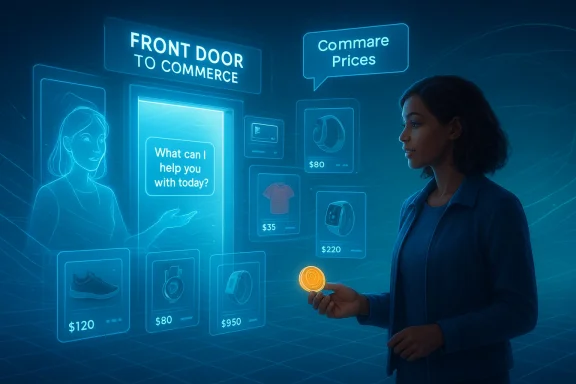
Andy Jassy’s warning on Amazon’s latest earnings call was blunt: the single biggest long-term risk to Amazon’s retail dominance isn’t Walmart or Alibaba — it’s the rise of horizontal AI agents that aim to become consumers’ new “front door to commerce.” What sounded at first like a tactical quip about product accuracy has rapidly become an existential industry conversation about who owns the shopping moment, how transactions are routed, and whether the multibillion-dollar retail-media model that underpins modern e-commerce will survive the migration of intent from search bars to conversational agents.
Caveat: the exact scale and attribution of Rufus-driven sales vary in reporting and Amazon’s own public statements; some figures are repeated across press coverage, and other outlets report different run‑rate estimates. I treat the higher conversion claim and broad adoption as verified core facts while noting specific dollar‑value projections are company estimates.
At the same time, horizontal agents backed by robust payment primitives and broad merchant integrations are moving fast to claim the front door. The next 12–24 months will determine whether commerce becomes fragmented across many agent ecosystems (and a new class of commerce intermediaries arise), or whether a few dominant agents — working with a set of merchant‑friendly protocols — create an open yet stable channel for brands.
For retailers, brands, and advertisers, the pragmatic imperative is clear: stop assuming a single front door. Prepare to be discoverable across agents, reengineer attribution and feed quality, and actively negotiate the economics of agent‑enabled commerce. The tools for agentic commerce are here; the winners will be those who treat the new interfaces as channels to be earned, managed, and measured — not as threats to be ignored.
Source: The420.in Amazon CEO Andy Jassy Flags Biggest Threat — Not Retail Rivals, But AI Agents - The420.in
 Background
What we mean by “AI agents” and “agentic commerce”
Over the last two years, a new category of AI-driven services has moved from laboratory demos into mainstream use: agentic AI — systems that do more than answer questions. They reason, compare across sources, maintain context, and increasingly execute actions on behalf of users (including purchases). These agents can be horizontal — general-purpose assistants like ChatGPT, Google’s Gemini, and Microsoft Copilot — or first‑party retailer agents, such as Amazon’s Rufus or Walmart’s Sparky. The industry labels the expected commerce outcome “agentic commerce”: AI that discovers, recommends, and completes purchases directly inside the assistant experience.Why this matters now
Two technical and business developments moved agentic commerce from theory to reality late in 2025: (1) payment and protocol primitives designed for agents (most notably the Agentic Commerce Protocol co-developed by OpenAI and Stripe), and (2) merchant integrations from major commerce platforms (Shopify, Etsy, Salesforce and others) that made product feeds and checkout available to agents. Together, these advances allowed an assistant to surface a product and complete a secure, tokenized transaction without the user ever visiting a retailer website. That change breaks the longstanding assumption that product discovery begins on a retailer search result page — the very assumption that powers retail media advertising.The CEO’s Case: Jassy’s Concern and Amazon’s Response
What Andy Jassy said — and why it cut through
On the February earnings call, Andy Jassy framed the competitive threat succinctly: horizontal agents are trying to become the first interface consumers use to shop, and if they succeed that front door could reroute enormous volumes of purchase intent away from marketplaces that sell advertising. Jassy argued horizontal agents currently make mistakes — they lack shoppers’ purchase histories, they misstate price and availability — but he also acknowledged the speed of adoption and the real risk to Amazon’s discovery and advertising economics.Amazon’s bet: build and defend
Amazon responded with a dual playbook: (1) productize first‑party agent capabilities through Rufus — an AI shopping assistant Amazon says reached roughly 300 million users in 2025 and whose users convert at materially higher rates — and (2) apply defensive controls by limiting third‑party crawler access and invoking site‑use policies where necessary. The company claims Rufus users are about 60% more likely to complete a purchase, and executives tied the tool to billions in incremental sales run‑rate figures. At the same time Amazon’s public robot‑access controls and enforcement actions against third parties signaled it will not passively accept an uncontrolled crawl-and-index model that could undercut its ad stack.Caveat: the exact scale and attribution of Rufus-driven sales vary in reporting and Amazon’s own public statements; some figures are repeated across press coverage, and other outlets report different run‑rate estimates. I treat the higher conversion claim and broad adoption as verified core facts while noting specific dollar‑value projections are company estimates.
The Horizontal Agent Playbook: OpenAI, Google, Microsoft, Perplexity, Claude
The horizontal advantage: breadth, neutrality, and discovery
Horizontal agents offer two powerful consumer propositions. First, neutral aggregation — they can compare products across multiple retailers in real time, reducing friction for shoppers who prefer a single, unbiased assistant rather than bouncing across apps. Second, convenience: once shopping and payments are integrated, users can move from inspiration to checkout in a single conversational session. OpenAI’s Instant Checkout, launched with Stripe and early merchant partners (Etsy, Shopify), is an early expression of that promise: discovery and transaction inside the chat.The platform response: protocols and partnerships
Two competing standards emerged quickly, and they matter. Agentic Commerce Protocol (ACP) — co‑developed by OpenAI and Stripe — focuses on chat‑centric, tokenized, merchant‑friendly checkouts inside assistant experiences. Universal Commerce Protocol (UCP), championed by Google and platform partners including Shopify, takes a broader interoperability stance designed to make commerce across multiple agents and surfaces easier for merchants. These protocol efforts are not merely technical; they define who gets the merchant relationship, how payments are tokenized, and how order and identity flows are governed.Players and moves
- OpenAI: Instant Checkout via ACP with Stripe; merchant onboarding from Etsy and Shopify merchants.
- Google: Gemini + Universal Commerce Protocol, working with major retailers and payments partners.
- Microsoft: Copilot checkout integrations and enterprise-first agent experiences. Reported metrics show higher conversion on Copilot-driven shopping journeys in early tests.
- Perplexity & Claude: smaller but fast-moving players focused on answer-engine experiences and integrations with payments partners (reports show Perplexity experimenting with embedded checkout via PayPal and Shopify plugs).
The Money: Why Retail Media Is Central to the Conflict
Retail media’s golden role
Retail media — the sponsored results, product placements, and brand ads inside retailer search — has become a high‑margin growth engine for marketplaces. For Amazon, published industry datasets show advertising revenue on the order of tens of billions annually; many outlets reported Amazon’s advertising business near or above the $50–$60 billion range for 2024. That ad stack effectively monetizes the “search inside the marketplace” behavior that historically began most product journeys. If the starting point shifts from Amazon’s search box to an agent like ChatGPT or Gemini, that ad model faces direct pressure.The risk map
- If agents deliver unbiased, cross‑retailer recommendations and then surface merchant checkouts (via ACP or UCP), brands can be found without paying a retailer toll; the retailer loses its discovery rent.
- If horizontal agents keep results organic, retail ads lose viewability and targeting reach. If agents adopt paid placements, a new ad market will form and brands will need to split or multiply spend across agents and retailers.
The Legal and Technical Friction: Crawlers, Robots, and IP
The crawler controversy and site access
A heated point of contention is how agents obtain product data and content. Some agents rely on web crawlers to index merchant pages; controversy erupted in 2024–2025 as publishers, retailers, and infrastructure companies accused some AI services of aggressive scraping practices, ignoring robots.txt, or using “stealth” crawlers. Perplexity, in particular, faced lawsuits and scrutiny over whether its indexing respected site directives. Amazon has taken steps to limit or block multiple crawler user agents from its site and has used legal threats or enforcement actions against specific firms — a clear sign of escalating friction between platforms and independent agents. The precise counts (for example, an oft‑repeated “47” crawlers figure) vary across reports and depend on how one counts user agents and IP ranges; the broader point — Amazon is actively restricting third‑party crawl access — is well documented.Why site‑access control matters
Retailers argue that crawlers should respect robots.txt, that merchant data is sensitive (pricing, inventory, promotional mechanics), and that unchecked scraping can undermine return policies, advertising integrity, and fraud prevention. Agents counter that, for many customers, the agent is acting as an authorized tool on their behalf and must access product pages to verify pricing and availability. The legal and technical lines here are unresolved, and expect more litigation and standards work in 2026.Strategic Tradeoffs: Moat vs. Bridge
The moat argument
Amazon’s defensive case rests on three hard advantages that are difficult for external agents to replicate:- Data depth: complete purchase history, returns, preferences, subscriptions.
- Product truth: canonical pricing, guaranteed availability and seller‑provided metadata.
- Fulfillment: same‑day logistics and integrated delivery networks that convert recommendations into rapid physical receipts.
The bridge argument
Competitors and many merchants prefer a different strategy: embrace cross‑agent exposure. Walmart, for example, publicly partnered with OpenAI to enable purchases inside ChatGPT — a move that looks like a deliberate effort to be discoverable across horizontal agents rather than lock customers behind a proprietary experience. Shopify and a swath of brands are adopting both ACP and UCP capabilities to ensure their catalogs are agent‑discoverable regardless of which assistant consumers use. That approach treats agents as additional channels rather than existential threats.What Brands, Marketplaces, and Advertisers Should Worry About
For brands and sellers
- Visibility fragmentation: brands will need to support multiple agent protocols and maintain product‑feed hygiene across surfaces. Expect integration complexity and increased attribution headaches.
- Fee arbitrage and new marketplaces: agents may levy transaction fees (OpenAI’s ACP/Stripe model, merchant fees reported in some rollouts), so brands must model agent economics versus retailer fees.
For marketplaces and ad buyers
- Measurement risk: existing ad metrics tied to on‑site impressions will undercount agent‑driven discovery. Attribution models must evolve to include agent referrals, tokenized checkouts, and agent‑initiated orders.
- Price competition: agents make neutral price comparisons easier, potentially compressing sponsored product margins and driving a race to offer the best total delivered price (including speed and returns).
For consumers
- Convenience and choice: agents can simplify discovery and checkout, lowering friction. But consumers will trade convenience against control — who holds their purchase history, who can re‑target them, and which agent governs returns and dispute handling. Transparency and consent around data reuse will be critical.
Risks Beyond Competition: Privacy, Fraud, and UX Integrity
- Privacy and data governance: Agentic commerce depends on identity, payment tokens, and context passing between agent and merchant. Poorly designed integrations risk exposing more customer data or creating opaque data‑sharing flows. Protocol designs such as shared payment tokens mitigate some risk, but governance and regulatory scrutiny will increase.
- Fraud and chargeback complexity: When an assistant completes a purchase on behalf of a user, responsibility for fraud checks, refunds, and disputes becomes complex. Tokenized payments help, but real‑world testing across scale will reveal new edge cases.
- UX and trust erosion: Agents that hallucinate, misstate prices, or recommend biased, inside‑ecosystem products risk losing consumer trust quickly. Retailers pointing to product accuracy issues with horizontal agents are correct — but agents are improving fast, and trust can pivot just as quickly.
Practical Recommendations (for retailers, brands, and ad teams)
- Prioritize clean, canonical product data: GTINs, accurate pricing, images, shipping SLAs and return policies are now agent prerequisites. Merchants not surfaced reliably by agents will be effectively invisible.
- Implement agentic protocols early: support ACP, UCP, or both (depending on platform relationships) to ensure your catalog can be surfaced and transacted through multiple agents. The integration cost is lower if done proactively.
- Expand attribution models: instrument tokenized checkout flows to feed agent referral metrics into marketing mix models and ad platforms. Expect to reallocate spend to agent surfaces as data matures.
- Negotiate agent fee and data terms: merchants should define merchant‑of‑record controls, refund rules, and data-sharing boundaries before enabling agent checkouts at scale.
- Monitor robots.txt and API access policies: decide whether to allow agent crawlers or enforce strict control — each choice has a tradeoff between discoverability and protection of proprietary site logic. Establish a documented policy and test it across major agent user agents.
Who Wins? A Short Prognosis
This is not a zero‑sum game with one winner. But three durable dynamics will shape outcomes:- Interoperability will rule merchant economics. Merchants that plug into open agent protocols across multiple assistants will capture the widest reach. Platforms that successfully aggregate merchant catalogs and protect merchant relationships will have leverage when negotiating fees.
- Data and fulfillment still matter. For repeat purchases and quick delivery, first‑party retailer agents retain a clear advantage. Where delivery speed and subscription behaviors matter most, retailer agents (Amazon, Walmart) remain highly defensible.
- New ad markets will emerge. If horizontal agents avoid sponsored placements, retail media shrinks; if they monetize via sponsored recommendations, brands will simply move budget — but fragmentation will grow, raising measurement complexity and media-buying friction. Expect both outcomes in different agent ecosystems.
Conclusion
Andy Jassy’s warning crystallized a tension that had been simmering across e‑commerce for years: the interface matters. The shift from search-box discovery to conversational, agentic interaction threatens not only where consumers begin shopping but also the economic models that monetize discovery. Amazon’s aggressive mix of product investment (Rufus) and defensive controls reflects a company trying to preserve a hard‑won advertising moat while also betting on its own agent to become indispensable.At the same time, horizontal agents backed by robust payment primitives and broad merchant integrations are moving fast to claim the front door. The next 12–24 months will determine whether commerce becomes fragmented across many agent ecosystems (and a new class of commerce intermediaries arise), or whether a few dominant agents — working with a set of merchant‑friendly protocols — create an open yet stable channel for brands.
For retailers, brands, and advertisers, the pragmatic imperative is clear: stop assuming a single front door. Prepare to be discoverable across agents, reengineer attribution and feed quality, and actively negotiate the economics of agent‑enabled commerce. The tools for agentic commerce are here; the winners will be those who treat the new interfaces as channels to be earned, managed, and measured — not as threats to be ignored.
Source: The420.in Amazon CEO Andy Jassy Flags Biggest Threat — Not Retail Rivals, But AI Agents - The420.in
