AI Powered Incident Prioritization in Microsoft Defender XDR

  • Thread Author
Microsoft’s Defender platform now adds an AI-driven incident prioritization layer aimed squarely at reducing SOC overload by turning a noisy incident queue into an explainable, ranked worklist that analysts can act on with speed and confidence.

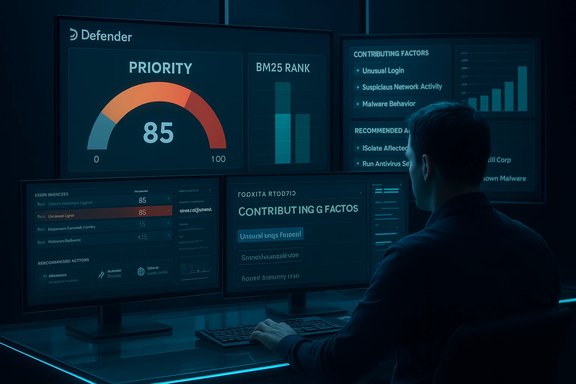
A security analyst monitors multiple screens displaying dashboards and threat metrics.Background​

Security operations centers (SOCs) have long faced a twin problem: too much telemetry and too little human attention. Microsoft’s recent enhancement to the Defender incident queue—announced in early January 2026—applies a machine learning prioritization model that assigns each correlated incident a priority score from 0–100, surfaces the critical incidents first, and exposes the factors that drove those rankings so analysts understand why something rose to the top. This feature sits in the unified Defender portal where alerts and automated investigations from Defender XDR and Microsoft Sentinel are already correlated into incidents. The new Queue Assistant (incident prioritization) is intended to address persistent SOC pain points—alert fatigue, inconsistent triage across shifts, and lengthy mean-time-to-investigate (MTTI)—by making prioritization both automated and transparent.

Overview: what Microsoft shipped and when​

Microsoft detailed the new incident prioritization capabilities in a Defender XDR blog post dated January 8, 2026, and the documentation for the incident queue was published on Microsoft Learn shortly after. The broader Defender/ Security Copilot investments that feed and complement this capability (agents, content analysis, and triage assistants) have been rolled out in stages since 2024–2025, with this incident prioritization described as a key operational improvement to the incident queue experience. Key on-the-record specifics include:
  • Incidents are automatically assigned a priority score (0–100).
  • Score color-coding: red for top priority (>85), orange for medium (15–85), and gray for low (<15).
  • The portal shows a summary pane for each incident that lists the priority assessment, contributing factors, recommended actions, and related threat intelligence.
These are concrete UX touches that aim to make prioritization scannable and actionable for analysts working under pressure.

How the AI-powered incident prioritization works​

Signal aggregation and correlation​

Microsoft Defender already collates alerts from endpoints, email, identity, and cloud telemetry into correlated incidents. The prioritization model runs on these correlated incidents—not on individual alerts—so the score represents the aggregate story across telemetry sources. This correlation improves signal context and reduces chasing isolated, decontextualized alerts.

What the model evaluates​

The prioritization algorithm considers a portfolio of high-signal inputs that indicate impact and campaign relevance, including:
  • Attack disruption signals (active containment or remediation triggers).
  • Threat intelligence context and indicators of known high-profile campaigns.
  • Alert severity and signal-to-noise ratio (SnR) characteristics.
  • MITRE ATT&CK techniques observed in the incident chain.
  • Asset criticality (importance of the affected host/user/cloud resource).
  • Alert rarity and type, which helps the model prioritize unusual, informative signals.
By design, the model favors rare, informative signals over repetitive, low-informative ones to avoid scenarios where noisy, voluminous incidents simply outrank concise but critical incidents.

Ranking mechanics and BM25 inspiration​

Microsoft explains that the ranking model uses principles similar to the BM25 algorithm (a well-known ranking function used in search engines). BM25-style logic helps normalize for incident “length” and frequency bias—so a large, noisy incident does not automatically outrank a small incident that contains a high-signal indicator like ransomware or a nation-state TTP. That normalization is also what makes per-term explanations possible: each contributing factor can be surfaced as an interpretable "term" that raised or lowered the score. This hybrid approach—search-ranking principles applied to security telemetry—enables the model to be both fast and explainable, which are crucial operational requirements in a SOC.

Explainability: why it matters and how Microsoft implemented it​

Explainability is the linchpin of practical AI in security. If analysts don’t trust a model or can’t see why it reached a conclusion, they’ll either ignore its output or lose confidence in automated triage—both undesirable outcomes.
Microsoft’s Queue Assistant addresses this by:
  • Displaying the incident priority score alongside the key factors that influenced it.
  • Offering recommended actions and related threat intelligence within the same summary pane so analysts get immediate, contextual next steps.
  • Allowing analysts to navigate incidents sequentially (up/down arrows) and adjust time ranges to suit handovers or campaign-level reviews, preserving continuity across shifts.
These UI decisions are more than polish—they are operational affordances that increase analyst confidence and speed when making containment and escalation decisions. Third-party coverage and industry reporting have emphasized explainability as a core requirement for AI adoption in the SOC, because it reduces second-guessing and improves consistent triage.

Signals that move the needle: what will push an incident into “red”?​

Although the model is multi-factorial, certain signals have outsized influence on priority scoring:
  • Active disruption evidence — e.g., successful lateral movement or live ransomware encryption.
  • Threat intel matches to known campaigns, especially those tied to ransomware gangs or nation-state clusters.
  • Critical asset involvement — domain controllers, privileged administrators, or key cloud infrastructure.
  • Uncommon MITRE techniques that indicate escalation or data exfiltration.
Color thresholds are explicit: top priority is >85 (red), medium is 15–85 (orange), and low is <15 (gray). These ranges make triage consistent across different analysts and shifts.

Benefits across the board: SMBs, MSSPs, and enterprises​

AI-driven incident prioritization promises measurable operational gains for organizations of all sizes.
  • For small and medium businesses (SMBs) with limited security headcount, automated prioritization reduces the manual triage burden and helps ensure that scarce analyst time focuses on what matters most. This effectively acts as a force multiplier.
  • For enterprises with large SOCs and multiple teams, the explainable ranking enables consistent triage across shifts and silos, reduces the chance that critical incidents slip through due to alert volume, and optimizes escalation and response workflows.
  • For MSSPs and managed detection providers, a prioritized queue shortens MTTI and allows service teams to standardize SLAs around priority bands rather than raw alert counts. Third-party reporting indicates that customers adopting AI triage often see significant reductions in manual sorting time and faster containment for high-impact incidents.
The practical outcome Microsoft highlights is improved resilience through faster containment and reduced mean-time-to-investigate (MTTI) for high-impact incidents. Industry analysts and vendors covering Microsoft’s rollouts echo that automated, explainable prioritization is already delivering SOC efficiency gains in early adopters.

Operational considerations and best practices for SOCs​

1. Treat the model as a decision support tool​

The Queue Assistant should change who decides first, not eliminate human judgment. Integrate the score into playbooks and runbooks but preserve analyst verification and escalation gates for high-impact incidents.

2. Tune asset criticality and data mappings​

Ensure Defender’s asset tagging and criticality metadata are accurate. Priority calculations weigh asset criticality; garbage-in yields misleading scores.

3. Use feedback loops to refine prioritization​

Where possible, feed analyst verdicts and post-incident outcomes back into tuning processes. Continuous feedback can reduce false positives and improve future prioritization.

4. Maintain human-in-the-loop for edge or gray cases​

For incidents with unusual context (e.g., planned network changes, patch cycles), provide an easy path for analysts to annotate incidents so the model’s future behavior can be adjusted.

5. Align SLAs to score bands, not just severity​

Operational SLAs should map to the 0–100 score bands (e.g., response within X minutes for red incidents) so teams have consistent expectations and workflows.

6. Integrate with orchestration and SOAR judiciously​

Where automation is applied (isolation, blocking), keep clear rollback and verification mechanisms; automated containment tied to a score demands high confidence and clear audit trails.
These practical steps are supported by Microsoft’s UI affordances (explainability, recommended actions, and time-range navigation) and by industry guidance on deploying AI in production SOCs.

Risks, limitations, and adversarial considerations​

No AI model is a panacea. SOC leaders should be realistic about possible failure modes.
  • Model drift and aging: Threat landscapes and tooling evolve. Without ongoing retraining and validation, prioritization models can become less accurate over time. Organizations must plan model governance and regular performance reviews.
  • Adversarial manipulation: Attackers may attempt to exploit or evade prioritization by crafting telemetry that lowers priority (e.g., blending malicious actions into noisy, benign-looking activity). Models that favor rare signals can be targeted by adversaries who understand scoring heuristics. Robust detection and red-team testing are essential.
  • Overreliance and complacency: Excessive trust in a single score can lead to missed context or tunnel vision. Explainability reduces this risk, but governance must enforce analyst verification for high-impact actions.
  • False positives / false negatives: Any automatic triage will produce misclassifications. SOCs must instrument metrics (precision, recall, analyst override rates) and track MTTI and containment times by score band to measure real-world effectiveness.
  • Data privacy and telemetry governance: The model uses telemetry and threat intelligence. Organizations with strict data residency or privacy constraints should evaluate where models run, what data is shared, and how outputs are stored and audited. Microsoft emphasizes data protection in its AI security messaging, but tenants must still ensure compliance with local rules and internal policies.

Verification of key claims and technical specifics​

To validate Microsoft’s public claims:
  • The priority score and color bands (0–100; red >85, orange 15–85, gray <15) are documented in Microsoft Learn’s incident queue documentation.
  • The use of an ML prioritization model and BM25-like ranking logic is detailed in Microsoft’s Defender XDR blog post published January 8, 2026.
  • Independent reporting from industry outlets—Petri’s January 9, 2026 coverage and third-party analysis—corroborates Microsoft’s description and highlights operational benefits for SMBs and enterprises.
Where Microsoft states that the algorithm is “trained on real-world anonymized data,” that description is consistent with typical vendor practices, but it is a claim that depends on internal datasets and training practices that are not fully public. This type of training statement should be treated as vendor-provided context unless an organization has a contractual or audit-level proof of the underlying datasets. Exercise standard procurement due diligence if data provenance is a regulatory or compliance concern.

Questions SOC leaders should ask before enabling prioritization​

  • How are asset criticality and sensitivity configured and sourced into Defender?
  • What audit logs are produced when a recommended action is applied automatically?
  • What governance processes exist for retraining or tuning the prioritization model?
  • How will SLAs map to the 0–100 priority bands in our incident playbooks?
  • What metrics will we collect to measure effectiveness (MTTI by band, override rate, missed high-impact incidents)?
These questions help ensure the feature is integrated into real operational practices rather than sitting as an isolated UI improvement.

Real-world impact: what early adopters and analysts can expect​

Early adopters that pair the Queue Assistant with clear playbooks and well-maintained asset metadata should see:
  • Faster initial triage — less manual sorting and more time on investigation.
  • Higher triage confidence — explainability means analysts can justify prioritization decisions to management and other teams.
  • Reduced MTTI for high-impact incidents — prioritization ensures the most consequential incidents receive first attention, improving containment metrics.
These outcomes depend on the organization’s ability to operationalize the score: accurate asset tagging, consistent runbooks, and continuous feedback loops. In short, technology alone yields limited returns—process and governance unlock the value.

Practical rollout checklist​

  • Inventory and tag critical assets; map them to Defender’s asset model.
  • Update runbooks to reference score bands and recommended reactions.
  • Configure dashboards to show incident score distribution and MTTI by band.
  • Pilot the feature with a defined analyst cohort; collect override and accuracy metrics for 30–90 days.
  • Build a retraining/governance cadence and integrate analyst feedback loops.
  • Run adversarial tests to surface potential evasion techniques and tune model thresholds.
These steps will maximize the chance that AI-driven prioritization becomes an operational multiplier rather than a cosmetic addition.

Conclusion​

Microsoft’s AI-powered incident prioritization is a notable and practical advancement in the Defender XDR experience: it combines cross-product correlation, search-like ranking logic, and explainable ML to produce an incident worklist that is scannable, defensible, and operationally useful. The feature’s explicit scoring range (0–100), color bands, and UI-level explainability are pragmatic design choices that target the day-to-day problems SOC analysts face—namely alert fatigue, inconsistent triage, and slow MTTI. Adoption will deliver the most real benefit where it is paired with solid asset hygiene, tuned playbooks, and governance around model performance and retraining. Risks—model drift, adversarial manipulation, and overreliance—are real but manageable with the right controls. For SOC teams and security leaders, the practical next steps are straightforward: pilot with measurable KPIs, enforce human-in-the-loop verification for critical actions, and use the explainability features to align SOC behavior across shifts and teams. When those pieces are in place, AI-driven prioritization can materially cut through alert noise and accelerate containment of the threats that matter most.
Source: Petri IT Knowledgebase Microsoft Defender Adds AI-Powered Incident Prioritization
 

Shopify’s move to make its merchants broadly discoverable and purchasable inside major AI assistants — including Google Gemini and Microsoft Copilot — marks the latest and most consequential phase of what industry players call agentic commerce: AI systems that not only recommend products but can complete purchases without redirecting shoppers to merchant websites. The shift bundles three technical pieces — machine‑readable product catalogs, delegated/tokenized payments, and conversational orchestration — into a unified retail surface, and the companies behind it are positioning merchant consent, auditable provenance, and existing payment rails as the guardrails for a fast‑moving change in how people buy online.

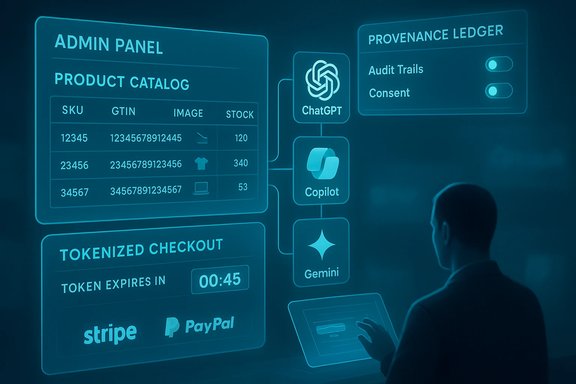
A futuristic blue holographic dashboard showing an admin panel, product catalog, and tokenized checkout with AI tools.Background​

AI-driven shopping has moved quickly from experiments to production pilots over the last 12–18 months. Platforms such as ChatGPT, Copilot, Gemini and others have progressively added the ability to surface product cards and initiate checkout flows in‑context, often working with payments and commerce partners to preserve merchant‑of‑record responsibilities and limit exposure of consumer payment data. Two protocols and standards now anchor this wave: the Agentic Commerce Protocol (ACP), championed early by OpenAI and Stripe, and a recently introduced Universal Commerce Protocol (UCP), which Google and Shopify describe as an open standard to unify agent-to-business interactions across multiple assistant platforms. Those protocols define the plumbing that lets an assistant present products and obtain a short‑lived payment credential so the merchant (or its payment processor) handles settlement and fulfillment. This is not a single‑company play. Shopify has positioned itself as an agentic commerce infrastructure — a syndication layer that converts merchant catalogs into machine‑readable feeds, applies enrichment, and exposes toggles merchants can use to control where their products appear. Microsoft, Google, OpenAI and payments vendors like PayPal and Stripe provide the discovery, checkout orchestration and delegated payment workstreams. The result: multiple conversational surfaces competing to capture the moment of purchase.

What Shopify announced (and what it means for merchants)​

Agentic Storefronts: one setup for many AI channels​

Shopify’s Agentic Storefronts (part of its Winter ’26 / “Renaissance” edition) gives merchants a single admin path to make products discoverable across AI platforms such as ChatGPT, Microsoft Copilot, Perplexity — and now Google’s AI Mode / Gemini through the newly announced Universal Commerce Protocol (UCP). The feature centralizes:
  • Structured product metadata (SKUs, GTINs, images, attributes, inventory)
  • Brand voice, policy, and FAQ content for consistent agent responses
  • Channel toggles to opt into or out of specific AI assistants
  • Order attribution and analytics surfaced back into the Shopify admin
Shopify frames this as a merchant‑first model: you “set it up once” and your store can appear across multiple assistants while retaining the merchant‑of‑record relationship. That approach aims to avoid the merchant frustrations seen in previous experiments where platforms indexed or listed products without clear consent.

Universal Commerce Protocol (UCP) and scale​

Shopify’s recent announcements describe co‑development of the Universal Commerce Protocol (UCP) with Google to make agentic commerce interoperable at scale. UCP aims to be a common language for agents and merchant backends — standardizing cart building, identity linking, checkout initiation, and recovery from failed steps — so different assistants and payment providers can interoperate without bespoke integrations for every agent‑merchant pair. Early UCP partners named include major retailers and payments firms, signaling industry intent to avoid a single‑vendor lock‑in for the agentic checkout layer.

Enrollment and merchant control: the opt‑out debate​

To accelerate coverage, Shopify and some platform partners are adopting automatic enrollment models with merchant opt‑out windows. That design dramatically shortens time-to-coverage, but merchants must carefully review default settings, discoverability rules, and the visibility of pricing, subscription and loyalty features inside agentic checkouts. Shopify emphasizes that merchants remain the merchant of record and will retain order data and fulfillment responsibilities; however, automatic enrollment raises governance questions that merchants must evaluate quickly as these channels go live.

Microsoft’s Copilot Checkout: a new checkout lane​

What Copilot Checkout is designed to do​

Microsoft’s Copilot Checkout embeds a compact, branded checkout interface directly inside Copilot conversations: product discovery, specification confirmation and payment can all occur without a full redirect to the merchant website. At launch, Microsoft named partnerships with PayPal, Stripe and Shopify (and early merchant participants like Urban Outfitters, Anthropologie and Ashley Furniture), and it shipped merchant-facing templates — Brand Agents and a personalized shopping agent in Copilot Studio — to encourage rapid onboarding and consistent experiences. Microsoft stresses that merchants remain the merchant of record and that checkout is delegated to payment partners to preserve payment security and fraud checks.

Delegated checkout, tokenization and provenance​

Copilot Checkout, like other agentic checkout implementations, uses delegated or tokenized payment flows: the assistant orchestrates the user experience and obtains a short‑lived payment token or checkout session from a PSP; the PSP then handles settlement and fraud checks. This structure reduces the assistant’s exposure to raw card data, and the merchant’s systems stay responsible for final settlement and customer service. Microsoft and partners are explicit about auditable provenance — each recommendation or buy action should map back to a canonical product record so disputes about price or availability can be reconciled.

Partner mechanics and merchant onboarding​

Microsoft’s playbook mixes automated scale and partner onboarding:
  • Shopify: automatic enrollment (opt‑out model) to rapidly surface many storefronts inside Copilot.
  • PayPal: store sync and branded checkout that maps a merchant’s catalog into agentic surfaces.
  • Stripe: delegated payment primitives and Shared Payment Tokens (SPTs) when merchants use Stripe rails.
Merchants using PayPal or Stripe can apply for enrollment; Shopify merchants will be enrolled by default unless they opt out. This strategy provides quick scale, but it places the onus on merchants to understand how their pricing, inventory policies, and returns processes map into agentic flows.

Google’s Direct Checkout and the Universal Commerce Protocol​

UCP as the connective tissue​

Google announced direct checkout functionality for AI Mode in Search and the Gemini app, built as an early production test of the Universal Commerce Protocol (UCP). Google positions UCP as the “common language” that sits between agent experiences and merchant backends, ensuring cart building, identity linking and checkout actions are standardized and secure across platforms. Retail partners cited in the UCP rollout include big names and payments providers, reinforcing that this is meant to be an industry-level foundation rather than a single‑platform experiment.

Direct offers and moment-of-purchase incentives​

Google’s pilot also includes Direct Offers — advertiser‑driven, in‑moment discounts (for example, “20% off if you buy now”) presented inside AI Mode — which merchants can opt into. This capability is an explicit attempt to blend ad mechanics with conversational shopping, making offers contextually relevant and actionable inside the agent experience. For advertisers, it’s a new ad product that competes with conventional sponsored listings. For merchants, it’s a potential conversion lever — but one that must be reconciled with pricing strategies and loyalty program rules.

The technical anatomy of agentic commerce — what actually needs to work​

Agentic commerce is not a single feature; it’s a coordinated stack. For reliability and merchant trust the industry has converged on three core technical primitives:
  • Canonical, machine‑readable product catalogs
  • Products must expose structured metadata (variants, GTINs, inventory levels, shipping windows, images).
  • Catalog quality directly affects the assistant’s ability to avoid hallucinations and to surface correct price/availability.
  • Shopify’s Agentic Storefronts and catalog‑enrichment templates aim to automate and normalize this work at scale.
  • Conversational orchestration and provenance
  • The assistant must interpret intent, ask clarifying questions (size, color, delivery window), and link every suggested item to a canonical SKU.
  • Provenance logs are essential for dispute resolution and merchant customer service workflows. Microsoft emphasizes auditable traces as part of Copilot Checkout.
  • Delegated, tokenized checkout
  • Delegated payment specs (ACP / UCP variants) let AI assistants request single‑use, scoped payment tokens from PSPs to preserve PCI boundaries and security.
  • Stripe’s Shared Payment Token (SPT) is a concrete implementation used in early ACP pilots; the token is limited by amount, expiry and merchant scope to reduce misuse. These tokens shift settlement to the merchant/PSP while keeping the assistant out of raw payment handling.
Each layer has operational consequences: catalog errors lead to incorrect orders; poor provenance increases dispute costs; weak token controls invite fraud. The industry has responded with tooling (catalog enrichment agents, Brand Agents, merchant dashboards), but the operational lift for merchants — particularly smaller sellers — is real.

Why merchants should care — benefits and early promises​

  • Reach at the moment of decision: Agents can intercept purchase intent and convert it immediately, potentially reducing cart abandonment and context switching. Platforms claim meaningful conversion uplifts in pilot data. Treat these as vendor claims until independently verified.
  • New distribution channels with centralized control: Shopify’s model aims to let merchants manage where they appear and how their brand voice is represented, while keeping customer relationships and fulfillment intact.
  • Reduced friction at checkout: Tokenized, delegated payments remove redirects and make the checkout experience smoother for buyers, improving mobile conversion rates.
  • Analytics and attribution: Orders that originate in AI conversations can be attributed back into merchant analytics, enabling measurement and optimization. Shopify promises in‑admin visibility and attribution for agentic channels.

The risks, operational costs and unanswered governance questions​

Agentic commerce introduces distinct risks that merchants, payments providers and platforms must address:
  • Data quality becomes mission‑critical. Poor or stale inventory data — especially for limited‑stock or time‑sensitive items — can cause costly fulfillment errors and reputational damage. Catalog enrichment tools help, but merchants must invest in feed discipline.
  • Dispute and returns complexity. Even if the assistant provides provenance, merchants will shoulder refunds, chargebacks, and the operational burden of reconciling conversational context with order state. Robust logs and clear SLAs between assistants and PSPs will be necessary to manage liability.
  • Fraud and authorization dynamics. Delegated tokens constrain exposure but do not eliminate fraud risk. PSPs like Stripe add additional fraud signals (Radar) to SPT flows, but merchants must tune fraud rules for agent-originated traffic and monitor for bot-driven abuse.
  • Privacy and user consent. Agents often have access to a wider context than a standard web session. Platforms must ensure explicit consumer consent for using stored payment methods, saved addresses, and personalization signals in agentic purchases.
  • Default enrollment governance. Automatic enrollment models accelerate reach but can provoke merchant backlash if defaults are burdensome or lead to unexpected operational load. Opt‑out defaults need transparent communications, easy opt‑out flows, and clear terms about how returns and data are handled.
  • Channel fragmentation and channel economics. Merchants will have to decide which agent channels to prioritize. Each platform offers different placement mechanics, promotional primitives (e.g., Google’s Direct Offers), and fee models; managing these across multiple agents will create new operational complexity.

Practical steps merchants should take now​

  • Audit catalogs and improve feed quality
  • Ensure SKUs, variant data, accurate inventory and shipping windows are machine‑readable and synchronized with your systems.
  • Review payment provider options and token support
  • If using Stripe or PayPal, confirm support for Shared Payment Tokens / delegated payment specs and understand the fraud tools available in tokenized flows.
  • Check enrollment defaults and opt‑out settings
  • If your platform (Shopify or others) plans automatic enrollment, verify the admin controls and test the buy flow to confirm branding, pricing and returns behave as expected.
  • Design dispute and fulfillment playbooks
  • Map conversational order data into your OMS (order management system) and define SLAs for responding to provenance-based disputes or pricing mismatches.
  • Pilot with measurement
  • Start with a subset of SKUs or promotions, instrument conversion and return metrics, and compare agentic channel economics to your other channels.

How to evaluate vendor claims — a cautionary lens​

Early partner materials and press releases are optimistic — they highlight conversion uplifts, faster purchases and improved customer experiences. For example, PayPal’s launch materials reference higher purchase rates in certain journeys, but these are pilot figures from controlled environments. Treat vendor-provided performance numbers as directional signals, not industry averages; independent audits and multi‑merchant field data are needed before drawing broad conclusions about uplift or margin impact. Vendors generally have incentives to publicize the best pilot numbers; prudent merchants should run their own A/B tests and measure real-world costs.

Competitive dynamics: who stands to win?​

  • Shopify: By offering catalog syndication and shop‑admin controls, Shopify positions itself as the infrastructure provider enabling merchants to appear across many AI channels. That role could make Shopify a durable monetization point if it retains merchant trust and control.
  • Microsoft: Copilot’s distribution across Edge, Windows surfaces and Copilot.com gives Microsoft a distinct front‑end reach, and its templates (Brand Agents, Copilot Studio) aim to reduce merchant integration friction. The merchant opt‑in/opt‑out mechanics and reliance on established PSPs help Microsoft present Copilot Checkout as merchant‑friendly.
  • Google: Google’s advantage is search‑scale and ad inventory; UCP plus Direct Offers lets Google blend discovery, advertising and checkout into a single flow — a potent combination if merchants adopt it and regulators don’t restrict gatekeeper behavior.
  • Payments providers (Stripe, PayPal): Both companies are central to building secure programmatic payment rails (SPTs and store sync). Their role as the settlement layer makes them indispensable intermediaries and potential revenue owners in agentic commerce.

What regulators and standards bodies will watch​

Regulators will focus on four main domains: consumer protection, data privacy, competition, and payments regulation. Key issues include:
  • How price and availability are displayed and reconciled when an agent finalizes an order.
  • Whether default enrollment or opaque placement algorithms disadvantage merchants or raise antitrust concerns.
  • The handling of identity and consent for saved payment methods.
  • Financial compliance: delegated tokens reduce surface area for platforms, but money‑movement and anti‑money‑laundering responsibilities remain with payment rail operators and merchants.
Standards work (ACP, UCP‑like efforts) and transparent conformance testing will be central to reducing regulatory friction and to giving merchants confidence that agentic commerce can scale responsibly.

Conclusion — a pragmatic view​

Agentic commerce is here: large platform providers are shipping the technical primitives, payments vendors are enabling secure, delegated tokens, and commerce platforms are offering the cataloging and enrollment tooling merchants need to appear across assistants. That combination brings powerful benefits — faster conversions, behaviorally targeted offers, and the potential to capture the moment of purchase — but it also creates a new operational surface that merchants must manage carefully.
The promise of conversation to conversion is technically credible, but the long‑term winner will be the ecosystem that balances convenience with merchant control, transparent defaults, auditable provenance, and robust fraud controls. For merchants, the sensible path is to pilot deliberately, instrument everything, and treat early performance claims as hypotheses to be validated in the merchant’s own data. The upside is significant; the cost of getting the plumbing wrong is real. Vigilant onboarding, tested workflows, and clear governance will decide whether agentic commerce becomes a durable new channel or a short‑lived experiment in conversational novelty.

Source: Barron's https://www.barrons.com/articles/sh...QxcL4odbgtLoG1j_-DN3Ji5rYbmMZelJ5owTqQ%3D%3D/
Source: Retail TouchPoints Google Launches Direct Checkout in Search, Gemini - Retail TouchPoints
Source: Barron's https://www.barrons.com/articles/shopify-stock-price-ai-gemini-copilot-8091a3bf/
 

Back
Top