

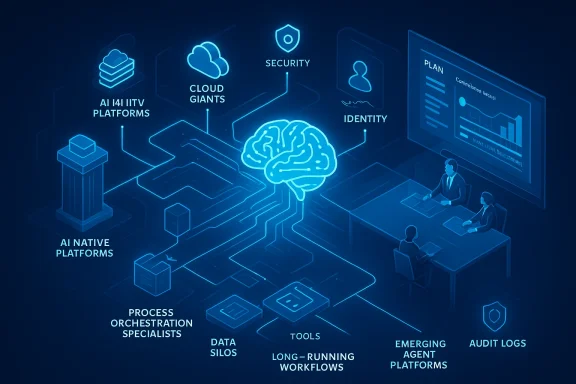
The race to build the “agentic enterprise” is no longer a thought experiment — it’s a multi-sided market battle in which six distinct categories of players are jockeying for position, each bringing complementary strengths and acute vulnerabilities. As companies move from chat and retrieval to agents that plan, act, and learn, the winners will be those who combine model capability, enterprise trust, data access, and orchestration control into a coherent product and go‑to‑market advantage before the market consolidates.
Background / Overview
The term agentic enterprise describes organizations that treat autonomous AI agents as first‑class workers: software entities that can reason across context, access systems and data securely, execute multi‑step processes, and improve through experience. These agents are not simple chatbots. They are composite systems with memory, planning, tool use, and governance primitives that allow them to work across long horizons and multiple systems.Three traits define the shift from “predictive” AI to the agentic enterprise:
- Orchestrated multi‑agent collaboration rather than isolated single‑shot responses.
- Deep integration with enterprise systems and identity/permissions layers.
- Deterministic guardrails plus probabilistic reasoning — hybrid logic that blends workflow engines with LLM reasoning.
The Six Categories Racing for the Agentic Enterprise
The emerging competitive map breaks into six categories. Each has structural advantages that map to the four decisive battlegrounds — models, trust, data, and orchestration — and each faces unique levers and constraints.1. AI‑Native Platforms
- Representative players: modern model houses and agent platform providers that designed agent orchestration and frontier models from the ground up.
- What they bring: leading model capabilities, specialized agent SDKs, and orchestration-native architectures. They can innovate rapidly on model features like long context, tool chaining, automated code execution, and memory systems.
- Typical strength profile:
- Model quality and reasoning capabilities are best‑in‑class.
- Native support for long‑running, stateful agents with built-in telemetry.
- Typical weaknesses:
- Enterprise trust and integration are newly built or nascent.
- Enterprise sales motion and compliance controls need time to mature.
2. Cloud Infrastructure Giants
- Representative players: hyperscalers and cloud providers that control compute, identity, and enterprise relationships.
- What they bring: scale, security controls, direct cloud integration, and deep enterprise contracts. They can place agents close to data, offer alternative models, and provide governance primitives across a customer’s entire stack.
- Typical strength profile:
- Enterprise procurement and trust, plus a built-in distribution channel.
- Ability to offer model variety and run agents with custom compliance (VPCs, private links, single‑tenancy).
- Typical weaknesses:
- Model innovation may be downstream or derivative if models are licensed.
- Product experience across applications may be inconsistent if orchestration is siloed.
3. SaaS Incumbents Pivoting
- Representative players: large enterprise SaaS companies that own workflows and customer data (CRM, HR, ERP).
- What they bring: rich, structured enterprise data and domain workflows — the very context agents need to deliver value. They can turn existing seat‑based licenses into agent‑augmented flows.
- Typical strength profile:
- Deep, permissioned data and an existing enterprise footprint with established contracts.
- Strong product‑market fit in specific business processes.
- Typical weaknesses:
- Legacy revenue models and seat‑based incentives misaligned with agentic pricing and outcomes.
- Cultural and technical pivot risks: integrating probabilistic agents into deterministic product ecosystems is hard.
4. Vertical AI‑Native Companies
- Representative players: domain specialists building agentic solutions for specific industries (legal, healthcare, CX, content).
- What they bring: domain expertise, tuned datasets, and compliance-aware agent designs. Specialized memory and retrieval tailored to regulatory needs make vertical agents more trustworthy faster.
- Typical strength profile:
- Rapid time‑to‑value in constrained domains where the problem space is well defined.
- Lower risk of catastrophic mistakes when operating within narrow domains.
- Typical weaknesses:
- Scalability beyond the vertical can be limited.
- Competitive pressure from platform partnerships or larger incumbents that bundle domain functionality.
5. Process Orchestration Specialists
- Representative players: vendors emerging from robotic process automation (RPA) and workflow orchestration.
- What they bring: enterprise workflow knowledge, deterministic process engines, and integration experience. They understand where agents break processes and have battle-tested control planes for auditability.
- Typical strength profile:
- Strong governance, observability, and an orientation toward moving agents from pilot to production safely.
- A playbook for mapping agents into end‑to‑end business processes.
- Typical weaknesses:
- Historically limited model capability; must partner or integrate LLM providers.
- Need to evolve from UI‑driven automation to agentic reasoning without sacrificing predictability.
6. Emerging AI Agent Platforms
- Representative players: new agent‑first startups and toolsmiths creating open or interoperable agent environments.
- What they bring: fast iteration, architectural novelty, and lightweight integrations. They move quickly on UX, agent discovery, and marketplace concepts.
- Typical strength profile:
- Agility to experiment with new execution models and open protocols.
- Attractive acquisition targets due to clean, agent‑first codebases.
- Typical weaknesses:
- Limited enterprise trust, resource constraints, and go‑to‑market reach.
- Vulnerability to platform suppression or acquisition.
No Single Category Has a Decisive Advantage
The current competitive landscape is fluid: model capability, enterprise trust, data access, and orchestration are each necessary but insufficient on their own. A leader that combines two or three of these attributes may win in narrow segments, but a true platform winner requires all four.- Model leaders without enterprise controls struggle with adoption.
- Cloud incumbents with trust and distribution may lack differentiated agents.
- SaaS incumbents have data but must restructure incentives and governance to use agents effectively.
- Orchestration vendors provide the bridge from pilot to production but must integrate best‑in‑class reasoning and models.
How Each Category Competes: Strategic Playbooks
Below are distilled, practical playbooks for each category — what to do if you are in it, and how competitors should respond.- AI‑Native Platforms
- Build modular orchestration APIs and enterprise SDKs; ship auditing, identity, and memory controls as first‑class features.
- Create a Frontier or partner builder program to seed vertical use cases.
- Competitors should pressure them on compliance certifications and enterprise SLAs.
- Cloud Infrastructure Giants
- Offer opinionated agent runtimes with region controls, IAM integration, and observability pipelines.
- Provide marketplace economics for agent builders and model choice.
- Competitors should push on open standards and portability to avoid lock‑in.
- SaaS Incumbents Pivoting
- Reimagine pricing (outcome‑based, per‑resolution) and product‑level orchestration.
- Embed human checkpoints, deterministic scripts, and agent logs into product flows.
- Competitors should integrate these SaaS products into cross‑platform agent orchestration.
- Vertical AI‑Native Companies
- Double down on compliance, legal safety, and longitudinal performance tracking.
- Use domain data to create defensible retrieval and memory layers.
- Competitors should evaluate embedding these vertical solutions into broader enterprise stacks.
- Process Orchestration Specialists
- Harmonize deterministic workflow engines with probabilistic reasoning, offering “agent script” constructs to harden outcomes.
- Push enterprise governance as the default — audit trails, rollback, and human‑in‑loop flows.
- Competitors should offer low‑friction connectors and no‑code agent builders for rapid adoption.
- Emerging Agent Platforms
- Focus on developer experience: fast prototyping, transparent tool use, and a marketplace for agent components.
- Seek integrations with larger platforms via open protocols to avoid being squeezed.
- Competitors should watch these vendors for acquisition or radical UX innovations.
The Trust Problem: Why So Few Agents Reach Production
Enterprises report a meaningful vision‑to‑reality gap when it comes to agentic AI. A recent large industry study of IT and business decision makers found that while many organizations experiment with agents, only about one in ten use cases reached production in the prior year. The barriers are familiar: risk appetite, regulatory compliance, lack of observability, skills gaps, and unclear ROI.Key operational reasons agents fail to scale:
- Lack of unified orchestration that treats agents like any other enterprise endpoint.
- Inadequate identity and least‑privilege access controls when agents act on data or systems.
- Poor telemetry and evaluation pipelines to measure agent correctness and drift.
- Incentive misalignment inside vendors and customers (seats vs. outcomes).
Real‑World Failure Modes and Safety Concerns
Agentic systems introduce new failure surfaces. Some concrete examples and failure modes to watch:- Hallucinations at scale: An agent that composes actions over multiple systems can propagate errors faster than a chat response. Even rare hallucinations can become expensive or legally risky when agents act autonomously.
- Privilege and identity misuse: Agents granted broad permissions may access or modify sensitive records unless identity is tightly gated and auditable.
- Tool‑chaining cascades: When agents call external tools or other agents, a single misstep (bad parse, malformed API call) can cascade across systems.
- Supply‑chain vulnerabilities: Reference implementations and integrations from third parties can introduce SQL injection, file‑API flaws, or other vulnerabilities that are not obvious in demos but are dangerous in enterprise deployments.
- Operational observability gaps: Insufficient logging or explainability reduces the ability to detect drift or to attribute root causes when agents misbehave.
Market Dynamics and the Economics of Agents
The economics of agentic products deviate from SaaS norms in several ways:- Pricing models shift from seats and tokens to outcome‑based or per‑resolution models for certain workflows.
- Operational costs can be dominated by memory, long‑running execution, and observability infrastructure rather than pure compute.
- Data advantage is increasingly decisive: agents rooted in proprietary, permissioned enterprise data create unique value that is hard to replicate.
- Acquisition dynamics favor companies that combine domain expertise with orchestration competence — vertical specialists often become high‑value targets.
What Enterprises Should Do Now: A Practical Checklist
Enterprises should treat agentic adoption as a program, not a feature. Here’s a stepwise, pragmatic approach:- Start with high‑value, narrow workflows that have clear decision bounds and success metrics.
- Implement an orchestration layer early — treat agents as endpoints with identity, permissions, and rollback options.
- Require comprehensive observability: action logs, plan traces, confidence scores, and human overrides.
- Apply deterministic fallbacks for high‑risk steps; use hybrid reasoning to combine formal business logic with LLM guidance.
- Measure outcomes, not interactions: track resolution rate, error remediation cost, and business KPIs.
- Protect data with least privilege, isolation (sandboxing), and strict data‑use contracts with vendors.
- Build a skills roadmap — operator roles, agent bosses, and audit teams are necessary to sustain production agents.
- Diversify models and vendors where strategic lock‑in is a risk; insist on portability and standard interfaces when possible.
Regulatory, Geopolitical, and Ethical Considerations
Agentic systems raise regulatory questions that are already appearing in compliance planning:- Data residency and cross‑border access controls when agents traverse systems spread across regions.
- Auditability and explainability mandates for regulated sectors (finance, healthcare, legal).
- Liability and accountability: who is responsible when an autonomous agent commits an error that harms customers or breaks compliance?
- Ethical constraints: agents that automate persuasive or behavioral flows require guardrails for fairness, consent, and privacy.
Who Wins? Scenarios and Probabilities
There are plausible, distinct winning archetypes:- The Platform Integrator: a cloud provider or SaaS incumbent that combines model partnerships, deep enterprise integration, and orchestration control — favored in conservative, regulated markets.
- The Frontier Model + Orchestration Leader: an AI‑native platform that matures enterprise controls quickly and attracts a broad third‑party developer ecosystem — favored in fast‑moving, product‑centric segments.
- The Vertical Kingmaker: a set of domain specialists that dominate high‑value professional workflows and either remain independent winners or become sought‑after acquisitions.
Notable Strengths and Key Risks — A Critical Appraisal
Strengths across the market:- Rapid model innovation is enabling new classes of automation that were previously impractical.
- A growing set of orchestration patterns is bridging proof‑of‑concept and production.
- Vertical players demonstrate that specialized agents deliver measurable ROI, validating the business case.
- Productionization remains the biggest barrier: many pilots stall without orchestration and governance.
- Security and supply‑chain vulnerabilities can undo trust quickly; enterprises must demand robust mitigations.
- Overhyping capabilities risks a market correction if widespread failures emerge — vendor claims should be validated against production metrics, not demos.
- Concentration of compute and data control could create geopolitical and dependency risks for critical industries.
Conclusion
The agentic enterprise transition will be a defining technology wave of this decade. It is not simply about smarter chat interfaces — it is about creating autonomous digital coworkers that can reason, act, and learn inside complex business systems. The competitive map is broad: model houses, cloud giants, SaaS incumbents, vertical specialists, orchestration veterans, and nimble startups are all racing to assemble the winning combinations of models, trust, data, and orchestration.Success will favor those who treat agents as products built for the realities of enterprise governance and risk, not as demos. Organizations that can orchestrate agents with the same rigor they apply to databases and identity systems will move faster from pilot to production and capture disproportionate value. The next 18 months will not determine a single hegemon, but they will define the alliances and architectures that shape enterprise work for years to come.
Source: FourWeekMBA Six Categories of Players Racing for the Agentic Enterprise - FourWeekMBA
