

Enterprises that rushed to adopt AI today face a familiar follow‑up: adoption without scale. Early wins—meeting summaries, draft generation, faster search—are real, but they rarely compound into measurable operational change unless leaders treat AI as a systems problem, not a feature toggle. The imperative is clear: move from individual productivity gains to agentic business transformation—workflows where autonomous agents own bounded tasks, systems of record become active workflow participants, and every agent ties directly to a business metric. Microsoft has been explicit about that shift in its recent platform messaging and product updates, urging leaders to design processes with agents and to invest in governance, observability, and outcome measurement as the only route to durable value.
AI adoption has passed the hype inflection point and entered the hard phase: real systems engineering at the process level. Where early projects focused on usefulness—does the tool help an employee now?—the next chapter asks whether AI can reliably change how work flows across teams, systems, and customers. That means reconceiving systems of record as active decision engines, instrumenting every automated action, and building the people + tech controls that contain risk while amplifying velocity. Microsoft and partners are increasingly framing these ideas through the lens of agentic platforms and Power Platform‑centric automation, while a growing set of vendors and integrators position orchestration and governance as the crucial difference between pilots and scale.
The trap is twofold. First, productivity gains are hard to translate into organizational KPIs. A faster draft doesn’t automatically move revenue or shorten cash collection cycles. Second, without reworking upstream and downstream processes, the same coordination overhead and handoffs remain. The result: a collection of useful islands, not an integrated archipelago.
That shift requires several practical changes:
That change is not merely architectural; it influences organizational boundaries:
Governance spans multiple dimensions:
Source: Microsoft Agentic business transformation: What leaders need to get right - Microsoft Power Platform Blog
 Background
AI adoption has passed the hype inflection point and entered the hard phase: real systems engineering at the process level. Where early projects focused on usefulness—does the tool help an employee now?—the next chapter asks whether AI can reliably change how work flows across teams, systems, and customers. That means reconceiving systems of record as active decision engines, instrumenting every automated action, and building the people + tech controls that contain risk while amplifying velocity. Microsoft and partners are increasingly framing these ideas through the lens of agentic platforms and Power Platform‑centric automation, while a growing set of vendors and integrators position orchestration and governance as the crucial difference between pilots and scale.Why “productivity” is only the beginning
The productivity trap
Most organizations begin with low‑risk, high‑visibility productivity features: summarization, personal copilots, search accelerants. These tools deliver clear immediate value, and they’re often the quickest route to adoption and positive user sentiment. But productivity features are primarily single‑user accelerants. They make a person faster at a task, not the business faster at delivering outcomes.The trap is twofold. First, productivity gains are hard to translate into organizational KPIs. A faster draft doesn’t automatically move revenue or shorten cash collection cycles. Second, without reworking upstream and downstream processes, the same coordination overhead and handoffs remain. The result: a collection of useful islands, not an integrated archipelago.
Process redesign as the lever for scale
The firms that get past pilots—what some vendors call “Frontier Firms” or outcome‑oriented adopters—use productivity features as a stepping stone toward process redesign. They identify end‑to‑end processes where agents can reasonably own a bounded scope of work, then redesign handoffs so agents execute routine work and humans step in for judgment, exceptions, or ethical decisions.That shift requires several practical changes:
- Defining clear inputs, outputs, and termination conditions for an agentic task.
- Establishing measurable success criteria at the process level (e.g., resolution time, cash collection rate, pipeline velocity).
- Ensuring the system of record enforces the rules and captures evidence for every automated decision.
Systems of record: from passive stores to active owners
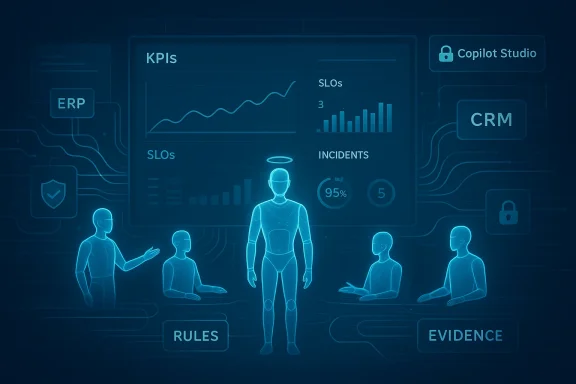
The new role of ERP, CRM, and case systems
Traditional systems of record—ERP, CRM, billing, service platforms—were designed to store authoritative data and support human workflows. In an agentic world, these systems must also own workflow responsibilities: they need to receive events, trigger agents, validate actions against rules, and persist evidence for audit and measurement.That change is not merely architectural; it influences organizational boundaries:
- Customer service agents must collate context across sales, contracts, and billing so escalation includes all the facts.
- Finance agents should automate routine reconciliation and only involve humans for flagged anomalies.
- Field service agents need to orchestrate parts ordering, schedule coordination, and SLA tracking without repeated human handoffs.
Practical requirements for active systems of record
The technical and process checklist looks like this:- Canonical inputs: well‑defined, validated data schemas so agents always consume the same signals.
- Deterministic rulesets: encoded decision boundaries (what the agent can, and cannot, do).
- Evidence trails: immutable logs and versioned artifacts for every agent action.
- Escalation patterns: clear thresholds and contextual bundles for human adjudication.
- Observability hooks: dashboards, metrics, and alerts that map agent behavior to business KPIs.
The differentiator: governance, observability, and measurement
Why governance scales, not features
When a single team automates a process, centralization isn’t necessary. When hundreds of teams do it, it becomes a chaotic sprawl. Agentic deployments multiply the number of autonomous processes that run in production. Governance is the mechanism that prevents drift, enforces risk controls, and ensures that agents pull in the right data and obey enterprise constraints.Governance spans multiple dimensions:
- Identity and access: who can create, run, or approve an agent and what data it may access.
- Lifecycle controls: testing, staging, and production promotion pipelines for agents.
- Policy enforcement: privacy, retention, and data residency rules embedded into agent templates.
- Cost and capacity controls: preventing runaway compute or model consumption.
Observability: the linchpin for continuous improvement
Observability gives leaders visibility into what agents do and whether they help the business. Useful observability is not just telemetry about errors; it’s metricized outcomes tied to business KPIs. Examples include:- Average resolution time for a class of service cases.
- Percentage of invoices auto‑cleared without human intervention.
- Pipeline velocity improvements attributable to agent‑driven lead qualification.
What leaders need to get right — a practical playbook
Below is an executable playbook leaders can use to transition from AI pilots to agentic business transformation. Each step links action to governance and outcome.1. Start small, measure what matters
- Pick one function, one process, one metric. Avoid cross‑enterprise pilots in the first wave.
- Define the desired business outcome in quantitative terms (e.g., reduce Days Sales Outstanding by X%, shorten ticket resolution time by Y%).
- Run a controlled experiment: instrument baseline metrics, deploy an agent in a contained environment, measure lift, and iterate.
2. Build a data readiness checklist
- Inventory authoritative data sources for the process.
- Validate data quality and lineage for the inputs an agent will use.
- Ensure real‑time or near‑real‑time data availability where agents need it.
- Set explicit fallbacks for missing or uncertain data (e.g., escalate rather than guess).
Caution: If an organization cannot produce a clear, testable path from data to decision, pilots that rely on heuristics will not generalize. Treat “AI‑ready data” as a gating factor, not a checkbox.
3. Design agents with bounded authority and human‑in‑the‑loop
- Document the agent’s scope: what it can decide, what it can initiate, and where it must ask for human approval.
- Use role‑based policies to enforce least privilege for data access.
- Implement provenance tracking so every automated action links to the inputs and the model version used.
4. Create an agent inventory and governance registry
- Maintain a central catalog of deployed agents, their owners, and their SLOs.
- Require change control for any agent that touches protected data or financial systems.
- Automate policy checks during CI/CD (model updates, prompt changes, retraining triggers).
5. Tie every agent to a business metric and a remediation plan
- For each deployment, declare a primary metric and an acceptable impact band.
- Define rollback and remediation procedures: what happens when the agent underperforms, and how do you restore service?
- Track drift: models, data distributions, and business context change; monitor all three.
Governance, compliance, and ethics risks to watch
Scaling agentic systems intensifies regulatory and ethical exposure. Leaders must proactively manage at least the following risks:- Data leakage and privacy violations: agents with excessive privileges can exfiltrate sensitive fields; policy‑enforced data minimization is essential.
- Model hallucination and decision correctness: generative models occasionally assert incorrect facts; agents must not be allowed to finalize actions that require legal or financial accuracy without human signoff.
- Regulatory auditability: financial, healthcare, and regulated industries require auditable trails. Agents must produce evidence that supports decisions.
- Vendor lock‑in and portability: heavy dependence on a single vendor’s agent framework can complicate migration and increase strategic risk.
- Distributional drift and entropic decay: business context changes—seasonality, policy shifts, mergers—make old models brittle. Continuous monitoring is non‑negotiable.
Technology landscape and integration considerations
Platforms and primitives to consider
- Low‑code platforms (for example, Power Platform) accelerate the translation of process logic into agent behavior and provide admin controls for governance and data grounding. These platforms often integrate with enterprise identity and data services to enforce policy.
- Copilot and agent studios provide the environment to compose models, tools, and APIs into goal‑directed agents; look for features that enable staging, model selection, and auditability.
- RPA and orchestration tools (UiPath and others) are extending integrations with agent platforms to coordinate cross‑system work and to manage non‑AI automations alongside agentic processes. Those integrations are crucial for organizations with a large legacy estate.
Integration best practices
- Treat agent outputs as events that enter your existing message and event buses; don’t create parallel, unobserved channels.
- Use canonical transformation layers to normalize data before it reaches an agent—a small step that significantly improves repeatability.
- Instrument every integration with both business metrics and technical telemetry; connect the two so engineers and business owners see the same picture.
Organizational readiness: people, process, and change
Technology is necessary but insufficient. Successful agentic transformations require human and organizational shifts.- Executive sponsorship: senior leaders must declare measurable business outcomes and commit to funding governance and observability capabilities.
- Operating model: establish an automation or agent center of excellence (CoE) that provides standards, templates, and a governance registry.
- Reskilling and role design: agents change work. Invest in upskilling for people who will supervise, interpret, and tune agent behavior.
- Change management: communicate clearly where agents provide assistance and where humans retain responsibility. Address job security concerns with transparency and career transition planning.
Measuring ROI: what good looks like
Measurement must be outcome‑first, not technology‑first. Good ROI programs include:- Baseline, treatment, and test windows for every agent deployment.
- Attribution models that separate agent effects from seasonal, marketing, and external factors.
- Ongoing A/B or canary testing strategies for model updates and prompt changes.
- Financial mappings: convert time savings and error reductions into dollars, and track realized vs. expected value.
- Early Cost Avoidance — soft benefits from faster work and reduced rework.
- Process Acceleration — measurable reductions in cycle time and manual handoffs.
- Revenue and Cash Flow — improved customer conversion and faster collections tied to agent behavior.
- New Business Models — agents create capabilities (e.g., 24/7 proactive servicing) that enable new revenue streams.
A realistic timeline for transformation
Agentic transformation is multi‑phase. A realistic roadmap for a single function could look like:- Month 0–3: Discovery and data readiness. Catalog systems, define KPIs, and create a data conditioning plan.
- Month 3–6: Pilot a single agent with human‑in‑the‑loop, instrument metrics, and run controlled tests.
- Month 6–12: Formalize governance, build an agent registry, and scale to 5–10 processes within the function.
- Year 1–2: Cross‑function integration, enterprise observability, and demonstrable financial impact; begin rationalizing vendor footprint and optimizing cost.
Conclusion: lead with outcomes, govern for trust
The work ahead for business leaders is less about picking a model or a partner and more about operationalizing AI with the discipline of software engineering and the accountability of business management. Agents offer the potential to transform operations, but only if organizations:- Start with clear, measurable outcomes.
- Rebuild processes so agents own end‑to‑end tasks with human oversight for exceptions.
- Treat systems of record as active workflow owners with defined inputs, rules, and evidence trails.
- Invest early in governance, observability, and an agent inventory to prevent sprawl.
- Continuously measure and adapt so agentic work compounds over time rather than remaining a string of isolated wins.
Source: Microsoft Agentic business transformation: What leaders need to get right - Microsoft Power Platform Blog
