

Agora’s recent collaboration with Microsoft positions real‑time voice, video, and conversational AI at the center of a practical, globally compliant multilingual strategy — one that promises low‑latency, intelligent interactions across more than 140 languages while offloading heavy model infrastructure and compliance burdens to Azure. (microsoft.com)
Agora is a long‑standing player in real‑time engagement (RTE) — offering SDKs and cloud services for voice, video, and interactive streams — and it has been pushing into AI‑driven experiences with its Conversational AI Engine and Conversational AI SDK. The company’s push to integrate large language models, speech services, and real‑time audio processing reflects a broader industry shift from asynchronous text interfaces to natural, voice‑first, multimodal interaction.
Microsoft, for its part, has been consolidating a portfolio of AI services under Azure AI and Microsoft Foundry Models: a managed marketplace and runtime that brings OpenAI models (and other partner models) into Azure with enterprise governance, speech capabilities, and specialized real‑time audio models. That Foundry stack is explicitly designed for enterprise requirements — model selection, routing, observability, and regional deployment choices — which influences how vendors like Agora architect global, low‑latency solutions.
Together Microsoft and Agora claim to address four major problems for global, real‑time services:
That said, the headline metrics (languages supported, millisecond latencies, profitability signals) must be examined in context. Language coverage is fragmentary across modalities, latency promises must be validated end‑to‑end from real client geographies, and safety/compliance remains primarily the customer’s responsibility to implement correctly. Organizations that balance rapid prototyping with disciplined risk management — rigorous testing across target languages, contractual clarity about data residency, and layered safety controls — will extract the most value from this partnership.
If you’re evaluating this stack, treat the Microsoft customer story and Agora’s SDK docs as starting points for a pragmatic pilot: pick a narrow, measurable use case; design experiments around latency and accuracy; instrument for cost; and codify the legal and compliance boundaries before you scale. The result can be a genuinely interactive, global voice experience that feels like talking to a person — provided you build with realistic expectations and sound engineering guardrails. (microsoft.com)
Source: Microsoft Agora collaborates with Microsoft Azure AI to enable a real-time, intelligent, and interactive future across 140+ languages | Microsoft Customer Stories
 Background
Agora is a long‑standing player in real‑time engagement (RTE) — offering SDKs and cloud services for voice, video, and interactive streams — and it has been pushing into AI‑driven experiences with its Conversational AI Engine and Conversational AI SDK. The company’s push to integrate large language models, speech services, and real‑time audio processing reflects a broader industry shift from asynchronous text interfaces to natural, voice‑first, multimodal interaction. Microsoft, for its part, has been consolidating a portfolio of AI services under Azure AI and Microsoft Foundry Models: a managed marketplace and runtime that brings OpenAI models (and other partner models) into Azure with enterprise governance, speech capabilities, and specialized real‑time audio models. That Foundry stack is explicitly designed for enterprise requirements — model selection, routing, observability, and regional deployment choices — which influences how vendors like Agora architect global, low‑latency solutions.
Together Microsoft and Agora claim to address four major problems for global, real‑time services:
- compliance and data sovereignty across jurisdictions,
- real‑time multilingual interaction (speech‑to‑speech / speech‑to‑text),
- cross‑region, low‑latency audio/video stability, and
- the high cost and slow pace of in‑house LLM development. (microsoft.com)
What exactly is being delivered?
Core capabilities Agora + Azure promise
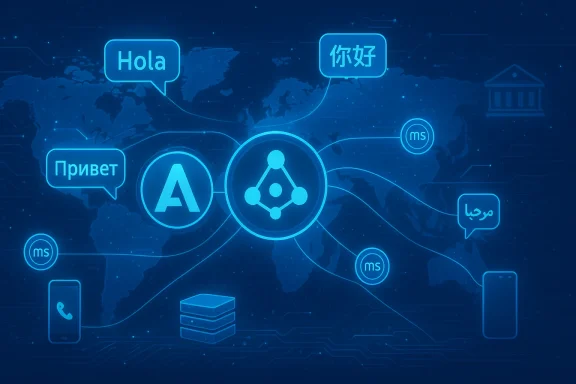
- Real‑time translation and interaction in 140+ languages: Microsoft’s customer story highlights Agora’s use of Azure Speech and Azure OpenAI to deliver translation and multimodal interactions across 140+ languages and variants. This claim ties together Azure’s speech and translator stacks with Agora’s low‑latency delivery. (microsoft.com)
- Millisecond‑class end‑to‑end latency: By leveraging Azure’s global backbone and network optimizations, Agora reports sub‑second — often millisecond‑level — latencies for global interactions. That performance is central to making voice conversations feel natural rather than stilted. (microsoft.com)
- Integrated model access through Azure Foundry / Azure OpenAI: Agora integrates with Azure OpenAI in Foundry Models (and other Foundry tooling) to run large and reasoning models close to the edge where needed, with added routing and governance features. This gives developers access to low‑latency audio‑capable models such as realtime audio variants and GPT‑4o‑Realtime‑style capabilities available through Foundry.
- Improved developer velocity: Using Azure tooling (including GitHub Copilot for code acceleration), plus Agora’s SDKs and sample integrations, the combined platform aims to reduce build time for voice agents and multimodal apps. Agora’s Conversational AI SDK and published quickstarts show direct integrations with OpenAI’s Realtime API and Azure services for faster time‑to‑market.
Verified technical elements
- Speech stack breadth: Azure’s speech and translation offerings comprise a combination of Translator (text translation), Speech‑to‑Text, Text‑to‑Speech (neural voices), and Speech Translation. Microsoft’s speech ecosystem documents show more than 140 voices and variants available for neural TTS and broad language coverage across STT and translation components; however, exact per‑feature language counts differ (Translator text vs. speech translation vs. neural TTS). This nuance matters for product teams evaluating language coverage.
- Model routing and Foundry marketplace: Azure Foundry exposes models from OpenAI and other partners with enterprise governance and options for deploying in specific regions — a functional fit for Agora’s compliance and regional deployment needs.
Why this matters for global real‑time apps
Reduced engineering overhead
Building reliable, multilingual, real‑time voice agents in‑house requires:- collecting large multilingual speech datasets,
- training or fine‑tuning speech and language models,
- provisioning global edge and regional compute for low latency,
- implementing compliance and data‑locality controls.
Global compliance and data residency
Microsoft’s Azure footprint and Foundry’s enterprise features enable customers to deploy models and AI pipelines inside specific geographic boundaries to meet local data laws. For Agora, that means it can route audio capture, transcription, model inference, and storage under regional controls — a practical requirement for corporate, healthcare, finance, and public sector customers. However, the exact legal compliance posture still depends on configuration and contracts between end customers, Agora, and Microsoft. (microsoft.com)Real‑world use cases that scale
- 24/7 global customer support with two‑way voice translation,
- telemedicine with instant transcribed notes and multilingual triage,
- education and language learning with interactive AI tutors,
- gaming and social apps with real‑time voice bots and localized audio experiences.
Strengths: where this partnership shines
- Global scale with enterprise plumbing: Azure’s presence in many regions and Foundry’s model governance give Agora a production‑grade way to meet data residency and compliance requirements without building a bespoke global cloud. This is a pragmatic win for regulated verticals. (microsoft.com)
- Lower latency through integrated routing: Agora’s RTE network combined with Azure regional compute reduces hop counts and improves jitter control, which is critical for human‑sounding voice interactions. Real‑time audio models (realtime APIs and audio‑capable models) minimize the sense of lag in conversations.
- Faster developer iteration: Out‑of‑the‑box SDKs, sample integrations, and GitHub Copilot usage shown in the Microsoft story accelerate product cycles — turning complex AI engineering into a more manageable integration project. (microsoft.com)
- Business outcomes: Agora’s investor statements and financial filings indicate improved unit economics and a path toward sustained profitability after the launch of AI initiatives — a commercial validation that investing in AI integration is moving the needle for Agora.
Risks and limitations (what to watch for)
Language coverage vs. translation quality
The headline “140+ languages” can be technically accurate when counting all Azure speech/TTS voices and translator text languages. However, translation and recognition quality varies significantly by language and dialect, and speech translation coverage (real‑time speech‑to‑speech) often supports fewer pairs than text translation. Expect to test per‑language accuracy, latency, and edge cases (code‑switching, accents, domain jargon) before committing to production‑grade SLAs. Do not assume parity across languages. (microsoft.com)Model hallucination and safety risks
LLMs used in conversational agents can hallucinate or produce unsafe outputs. While Azure adds safety tooling and Microsoft advertises responsible AI safeguards in Foundry, operators are still responsible for safety pipelines: RAG (retrieval‑augmented generation) safeguards, content filters, human‑in‑the‑loop review, and observability. Any customer handling regulated content must layer additional guardrails.Vendor concentration and lock‑in
Relying on Azure Foundry and Agora’s integrated SDKs reduces time‑to‑market but increases coupling to a specific stack. Organizations should evaluate multi‑cloud portability and fallback strategies (on‑prem models, alternative providers) to avoid future lock‑in or cost shocks.Cost, scaling, and observability
Real‑time audio routing plus cloud model inference can be costly at scale. Costs include:- edge/egress bandwidth,
- per‑second inference charges for real‑time models,
- storage and retention for transcripts,
- engineering for observability and incident response.
Regulatory nuance and contractual detail
Azure’s regional deployment features help, but compliance is nuanced: some jurisdictions require that certain categories of data never leave national boundaries, or demand auditability for model use. Verify contractual commitments, subprocessors lists, and whether model training/inference data are retained for service improvement. These are legal questions that require customer legal and vendor contracting teams to review. (microsoft.com)How product and platform teams should evaluate Agora + Azure
Pre‑launch checklist (technical)
- Validate language pairs for your use cases: test recognition and translation quality in the specific dialects and accents your users use. Don’t rely on aggregate “140+ languages” numbers without per‑language tests.
- Measure real‑world latency from representative client geographies: instrument client SDKs and measure median and tail latencies (p50, p95, p99).
- Test simultaneous speaker and noise conditions: run load tests with overlapping speech, background noise, and real device microphones.
- Build fallback paths: local ASR/TTS or simpler IVR fallbacks for when cloud models are degraded or unavailable.
- Validate privacy controls: confirm regional data retention, encryption at rest/in transit, and whether transcription data is used to improve vendor models by default.
Operational and security checklist
- Define SLOs and SLAs with Agora and Azure for latency, uptime, and incident response.
- Confirm subcontractor and subprocessor policies for model providers and edge partners; get written commitments for data locality if required.
- Implement content safety pipelines: RAG vetting, redact PII from transcripts where required, and keep audit logs for regulatory review.
- Plan for cost monitoring: instrument per‑call inference usage and set automated throttles or cost alerts.
Deployment patterns to consider
- Hybrid model routing: send routine traffic to cost‑efficient smaller models, route critical or complex queries to larger, higher‑quality models via Foundry model router.
- Regional breakout: deploy local regional inference endpoints for primary markets and fall back to a central region for low‑traffic languages.
- Edge pre‑processing: perform denoising, VAD (voice activity detection), and speaker diarization at the client or edge to reduce inference load and improve recognition accuracy.
- RAG for factuality: when agents must provide factual answers, combine LLM responses with retrieval from curated enterprise knowledge bases and present citations.
Business and competitive implications
For developers and startups
The combined stack lowers the barrier to launching voice‑first AI products. Startups can ship features like multilingual voice agents and live captioning without building and maintaining heavy ML pipelines. That speed is a competitive advantage — but it comes with an operational dependency on the vendor stack.For enterprises
Enterprises gain faster access to frontier LLMs and audio models while maintaining governance via Azure Foundry. Financially, the approach can reduce upfront ML spend and reallocate investment to productization and UX. Agora’s reported Q4 2024 GAAP profitability suggests the company’s pivot toward conversational AI is commercially meaningful. Still, procurement and legal teams must validate long‑term cost and compliance tradeoffs.For the wider market
This partnership is emblematic of the industry’s move toward AI stacks — ecosystems where cloud providers offer models, governance, and deployment tooling that independent infra players (like Agora) can leverage to deliver verticalized experiences. Expect to see more specialized RTE and edge vendors integrating Foundry or equivalent marketplaces to reduce friction for end customers.Practical recommendations: a playbook for IT decision makers
- Start small, measure fast: pilot in one language/region with well‑defined UX tests (latency, word error rate, contextual accuracy) before a wider rollout.
- Use A/B testing for model variants: evaluate cheaper, smaller speech models against high‑quality Foundry options and route dynamically.
- Instrument everything: monitor per‑region latency, model inference durations, token counts, audio quality metrics, and transcript error rates.
- Contract for clarity: include data residency, model usage, retention, and audit clauses in the contract with Microsoft/Azure and Agora.
- Plan for safety and escalation: implement content moderation, human escalation workflows for sensitive conversations, and traceability for model outputs.
Where claims need cautious reading
- The “140+ languages” figure is real but aggregative: it bundles text translation, TTS voices, and translation variants. Quality and availability vary across features and language pairs; teams must verify the specific languages and modalities they need rather than rely on the top‑line number. (microsoft.com)
- Speed and cost tradeoffs for realtime inference depend on usage patterns. Low latency is achievable in many geographies, but tail latency during peak load and degraded network conditions remains a practical concern that requires architectural mitigation.
Final assessment
The Agora + Microsoft Azure AI pairing is a compelling, pragmatic route to bring real‑time, multilingual conversational AI into production. It combines Agora’s mature real‑time network and developer SDKs with Azure’s broad speech tooling, Foundry model governance, and global regional presence — a blend that directly addresses compliance, scale, and developer velocity problems that historically blocked this category.That said, the headline metrics (languages supported, millisecond latencies, profitability signals) must be examined in context. Language coverage is fragmentary across modalities, latency promises must be validated end‑to‑end from real client geographies, and safety/compliance remains primarily the customer’s responsibility to implement correctly. Organizations that balance rapid prototyping with disciplined risk management — rigorous testing across target languages, contractual clarity about data residency, and layered safety controls — will extract the most value from this partnership.
If you’re evaluating this stack, treat the Microsoft customer story and Agora’s SDK docs as starting points for a pragmatic pilot: pick a narrow, measurable use case; design experiments around latency and accuracy; instrument for cost; and codify the legal and compliance boundaries before you scale. The result can be a genuinely interactive, global voice experience that feels like talking to a person — provided you build with realistic expectations and sound engineering guardrails. (microsoft.com)
Source: Microsoft Agora collaborates with Microsoft Azure AI to enable a real-time, intelligent, and interactive future across 140+ languages | Microsoft Customer Stories
