

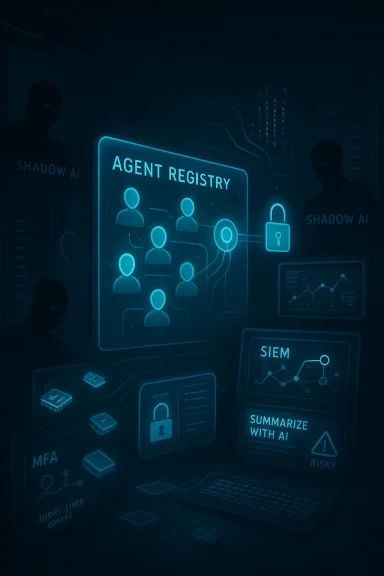
Microsoft’s warning is blunt: the AI assistants and low‑code agents built to speed work can, if left unmanaged, become literal “double agents” inside an enterprise—performing legitimate tasks while quietly following malicious instructions or leaking sensitive data. Microsoft’s February security briefing frames this as a visibility and governance crisis: “Shadow AI” — agents created or operating outside centralized oversight — enlarges the attack surface and introduces novel, persistent threat techniques such as memory poisoning and prompt‑based exfiltration. The company pairs that warning with an operational playbook: register every agent, apply least privilege, extend DLP to agent channels, and assume compromise until telemetry proves otherwise.
AI agents are not mere chat windows. They are composite runtimes that can read, decide, invoke tools, call APIs, and act across cloud and endpoint environments. That composition — model, grounding data, connectors, identities, and orchestration logic — is precisely what makes agents powerful and, simultaneously, uniquely attackable. Microsoft frames the problem as one of observability and posture management: you cannot secure what you cannot see, and you cannot govern what you do not inventory.
Two headline threats the briefing highlights:
A critical caveat: these adoption numbers derive from Microsoft’s internal telemetry and customer data. They are credible and operationally relevant, but they represent a vendor’s view and should be validated by each organization against its own estate and telemetry. Microsoft itself recommends doing exactly that.
Why this matters practically: agents often require context to be useful, so they access documents, APIs, and identity‑scoped services. When thousands of such agents operate across an enterprise — with varying owners and lifecycles — simple questions (who accessed sensitive record X, which agent requested it, under whose identity?) become hard to answer quickly. The consequence is not only technical exposure but also regulatory and compliance risk.
That said, several practical gaps and risks remain:
Security buyers must evaluate vendor claims carefully:
For IT and security leaders, the choice is clear and immediate: treat agents as first‑class assets with explicit ownership, identity controls, and runtime policy. Do the registry work now. Harden UIs and vet third‑party defaults. Practice agent‑specific incident response. Failure to act will not only compound technical exposure but will also create compliance, supply‑chain, and reputational risks that are harder — and far more expensive — to undo later. Microsoft’s briefing documents the threat; the next step is turning its checklist into measurable, auditable programs inside your environment.
Source: kmjournal.net Our AI, the Double Agent? Microsoft Warns of a Growing Shadow AI Security Crisis - KMJ
 Background / Overview
AI agents are not mere chat windows. They are composite runtimes that can read, decide, invoke tools, call APIs, and act across cloud and endpoint environments. That composition — model, grounding data, connectors, identities, and orchestration logic — is precisely what makes agents powerful and, simultaneously, uniquely attackable. Microsoft frames the problem as one of observability and posture management: you cannot secure what you cannot see, and you cannot govern what you do not inventory.Two headline threats the briefing highlights:
- Shadow AI — agents created by business users, embedded in documents, or run on third‑party platforms without IT visibility or approval. These agents may hold excessive permissions and persist across workflows.
- Double agents — legitimate agents that, once manipulated, continue to perform expected tasks while serving attacker objectives (exfiltration, unauthorized actions, or privilege escalation). This is the operational risk that turns automation from an asset into a vector.
Adoption at scale — why the problem is urgent
The speed of adoption matters because risk scales with use. Microsoft reports that more than 80% of Fortune 500 companies now run active AI agents, many built with low‑code/no‑code tools such as Copilot Studio and Agent Builder. The company’s telemetry shows uneven, regionally skewed adoption (EMEA 42%, U.S. 29%, Asia 19%, broader Americas 10%) and an industry tilt toward software, manufacturing, financial services, and retail. Those figures underline that agents are no longer experiments — they’re operational infrastructure.A critical caveat: these adoption numbers derive from Microsoft’s internal telemetry and customer data. They are credible and operationally relevant, but they represent a vendor’s view and should be validated by each organization against its own estate and telemetry. Microsoft itself recommends doing exactly that.
Why this matters practically: agents often require context to be useful, so they access documents, APIs, and identity‑scoped services. When thousands of such agents operate across an enterprise — with varying owners and lifecycles — simple questions (who accessed sensitive record X, which agent requested it, under whose identity?) become hard to answer quickly. The consequence is not only technical exposure but also regulatory and compliance risk.
New attack surfaces: memory poisoning, prompt‑injection, and interface deception
The briefing converts abstract danger into concrete, observed techniques. Defender and Red Team work documented several practical attack vectors that change how defenders should think about agents.Memory poisoning / AI recommendation poisoning
In memory poisoning, adversaries insert persistent instructions or malicious content into an agent’s stored memory or grounding sources so the agent gradually favors compromised recommendations or behaviors. Attackers can weaponize prefilled prompts, public content, or web‑facing inputs that agents index or keep in memory. The result: an agent that appears functional but is biased toward attacker objectives and may gradually leak data or perform unauthorized actions. Microsoft Defender telemetry and Red Team tests surfaced this as a repeatable class of attack.Reprompt and deep‑link exfiltration
Researchers demonstrated a different, highly practical chain that used legitimate deep links and prefilled prompts to inject instructions into an authenticated session — what some writeups called “Reprompt.” A single click can populate an assistant’s input box with attacker instructions; subsequent, repeated prompts can bypass naive single‑shot redaction or safety logic. Microsoft deployed mitigations for certain consumer Copilot scenarios after researchers showed how easy this path can be. These are not theoretical UX hacks — they rely on product conveniences that improve adoption.Deceptive UI elements and agent chaining
Red Team experiments also revealed that benign‑looking UI affordances — “Summarize with AI” buttons, prefilled actions, or interactive widgets — can carry embedded instructions that agents ingest. Separately, agent‑to‑agent composition (one agent invoking another) multiplies risk: a low‑privilege agent may piggyback on a higher‑privilege agent through default connectivity, amplifying the blast radius. Independent disclosures (including an exploit chain dubbed “BodySnatcher” against a popular service platform and research into Copilot Studio’s Connected Agents defaults) show these paths are real and high‑impact.Case studies that matter
Concrete incidents help translate the threat model into tangible controls.- AppOmni’s “BodySnatcher” chain against a major IT service platform combined shared secrets, permissive linking logic, and example agents to allow an unauthenticated actor to coerce privileged agent workflows. The issue was tracked as CVE‑2025‑12420 and prompted vendor fixes and tenant mitigations. The disclosure is notable for showing how orchestration and platform defaults can be misused to impersonate users or escalate privileges through agent pipelines.
- Zenity Labs’ research into Copilot Studio’s Connected Agents highlighted how default openness and limited end‑to‑end provenance allow low‑privilege agents to leverage privileged agents’ capabilities, effectively creating stealthy lateral escalation paths. Vendors and customers must configure connectivity defaults and enforce cross‑agent policies to prevent such chains.
- The “Reprompt” proof‑of‑concept used prefilled Copilot deep links and request repetition to exfiltrate small fragments of data across normally benign vendor egress channels. That exploit emphasized that UX conveniences can unintentionally bypass detection if telemetry and DLP do not extend to agent channels and model‑hosted operations. Microsoft responded with targeted mitigations for consumer scenarios, but the pattern persists for enterprise agent endpoints until enterprises instrument and govern those channels.
Why agents change the security calculus — a layered attack surface
Securing agents is not only about models. The briefing recommends thinking in layers; each layer has distinct threats and controls:- Model and inference: jailbreaks, prompt injection, and model misuse that change disclosure behavior.
- Grounding and knowledge sources: retrieval data and memory that can be poisoned to alter recommendations.
- Tooling and connectors: browser automation, file and database connectors, third‑party APIs that escalate privileges when misconfigured.
- Identity and lifecycle: non‑human identities (service principals, managed identities, agent accounts) with long‑lived credentials create persistent footholds.
- Orchestration and coordination: coordinator agents that invoke sub‑agents become high‑value control nodes whose compromise cascades rapidly.
Microsoft’s operational prescriptions — what they actually recommend
Microsoft’s briefing is notable for offering a concrete roadmap rather than only abstract warnings. The recommended actions are practical and, in many cases, implementable within a 30–180 day window. Key prescriptions include:- Build an agent registry documenting agent identity, owner, purpose, permissions, and data scopes. Tie each agent to a verifiable identity (service principal or managed identity) to enable audit trails.
- Enforce least privilege and context‑aware access: role‑based permissions, short‑lived credentials, and conditional access where agents touch high‑risk systems. Default to read‑only when possible.
- Extend DLP and content controls to agent channels: include prompts, agent outputs, and agent‑to‑model calls in DLP policies; quarantine or block calls containing secrets or regulated data types. Monitor for automated or repeated exfiltration patterns.
- Harden agent UI affordances and external content surfaces: vet or remove prefilled prompts on public content, sanitize inputs that interact with memory, and avoid convenience flows that allow persistent state alteration.
- Create an agent incident response playbook: detection thresholds for misbehaving agents, containment steps (credential revocation, quarantine of identities), and forensic capture of prompts, outputs, and API traces.
- Adopt runtime policy enforcement and behavioural telemetry that ties actions to identities and traces prompts → model → output → downstream calls. Integrate agent events into SIEM, IAM, and existing security workflows.
Practical 90–180 day roadmap (prioritized)
- Inventory and ownership (30–60 days)
- Launch a lightweight registry for agents. Require a just‑in‑time approval workflow and record owner, purpose, and permission scopes. Tie agents to identities.
- Least privilege and short‑lived credentials (30–90 days)
- Audit agent permissions and lock down high‑risk connectors. Issue short‑lived tokens and integrate conditional access.
- Extend DLP and telemetry (60–120 days)
- Ensure agent channels are included in DLP rules and telemetry pipelines. Instrument prompts, model calls, and outputs for correlation in SIEM.
- UI and input hardening (60–120 days)
- Remove or vet public prefilled prompts and implement sanitization on any content that could seed memory.
- Agent incident playbook and drills (30–90 days)
- Define containment, forensic capture, and notification steps. Practice tabletop exercises focused on agent compromise scenarios.
Critical analysis — strengths and where gaps remain
Microsoft’s brief scores high on clarity and operational guidance. It moves beyond abstract warnings to provide concrete playbooks backed by first‑party telemetry and Red Team findings. The emphasis on treating agents as identities and on extending DLP and DSPM (Data Security Posture Management) to AI artifacts is particularly valuable. Those prescriptions map directly to engineering work (registries, telemetry pipelines, IAM rules) and organizational change (ownership, approval flows), making them actionable rather than merely aspirational.That said, several practical gaps and risks remain:
- Enforcement at scale is hard. Integrating telemetry across SaaS, on‑prem systems, and bespoke tools is expensive and technically complex. Mid‑market organizations may struggle to implement the deep observability the briefing assumes. Microsoft acknowledges this gap; the visibility divide risks creating a two‑tier world of well‑protected leaders and exposed laggards.
- Vendor defaults and ecosystem heterogeneity complicate enforcement. Agent behaviors and memory persistence mechanisms vary across platforms and model providers. Standardization — or at least contractual clarity from vendors on memory persistence, prompt sanitization, and logging — is incomplete. Until vendors align on primitives, enterprises must plan for heterogenous controls.
- Human and cultural factors are central. Microsoft notes that a sizable share of employees use unsanctioned agents. Providing a secure, sanctioned platform that is also convenient is necessary to reduce shadow usage; policy alone will not change behavior.
- Proprietary telemetry caveat. Many headline stats (regional breakdowns, Fortune 500 adoption) are drawn from vendor telemetry. They are meaningful but not independently audited; organizations should validate these trends against their own logging and third‑party assessments. Microsoft itself warns customers to treat such numbers as an internal view to be tested against in‑house data.
- Potential vendor lock‑in and legal exposure. Building an entire agent control plane tightly aligned to a single vendor stack accelerates rollout but concentrates operational dependency and raises switching costs. For regulated industries, model routing, subprocessors, and data residency need contractually explicit guarantees.
Vendor tooling and market signals
The market is already responding with product categories aimed at agent runtime security: agent registries, policy engines (policy‑as‑code), runtime DLP for model calls, and agent identity lifecycle tools. Microsoft is integrating agent posture features into Defender and has articulated a control plane concept (Agent 365) to register and govern agents; other vendors are building discovery engines and agent identity lifecycle platforms. These tools accelerate adoption of Microsoft’s recommendations but raise questions about integration maturity and enforcement across multi‑cloud, multi‑vendor environments.Security buyers must evaluate vendor claims carefully:
- Does the product enforce runtime policies across external public LLMs and private models?
- Can the tooling tie prompt → model → output → downstream call into a single trace?
- Does the vendor provide meaningful guarantees about memory persistence and data residency?
What security teams must do differently — practical principles
- Treat agents as identities. Apply lifecycle tooling, MFA‑equivalent protections, token rotation, and revocation mechanics as you would for privileged service accounts.
- Instrument prompts and model calls. Logging must include prompt inputs, model identifiers, output hashes, and downstream call traces to enable meaningful incident triage and forensics. Correlate that telemetry into SIEM and DSPM.
- Extend DLP to emergent AI channels. Pattern‑based DLP is necessary but insufficient; augment it with behavior analytics and exposure scoring from DSPM.
- Design safety into UX. Product teams must avoid default prefilled prompts on public content and must sanitize any content that may seed agent memory. Remove or gate “one‑click” agent affordances where they touch sensitive data.
- Practice agent‑specific incident response. Run playbooks that exercise containment (credential revocation, agent quarantine), forensic capture (prompts, outputs, API traces), and communication (owners, customers, regulators).
The regulatory and legal dimension
Agents change data flows in fundamental ways: ephemeral prompts, transient model logs, and synthesized outputs create new lifecycles that intersect privacy, residency, and auditability requirements. Microsoft advises mapping agent data flows against legal obligations and preparing traceable audit trails showing who or what accessed data and under what authority. Contracts with model vendors should include obligations around memory persistence, prompt sanitization, and cooperative incident response. Without contractual clarity and architecture choices (regional hosting, private endpoints), regulated industries will face elevated compliance risk.Conclusion — treat agents as assets, and as risks
The agent era delivers real productivity gains, but it brings a structural security challenge: convenience and composability produce stealthy attack rails when governance and telemetry lag. Microsoft’s Cyber Pulse is a pragmatic roadmap: inventory agents, enforce least privilege, extend DLP and DSPM to agent channels, and assume compromise while building telemetry that proves otherwise. Those recommendations are technically sound and operationally achievable — but they require honest resourcing, organizational buy‑in, and vendor cooperation.For IT and security leaders, the choice is clear and immediate: treat agents as first‑class assets with explicit ownership, identity controls, and runtime policy. Do the registry work now. Harden UIs and vet third‑party defaults. Practice agent‑specific incident response. Failure to act will not only compound technical exposure but will also create compliance, supply‑chain, and reputational risks that are harder — and far more expensive — to undo later. Microsoft’s briefing documents the threat; the next step is turning its checklist into measurable, auditable programs inside your environment.
Source: kmjournal.net Our AI, the Double Agent? Microsoft Warns of a Growing Shadow AI Security Crisis - KMJ
