

Weather forecasting is part science, part engineering—and part humility. The weather’s raw data are messy, the physics are fiendishly complex, and the atmosphere itself is a chaotic system that refuses easy answers. Yet over the past 24 months we’ve watched two tectonic shifts collide: the rise of AI foundation models for Earth prediction, and a private-sector rush to collect fresh observational data from satellites and sensors. The result is a fast-moving, high-stakes effort to make forecasts both faster and more accurate—and Episode 4 of Catalyst, which follows Tomorrow.io’s work on Microsoft Azure and NVIDIA stacks, is a useful window into how that effort is unfolding now. verview
Weather forecasting historically rests on numerical weather prediction (NWP): physics-based models that simulate the atmosphere using the equations of fluid dynamics and thermodynamics. These systems have steadily improved as observations, computing power, and scientific understanding advanced, but they remain bound by three fundamental limits:
Strengths to celebrate include computational efficiency, open‑sourcing of research artifacts in some cases, and the democratizing potential when cloud platforms make advanced forecasts available to smaller players. Risks to mitigate include black‑box failures, the potential for widening global disparities, and the danger of overreliance on ML when physical plausibility checks are absent. The sensible middle path is hybrid intelligence: AI models accelerate and broaden predictive capability while human experts and physics-based simulations remain the reference standards for interpretation and public safety.
What the episode cannot fully resolve are the deep scientific questions: long-term generalization under climate change, blind‑spot performance for rare extremes, and the institutional governance of forecasts as critical public infrastructure. Those questions require broad collaboration across academia, operational centers, and civil society—not just engineering demos.
Source: YouTube
Weather forecasting historically rests on numerical weather prediction (NWP): physics-based models that simulate the atmosphere using the equations of fluid dynamics and thermodynamics. These systems have steadily improved as observations, computing power, and scientific understanding advanced, but they remain bound by three fundamental limits:
- Limits of predictability stemming from chaos (the so‑called butterfly effect) that amplify tiny measurement errors into large forecast differences beyond a certain lead time.
- Observation gaps—especially over oceans and poorly instrumented regions—that leave NWP models with incomplete initial conditions.
- Computational cost because high-resolution physics-based simulations are expensive and slow to run, limiting update frequency and local detail.
 Why forecasts are so hard to get right
1. The atmosphere is chaotic — not random, but sensitive
A key scientific constraint is the atmosphere’s chaotic dynamics. Small uncertainties in initial measurements grow over time; beyond a window of roughly one to two weeks, attempts to predict detailed weather at a point meet the natural limit of predictability. That’s not a failure of computers—it's a property of the system. Recent academic and institutional summaries reiterate this boundary while noting that incremental improvements are still possible via better observations and smarter models.- Practical implication: expect skillful deterministic forecasts for temperature and wind a few days out, decreasing reliability for precise local precipitation beyond several days, and fundamentally limited ability to predict specific events (e.g., the exact hour and street for a thunderstorm) two weeks ahead.
2. Observations are incomplete and uneven
A model is only as good as its initial conditions. Over the oceans, in low-income regions, or in complex urban microclimates, sensor coverage can be sparse. Private constellations (like Tomorrow.io’s weather radars) and denser mesonets help fill those gaps, but the integration of heterogeneous data streams—satellite radar, ground stations, aircraft, buoys, mobile sensors—remains a major engineering challenge. Data latency, calibration differences, and quality control are constant operational headaches.3. Physics vs. machine learning: different error modes
Traditional NWP explicitly simulates physical processes—advection, convection, radiation—so its errors are constrained by physics, and meteorologists can interpret model biases in physical terms. Machine learning (ML) models, by contrast, are statistical: they learn mappings from inputs to outputs and can be superb within their training domain, but they may “hallucinate” unrealistic fields when faced with rare or out‑of‑distribution situations. That makes ML both powerful and brittle unless carefully verified and constrained.4. Small-scale processes are costly to resolve
Precipitation, turbulence, and convection evolve at scales far smaller than the grid sizes used for global models. Parameterizations approximate those processes, but approximations introduce systematic biases. Achieving kilometer-scale forecasts globally would multiply computational demands dramatically—unless new approaches (e.g., learned super-resolution or AI surrogates) bridge the gap. NVIDIA and Tomorrow.io are explicitly pursuing GPU-accelerated super-resolution and ensemble strategies to make high-resolution, near‑real‑time forecasting feasible.5. Communicating uncertainty is hard
Operational forecasting is not just prediction; it's communication. Conveying probabilities, confidence intervals, and scenario-based risks to diverse audiences (emergency managers, pilots, farmers, commuters) requires expert judgment. Automated systems can produce numbers quickly, but misinterpreted probabilities or overconfident deterministic maps can lead to poor decisions. This is where human meteorologists remain indispensable.The AI and cloud revolution: Aurora, Tomorrow.io, Azure, NVIDIA
What Aurora changed
Microsoft’s Aurora project embodies the “foundation model” approach for the atmosphere: pretrain a large model on a massive corpus of historical and simulated data, then fine‑tune for downstream tasks such as 10‑day global weather forecasts, 5‑day air pollution prediction, and hurricane-track guidance. The published Nature paper and Microsoft’s own documentation show Aurora achieving state‑of‑the‑art skill in several benchmark tasks while operating orders of magnitude faster than traditional NWP—capable of producing global forecasts in seconds to minutes on GPUs rather than hours on supercomputers.- Key technical numbers verified in Microsoft’s papers and docs:
- Pretraining on more than one million hours of diverse Earth system data.
- A compact 1.3 billion–parameter model (foundation-scale for spatiotemporal tasks).
- Reported improvements over leading numerical models on many benchmarks (for example, 92% of targets in their 10‑day global weather evaluation and 100% on selected 5‑day cyclone-track tests as reported in the Nature paper).
Tomorrow.io’s data + NVIDIA’s GPU stack
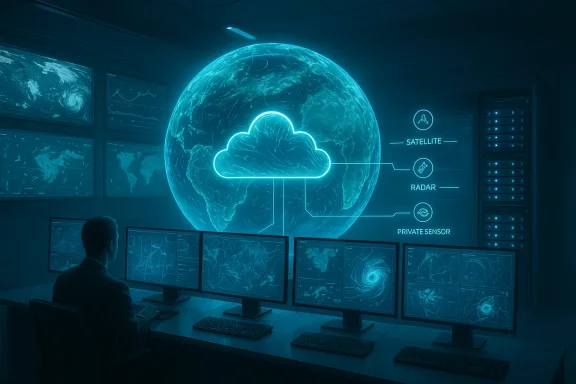
Tomorrow.io couples proprietary satellite radars and a planned constellation with a modern AI stack. NVIDIA’s Earth‑2 and related GPU frameworks accelerate ingestion, assimilation, and ensemble runs, allowing hundreds of high‑resolution scenarios to be computed in the time legacy systems produce one. That speed enables continuous updates and hyperlocal predictions tailored to business workflows—airport operations, logistics routing, and energy dispatch are common use cases.- What this architecture buys you:
- Faster updates (near real‑time inference and reanalysis).
- Hyperlocal resolution—kilometer or sub‑kilometer forecasts where sensor density allows.
- Ensemble multiplicity for probabilistic risk metrics without prohibitive compute costs.
Why Microsoft Azure matters
Azure provides the cloud fabric, managed GPU fleets, and enterprise-scale data pipelines that let private firms and research labs deploy these heavy models without owning a supercomputer. Azure’s integration with model management, data storage, and security features reduces engineering overhead, but it also centralizes sensitive environmental data and algorithmic control—raising questions about governance, access, and lock‑in.Notable wins and real-world validation
AI models have started delivering impressive wins in specific contexts. Microsoft’s Aurora and comparable systems reported better tropical cyclone track predictions in 2022–2023 tests; one widely discussed example is Typhoon Doksuri, where machine-learning forecasts reportedly outperformed some operational tracks days ahead. These case studies hint at ML’s ability to capture subtle, data‑driven patterns that might evade physics-only models—particularly in data‑sparse regions or complex storm evolutions. That said, anecdote is not the same as rigorous, blind operational validation across years and climates; the community rightly asks for long-term, transparent benchmarking.Strengths: What AI + cloud bring to forecasting
- Speed — AI inference on GPUs slashes turnaround time for global products from hours to minutes or seconds.
- Cost-efficiency at inference — running many forecast scenarios becomes affordable compared with supercomputer runs.
- Data fusion — learned models can opportunistically use heterogeneous inputs (satellites, radar, private sensors) and learn to compensate for gaps.
- Hyperlocal products — tailored forecasts for airports, logistics hubs, or industrial sites enable direct commercial value and operational resilience.
Risks, limitations, and open questions
Black‑box concerns and physical plausibility
Deep models can produce realistic-looking but physically impossible outputs if unguarded. Embedding physical constraints or verifying AI forecasts against physics-based sanity checks is essential. Many researchers argue for “physics‑informed” ML hybrids to combine statistical agility with the safety of mechanistic laws.Rare and emerging events
Models trained on historical records struggle with events underrepresented in the training set—true outliers or phenomena becoming more common due to climate change. That’s where human expertise and ensemble cross‑checks remain critical.Data equity and governance
If cutting-edge forecasts concentrate behind enterprise contracts and cloud platforms, global inequality in warning capabilities could widen. Open publication of models, transparent benchmarks, and capacity-building in lower‑resourced countries are vital policy levers.Security and integrity
Cloud‑hosted pipelines and satellite feeds are attractive targets for cyberattacks. Ensuring data authenticity and defending model integrity are operational necessities for any mission‑critical forecasting service.Practical guidance for IT decision‑makers and WindowsForum readers
If you’re evaluating AI-enabled weather services, or planning an internal implementation on Azure + NVIDIA GPUs, here’s a practical checklist and roadmap.1. Define the decision problem (business value first)
- Specify the exact operational question: Is it scheduling flights, dispatching crews, optimizing renewable energy, or public safety? Forecasting requirements differ by lead time, spatial resolution, and variable type.
- Map the cost of being wrong (false alarm vs missed event) to the choice of deterministic vs probabilistic products.
2. Demand transparent benchmarks
- Require vendors to provide local and global skill metrics against recognized baselines (ECMWF, NOAA, WMO standards) and independent benchmarks (WeatherBench-style evaluations).
- Prefer vendors who share verification scores over multiple seasons and extreme-event datasets.
3. Insist on hybrid workflows
- Use AI models for speed and scenario breadth, but keep NWP and observational assimilation as oversight layers.
- Implement automated sanity checks (physical consistency tests) and a human‑in‑the‑loop process for critical alerts.
4. Plan compute and cost strategy on Azure + NVIDIA
- For inference-heavy workflows, provision NVIDIA GPUs optimized for large matrix ops and mixed precision (A100, H100 class where available) and use managed services to scale dynamically.
- Consider edge deployments for latency‑sensitive local predictions; simulations suggest many AI models can run on a single GPU for regional forecasting.
5. Data governance and contracts
- Clarify who owns derivative forecasts, aggregated datasets, and model outputs.
- Negotiate data access clauses for disaster response and public-good use cases to avoid lock‑in.
A critical assessment: hype vs. reality
AI weather models such as Aurora are legitimately transformat dramatic speedups and notable skill gains in controlled benchmarks, and they enable scalable, hyperlocal forecasting for private and public clients. At the same time, their deployment into operational forecasting—especially for life‑critical warnings—must be conservative and evidence‑driven.Strengths to celebrate include computational efficiency, open‑sourcing of research artifacts in some cases, and the democratizing potential when cloud platforms make advanced forecasts available to smaller players. Risks to mitigate include black‑box failures, the potential for widening global disparities, and the danger of overreliance on ML when physical plausibility checks are absent. The sensible middle path is hybrid intelligence: AI models accelerate and broaden predictive capability while human experts and physics-based simulations remain the reference standards for interpretation and public safety.
What Episode 4 of Catalyst shows us (and what it doesn’t)
The Catalyst episode that follows Tomorrow.io on Azure with NVIDIA GPUs is a practical case study—showing data pipelines, engineering tradeoffs, and how you stitch together satellites, cloud, and inference engines to deliver business‑grade forecasts. The episode rightly highlights operational wins: reduced delays for airlines, better routing for logistics, and faster situational awareness for emergency response teams.What the episode cannot fully resolve are the deep scientific questions: long-term generalization under climate change, blind‑spot performance for rare extremes, and the institutional governance of forecasts as critical public infrastructure. Those questions require broad collaboration across academia, operational centers, and civil society—not just engineering demos.
Where forecasting will likely be in five years
- AI‑assisted forecasting will be integrated into most operational centers, not replacing meteorologists but changing their workflows. Expect faster scenario evaluation, more frequent updates, and better probabilistic products.
- Satellite constellations and private sensor networks will shrink observational blind spots, especially over oceans and low‑income regions, but data interoperability will remain a bottleneck.
- Hybrid models that marry physics constraints with learned components will gain traction as a way to combine plausibility with speed.
- Governance frameworks (open benchmarking, model transparency, and disaster-use clauses in commercial contracts) will become a battleground for fairness and public interest.
Final takeaways for WindowsForum readers
- Why forecasts are hard: because the atmosphere is chaotic, observations are imperfect, and small‑scale physics are computationally expensive to resolve. No single technology will magically remove those facts of nature.
- Why the current moment matters: cloud platforms like Azure, GPU accelerators from NVIDIA, and rich private observational data (Tomorrow.io’s constellation, for example) combine to make faster, more localized, and more economically accessible forecasts possible.
- How to be pragmatic: adopt AI where it demonstrably improves the decision problem, demand transparent verification, keep human expertise central, and design contract terms that protect public interest and data rights.
Source: YouTube
