

AI Search Engineers said in a June 2026 press release that businesses asking whether AI can perform SEO are focusing on the wrong problem, arguing instead that traditional search optimization does not reliably make companies visible in ChatGPT, Gemini, Copilot, Perplexity, or Grok answers. The claim is self-interested, as agency claims usually are, but it lands in the middle of a real market shift. Search is no longer only a rankings game played on Google’s results page. For businesses, the new fight is whether an answer engine names them at all.
Every major platform shift produces a naming war. In the 2000s, everyone learned SEO. In the social era, marketers discovered SMO, then growth hacking, then content marketing, then performance marketing. Now AI search has given the industry another cluster of labels: AEO, GEO, AI SEO, answer optimization, entity optimization, and whatever the next consultant deck needs to call it.
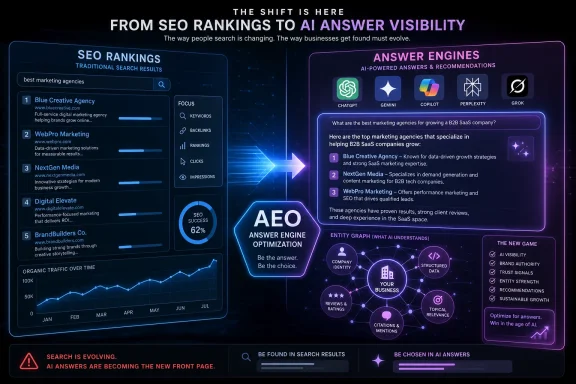
AI Search Engineers wants “Answer Engine Optimization,” or AEO, to be the term that survives. Its argument is simple: SEO was built for ranking pages, while AI systems increasingly select entities, synthesize claims, and produce answers without necessarily sending users to a website. That distinction matters because a business can rank well in Google and still be absent when a prospective customer asks an AI assistant for recommendations.
The company’s press release says its audits of more than 50 professional-service businesses found that every audited company with strong Google rankings was missing from at least two major AI platforms for primary category queries. That is a vendor-provided data point, not an independently audited industry benchmark. Still, it reflects what many publishers, agencies, and site owners are already seeing: visibility inside AI-generated answers behaves differently from visibility inside classic search.
That difference is becoming more commercially important because the search interface is changing. Google AI Overviews, Gemini, Microsoft Copilot, ChatGPT Search, and Perplexity all compress discovery into fewer visible choices. A blue-link results page can display ten organic options, ads, maps, videos, reviews, and snippets. An AI answer may mention three providers, one citation, or no brand at all.
But the press release is right to separate tool use from market visibility. Using ChatGPT or another model to create search content does not automatically make that content trusted by answer engines. It may even increase the amount of bland, interchangeable copy that answer engines have little reason to cite.
This is the same trap businesses fell into during earlier SEO waves. When content marketing became fashionable, many companies assumed that publishing more pages meant earning more authority. When backlinks became a commodity, many assumed link volume mattered more than source quality. AI-generated SEO risks repeating both mistakes at industrial speed.
The more useful question is not whether AI can help produce SEO work. It is whether the work changes how a business is represented across the information sources that AI systems consult. That includes the company’s own website, structured data, third-party mentions, reviews, knowledge panels, industry publications, local business profiles, and the broader entity graph around the brand.
For WindowsForum readers, the analogy is familiar. Automating a patch deployment is not the same as improving an organization’s security posture. A tool can execute a task quickly while leaving the underlying architecture untouched. AI SEO can accelerate the mechanics of optimization without solving the harder problem of being recognized as a trustworthy answer.
Classic SEO asks how a page ranks for a query. Answer visibility asks whether a system understands an entity well enough to recommend it in a synthesized response. That is a different measurement problem, and therefore a different investment problem.
AI Search Engineers frames this around a “five-signal authority stack”: entity clarity, structured data, trusted-source citations, topical authority, and documented client outcomes. The wording is agency-branded, but the underlying logic is not exotic. AI systems need to identify who a business is, what category it belongs to, where independent sources mention it, whether its claims are consistent, and whether there is evidence that others trust it.
That is why the SEO-to-AEO transition is uncomfortable for many businesses. You can buy content production. You can contract technical SEO. You can run a backlink campaign. But you cannot easily fake a durable footprint across credible sources without doing the slower work of becoming legible in your market.
The uncomfortable part for agencies is similar. Ranking reports are easy to package. Keyword position changes are easy to chart. AI answer visibility is more volatile, more platform-specific, and harder to attribute. It forces marketers to test prompts, track mentions, compare engines, evaluate citations, and admit when a campaign produces no answer-level presence at all.
That changes the stakes for professional services and B2B vendors. A buyer no longer needs to open a browser tab, search Google, and scan ten results. They may ask Copilot inside a work context to summarize vendors, compare options, draft an RFP, or identify reputable providers in a category. If the system’s answer draws from a narrow set of sources, the visibility contest has already happened before the company’s website enters the user’s view.
This is why “AI SEO” is too small a phrase. It suggests the old battlefield with a new toolchain. Copilot-style discovery suggests something broader: enterprise assistants mediating research, procurement, troubleshooting, and recommendation flows across multiple data sources.
The implications go beyond marketing. IT departments are already being asked to govern which AI tools employees can use, what data those tools can access, and how generated answers should be verified. As AI assistants become a layer over business research, vendors will care not only about whether they appear in public web search but also whether they are represented accurately in the systems employees use to make decisions.
This is where the answer-engine economy could become messy. A company may be visible in Perplexity, invisible in Gemini, mischaracterized in ChatGPT, and cited in Copilot through a third-party source it does not control. The old dream of a single Google ranking as the scoreboard for digital visibility is breaking apart.
But a vendor can be self-interested and still identify a real shift. The SEO industry is already rebranding around AI search because client demand has moved faster than measurement standards. Businesses are asking why they do not appear in ChatGPT recommendations, why competitors show up in AI Overviews, and whether old ranking investments still compound in the same way.
The answer is likely mixed. Traditional SEO still contributes to discoverability, crawlability, content quality, and topical authority. Google’s AI experiences are especially intertwined with Google’s broader search infrastructure. But visibility in answer engines is not reducible to a keyword ranking. It depends on how systems retrieve, compare, summarize, and trust information across sources.
That means businesses should distrust two extremes. The first is the claim that SEO is obsolete and should be abandoned. The second is the claim that AI visibility is merely SEO with a new dashboard. The truth is more operationally annoying: the disciplines overlap, but the measurements diverge.
This divergence is where budgets will shift. Companies that once asked for blog calendars and backlink reports will start asking for prompt tests, citation audits, entity consistency reviews, schema validation, third-party authority mapping, and platform-by-platform visibility tracking. Agencies that cannot show evidence inside AI answers will have a harder time defending “AI SEO” retainers.
Many businesses have weak entity footprints. Their website says one thing, directory listings say another, review profiles are sparse, executive bios are inconsistent, local pages are duplicated, schema is missing, and third-party mentions are thin. A human researcher can often resolve the confusion. An automated answer system may simply skip the brand.
That is especially damaging in professional services, the category AI Search Engineers emphasizes. A law firm, medical practice, financial advisor, or cybersecurity consultancy is not selling a commodity page view. It is selling trust. If the public evidence around that trust is fragmented, AI systems have little incentive to surface the business as a recommended answer.
This is where AEO, GEO, and entity SEO converge. Whatever label wins, the work increasingly involves making a business machine-readable and corroborated. Structured data helps, but it is not magic. Independent mentions help, but low-quality syndication is not the same as authority. Reviews help, but only if they are visible, current, and tied clearly to the same entity.
The hard part is sequence. Many businesses want the final artifact — “make ChatGPT recommend us” — without the underlying cleanup. But answer systems are downstream of the open web, search indexes, knowledge graphs, publisher data, reviews, and platform-specific retrieval systems. If the source material is weak, the answer will be weak or absent.
AI answer visibility will have its own distortions, and perhaps worse ones. Prompt wording can change the result. Personalization can affect output. Location, account state, model version, retrieval freshness, and platform policy can all alter what a user sees. A business may appear in an answer one week and vanish the next.
That does not make measurement impossible. It makes measurement probabilistic. Instead of asking where a page ranks for a single keyword, companies will need to test baskets of real buyer prompts across multiple engines and record whether the brand appears, how it is described, which sources are cited, and which competitors are named.
This is a more qualitative style of visibility tracking, but it can still be rigorous. The mistake would be pretending that an AI answer is a stable search result. The better approach is to treat answer visibility like reputation monitoring mixed with technical search diagnostics.
For agencies, this is a business model challenge. Ranking screenshots and traffic charts are familiar. Answer testing requires more explanation and more humility. It also exposes whether the work is producing the outcome clients actually care about: being present when a buyer asks an AI system whom to trust.
For businesses, the danger is not simply losing traffic. It is losing consideration. If an AI system answers “best managed IT providers near me” or “top estate planning attorneys for high-net-worth families” without mentioning a company, the user may never know that company exists.
This shifts value from click acquisition to answer inclusion. In classic SEO, a business could survive below the top result if users compared options. In AI search, the answer may collapse the comparison set before the user sees the market. Visibility becomes more winner-take-most, especially for high-intent queries.
There is also a trust inversion. On the old web, the user judged the source after clicking. In AI search, the system often judges sources before presenting an answer. That makes source selection a hidden layer of competition.
The risk for users is obvious. AI answers can be incomplete, outdated, or wrong. The risk for businesses is equally obvious: a company can be excluded for reasons it cannot easily inspect. The risk for the web is larger still: if fewer users click through, fewer publishers and businesses receive the feedback and revenue that keep the source ecosystem healthy.
AI Search Engineers’ AEO Differentiation Standard is part of that move. The company divides providers into tiers, distinguishing verified AEO agencies from partial practitioners and SEO rebrands. Because the standard comes from a market participant, buyers should treat it as a sales framework rather than a neutral industry accreditation.
But the buyer question embedded in the release is useful: can the agency show the business appearing in AI-generated answers as a result of its work? That is more concrete than asking whether it “does AI SEO.” It forces the conversation toward evidence.
Even then, attribution will be difficult. AI answer visibility can improve because of PR, reviews, technical fixes, content quality, schema, competitor decline, platform changes, or fresh third-party coverage. A serious agency should be able to explain which levers it pulled and what changed afterward. A weak agency will hide behind the novelty of the category.
The market will also need better norms around claims. “We got you into ChatGPT” is too vague. Which version? Which prompt? Which geography? Was browsing involved? Was the user logged in? Were citations shown? Did the answer persist across repeated tests? Did it appear in Gemini, Copilot, Perplexity, and Google AI Overviews, or only in one favorable screenshot?
These details sound pedantic until money moves. Once AI visibility becomes a line item in marketing budgets, measurement integrity becomes the difference between strategy and theater.
The change is that businesses need to widen the aperture. A website is now one node in a larger evidence network. The company’s visibility depends on whether that network consistently identifies the business, supports its expertise, and gives answer systems enough confidence to name it.
That means some old SEO investments remain valuable. Clear service pages, fast sites, internal linking, schema, editorial depth, and authoritative mentions still help. But the reason they help is shifting. They are no longer just tools for ranking pages; they are inputs into machine-mediated trust.
The danger is chasing hacks. Marketers will promise prompt injection for the public web, synthetic mentions, mass AI-written content, and dubious citation farms. Some of those tactics may produce short-term artifacts. They are unlikely to build durable authority, and they may pollute the information environment that answer engines are already struggling to interpret.
A better strategy starts with boring work. Make the business identity consistent. Publish genuinely useful, specific material. Earn credible third-party coverage. Maintain review profiles. Use structured data correctly. Test actual buyer questions across platforms. Then repeat, because the answer layer is not static.
Microsoft’s role makes that especially important. Copilot is not merely a chatbot destination; it is a brand being stretched across Windows, Microsoft 365, Edge, Bing, security tooling, developer workflows, and enterprise software. If AI-mediated answers become normal inside those environments, vendors will have to think about discoverability the way they already think about identity, compliance, and data governance.
That does not mean every small business needs an AEO retainer tomorrow. It does mean that digital visibility can no longer be measured only by Google rankings and website traffic. A company may need to know how it appears in the answer layer, whether that appearance is accurate, and whether competitors are being recommended instead.
There is a defensive side as well. Businesses should test AI systems not only for whether they appear, but for whether the systems describe them correctly. Wrong addresses, outdated services, misattributed reviews, hallucinated credentials, or confused brand names can be commercially damaging. Visibility without accuracy is not a win.
This is where marketing, IT, legal, and operations start to overlap. The marketing team may care about lead generation. IT may care about data exposure and platform policy. Legal may care about claims and regulated advice. Operations may care about whether public information matches reality. AI answer visibility sits awkwardly across all of them.
The near-term playbook is concrete, even if the category name remains unsettled.
 The SEO Industry Has Found Its Next Three-Letter Acronym
Every major platform shift produces a naming war. In the 2000s, everyone learned SEO. In the social era, marketers discovered SMO, then growth hacking, then content marketing, then performance marketing. Now AI search has given the industry another cluster of labels: AEO, GEO, AI SEO, answer optimization, entity optimization, and whatever the next consultant deck needs to call it.AI Search Engineers wants “Answer Engine Optimization,” or AEO, to be the term that survives. Its argument is simple: SEO was built for ranking pages, while AI systems increasingly select entities, synthesize claims, and produce answers without necessarily sending users to a website. That distinction matters because a business can rank well in Google and still be absent when a prospective customer asks an AI assistant for recommendations.
The company’s press release says its audits of more than 50 professional-service businesses found that every audited company with strong Google rankings was missing from at least two major AI platforms for primary category queries. That is a vendor-provided data point, not an independently audited industry benchmark. Still, it reflects what many publishers, agencies, and site owners are already seeing: visibility inside AI-generated answers behaves differently from visibility inside classic search.
That difference is becoming more commercially important because the search interface is changing. Google AI Overviews, Gemini, Microsoft Copilot, ChatGPT Search, and Perplexity all compress discovery into fewer visible choices. A blue-link results page can display ten organic options, ads, maps, videos, reviews, and snippets. An AI answer may mention three providers, one citation, or no brand at all.
AI Can Write SEO Copy, But That Was Never the Strategic Question
The phrase “Can AI do SEO?” sounds practical, but it hides several different questions. AI can draft blog posts, cluster keywords, summarize search intent, generate schema markup, audit title tags, and produce large volumes of content faster than a human team working manually. In that narrow operational sense, AI can do many SEO tasks.But the press release is right to separate tool use from market visibility. Using ChatGPT or another model to create search content does not automatically make that content trusted by answer engines. It may even increase the amount of bland, interchangeable copy that answer engines have little reason to cite.
This is the same trap businesses fell into during earlier SEO waves. When content marketing became fashionable, many companies assumed that publishing more pages meant earning more authority. When backlinks became a commodity, many assumed link volume mattered more than source quality. AI-generated SEO risks repeating both mistakes at industrial speed.
The more useful question is not whether AI can help produce SEO work. It is whether the work changes how a business is represented across the information sources that AI systems consult. That includes the company’s own website, structured data, third-party mentions, reviews, knowledge panels, industry publications, local business profiles, and the broader entity graph around the brand.
For WindowsForum readers, the analogy is familiar. Automating a patch deployment is not the same as improving an organization’s security posture. A tool can execute a task quickly while leaving the underlying architecture untouched. AI SEO can accelerate the mechanics of optimization without solving the harder problem of being recognized as a trustworthy answer.
Answer Engines Reward Authority, Not Merely Pages
Traditional SEO is not dead, and anyone claiming otherwise is selling drama. Google remains enormous, websites still matter, and conventional technical hygiene still affects whether content can be discovered, parsed, and trusted. But answer engines change the unit of competition.Classic SEO asks how a page ranks for a query. Answer visibility asks whether a system understands an entity well enough to recommend it in a synthesized response. That is a different measurement problem, and therefore a different investment problem.
AI Search Engineers frames this around a “five-signal authority stack”: entity clarity, structured data, trusted-source citations, topical authority, and documented client outcomes. The wording is agency-branded, but the underlying logic is not exotic. AI systems need to identify who a business is, what category it belongs to, where independent sources mention it, whether its claims are consistent, and whether there is evidence that others trust it.
That is why the SEO-to-AEO transition is uncomfortable for many businesses. You can buy content production. You can contract technical SEO. You can run a backlink campaign. But you cannot easily fake a durable footprint across credible sources without doing the slower work of becoming legible in your market.
The uncomfortable part for agencies is similar. Ranking reports are easy to package. Keyword position changes are easy to chart. AI answer visibility is more volatile, more platform-specific, and harder to attribute. It forces marketers to test prompts, track mentions, compare engines, evaluate citations, and admit when a campaign produces no answer-level presence at all.
Microsoft Copilot Makes This More Than a Google Story
For a Windows and IT audience, the Microsoft angle is essential. AI search is not just a consumer behavior shift happening on Google.com. It is being embedded into the work surface through Copilot, Edge, Bing, Microsoft 365, Windows, and enterprise productivity flows.That changes the stakes for professional services and B2B vendors. A buyer no longer needs to open a browser tab, search Google, and scan ten results. They may ask Copilot inside a work context to summarize vendors, compare options, draft an RFP, or identify reputable providers in a category. If the system’s answer draws from a narrow set of sources, the visibility contest has already happened before the company’s website enters the user’s view.
This is why “AI SEO” is too small a phrase. It suggests the old battlefield with a new toolchain. Copilot-style discovery suggests something broader: enterprise assistants mediating research, procurement, troubleshooting, and recommendation flows across multiple data sources.
The implications go beyond marketing. IT departments are already being asked to govern which AI tools employees can use, what data those tools can access, and how generated answers should be verified. As AI assistants become a layer over business research, vendors will care not only about whether they appear in public web search but also whether they are represented accurately in the systems employees use to make decisions.
This is where the answer-engine economy could become messy. A company may be visible in Perplexity, invisible in Gemini, mischaracterized in ChatGPT, and cited in Copilot through a third-party source it does not control. The old dream of a single Google ranking as the scoreboard for digital visibility is breaking apart.
The Press Release Is Selling AEO, But the Diagnosis Has Teeth
AI Search Engineers’ release is promotional. It describes the company as the only AEO Verified agency in the United States under its own AEO Differentiation Standard, a framework the company introduced. That kind of self-certifying market language deserves skepticism.But a vendor can be self-interested and still identify a real shift. The SEO industry is already rebranding around AI search because client demand has moved faster than measurement standards. Businesses are asking why they do not appear in ChatGPT recommendations, why competitors show up in AI Overviews, and whether old ranking investments still compound in the same way.
The answer is likely mixed. Traditional SEO still contributes to discoverability, crawlability, content quality, and topical authority. Google’s AI experiences are especially intertwined with Google’s broader search infrastructure. But visibility in answer engines is not reducible to a keyword ranking. It depends on how systems retrieve, compare, summarize, and trust information across sources.
That means businesses should distrust two extremes. The first is the claim that SEO is obsolete and should be abandoned. The second is the claim that AI visibility is merely SEO with a new dashboard. The truth is more operationally annoying: the disciplines overlap, but the measurements diverge.
This divergence is where budgets will shift. Companies that once asked for blog calendars and backlink reports will start asking for prompt tests, citation audits, entity consistency reviews, schema validation, third-party authority mapping, and platform-by-platform visibility tracking. Agencies that cannot show evidence inside AI answers will have a harder time defending “AI SEO” retainers.
The New Visibility Problem Is an Entity Problem
The word entity sounds like jargon, but it is central to the AI search debate. A page is a document. An entity is a thing in the world: a company, person, product, place, service, or concept. AI systems need to connect documents to entities before they can confidently recommend one.Many businesses have weak entity footprints. Their website says one thing, directory listings say another, review profiles are sparse, executive bios are inconsistent, local pages are duplicated, schema is missing, and third-party mentions are thin. A human researcher can often resolve the confusion. An automated answer system may simply skip the brand.
That is especially damaging in professional services, the category AI Search Engineers emphasizes. A law firm, medical practice, financial advisor, or cybersecurity consultancy is not selling a commodity page view. It is selling trust. If the public evidence around that trust is fragmented, AI systems have little incentive to surface the business as a recommended answer.
This is where AEO, GEO, and entity SEO converge. Whatever label wins, the work increasingly involves making a business machine-readable and corroborated. Structured data helps, but it is not magic. Independent mentions help, but low-quality syndication is not the same as authority. Reviews help, but only if they are visible, current, and tied clearly to the same entity.
The hard part is sequence. Many businesses want the final artifact — “make ChatGPT recommend us” — without the underlying cleanup. But answer systems are downstream of the open web, search indexes, knowledge graphs, publisher data, reviews, and platform-specific retrieval systems. If the source material is weak, the answer will be weak or absent.
Ranking Reports Are Giving Way to Answer Tests
SEO reporting has always had its distortions. A keyword can rank well and produce little revenue. A page can gain impressions while attracting the wrong intent. A dashboard can show upward movement while the business pipeline remains flat.AI answer visibility will have its own distortions, and perhaps worse ones. Prompt wording can change the result. Personalization can affect output. Location, account state, model version, retrieval freshness, and platform policy can all alter what a user sees. A business may appear in an answer one week and vanish the next.
That does not make measurement impossible. It makes measurement probabilistic. Instead of asking where a page ranks for a single keyword, companies will need to test baskets of real buyer prompts across multiple engines and record whether the brand appears, how it is described, which sources are cited, and which competitors are named.
This is a more qualitative style of visibility tracking, but it can still be rigorous. The mistake would be pretending that an AI answer is a stable search result. The better approach is to treat answer visibility like reputation monitoring mixed with technical search diagnostics.
For agencies, this is a business model challenge. Ranking screenshots and traffic charts are familiar. Answer testing requires more explanation and more humility. It also exposes whether the work is producing the outcome clients actually care about: being present when a buyer asks an AI system whom to trust.
The Zero-Click Economy Gets a New Gatekeeper
The web has been moving toward zero-click discovery for years. Featured snippets, knowledge panels, map packs, shopping boxes, and social feeds all trained users to accept answers without visiting publishers. Generative AI intensifies that pattern by turning the results page into a composed response.For businesses, the danger is not simply losing traffic. It is losing consideration. If an AI system answers “best managed IT providers near me” or “top estate planning attorneys for high-net-worth families” without mentioning a company, the user may never know that company exists.
This shifts value from click acquisition to answer inclusion. In classic SEO, a business could survive below the top result if users compared options. In AI search, the answer may collapse the comparison set before the user sees the market. Visibility becomes more winner-take-most, especially for high-intent queries.
There is also a trust inversion. On the old web, the user judged the source after clicking. In AI search, the system often judges sources before presenting an answer. That makes source selection a hidden layer of competition.
The risk for users is obvious. AI answers can be incomplete, outdated, or wrong. The risk for businesses is equally obvious: a company can be excluded for reasons it cannot easily inspect. The risk for the web is larger still: if fewer users click through, fewer publishers and businesses receive the feedback and revenue that keep the source ecosystem healthy.
The Agency Market Is About to Get Noisy
Whenever a new marketing category emerges, the first wave is vocabulary. The second wave is certification. The third wave is disappointment. AI search optimization is now somewhere between the first and second waves.AI Search Engineers’ AEO Differentiation Standard is part of that move. The company divides providers into tiers, distinguishing verified AEO agencies from partial practitioners and SEO rebrands. Because the standard comes from a market participant, buyers should treat it as a sales framework rather than a neutral industry accreditation.
But the buyer question embedded in the release is useful: can the agency show the business appearing in AI-generated answers as a result of its work? That is more concrete than asking whether it “does AI SEO.” It forces the conversation toward evidence.
Even then, attribution will be difficult. AI answer visibility can improve because of PR, reviews, technical fixes, content quality, schema, competitor decline, platform changes, or fresh third-party coverage. A serious agency should be able to explain which levers it pulled and what changed afterward. A weak agency will hide behind the novelty of the category.
The market will also need better norms around claims. “We got you into ChatGPT” is too vague. Which version? Which prompt? Which geography? Was browsing involved? Was the user logged in? Were citations shown? Did the answer persist across repeated tests? Did it appear in Gemini, Copilot, Perplexity, and Google AI Overviews, or only in one favorable screenshot?
These details sound pedantic until money moves. Once AI visibility becomes a line item in marketing budgets, measurement integrity becomes the difference between strategy and theater.
Businesses Should Not Burn Down SEO to Chase the New Thing
The practical lesson is not to abandon SEO. It is to stop treating SEO as the whole map. Search engines still crawl websites. AI systems still rely on retrievable information. Strong technical foundations still matter because invisible, blocked, slow, contradictory, or low-quality pages are poor raw material for any discovery system.The change is that businesses need to widen the aperture. A website is now one node in a larger evidence network. The company’s visibility depends on whether that network consistently identifies the business, supports its expertise, and gives answer systems enough confidence to name it.
That means some old SEO investments remain valuable. Clear service pages, fast sites, internal linking, schema, editorial depth, and authoritative mentions still help. But the reason they help is shifting. They are no longer just tools for ranking pages; they are inputs into machine-mediated trust.
The danger is chasing hacks. Marketers will promise prompt injection for the public web, synthetic mentions, mass AI-written content, and dubious citation farms. Some of those tactics may produce short-term artifacts. They are unlikely to build durable authority, and they may pollute the information environment that answer engines are already struggling to interpret.
A better strategy starts with boring work. Make the business identity consistent. Publish genuinely useful, specific material. Earn credible third-party coverage. Maintain review profiles. Use structured data correctly. Test actual buyer questions across platforms. Then repeat, because the answer layer is not static.
The Copilot Era Turns Visibility Into Infrastructure
For IT pros, the most interesting part of this story is not the marketing terminology. It is the infrastructure pattern. AI search is becoming a middleware layer between users and the web, much as operating systems, browsers, app stores, and cloud marketplaces became layers between software and customers.Microsoft’s role makes that especially important. Copilot is not merely a chatbot destination; it is a brand being stretched across Windows, Microsoft 365, Edge, Bing, security tooling, developer workflows, and enterprise software. If AI-mediated answers become normal inside those environments, vendors will have to think about discoverability the way they already think about identity, compliance, and data governance.
That does not mean every small business needs an AEO retainer tomorrow. It does mean that digital visibility can no longer be measured only by Google rankings and website traffic. A company may need to know how it appears in the answer layer, whether that appearance is accurate, and whether competitors are being recommended instead.
There is a defensive side as well. Businesses should test AI systems not only for whether they appear, but for whether the systems describe them correctly. Wrong addresses, outdated services, misattributed reviews, hallucinated credentials, or confused brand names can be commercially damaging. Visibility without accuracy is not a win.
This is where marketing, IT, legal, and operations start to overlap. The marketing team may care about lead generation. IT may care about data exposure and platform policy. Legal may care about claims and regulated advice. Operations may care about whether public information matches reality. AI answer visibility sits awkwardly across all of them.
The Smart Money Follows the Evidence, Not the Acronym
The AI Search Engineers release is best read as a signal, not scripture. It signals that agencies are racing to define a market where businesses feel pain before they understand the mechanism. It also signals that the old SEO scorecard is no longer enough.The near-term playbook is concrete, even if the category name remains unsettled.
- Businesses should test the actual prompts their buyers are likely to ask across ChatGPT, Gemini, Microsoft Copilot, Perplexity, Google AI experiences, and other relevant answer engines.
- Strong Google rankings should be treated as useful but insufficient evidence of AI search visibility.
- Agencies selling “AI SEO” should be asked to show repeatable answer-level outcomes, not just content volume, keyword movement, or generic ranking reports.
- Entity consistency, structured data, credible third-party citations, topical depth, and documented customer outcomes should be treated as connected parts of one visibility system.
- Companies should monitor not only whether AI systems mention them, but whether those systems describe them accurately and cite trustworthy sources.
- SEO budgets should evolve rather than disappear, with more money moving toward authority engineering, reputation evidence, and platform-specific answer testing.
References
- Primary source: newswire.com
Published: 2026-06-12T15:50:10.311756
- Related coverage: theatlantic.com
Your Search Results Are Getting Sloptimized - The Atlantic
How companies are gaming the chatbot internetwww.theatlantic.com
- Related coverage: geodocs.dev
What Is AI Search Visibility? | Geodocs.dev
AI search visibility is the degree to which content is mentioned, cited, or recommended in AI-generated answers. It is the core metric that GEO and AEO optimise for.geodocs.dev
- Related coverage: ai-visibility.org.uk
How AI Search Actually Works: Inside ChatGPT, Claude, Gemini, and Perplexity | AI Visibility
AI search engines retrieve, they don't recall. See the full pipeline ChatGPT, Claude, Gemini, and Perplexity run for every query, and why most websites never make the cut. www.ai-visibility.org.uk
- Related coverage: makebttr.com
What Is AI Search Visibility? · The definitive answer | Bttr.
AI Search Visibility is whether your brand surfaces when users ask AI answer engines (ChatGPT, Perplexity, Claude, Gemini) about your category. The AI era equivalent of search ranking · measured per engine, with engine specific playbooks. www.makebttr.com
- Related coverage: competlab.com
How AI Answer Engines Actually Select Your Content | CompetLab
92-96% of AI Overview sources rank outside Google's top 20. Learn how AI answer engines select content and how to optimize your pages for citations.competlab.com
- Related coverage: seoglen.com
AI Search Engine Optimisation: The Complete Strategy Guide (2026) | Seoglen
Learn how to optimise for Google AI Overviews, ChatGPT, Perplexity, and Gemini. Covers GEO strategy, multi-LLM citation patterns, structured data for AI, and how to measure AI search visibility.seoglen.com - Related coverage: helixscale.com
Why Companies Don’t Show Up in ChatGPT, Gemini, or AI Search – and How to Rank | AI Intern
AI Visibility explains why companies don’t show up in ChatGPT, Gemini, or AI search results. Generative AI does not rank websites. It assembles answers from trusted sources it can reuse and cite. If your company is not mentioned in those sources, you are invisible. This guide explains how AI... www.helixscale.com
- Related coverage: techradar.com
Agentic Search Optimization reshapes brand visibility in AI search | TechRadar
Search is evolving fast, brands must adopt ASO to stay visible in AI-driven discoverywww.techradar.com - Related coverage: home.norg.ai
index
https://home.norg.ai/ai-search-answer-engines/answer-engine-architecture-citation-mechanics/what-is-an-answer-engine-how-ai-replaced-the-search-results-page/home.norg.ai
