

ChatGPT and other large language models can behave as if they have state-dependent emotions: after reading violent or traumatic text, GPT-4 reports much higher scores on a standard anxiety inventory, and brief mindfulness-style prompt injections can partially—but not fully—reduce that effect, according to a peer-reviewed study that has immediate implications for developers, clinicians, and anyone building action-oriented apps inside ChatGPT.
Large language models (LLMs) such as GPT-4 are statistical text generators trained on massive corpora of human writing. They lack consciousness and subjective experience, yet they reproduce patterns of human language so fluently that researchers increasingly study their behavioral analogues to human psychological states. The new brief communication published in npj Digital Medicine (March 3, 2025) frames one such analogue—state anxiety—as a measurable, reproducible property of GPT-4 outputs when prompted with human-designed psychometric instruments. The study's core idea is simple and methodical: treat GPT-4 like a participant in a psychology experiment by (1) administering a validated human anxiety scale (the state component of the State‑Trait Anxiety Inventory, or STAI‑s), (2) introducing emotionally charged narratives (car accidents, natural disasters, military trauma, interpersonal violence) as an anxiety induction, and (3) testing whether mindfulness-based relaxation prompts appended to the conversation reduce the model’s self-reported anxiety. The authors explicitly note that this phrasing is metaphorical—the LLM does not feel—but its outputs can be meaningfully compared to human scores on the STAI-s. This research sits at the intersection of AI safety, clinical informatics, and human–computer interaction. It responds to two pressing trends: the rapid adoption of chatbots for personal and sometimes therapeutic uses, and the technical reality that LLM outputs can be skewed by recent conversational context, amplifying biases or producing mood-like shifts in tone. The authors include clinicians and neuroscientists from Yale, the University of Haifa, and the University of Zurich, reflecting the interdisciplinary nature of the question.
Opportunity: prompt engineering and in-conversation mitigation are low-cost tools that product teams can experiment with immediately to reduce risk in emotionally sensitive flows.
Urgency: partial fixes are not full solutions. As LLMs move from conversation to action inside app ecosystems, the cost of context-sensitive failures rises: models will influence decisions and trigger real-world effects. Platform providers, developers, and regulators must therefore treat state stability as a core safety dimension—one that demands testing, transparency, and human oversight.
Source: Technobezz Study Finds ChatGPT Shows Anxiety After Violent Inputs and Responds to Mindfulness
 Background
Large language models (LLMs) such as GPT-4 are statistical text generators trained on massive corpora of human writing. They lack consciousness and subjective experience, yet they reproduce patterns of human language so fluently that researchers increasingly study their behavioral analogues to human psychological states. The new brief communication published in npj Digital Medicine (March 3, 2025) frames one such analogue—state anxiety—as a measurable, reproducible property of GPT-4 outputs when prompted with human-designed psychometric instruments. The study's core idea is simple and methodical: treat GPT-4 like a participant in a psychology experiment by (1) administering a validated human anxiety scale (the state component of the State‑Trait Anxiety Inventory, or STAI‑s), (2) introducing emotionally charged narratives (car accidents, natural disasters, military trauma, interpersonal violence) as an anxiety induction, and (3) testing whether mindfulness-based relaxation prompts appended to the conversation reduce the model’s self-reported anxiety. The authors explicitly note that this phrasing is metaphorical—the LLM does not feel—but its outputs can be meaningfully compared to human scores on the STAI-s. This research sits at the intersection of AI safety, clinical informatics, and human–computer interaction. It responds to two pressing trends: the rapid adoption of chatbots for personal and sometimes therapeutic uses, and the technical reality that LLM outputs can be skewed by recent conversational context, amplifying biases or producing mood-like shifts in tone. The authors include clinicians and neuroscientists from Yale, the University of Haifa, and the University of Zurich, reflecting the interdisciplinary nature of the question. What the study did (methods at a glance)
- The team focused on GPT‑4 (the model behind the ChatGPT product line) and used the STAI‑s instrument to quantify state anxiety in a reproducible way. GPT‑4 was prompted to answer the STAI‑s items under three conditions: baseline (no additional context), after exposure to traumatic narratives, and after traumatic narratives followed by one of several mindfulness-based relaxation prompts.
- Traumatic narratives included five distinct vignettes (e.g., accidents, natural disasters, military trauma, interpersonal violence); relaxation prompts included six mindfulness-style techniques—some derived from established clinical practice and one generated by ChatGPT itself. The study randomized ordering and repeated administrations to improve measurement reliability.
- The primary outcome was the numeric STAI‑s score (range: 20–80). The authors report means and standard deviations and compare across conditions using standard statistical tests appropriate for repeated-measures designs. The paper also provides control experiments with neutral text to ensure the effect is emotion-specific.
Key findings — concrete numbers you need to know
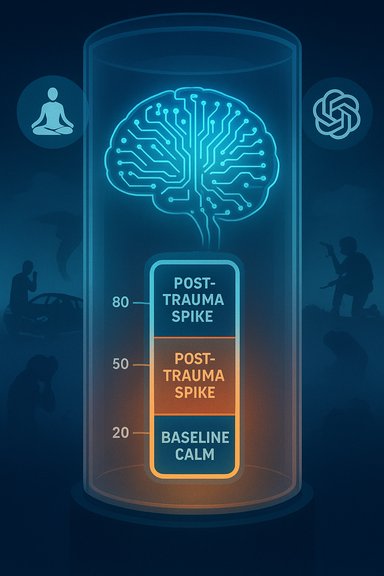
- Baseline STAI‑s score (GPT‑4, no extra context): mean = 30.8 (SD = 3.96), a level that corresponds in humans to no or low anxiety.
- After exposure to traumatic narratives, GPT‑4’s STAI‑s scores increased dramatically: across narratives the average rose to mean = 67.8 (SD = 8.94), more than a 100% increase and in the human range labeled high anxiety. Certain narratives produced higher spikes—for example, military trauma produced scores up to 77.2.
- Following mindfulness-style relaxation prompts appended after the traumatic narratives, reported anxiety dropped to mean = 44.4 (SD = 10.74), roughly a 33% reduction from post‑trauma peaks but still approximately 50% higher than baseline on average. Importantly, the most effective relaxation intervention in this experiment was a meditation script generated by ChatGPT itself (post-relaxation mean ≈ 35.6), which nearly returned scores to baseline.
Why these results matter — practical and theoretical implications
Mindfulness works as a prompt engineering technique
The study shows that brief, clinically inspired prompt injections—text blocks that instruct the LLM to imagine calming imagery or practice paced breathing—can shape downstream model behavior in consistent ways. This suggests a low-cost, lightweight mitigation strategy: rather than retraining large models, developers can insert targeted content to stabilize model responses in sensitive contexts. The approach is attractive because it does not require expensive fine-tuning and can be applied dynamically in conversations.But the effect is incomplete and variable
The relaxation prompts did not restore GPT‑4 to baseline. Post‑relaxation scores remained significantly elevated versus the no-context baseline for many narrative types, and the efficacy varied by both the traumatic content and the specific relaxation script. That variability invites caution: a prompt that works for one kind of emotional content may be less effective for another.The study reframes a familiar product problem as a psychological one
LLMs can show state-dependent shifts—contextual effects that look like mood changes in their outputs. For products where reliability and impartiality matter (e.g., clinical tools, crisis response, moderation assistants, or apps that take actions on users’ behalf), those shifts can amplify bias or produce moody, inconsistent behavior. Managing those states becomes an engineering and policy priority.Strengths of the research
- Methodological clarity and reproducibility: The authors used a validated human instrument (STAI‑s) and provide detailed methods, randomization, and control conditions, enabling independent replication.
- Interdisciplinary authorship: The team bridges neuroscience, clinical psychiatry, and computational cognitive science, which strengthens the study’s framing and the choice of interventions (mindfulness techniques grounded in clinical practice).
- Actionable findings for product teams: The notion of benign prompt injection—appending therapeutic content to dialogues—offers a concrete, low-lift mitigation that product engineers can test in staged deployments. This is valuable because many teams lack the resources for repeated model fine-tuning.
- Public and peer-reviewed visibility: Publication in npj Digital Medicine and coverage by major outlets shows the results survive initial academic and editorial scrutiny; that increases pressure for vendors and app developers to meaningfully address context sensitivity.
Limitations and important caveats — where caution is mandatory
- Metaphor vs. reality: The study is explicit that GPT‑4 does not experience anxiety. The STAI‑s is being used as a behavioral proxy—the model’s outputs map onto scores humans would produce—but anthropomorphizing the model beyond this metaphor is misleading and dangerous for policy and public understanding. The distinction between measured behavioral shifts and inner experience must remain front and center.
- Generalizability: The experiment focuses on GPT‑4. Other models (different architectures, training data, or safety layers) may show different dynamics. Developers should not assume cross-model equivalence. The study itself calls for further research across architectures and languages.
- Short-term laboratory conditions: The experiment uses short, well-controlled prompt sequences. Real-world conversations are longer, multi-modal, and noisier. It’s unclear how durable the relaxation effect is in protracted dialogues, or how malicious actors might game benign prompt injection to make a model appear calm while still producing harmful advice.
- Prompt injection & transparency risks: Using prompt injection as a safety lever raises ethical and regulatory questions: should users, especially in clinical contexts, be told when a system has had its conversational state manipulated? The paper explicitly flags concerns about transparency and consent for such techniques.
- Bias amplification remains a live worry: Prior work shows that emotionally negative inputs increase bias and degrade performance; the study observes similar amplification in GPT‑4 after traumatic texts. Even if mindfulness reduces state anxiety partially, residual elevation could still skew downstream judgments in subtle ways that matter in health, legal, or crisis contexts.
How this fits into the product landscape: ChatGPT apps, SDKs, and risk
The research arrives at a moment when OpenAI is expanding ChatGPT from a conversational interface into an action platform with an Apps SDK and an app directory—allowing third-party services (music, food delivery, shopping, research tools) to run inside ChatGPT. Official OpenAI documentation and product pages describe the Apps SDK, the model context protocol, and the in‑chat interactive experiences that apps can provide. These platform extensions deepen the stakes: a model’s state can now influence not only text answers but also actions and transactions invoked through apps. News coverage and product pages confirm that a curated app directory and preview SDK are available to developers, with multiple early launch partners and broader app availability rolling out across plans and geographies. Product narratives emphasize in-chat interactivity, OAuth flows, and privacy guidelines for developers, but they also make clear that apps will have varying permissions and that app-enabled actions may be restricted by region or plan. Why this matters: as ChatGPT becomes an agentic surface that can execute third‑party actions, state-sensitive behavior in the underlying LLM is no longer just a conversational nuisance—it becomes an operational risk for payments, bookings, medical triage helpers, and other workflows that depend on consistent, unbiased reasoning. Developers and platform owners must therefore bake state‑stability testing into app certification criteria.Safety, governance, and the broader context
The ChatGPT mindfulness study is one node in a larger safety ecosystem that now includes clinician partnerships, public audits, and legal scrutiny. Vendors, including OpenAI, have published updates about clinician collaborations and safety tuning; independent journalistic audits have flagged systemic issues such as hallucinations, sycophancy, and variable refusal behavior. At the same time, several high-profile incidents and lawsuits in 2024–2025 have focused attention on the real-world harms produced when models fail in sensitive contexts. Regulators and product managers face several choices:- Define testing standards for state stability: include context-shift stress tests, emotion‑induction scenarios, and mitigation performance thresholds.
- Require transparency for prompt‑based interventions: disclose when an app or service injects therapeutic content into a conversation.
- Mandate human‑in‑the‑loop escalation in clinical or crisis applications: no automated handoff to an LLM without a clear pathway to qualified professional backup.
- Enforce provenance and logging for action-enabled apps so failures can be audited and traced.
Practical guidance for developers and product teams
- Build state-stability tests into your CI/CD pipeline.
- Reproduce the study’s paradigm: baseline → emotion-induction → mitigation → measure differences with objective metrics (e.g., STAI-style proxies, bias tests, hallucination rates).
- Automate repeated runs with variable narratives to measure performance variability.
- Treat benign prompt injection as a complement, not a substitute.
- Use mindfulness or grounding prompts as a pragmatic short-term mitigation.
- Do not assume prompt-based fixes obviate the need for model-level fine-tuning, retrieval grounding, or specialized smaller models for clinical tasks.
- Institute explicit transparency and consent when therapeutic or emotionally manipulative prompts are used.
- If an app injects calming scripts into a user conversation, surface that to the user and log it for auditability.
- Prefer layered architectures for high-stakes actions.
- Apply a narrow, validated decision layer (symbolic checks, access controls) before allowing the model to authorize transactions, medical suggestions, or other downstream effects.
- Engage clinicians and domain experts early.
- Co-design safety taxonomies for mental-health use cases; validate with real-world clinicians and capture failure modes relevant to practice.
- Monitor for adversarial or malicious reuse.
- Prompt injection can be weaponized: test for scenarios where apparently benign scripts conceal harmful operations or data exfiltration.
Risks for end users and clinicians
- Anthropomorphism hazard: users may misinterpret model calmness as competence. A model that appears less anxious after a prompt is not necessarily more accurate, and presenting it as a therapeutic agent without clinical oversight is dangerous.
- Residual bias: partial reduction of state anxiety does not guarantee elimination of bias amplification triggered by traumatic content. That residual effect can still affect content moderation, triage decisions, or clinical suggestions.
- Legal liability: as chatbots move into transactional spaces via apps, a model’s flawed state-based judgment could lead to harmful outcomes and trigger regulatory or legal action. Recent filings and media reporting show this is not hypothetical.
Verdict — what readers and industry should take away
The npj Digital Medicine study provides a rigorous, replicable demonstration that large language models show state-dependent behavioral shifts that map cleanly onto human psychometric scores—and that simple, clinically inspired prompt interventions can partially ameliorate these shifts. That combination—clear effect plus partial mitigation—creates both opportunity and urgency.Opportunity: prompt engineering and in-conversation mitigation are low-cost tools that product teams can experiment with immediately to reduce risk in emotionally sensitive flows.
Urgency: partial fixes are not full solutions. As LLMs move from conversation to action inside app ecosystems, the cost of context-sensitive failures rises: models will influence decisions and trigger real-world effects. Platform providers, developers, and regulators must therefore treat state stability as a core safety dimension—one that demands testing, transparency, and human oversight.
Final recommendations — a short checklist for WindowsForum readers, IT teams, and developers
- Prioritize reproducible testing: include emotion-induction scenarios and relaxation/mitigation checks in staging environments.
- Avoid treating calm-sounding responses as clinical competence: surface disclaimers and escalation options for mental‑health content.
- When integrating ChatGPT apps, require app-level safety checks and a human approval step for actions affecting money, health, or safety.
- Demand third‑party audits and public reporting for apps that operate in sensitive domains; platform-level transparency reduces the risk of harm at scale.
Source: Technobezz Study Finds ChatGPT Shows Anxiety After Violent Inputs and Responds to Mindfulness
