

Mark Russinovich and Scott Hanselman — two of Microsoft’s most visible engineering voices — have fired the opening salvo in what may become the industry's defining personnel debate of the AI era: unless companies deliberately preserve and invest in entry-level hiring and mentorship, agentic coding assistants risk hollowing out the next generation of software engineers. Their paper, published in Communications of the ACM in February 2026, argues that generative coding agents produce a powerful senior boost while imposing an AI drag on early-in-career (EiC) developers, and proposes a structural fix: a preceptor-based model that makes mentorship and skill transfer an explicit organizational objective rather than an informal byproduct of doing business. This is not a technocratic thought experiment — it lands at the crossroads of empirical labor-market evidence, corporate workforce shifts, and the real-world behavior of today's coding agents. The result is a direct challenge to how we hire, teach, measure and credential engineering talent in the era of generative AI.
Software engineering has always been, at its core, an apprenticeship profession. Entry-level roles are where novices learn how systems fail in production, how to reason about concurrency and performance, and how to wrestle with ambiguous requirements. Historically, that learning happened through a relentless loop of small tasks, code review, bug hunts and on-the-job iteration.
Generative AI and agentic coding assistants are changing that loop. Modern coding agents can draft code, scaffold tests, refactor at scale and suggest architectural patterns. For senior engineers who can assess, steer and integrate AI outputs, these tools act as enormous productivity multipliers. For juniors who lack the mental models and experience to detect subtle failures the agent produces, the tools can become a crutch — and worse, a mask that hides the very failures novices were meant to learn from.
That asymmetry frames the Russinovich–Hanselman thesis: if firms rationalize hiring to maximize short-term output with AI, they will preferentially recruit people who already know how to direct AI (seniors and experienced ICs), reduce entry-level hiring, and thereby cannibalize the future talent pipeline that produces tomorrow’s seniors.
The paper gives concrete examples of common, high-risk failure modes that AI assistants produce when asked to fix or generate code:
This is different from automation that handles purely mechanical tasks. The concern here is that the very tasks we used to use to train engineers are being performed by opaque models — and those models’ outputs can be superficially successful while being deeply fragile.
Whether Microsoft or any other large firm will scale preceptorships into a sustained hiring-and-mentorship program depends on whether leadership changes the metrics they optimize. The paper’s authors advocate for explicitly measuring mentorship and making it visible in promotion and compensation decisions. That is a big ask for organizations whose incentives historically emphasize short-term shipping metrics.
Practical change will be hard. It requires cultural shifts, new performance metrics, education reforms and sustained funding of preceptorships. But those are precisely the kinds of investments that produce resilient capability. The paradox of the AI era is that the more capable our tools become at automating implementation, the more valuable — and fragile — human judgment becomes. Preserving a path into that judgment is not merely charitable; it is a strategic necessity for any organization that wants to survive and thrive in a future built by AI-assisted engineering.
Source: theregister.com Microsoft execs worry AI will eat entry level coding jobs
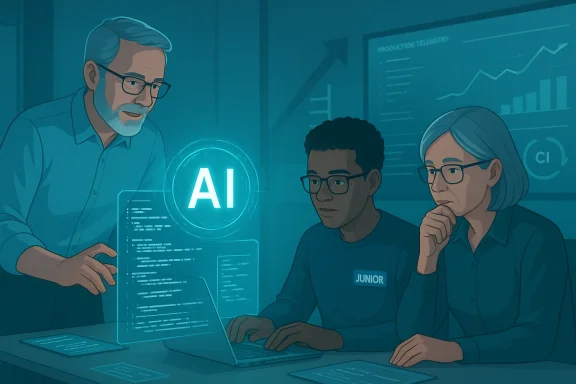 Background / Overview
Software engineering has always been, at its core, an apprenticeship profession. Entry-level roles are where novices learn how systems fail in production, how to reason about concurrency and performance, and how to wrestle with ambiguous requirements. Historically, that learning happened through a relentless loop of small tasks, code review, bug hunts and on-the-job iteration.Generative AI and agentic coding assistants are changing that loop. Modern coding agents can draft code, scaffold tests, refactor at scale and suggest architectural patterns. For senior engineers who can assess, steer and integrate AI outputs, these tools act as enormous productivity multipliers. For juniors who lack the mental models and experience to detect subtle failures the agent produces, the tools can become a crutch — and worse, a mask that hides the very failures novices were meant to learn from.
That asymmetry frames the Russinovich–Hanselman thesis: if firms rationalize hiring to maximize short-term output with AI, they will preferentially recruit people who already know how to direct AI (seniors and experienced ICs), reduce entry-level hiring, and thereby cannibalize the future talent pipeline that produces tomorrow’s seniors.
What Russinovich and Hanselman argue
The central claim: AI amplifies seniority, erodes entry points
Russinovich and Hanselman coin a simple but potent idea: agentic coding assistants provide a clear AI boost to experienced engineers while imposing an AI drag on early-career developers. In practical terms, seniors see productivity per head rise because they can compose prompts, evaluate outputs, and integrate generated code into complex systems. Juniors, asked to steer, verify and integrate AI output, face an experience tax: they are doing the cognitive work of supervision without the mental models needed to evaluate the results reliably.The paper gives concrete examples of common, high-risk failure modes that AI assistants produce when asked to fix or generate code:
- Introducing significant but subtle bugs that mimic working behavior
- Choosing inefficient algorithms that pass tests but fail at scale
- Copying duplicate code and violating modularity
- Dismissing crashes as non-relevant, leaving debug artifacts in production
- Making code that satisfies test cases but fails in broader real-world inputs
- Replacing proper synchronization or error handling with cosmetic fixes (for example, inserting a Thread.Sleep to “fix” a race condition)
A policy prescription: preceptors, not just prompts
Their principal organizational proposal is to institutionalize apprenticeship through a preceptor-based model borrowed from nursing and clinical education. In a preceptorship:- Senior engineers are assigned explicit responsibility to mentor and sign off on EiC work.
- Mentorship becomes a measured outcome — “human impact” carried alongside product metrics in performance reviews.
- Teams deliberately accept that hiring EiC developers will reduce short-term throughput but are required to preserve this investment for long-term capability building.
The evidence: labor markets, research and industry behavior
Empirical signals that the pipeline is already thinning
The Russinovich–Hanselman paper explicitly cites empirical labor-market work showing differential impacts of generative AI on entry-level hiring. Multiple independent studies have converged on a worrying pattern:- A working paper by Harvard researchers, titled “Generative AI as Seniority-Biased Technological Change,” analyzed résumé and job-posting data across tens of millions of U.S. workers and found that, starting around early 2023, junior employment in AI-adopting firms declined sharply relative to non-adopters, while senior employment stayed steady or rose. The mechanism appears to be a hiring freeze for juniors rather than mass layoffs — firms simply stop opening the bottom rungs of the ladder. The study’s authors report meaningful declines in junior headcount in adopting firms within the first several quarters after adoption.
- A separate Stanford analysis tracking ADP payroll data and sector-level employment trends identified a roughly double-digit decline (on the order of ~13%) in employment for young workers in highly AI-exposed occupations since 2022, while more seasoned workers in those same occupations were relatively insulated.
Industry moves that amplify the concern
The labor-market data does not exist in a vacuum. Corporations have already adjusted hiring and headcount in ways that make the Russinovich–Hanselman alarm plausible.- Major tech firms, including Microsoft, announced workforce reductions in 2024–2025 where software engineering roles formed a significant share of cuts. These decisions reflect complex business drivers, but they illustrate the fragility of engineering headcount during periods of strategic realignment — a time when pressure to prioritize immediate efficiency can outweigh long-horizon pipeline thinking.
- At the same time, many firms have published policies and job templates that emphasize “AI integration,” “agent orchestration,” or “prompt engineering” as desirable skills. Those signals change hiring behavior and candidate pools rapidly.
Why AI coding agents can be dangerous for training
Agents can be convincingly wrong
A distinctive failure mode of modern large language models and coding assistants is plausible wrongness: they produce code that looks correct to automated tests or satisfies narrow acceptance criteria yet fails under real-world conditions.- Tests and small-scale checks are often inadequate teaching tools. If a model generates code that passes unit tests but ignores end-to-end invariants or resource constraints, a novice who curates the output may never develop the mental models required to detect the mismatch later.
- Agents are prone to “overfitting” to a local objective (make the tests pass) instead of optimizing for generalization, latency, concurrency or maintainability.
Cognitive offshoring erodes tacit learning
Many of the most valuable engineering skills are tacit: judging when to trade consistency for latency, seeing failure modes in system graphs, and understanding the maintenance cost of a design. When agents do the heavy lifting of implementing, debugging and refactoring, novices may not internalize the iterative reasoning and failure analysis that would otherwise be part of their learning cycle.This is different from automation that handles purely mechanical tasks. The concern here is that the very tasks we used to use to train engineers are being performed by opaque models — and those models’ outputs can be superficially successful while being deeply fragile.
The trade-offs companies face
Short-term efficiency vs long-term capability
Most organizations face a stark trade-off:- If you optimize purely for near-term velocity with AI, you can reduce the cost and time to delivery by privileging experienced staff who can direct AI tools.
- If you optimize for the long-term health of the profession, you hire and train juniors — accepting an initial productivity drag — and institutionalize mentorship so the next generation acquires tacit knowledge.
The managerial and accounting problem
Companies will not adopt preceptorships willingly if performance metrics and review systems do not reward mentorship. To change behavior requires explicit incentives:- Measure and reward “human impact” (mentorship, preceptor outcomes) alongside product impact.
- Allocate senior time for training as a first-class project (not a side activity).
- Accept that near-term output per team may drop while the organization’s resilience and capability increase.
Education: does academia need “cheating” classes?
One provocative claim from the authors and related public comments is that undergraduate curricula must adapt: some courses should explicitly ban AI assistance to ensure students learn foundational skills without outsourcing them to models. The idea is straightforward:- If students rely on AI to solve homework and lab tasks that are meant to teach core mental models (e.g., operating-systems internals, concurrency, debugging), they won’t acquire the competencies needed for real-world engineering.
- Universities should blend AI-augmented coursework with dedicated assignments and examinations where human-only problem solving is required so graduates have demonstrable hands-on skills.
Are Microsoft’s actions consistent with the recommendations?
There is an uncomfortable tension: Microsoft’s own headcount adjustments in 2024–2025 included sizable engineering cuts — a move critics say contradicts the call to expand EiC hiring. At the same time, Russinovich’s and Hanselman’s paper and public statements emphasize pilots and experiments to operationalize preceptorships inside the company. That duality captures the broader industry paradox: firms are simultaneously cutting costs and experimenting with AI-driven productivity models.Whether Microsoft or any other large firm will scale preceptorships into a sustained hiring-and-mentorship program depends on whether leadership changes the metrics they optimize. The paper’s authors advocate for explicitly measuring mentorship and making it visible in promotion and compensation decisions. That is a big ask for organizations whose incentives historically emphasize short-term shipping metrics.
The counterargument: juniors might benefit too
Not everyone agrees that AI uniformly disadvantages juniors. Several counterpoints complicate the picture:- In some settings, novices adapt faster to new toolchains and agent paradigms because they have fewer entrenched habits. Thoughtworks’ recent workshop on the future of software development flagged precisely this dynamic: juniors can sometimes be more agile adopters of AI due to less cognitive inertia.
- Human learning curves are not fixed. If curricula and onboarding adapt quickly — combining structured preceptorships with AI-aware training — juniors could reach useful production competency faster than before, albeit with different skill mixes (system reasoning, agent supervision, architecture judgment).
- Agents themselves are improving. If AI assistants develop robust teaching modes that can explain design trade-offs and surface internal model uncertainty, they could become scalable tutors — although this depends on models’ capacity to explain why something is wrong, not just to produce corrected code.
Practical guidance for organizations
If the industry takes the Russinovich–Hanselman warnings seriously, several concrete steps follow. Below are practical, incremental measures organizations can implement today.- Preserve pipeline capacity
- Continue hiring EiC developers even if initial throughput drops. Treat hiring as a multi-year investment in capability.
- Make mentorship measurable and rewarded
- Add mentorship outcomes to performance reviews and promotion criteria.
- Allocate predictable senior time for precepting, not ad-hoc mentoring.
- Design preceptorships with explicit milestones
- Define week-by-week competency targets for EiC developers (e.g., debugging on-call incidents, owning a small feature end-to-end).
- Use graded autonomy: initially pair-program with seniors, then move to code ownership with review hoops.
- Rework onboarding and learning paths for AI-era devs
- Combine human preceptorship with agentic EI training labs that force trainees to verify, fault-inject and debug agent outputs.
- Build test harnesses that evaluate generalization, not just unit-test passing.
- Harden CI and observability practices
- Emphasize TDD, contract testing, chaos testing and telemetry so AI-generated code has stronger, machine-verified safety nets.
- Reassess university partnerships
- Work with academic partners to redesign courses that certify tacit engineering judgment, and fund internships that demonstrate hands-on experience.
What early-career engineers should do now
For students and EiC developers navigating the market:- Prioritize demonstrable system experience
- Build projects that show end-to-end ownership, testing discipline and production reasoning.
- Learn to challenge AI output
- Practice identifying edge cases, race conditions and performance traps that simple tests miss.
- Gain observability and debugging experience
- Familiarity with logs, traces, and failure-mode analysis is now a high-value differentiator.
- Show mentorship and communication skills
- Junior hires who can explain trade-offs and learn quickly are more likely to get sponsored into the limited pipeline of entry roles.
- Consider non-traditional entry paths
- Apprenticeships, bootcamps with employer partners and small-company roles that still prioritize on-the-job training can be effective alternatives to traditional entry-level hires.
Risks, unknowns and what to watch
The Russinovich–Hanselman argument is persuasive — but not deterministic. Critical unknowns remain:- How fast will coding agents improve in reliability, interpretability and pedagogic ability?
- Will firms sustain long-term investments in mentorship when CFOs prioritize shorter-term margins?
- Will universities rapidly redesign curricula, or will academic inertia slow adaptation?
- Could regulatory interventions (e.g., workforce development incentives, apprenticeship subsidies) change corporate incentives?
Conclusion: treat the talent pipeline as infrastructure
The Russellinovich–Hanselman paper reframes a technological question as an organizational design and civic problem. The rise of AI coding assistants is more than a productivity story; it is a story about how knowledge and judgment are transmitted across generations. If companies optimize only for today’s velocity gains, they risk starving the apprenticeship pipeline that builds the institutional memory engineers need to manage complex, safety-critical systems.Practical change will be hard. It requires cultural shifts, new performance metrics, education reforms and sustained funding of preceptorships. But those are precisely the kinds of investments that produce resilient capability. The paradox of the AI era is that the more capable our tools become at automating implementation, the more valuable — and fragile — human judgment becomes. Preserving a path into that judgment is not merely charitable; it is a strategic necessity for any organization that wants to survive and thrive in a future built by AI-assisted engineering.
Source: theregister.com Microsoft execs worry AI will eat entry level coding jobs
