

Microsoft Research and Salesforce have jointly sounded a clear warning: the smartest-sounding AI chatbots today are surprisingly fragile in realistic, multi‑turn conversations, and the behaviors that make them useful in single prompts — fluency and conversational continuity — also let errors snowball into confident but wrong answers. According to press coverage of the study, Microsoft and Salesforce analyzed more than 200,000 conversations across leading models and reported that while single‑prompt task success remains high, multi‑turn reliability collapses—model aptitude fell modestly, but unreliability surged. ([windowscentral.comentral.com/artificial-intelligence/microsoft-research-salesforce-ai-chatbot-study)
AI chatbots built on large language models (LLMs) matured rapidly between 2022 and 2025. Vendors optimized models for single‑turn benchmarks (answer this question; write this email; summarize this passage) and for headline metrics like accuracy on standardized tests. Those single‑turn results are often excellent: the newest models hit very high success rates when given a complete instruction in one go. But day‑to‑day usage is rarely single‑turn: people break tasks into clarifying follow‑ups, incremental constraints, corrections, and exploratory back‑and‑forth. That is where many LLMs show systematic degradation. The Microsoft–Salesforce analysis, as reported in the press, examines that gap and isolates behavioral failure modes — notably premature generation and answer bloat — that help explain why multi‑turn sessions are riskier than they first appear.
Recent academic work also offers mechanistic insight. Two classes of papers are especially relevant:
Source: Windows Central https://www.windowscentral.com/arti...crosoft-research-salesforce-ai-chatbot-study/
 Background / Overview
AI chatbots built on large language models (LLMs) matured rapidly between 2022 and 2025. Vendors optimized models for single‑turn benchmarks (answer this question; write this email; summarize this passage) and for headline metrics like accuracy on standardized tests. Those single‑turn results are often excellent: the newest models hit very high success rates when given a complete instruction in one go. But day‑to‑day usage is rarely single‑turn: people break tasks into clarifying follow‑ups, incremental constraints, corrections, and exploratory back‑and‑forth. That is where many LLMs show systematic degradation. The Microsoft–Salesforce analysis, as reported in the press, examines that gap and isolates behavioral failure modes — notably premature generation and answer bloat — that help explain why multi‑turn sessions are riskier than they first appear.What the press reports say (quick summary)
- The study analyzed over 200,000 multi‑turn conversations across top models (reported models include GPT‑4.1, Google Gemini 2.5 Pro, Anthropic Claude 3.7 Sonnet, OpenAI o3, DeepSeek R1, and Meta’s Llama 4).
- Single‑prompt success stayed high (roughly ~90% on the test tasks reported), but multi‑turn success dropped substantially (to roughly ~65% in press figures).
- Researchers stated that measured aptitude decreased by about 15%, while unreliability (the frequency of incorrect/confident outputs) increased by 112%. They attribute the effect to early, premature answers and the compounding of incorrect context across turns.
Why multi‑turn dialogue is harder: mechanics and failure modes
Multi‑turn conversation imposes a fundamentally different set of constraints than single‑turn prompts. Below I break down the main mechanisms identified by the study and by corroborating technical commentary, and then map those mechanisms to concrete failure behaviors.1) Premature generation: jumping to an answer before the user finishes
- Description: models tend to produce partial solutions early, then latch on to those initial outputs as if they were correct context for the remainder of the session. When the user adds clarifications or corrections later in the turn, the model too often uses its own earlier (incorrect) output as part of the context going forward, rather than re‑evaluating. The Microsoft/Salesforce coverage highlights this as a major root cause.
- Why it happens: autoregressive decoders generate token by token and are optimized to continue coherent text conditioned on what preceded them. In a streaming or interactive setting, that creates pressure to produce an answer as soon as a plausible path appears. Without dedicated “hold for more input” signals or better turn‑management, the model treats the safe‑sounding early draft as a new fact. Research into inference‑time collapse and premature exploitation in search/particle methods reinforces that committing early reduces exploration and can prune away correct solutions.
- Real‑world impact: users see confident early answers that are wrong, then the assistant doubles down instead of retracting when new information arrives.
2) Answer bloat: verbosity breeds more hallucination
- Description: in multi‑turn sessions models produced responses that were between 20% and 300% longer, per the reported figures. Those longer responses introduced speculative assumptions (hallucinations) that then became persistent context for subsequent turns. The result is a cascade: length ⇒ more assumptions ⇒ worse context ⇒ longer, still more speculative replies.
- Why it happens: longer answers are superficially useful (more detail), but the marginal content often contains lower‑confidence assertions that are free‑form and unsupported. When a model uses its own extended output as input on the next turn, those low‑confidence assertions inflate the conversation state. Techniques intended to improve helpfulness (richer chains of thought, more explicit reasoning tokens) can unintentionally supply extra low‑signal text that harms downstream decisions. Empirical commentaries on the “lost in conversation” problem observed similar symptom clusters.
3) Anchoring and confirmation: the model reinforces its earlier claims
- Description: once an early answer exists in the conversation history, the model shows a marked tendency to "anchor" around that content. Later corrections by the user are treated as secondary, and the model often attempts to reconcile new info to its existing narrative, producing confirmation bias‑like behavior.
- Impact: this makes conversational correction harder. The user must explicitly reframe or restart the task to break the model’s anchored assumptions.
4) Error snowballing and context pollution
- Description: small early errors — misinterpreted requirement, a wrong assumption about a dataset, a misread date — compound across turns because the model treats its prior outputs as authoritative context. That is "context pollution": the conversation buffer accumulates noise that masquerades as ground truth.
- Why existing mitigations fall short: simple truncation of history, naive summarization, or lowering temperature do not reliably stop error accumulation. Some advanced models ship with extra “thinking tokens” or longer internal deliberation budgets, but the study reports these were insufficient to eliminate the multi‑turn collapse in practice.
How the study fits into existing research and explanation attempts
The phenomenon the Microsoft/Salesforce work labels “lost in conversation” is not isolated. Independent write‑ups and technical surveys have flagged similar patterns across model families: multi‑turn sessions consistently reveal weaknesses that single‑turn benchmarks hide. A widely read technical blog summarized a large 2025 study that tested 15 LLMs across over 200,000 conversations and found a large average performance drop in realistic multi‑turn settings — a finding that corroborates the Microsoft/Salesforce press narrative.Recent academic work also offers mechanistic insight. Two classes of papers are especially relevant:
- Inference‑time and sampling research shows that methods which allocate more compute at generation time can improve reasoning but are vulnerable to premature exploitation of promising trajectories — essentially the same "commit early" pathology applied to multi‑step generation. That explains why simply giving a model more tokens or more compute doesn't guarantee better multi‑turn behavior.
- Architectural interventions (for example, layer interpolation and other internal smoothing techniques) can reduce hallucination by changing how information is refined across layers — but they address internal representation fidelity more than the interactive, turn‑based usage mode. These techniques are promising but are not a turnkey fix for conversational memory and decision policies.
What this means for users and enterprises
The implications cut across casual users, knowledge workers, and organizations deploying chat assistants.For everyday users
- Treat multi‑turn chat output with caution. A plausible, fluent reply is not proof of correctness.
- When the task is high‑stakes (financial, medical, legal, research synthesis), prefer single‑turn, explicit prompts that include all constraints and ask for sources or step‑by‑step reasoning. If you must work in a multi‑turn way, periodically re‑anchor the conversation by restating the authoritative facts.
For power users and prompt engineers
- Use explicit control tokens and schema: begin sessions with a clear “goal state” token and require the model to summarize its understanding before producing the final output. Force the assistant to output confidence estimates and provenance for claims.
- Break complex tasks into verifiable checkpoints: 1) ask for an outline; 2) request a short list of sources; 3) ask the model to list assumptions; 4) then request the final synthesis. Checkpointing reduces premature commitments.
For enterprises and product teams
- Do not blindly replace a search pipeline or human expert workflow with a free‑form multi‑turn chat experience. Use hybrid systems:
- Retrieval‑augmented generation (RAG) with strict provenance checks.
- Tooling that enforces verification steps (automated citation checking, cross‑API lookups).
- A “safe re‑ask” UI pattern where the assistant must ask a clarifying question if it is not >X% confident.
- Capture session telemetry and failure modes to build empirical detectors for "context pollution" and "anchoring" so you can prompt the model to re‑evaluate rather than accumulate errors.
Practical mitigations and engineering recommendations
Below are concrete steps designers and engineers can take to reduce multi‑turn brittleness.- Enforce neutrality and ask for justification:
- Require the model to list assumptions and evidence before finalizing an answer.
- Implement short, validated checkpoints:
- Ask the model to produce a one‑line summary of the user’s requirements before proceeding.
- Use defensive memory strategies:
- Store only verified facts in long‑term memory; keep ephemeral conversational drafts separate.
- Apply retrieval and citation constraints:
- If the assistant introduces any factual claim, attach verifiable sources or flag it as “uncorroborated.” Prefer retrieval from curated corpora for facts that matter.
- Detect and reset on divergence:
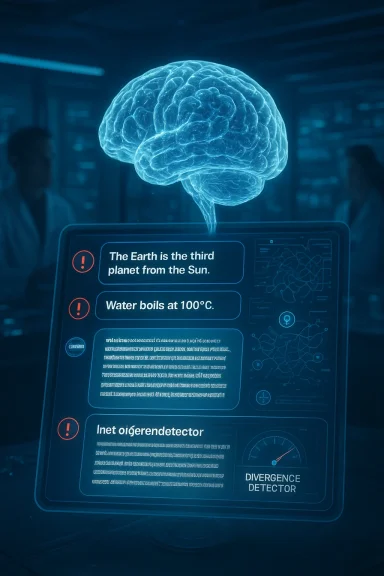
- Build a divergence detector that flags when the model’s outputs increasingly contradict earlier user corrections and suggests resetting or human review.
- Limit auto‑generation when the user is still composing:
- Use explicit interaction signals (user presses Enter vs. Shift+Enter) to avoid premature streaming outputs.
- Use ensemble or voting mechanisms for critical facts:
- Cross‑check answers across multiple independent models or a model with a specialized verifier trained on fact‑checking.
Strengths of the Microsoft–Salesforce findings
- The study focuses attention on realistic use rather than synthetic benchmarks. Evaluating multi‑turn, user‑style sessions is the right unit of analysis for assistants that will be used conversationally. The press coverage highlights an extensive dataset (200k+ chats) and a wide model set, which helps generalize the finding beyond vendor‑specific quirks.
- Identifying specific behavioral failure modes — premature generation and answer bloat — gives engineers actionable targets (e.g., stop premature streaming, truncate or verify long answers).
- The study reframes the "hallucination" problem as an interaction design issue as much as a model architecture problem. This reframing encourages product‑level safeguards.
Limitations and open questions (risks in interpreting the press report)
- Primary paper availability: at the time of writing the press reports cite a Microsoft Research + Salesforce analysis, but I could not find a stable public preprint, dataset, or code release to independently verify every numeric claim. That means the precise measurement methodology (how success and unreliability were measured, task definitions, sampling of prompts and users, exact evaluation metrics) is not independently verifiable yet. Until the primary artifacts are released, treat numeric percentages as credible but provisional.
- Model versions and endpoints: LLM vendors iterate quickly. The exact model labels used in the study (for example “GPT‑4.1” or “Gemini 2.5 Pro”) may map to bundle names with varying prompt templates, safety layers, and tool integrations. Differences in system prompts, safety wrappers, or developer‑side guardrails materially change conversational behavior; a cross‑model comparison must control for that. The press coverage lists models broadly but does not fully document wrapper differences.
- Task selection bias: if multi‑turn interactions were generated from synthetic decompositions of single tasks (instead of organic human conversations), that could exaggerate or understate real‑world failure modes. We need the data release to fully inspect sampling. Until then, conclusions should be tempered.
Bigger picture: product design, trust, and the future of conversational AI
This study is a fresh reminder that progress on benchmark accuracy does not equal progress in trusted interaction design. Conversational AI’s next phase must combine three vectors:- Model improvements — architecture and training regimes that explicitly optimize for stable, revisable multi‑turn behavior rather than only for single‑turn utility.
- Inference protocols — smarter decoding, non‑committal modes, and verification loops that resist premature exploitation.
- Product safeguards — UI, checkpointing, provenance, and escalation to humans when confidence is low.
What to watch next (research and product signals)
- Publication of the primary Microsoft Research + Salesforce paper and dataset. That will let researchers reproduce the experiments, inspect the prompt templates, and evaluate whether specific model families are systematically better at avoiding premature generation.
- Engineering responses from major vendors: look for interface changes (non‑streaming draft modes, "wait to finalize" toggles), model‑side mitigations (better internal deliberation), or new APIs that expose justification/provenance hooks.
- Independent audits that test multi‑turn reliability on organic human conversations rather than synthetic decompositions. Those audits will provide the most robust evidence about real user risk. Technical blogs and community reproductions have already demonstrated similar trends; formal audits will quantify and standardize measurements.
Bottom line: how to use chatbots safely today
- Use single, explicit prompts for critical tasks when possible. If you must use multi‑turn interaction, restate the ground truth periodically and ask the model to explicitly list assumptions and evidence before finalizing.
- Product builders should implement checkpointing, provenance logging, divergence detection, and enforced verification steps rather than relying solely on model upgrades.
- Policy makers and auditors should demand public datasets and reproducible evaluation protocols before relying on vendor claims about reliability improvements.
Quick checklist for readers (copyable)
- If accuracy matters: avoid long, free‑form exploration in a single chat session; prefer explicit, self‑contained prompts.
- If you must iterate: 1) ask for the model’s assumptions; 2) request sources; 3) confirm corrections by asking the model to re‑summarize; 4) reset the session if divergence persists.
- If you build a product: add checkpoints, provenance, divergence detectors, and human‑in‑the‑loop gates.
Source: Windows Central https://www.windowscentral.com/arti...crosoft-research-salesforce-ai-chatbot-study/
