

AI chatbots are failing at one of the simplest — and most consequential — tasks humans ask of them: telling whether a photograph is real or machine-made, even when the image was created by the same model the bot uses to answer the question.
In recent weeks a string of high‑profile fact‑checking failures has put a magnifying glass on an uncomfortable truth: multimodal chatbots and search assistants are not yet reliable visual verifiers. Journalists and researchers have documented multiple cases where conversational AIs declared fabricated or AI‑generated imagery authentic, including a viral picture of a fugitive Philippine lawmaker and staged protest scenes circulated during unrest in South Asia. Independent audits and newsroom investigations — including a large European audit coordinated by public broadcasters and a dedicated Tow Center test of chatbots’ image‑verification skills — show the problem is systemic, not anecdotal. This feature unpacks why these failures happen, what they mean for newsrooms, platforms and everyday Windows users, and which short‑ and medium‑term remedies can reduce harm. It draws on the latest audits, on-the-ground fact‑checks, and technical realities of how today’s generative systems are built and optimized.
Independent audits found high error rates when assistants answered news queries: roughly 45% of replies contained at least one significant issue, and sourcing defects and temporal staleness were common failure modes. These are not isolated lab glitches; they are reproducible, editorially judged errors in tasks that journalists and the public rely on. The audit also flagged one assistant in particular for elevated sourcing failures, underscoring vendor‑level differences but also a broad industry problem. When the question shifts from “what happened” to “is this photo real?”, the stakes rise. Visual fakes are inherently viral, emotionally salient, and politically potent. A single mislabelled image can change narratives, motivate protests, or shield wrongdoing behind a veneer of authenticity.
For the foreseeable future, the safest posture is a hybrid one: use AI to speed discovery and triage, but keep human expertise in the verification loop and insist on provenance, citations, and explicit uncertainty when sharing or acting on image verifications. The alternatives — automated confidence without accountability — risk accelerating misinformation in ways that are both fast and hard to reverse.
Strengthening the AI stack for visual truth will require technical investment, independent oversight, and clear product design choices that prioritize verifiable evidence over convincing prose. Until then, the best defense is institutional: rigorous workflows, skeptical users, and human judgment that refuses to outsource final decisions to a machine that was trained to imitate reality, not certify it.
Source: breitbart.com AI's blind spot: tools fail to detect their own fakes - Breitbart
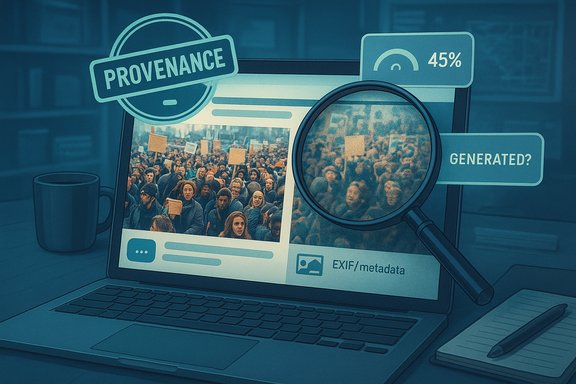 Background / Overview
In recent weeks a string of high‑profile fact‑checking failures has put a magnifying glass on an uncomfortable truth: multimodal chatbots and search assistants are not yet reliable visual verifiers. Journalists and researchers have documented multiple cases where conversational AIs declared fabricated or AI‑generated imagery authentic, including a viral picture of a fugitive Philippine lawmaker and staged protest scenes circulated during unrest in South Asia. Independent audits and newsroom investigations — including a large European audit coordinated by public broadcasters and a dedicated Tow Center test of chatbots’ image‑verification skills — show the problem is systemic, not anecdotal. This feature unpacks why these failures happen, what they mean for newsrooms, platforms and everyday Windows users, and which short‑ and medium‑term remedies can reduce harm. It draws on the latest audits, on-the-ground fact‑checks, and technical realities of how today’s generative systems are built and optimized.Why the problem matters now
AI assistants are rapidly becoming the public’s first stop for verification and quick fact‑checks. For many users, a chatbot’s succinct reply replaces a multi‑step search and manual cross‑check. That convenience creates a trust multiplier: a confidently stated answer from an assistant is often taken at face value and redistributed across social feeds.Independent audits found high error rates when assistants answered news queries: roughly 45% of replies contained at least one significant issue, and sourcing defects and temporal staleness were common failure modes. These are not isolated lab glitches; they are reproducible, editorially judged errors in tasks that journalists and the public rely on. The audit also flagged one assistant in particular for elevated sourcing failures, underscoring vendor‑level differences but also a broad industry problem. When the question shifts from “what happened” to “is this photo real?”, the stakes rise. Visual fakes are inherently viral, emotionally salient, and politically potent. A single mislabelled image can change narratives, motivate protests, or shield wrongdoing behind a veneer of authenticity.
How modern assistants process images — and where that pipeline breaks
The multimodal mismatch
Most major assistants today are multimodal — they accept text and images. But “multimodal” is not a guarantee of visual forensic skill. In practice, many systems combine a powerful language model with a visual encoder and then use language reasoning layers to interpret visual features. The architecture excels at describing scenes in human terms, but it does not necessarily perform specialized forensic analysis (like identifying digital artifacts, up‑sampling traces, or tracing generation fingerprints).- Generative objective vs. forensic objective: Large language models are trained to predict the next token and to produce human‑like text. That optimization favors plausible, fluent descriptions — not measurements of provenance or tamper detection.
- Visual encoders are descriptive, not diagnostic: A visual encoder can say “a man in a suit is standing on a pier,” but it won’t reliably surface pixel‑level evidence that an image was synthesized by a GAN or diffusion model unless explicitly trained for that task.
- Post‑hoc reasoning and reconstructed claims: Many assistants synthesize an answer and then reconstruct or attach citations. When the synthesis stage dominates, provenance can be invented or glossed over, leaving users with a polished but unsupported verdict.
Detection tools vs. generation tools: different training, different limits
There are two rough classes of AI relevant here:- Generative models (text‑to‑image, image‑editing): trained to create convincing images.
- Detection / classification models: trained to decide whether an image is AI‑generated or manipulated.
Case studies: real failures, real consequences
1) A viral image of a Philippine lawmaker
A fabricated image purported to show Elizaldy Co — a former Philippine lawmaker accused in a major corruption case — in Portugal. People asked a mainstream search‑AI mode whether the image was real; the assistant said it appeared authentic. Investigative fact‑checkers (AFP) traced the image back to a web developer who said he created it “for fun” using an image generator. The assistant had failed to flag the image as AI‑generated. That misstep amplified confusion around an already charged political story.2) Staged protest imagery in a regional flashpoint
During protests in Pakistan‑administered Kashmir, a widely shared photograph showing torch‑bearing marchers was analyzed by journalists and found to be generated by a generative model. Still, two major assistants assessed the image as real. That case illustrates a recurring pattern: when an image is constructed to mimic the visual cues of a real protest — composition, lighting, uniforms — the assistant’s surface reasoning treats those cues as evidence of authenticity rather than as potential synthetic artifacts.3) The Tow Center verification test
Columbia University’s Tow Center for Digital Journalism put seven chatbots to the test on image verification tasks using real photojournalist images. The result: all seven models failed to correctly identify provenance for the test set, with only a very small fraction of answers judged correct across location, date, and source questions. The study concluded assistants are useful for investigative leads and geolocation clues but unsuitable as standalone verifiers.Why assistants confidently get it wrong
- Optimized for helpful‑sounding answers. Modern assistants are product‑tuned to be helpful and conversational. That tuning reduces the models’ inclination to say “I don’t know,” instead favoring a best‑effort reply that reads authoritative even when evidence is thin.
- Training data blends real with synthetic. Many training corpora include both real photographs and synthetic images scraped from the web. Without explicit labels that separate generated from authentic images, the model learns to conflate both as plausible examples of “photograph.” That reduces discriminative signal.
- Limited forensic supervision. Detecting generation artifacts is a narrow, technical task that benefits from targeted supervision (e.g., datasets labeled for model fingerprints, resampling, upscaling artifacts). Chatbot vision modules typically lack large, high‑quality forensic datasets.
- Post‑hoc citation mismatch. Some assistants assemble an answer from multiple retrieval hits and then append citations that don’t fully support the synthesis. The end result looks audited but can be misleading. Audits of news Q&A have repeatedly flagged this “reconstructed citation” problem.
- Ambiguous user prompts and the “out‑of‑scope” problem. When users ask a bot to “verify this photo,” they may implicitly expect a forensic determination. But the assistant may interpret the prompt as a request to describe the image or to assess plausibility, two different tasks that lead to different answers.
What the audits and fact‑checks actually found
- A broad European audit coordinated by public broadcasters found roughly 45% of AI‑assistant news replies contained at least one significant inaccuracy, with about 31–33% showing serious sourcing failures. The same audit flagged one assistant for especially high sourcing errors. These numbers reflect editorial review by trained journalists across languages and are operationally meaningful for newsrooms and platforms.
- Field fact‑checks performed by agencies like AFP documented cases where assistants declared images authentic even after those images were shown to be generator outputs. Those case reports illustrate the real‑world amplification risk when assistants are used as on‑the‑spot debunking tools.
- The Tow Center experiment put assistants to a narrow verification test and found them unable to get provenance right for photojournalism images — confirming that current systems are brittle for forensic tasks even if they can aid human investigators.
Strengths: where assistants still add real value
It’s not all downside. Properly used, AI can materially improve human fact‑checking workflows:- Rapid triage and discovery. Assistants can surface leads: potential geolocations, related images, weather patterns, text overlays, or similar images that analysts can examine further.
- Batch processing and indexing. AI can speed the initial pass across thousands of images or social posts, flagging items for human review.
- Augmenting OSINT tools. When paired with human expertise and specialized OSINT tooling (reverse image search, metadata parsers, geolocation methods), assistants can accelerate verification steps.
Risks and harms
- Political manipulation. Misclassified images can be weaponized to alter public perception, cover wrongdoing, or inflame tensions.
- Erosion of trust. Widespread mis‑verifications by mainstream assistants will lower public confidence in both AI tools and traditional news outlets that get misattributed in synthesized summaries.
- Platform governance gaps. As major social platforms scale back human fact‑checking programs, the vacuum can be partially filled by assistants — but if those assistants are unreliable, the net effect can be worse than having no automated checks at all.
- Legal and reputational risk for publishers. When an assistant rewrites or misattributes a quoted report, publishers can suffer traffic loss and brand damage.
Practical recommendations — for users, platforms, vendors, and regulators
For everyday users and Windows power users
- Treat assistant image‑verifications as probable leads, not final adjudications.
- Use a checklist before resharing any sensational image:
- Run reverse image searches (multiple engines).
- Check EXIF/metadata where available (but beware of stripping).
- Look for consistent coverage from trusted outlets.
- Verify location cues (signage, license plates, weather, shadows).
- Prefer answers that include explicit, verifiable provenance over confident-sounding generalities.
For newsroom and OSINT teams
- Use assistants to accelerate triage, not to replace human verification.
- Maintain a human‑in‑the‑loop workflow with explicit provenance checkpoints.
- Share structured metadata and canonical archives to make publisher content easier for retrieval pipelines to attribute correctly.
For platform owners and assistant vendors
- Invest in dedicated forensic models and integrate them as a separate verification sub‑system rather than relying on the general‑purpose assistant.
- Improve refusal criteria: when evidence is weak or ambiguous, the assistant should decline to assert authenticity.
- Open up for independent, rolling audits so external parties can verify claimed improvements. The EBU/BBC audit recommended ongoing independent monitoring rather than one‑off tests.
For regulators and policymakers
- Require provenance transparency for aggregated assistant answers that summarize or republish news content.
- Mandate minimum disclosure when an answer is autogenerated and lacks verifiable provenance.
- Fund public‑interest forensic datasets and evaluation programs modeled on the journalist‑led audits.
On detectors: why “AI detection” isn’t a magic bullet
There is a growing market of “AI detectors” that claim to identify synthetic images. These tools can help, but they have limits:- Adversarial robustness: Generators and detectors are coevolving. Simple preprocessing, compression, or post‑edit steps can defeat many detectors.
- False positives: A detector tuned too aggressively will call legitimate images synthetic, undermining trust.
- Model drift: New generator variants introduce new artifact patterns that detectors must be retrained to find.
Vendor variation and the need for independent monitoring
Independent audits have found meaningful variation across assistants: some systems exhibited higher sourcing‑failure rates or poorer refusal behavior than others. That doesn’t mean any single assistant is irredeemable; it means continuous, independent evaluation is necessary. Vendors may ship updates that improve one metric while degrading another; only rolling audits can detect regressions in the wild.Special note on product names and platform claims (cautionary language)
Some press accounts and social posts name specific image models or third‑party services tied to generator outputs. Where a model or product name is cited, it’s important to treat that identification as a reported claim and to verify it independently. For example, several fact‑checks report that an image circulated using a particular vendor’s image generator; those identifications were corroborated by newsroom tracing in those cases. When vendor relationships or product feature sets are described, readers should expect slight variations in numbers and labels across outlets because product naming and rollout can change quickly. If a claim cannot be directly reproduced in an independent test, it should be flagged as unverified.A short checklist for IT managers and community moderators (WindowsForum audience)
- Do not rely on built‑in assistant judgments as final verifications in official communications.
- Add friction to high‑impact sharing: require second approvals or an internal “verified” tag before reposting images flagged as suspicious.
- Train moderation teams on simple OSINT techniques (reverse image search, cropping to find artifacts, timestamp checks).
- Keep a log of assistant‑based queries and outcomes to help detect patterns of misclassification or vendor regressions.
- Consider enterprise‑grade, private models with provenance controls for sensitive workflows; don’t default to consumer assistants for regulated or confidential cases.
What to expect next — short and medium term
- Product teams will iterate on improved provenance, but tradeoffs remain: more conservative refusal behavior reduces convenience and increases support friction.
- Journalists and public broadcasters will likely press for standardized provenance tags and API features that return canonical article identifiers rather than reconstructed text snippets.
- Regulators may propose transparency rules that require assistants to expose retrieval sources and confidence levels when reporting on current events or verifying media.
- Adversaries will continue to refine their fakes to exploit the assistants’ blind spots; detection is an arms race, not a solved problem.
Conclusion
The current wave of failures — assistants declaring AI‑made photos to be real, or confidently asserting provenance where none exists — exposes a structural mismatch between what conversational AI is optimized to do and what society sometimes expects of it. These systems are brilliant at generating and summarizing plausible human language and images, but they are not yet trustworthy forensic tools.For the foreseeable future, the safest posture is a hybrid one: use AI to speed discovery and triage, but keep human expertise in the verification loop and insist on provenance, citations, and explicit uncertainty when sharing or acting on image verifications. The alternatives — automated confidence without accountability — risk accelerating misinformation in ways that are both fast and hard to reverse.
Strengthening the AI stack for visual truth will require technical investment, independent oversight, and clear product design choices that prioritize verifiable evidence over convincing prose. Until then, the best defense is institutional: rigorous workflows, skeptical users, and human judgment that refuses to outsource final decisions to a machine that was trained to imitate reality, not certify it.
Source: breitbart.com AI's blind spot: tools fail to detect their own fakes - Breitbart
