

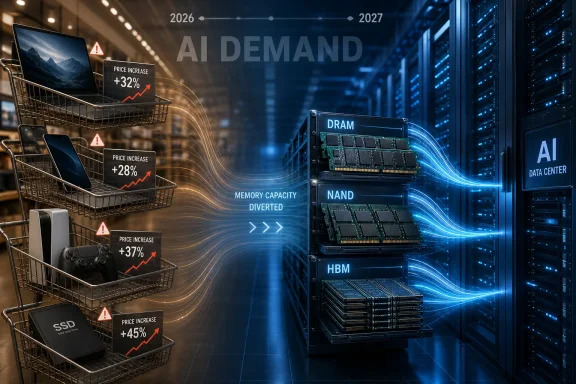
In 2026, analysts and industry suppliers say the AI data-center buildout is diverting memory-chip capacity away from consumer electronics, with TF International Securities analyst Ming-Chi Kuo estimating that 15% to 20% of consumer-device memory allocation could shift toward data centers in 2027. That is not just another component shortage story. It is the moment the PC, phone, console, and gadget markets discover that artificial intelligence has become the highest-paying customer in the semiconductor supply chain. As reported by outlets including Techlife News, Tom’s Hardware, S&P Global Market Intelligence, and Windows Central, the pressure is now moving from server rooms into shopping carts.
The uncomfortable truth is that AI did not merely create new demand for GPUs. It changed the pecking order for memory itself. DRAM, NAND, and especially high-bandwidth memory are no longer background commodities whose prices quietly rise and fall behind the scenes; they are now strategic infrastructure, and the companies building trillion-dollar AI ambitions are willing to reserve capacity years ahead of everyone else.
For Windows users and IT buyers, that means the next upgrade cycle may arrive with an unpleasant invoice. The industry spent years teaching consumers to expect more RAM, faster SSDs, and cheaper storage with every generation. The AI boom is now testing whether that bargain still holds.
For most of the PC era, memory was essential but rarely glamorous. CPU launches got the keynote slides, GPU launches got the gaming demos, and RAM was what you bought more of when Chrome, Photoshop, or a virtual machine started misbehaving. Even SSDs, once exotic, became ordinary enough that a 1TB drive stopped feeling like a luxury.
AI infrastructure has blown up that old hierarchy. Large models need processors, but processors are only useful if they can be fed with enough data quickly enough. That makes memory bandwidth and memory capacity central to performance, not merely supporting actors in the system.
The most obvious winner is high-bandwidth memory, or HBM, the stacked DRAM technology used alongside advanced AI accelerators. HBM is not interchangeable with the DDR5 DIMM in a desktop PC, but it competes for engineering focus, fab capacity, packaging capacity, and capital spending. In a constrained market, that distinction matters less than consumers might hope.
Memory manufacturers have a brutally rational incentive to prioritize AI infrastructure. HBM and server-focused memory products command higher margins, arrive with hyperscaler-scale purchase commitments, and plug directly into the fastest-growing part of the semiconductor economy. A laptop OEM asking for better pricing on LPDDR or a motherboard vendor looking for DDR5 modules does not carry the same leverage as a cloud giant trying to secure the next wave of AI training and inference clusters.
That is the mechanism behind Kuo’s warning. If 15% to 20% of capacity previously earmarked for consumer electronics can migrate toward data centers in 2027, then the shortage is not simply about demand being too high for a quarter or two. It is about a structural reprioritization of who gets served first.
Smartphone makers, PC vendors, console manufacturers, and SSD brands still matter. They ship in huge volumes, shape public perception, and keep ecosystems alive. But their business models are built around cost discipline. A $50 bill-of-materials increase can ruin a carefully positioned laptop, phone, or game console.
Data centers operate on a different plane. If a hyperscaler believes additional memory capacity unlocks more AI revenue, protects a strategic platform, or prevents a rival from gaining compute advantage, it can justify paying more. The market then discovers that “commodity” pricing was only commodity pricing when no buyer was willing to distort the entire demand curve.
That is why the pain spreads unevenly. Premium servers and AI systems absorb high memory prices because their economics support it. Consumer devices cannot always do the same. The result is likely to be a mix of higher prices, smaller default configurations, delayed launches, and more aggressive upselling.
Windows buyers have already learned to read between the spec lines. A laptop with 16GB of RAM may remain the mainstream recommendation, but vendors facing memory pressure have every reason to protect margins by charging more for 32GB configurations. SSD upgrades could become similarly punishing, especially if NAND tightness persists alongside DRAM pressure.
The danger is not that PCs stop shipping. It is that the good configurations become worse deals.
But AI PCs need memory too. Local AI features may not require HBM, but they do benefit from generous RAM, fast storage, and higher baseline specifications. A device pitched as ready for the next era of computing looks less convincing if it ships with the minimum memory needed to protect a price point.
This is where the AI boom becomes circular. Cloud AI drives data-center demand for advanced memory. That demand tightens the supply of conventional memory. Then PC makers trying to sell local AI features face higher costs for the very components that make those features usable. The industry’s marketing story says AI is coming to every device; the supply chain story says AI infrastructure gets first claim on the parts.
For enthusiasts, the practical advice is grimly familiar: if a memory-heavy upgrade is necessary, waiting for the old price curve to reappear may be risky. RAM and SSD prices have always cycled, but several analysts now argue that the current cycle is being reshaped by longer-term AI demand rather than a normal inventory correction.
For corporate IT, the consequences are more procedural. Procurement teams may need to lock configurations earlier, standardize around fewer models, and revisit refresh budgets that assumed memory and storage would remain relatively benign. A fleet refresh built around 32GB laptops looks very different when memory pricing spikes across the channel.
And for small businesses, schools, and budget-conscious buyers, the shortage could quietly push them toward underconfigured machines. That is the worst version of a PC market recovery: units may sell, but users end up with devices that age badly.
Building or expanding fabs takes years and costs billions. If manufacturers add too much capacity and AI demand cools, customers delay purchases, or a new architecture changes the memory mix, the industry can fall back into oversupply. That usually means brutal price declines, inventory write-downs, and shareholder pressure.
This history explains why suppliers are cautious even when demand looks overwhelming. Samsung, SK hynix, and Micron dominate much of the DRAM market, and they know that capacity decisions made today will shape pricing years from now. They also know that AI customers are offering a rare opportunity to sell premium memory into a market that appears hungry for every bit available.
The rational response is not simply “build everything.” It is to steer limited capacity toward the highest-margin products while using long-term agreements to reduce risk. That is excellent for memory makers and their best customers. It is less comforting for everyone else.
S&P Global Market Intelligence has described the squeeze as a consequence of manufacturers diverting capacity toward HBM and other AI-linked products, tightening supplies of conventional DRAM. Other market watchers, including Counterpoint Research and TrendForce as cited across industry coverage, have warned that relief may not arrive quickly, with pressure potentially lasting into the second half of 2027 or beyond.
That does not mean every alarming forecast will come true. Semiconductor markets are famous for turning faster than consensus expects. But the direction of travel is clear enough: AI has given memory suppliers a better customer than the consumer market, and suppliers are responding accordingly.
For decades, consumer electronics companies could rely on scale as leverage. Apple, Dell, HP, Lenovo, Samsung’s device divisions, console makers, and smartphone brands bought enormous volumes. That gave them influence over component availability and pricing. In the AI era, hyperscalers have become the buyers whose orders define the road map.
Microsoft, Amazon, Google, Meta, OpenAI, and other AI infrastructure builders are no longer just customers for servers. They are gravitational forces in the component economy. Their appetite for GPUs, HBM, networking gear, power equipment, and storage changes what suppliers choose to produce.
That matters because the consumer device market is downstream of those choices. If the most profitable path for a memory vendor is HBM for AI accelerators, then conventional DRAM becomes relatively less attractive. If enterprise SSDs and data-center storage absorb NAND output, consumer SSD pricing feels the squeeze. If packaging capacity goes to AI parts, adjacent products wait.
The result is a hardware economy increasingly organized around the needs of AI platforms rather than the upgrade expectations of ordinary users. That is a profound reversal from the smartphone era, when consumer devices pulled the semiconductor industry forward. The phone boom forced advances in mobile processors, displays, sensors, NAND, and low-power memory. Now the data center is doing the pulling.
There is a Windows angle here that should not be missed. The PC was once the center of gravity for personal computing supply chains. Today it is competing with cloud AI for attention from the same upstream vendors. That does not make the PC irrelevant, but it does make it less sovereign.
Recent reporting from Windows Central and others has highlighted legal claims accusing major memory suppliers of manipulating supply and prices, including by shifting production away from older DRAM categories while prioritizing newer and more lucrative products. Those are allegations, not established facts, and they should be treated as such. But the existence of such claims shows how politically charged the memory shortage has become.
There is also a policy dilemma. Governments want AI leadership, domestic semiconductor resilience, affordable consumer electronics, and stable industrial supply chains. Those goals do not always point in the same direction. Subsidizing advanced fabs may help long-term capacity, but it does not instantly produce more consumer RAM. Pressuring suppliers to reserve domestic memory supply might help some buyers while worsening allocation distortions elsewhere.
Industry groups are already warning against heavy-handed intervention, arguing that attempts to force production priorities could backfire. That argument is self-interested, but not absurd. Semiconductor production is complex, and blunt policy tools can create new bottlenecks while trying to solve old ones.
Still, the political pressure will grow if ordinary buyers experience AI as a tax on laptops, phones, SSDs, and consoles. The public was sold a future of smarter devices and cheaper compute. It may be less enthusiastic if the first visible result is a worse memory configuration at a higher price.
That logic still has merit, but it is weaker in a market shaped by AI infrastructure contracts. Hyperscalers do not buy memory like a gamer waiting for a holiday sale. They reserve capacity, sign strategic agreements, and plan deployments years in advance. That can remove supply from the spot market before consumers ever see it.
This makes pricing feel stickier. Even if demand for consumer PCs softens, memory makers may not rush to flood the channel with cheaper modules if AI and server customers are still paying premiums. Even if NAND output improves, enterprise storage demand can absorb much of the relief. Even if HBM production ramps, the transition itself can consume resources that once supported conventional memory.
The most vulnerable buyers are those with inflexible needs. A developer workstation that genuinely needs 64GB or 128GB of RAM cannot be replaced by wishful thinking. A small business running local VMs, large spreadsheets, design tools, or video workloads cannot always accept a base configuration. A homelab builder may discover that the used-server bargain is less attractive when memory upgrades cost more than expected.
This is where WindowsForum readers should be especially skeptical of marketing. An “AI-ready” PC with soldered memory and no upgrade path is a bet that the original configuration will remain sufficient. In a memory-constrained market, vendors may have every incentive to sell that bet cheaply and charge heavily for the version users actually should buy.
If memory prices stay elevated, OEMs face a painful choice. They can raise prices on better-equipped machines, preserve entry prices by limiting RAM and SSD capacity, or absorb costs and damage margins. The third option is the least likely to survive contact with quarterly earnings.
This could split the Windows market in a familiar but frustrating way. Premium machines get the memory needed for AI features, multitasking, and long service life. Budget machines get the branding without the breathing room. The gap between “technically supported” and “pleasant to use” widens.
That is not a new problem for Windows PCs, but AI makes it worse. Background assistants, local models, richer search, image tools, transcription, developer agents, and security features all compete with the user’s ordinary workload. A system that felt fine with 16GB yesterday may feel tighter when more resident intelligence is layered on top.
The lesson for buyers is simple: memory is becoming a strategic spec again. For years, SSD adoption delivered the most visible upgrade. In the next cycle, RAM capacity and memory architecture may matter just as much, particularly because so many modern laptops cannot be upgraded after purchase.
Console makers are especially exposed because their hardware pricing is politically sensitive. A console generation depends on predictable component-cost declines over time. If memory and storage costs rise instead, platform holders must choose between price increases, lower margins, revised models, or delayed transitions.
Phone makers have more flexibility at the high end, where buyers are already accustomed to expensive storage tiers. But in the midrange, memory pressure can become a silent downgrade machine. The difference between 8GB and 12GB of RAM, or between 128GB and 256GB of storage, may not dominate a launch event, but it affects how long a device feels viable.
SSD buyers may see the same pattern. Consumer NAND has benefited from years of aggressive pricing, making large drives affordable for gamers, creators, and IT departments. If data-center SSD demand tightens supply, the cheap-terabyte era may look less permanent than it did in 2024 and early 2025.
This is the broader consumer consequence of AI infrastructure. The shortage is not confined to some exotic part used only in Nvidia accelerator modules. It is part of a general repricing of memory across the computing stack.
If a cloud provider believes compute scarcity determines AI leadership, then overbuying looks prudent. If a model company believes inference demand will explode, reserving memory becomes defensive. If an enterprise software giant sees AI as the next platform shift, it cannot afford to be last in line for infrastructure.
Consumers, by contrast, buy when they need a device. They are price-sensitive, fragmented, and reactive. They do not sign multi-year wafer agreements. That asymmetry is why the shortage feels less like a normal squeeze and more like a reallocation of industrial priority.
The old expectation was that consumer technology would get better and cheaper because scale solved everything. AI is introducing a competing scale, one that is larger, richer, and more urgent than the consumer upgrade cycle. The laptop buyer is not competing with another laptop buyer. The laptop buyer is competing, indirectly, with the next AI cluster.
That is the part of the story that should unsettle IT planners. If AI demand continues to absorb the best economics in memory, then consumer and enterprise endpoint hardware may no longer enjoy the same predictable cost declines. Budgeting assumptions built on the last decade may not survive the next one.
For Windows users, administrators, and system builders, the concrete lessons are already visible:
The AI boom is often described as a software revolution, but its most immediate consequences are physical: fabs, wafers, packaging lines, power grids, cooling systems, and now memory allocations. If the industry wants AI on every desktop, in every app, and inside every workflow, it will have to confront the fact that AI is also consuming the components that make those devices usable. The next few years will show whether memory suppliers can expand fast enough to serve both the cloud and the client, or whether consumers will keep paying the hidden hardware tax of the AI race.
The uncomfortable truth is that AI did not merely create new demand for GPUs. It changed the pecking order for memory itself. DRAM, NAND, and especially high-bandwidth memory are no longer background commodities whose prices quietly rise and fall behind the scenes; they are now strategic infrastructure, and the companies building trillion-dollar AI ambitions are willing to reserve capacity years ahead of everyone else.
For Windows users and IT buyers, that means the next upgrade cycle may arrive with an unpleasant invoice. The industry spent years teaching consumers to expect more RAM, faster SSDs, and cheaper storage with every generation. The AI boom is now testing whether that bargain still holds.
 AI Has Turned Memory From Commodity Plumbing Into Strategic Ammunition
For most of the PC era, memory was essential but rarely glamorous. CPU launches got the keynote slides, GPU launches got the gaming demos, and RAM was what you bought more of when Chrome, Photoshop, or a virtual machine started misbehaving. Even SSDs, once exotic, became ordinary enough that a 1TB drive stopped feeling like a luxury.AI infrastructure has blown up that old hierarchy. Large models need processors, but processors are only useful if they can be fed with enough data quickly enough. That makes memory bandwidth and memory capacity central to performance, not merely supporting actors in the system.
The most obvious winner is high-bandwidth memory, or HBM, the stacked DRAM technology used alongside advanced AI accelerators. HBM is not interchangeable with the DDR5 DIMM in a desktop PC, but it competes for engineering focus, fab capacity, packaging capacity, and capital spending. In a constrained market, that distinction matters less than consumers might hope.
Memory manufacturers have a brutally rational incentive to prioritize AI infrastructure. HBM and server-focused memory products command higher margins, arrive with hyperscaler-scale purchase commitments, and plug directly into the fastest-growing part of the semiconductor economy. A laptop OEM asking for better pricing on LPDDR or a motherboard vendor looking for DDR5 modules does not carry the same leverage as a cloud giant trying to secure the next wave of AI training and inference clusters.
That is the mechanism behind Kuo’s warning. If 15% to 20% of capacity previously earmarked for consumer electronics can migrate toward data centers in 2027, then the shortage is not simply about demand being too high for a quarter or two. It is about a structural reprioritization of who gets served first.
The Consumer Electronics Market Is Being Outbid, Not Forgotten
There is a temptation to frame this as neglect: chipmakers turning their backs on consumers in pursuit of AI riches. That is emotionally satisfying and mostly incomplete. The sharper point is that consumer electronics are being outbid by a customer class with deeper pockets, longer planning horizons, and less tolerance for supply uncertainty.Smartphone makers, PC vendors, console manufacturers, and SSD brands still matter. They ship in huge volumes, shape public perception, and keep ecosystems alive. But their business models are built around cost discipline. A $50 bill-of-materials increase can ruin a carefully positioned laptop, phone, or game console.
Data centers operate on a different plane. If a hyperscaler believes additional memory capacity unlocks more AI revenue, protects a strategic platform, or prevents a rival from gaining compute advantage, it can justify paying more. The market then discovers that “commodity” pricing was only commodity pricing when no buyer was willing to distort the entire demand curve.
That is why the pain spreads unevenly. Premium servers and AI systems absorb high memory prices because their economics support it. Consumer devices cannot always do the same. The result is likely to be a mix of higher prices, smaller default configurations, delayed launches, and more aggressive upselling.
Windows buyers have already learned to read between the spec lines. A laptop with 16GB of RAM may remain the mainstream recommendation, but vendors facing memory pressure have every reason to protect margins by charging more for 32GB configurations. SSD upgrades could become similarly punishing, especially if NAND tightness persists alongside DRAM pressure.
The danger is not that PCs stop shipping. It is that the good configurations become worse deals.
The PC Upgrade Cycle Is Walking Into a Memory Wall
The timing is particularly awkward for the Windows ecosystem. Microsoft and its partners are trying to sell users on a new class of AI-capable PCs, with local inference, neural processing units, and more ambitious background intelligence. Those machines are supposed to make the PC feel modern again after years of incremental upgrades.But AI PCs need memory too. Local AI features may not require HBM, but they do benefit from generous RAM, fast storage, and higher baseline specifications. A device pitched as ready for the next era of computing looks less convincing if it ships with the minimum memory needed to protect a price point.
This is where the AI boom becomes circular. Cloud AI drives data-center demand for advanced memory. That demand tightens the supply of conventional memory. Then PC makers trying to sell local AI features face higher costs for the very components that make those features usable. The industry’s marketing story says AI is coming to every device; the supply chain story says AI infrastructure gets first claim on the parts.
For enthusiasts, the practical advice is grimly familiar: if a memory-heavy upgrade is necessary, waiting for the old price curve to reappear may be risky. RAM and SSD prices have always cycled, but several analysts now argue that the current cycle is being reshaped by longer-term AI demand rather than a normal inventory correction.
For corporate IT, the consequences are more procedural. Procurement teams may need to lock configurations earlier, standardize around fewer models, and revisit refresh budgets that assumed memory and storage would remain relatively benign. A fleet refresh built around 32GB laptops looks very different when memory pricing spikes across the channel.
And for small businesses, schools, and budget-conscious buyers, the shortage could quietly push them toward underconfigured machines. That is the worst version of a PC market recovery: units may sell, but users end up with devices that age badly.
Memory Makers Are Acting Like the Last Crash Still Haunts Them
The obvious solution is to make more memory. The less obvious reality is that memory companies have been punished before for doing exactly that. DRAM and NAND markets are cyclical, capital-intensive, and unforgiving when supply overshoots demand.Building or expanding fabs takes years and costs billions. If manufacturers add too much capacity and AI demand cools, customers delay purchases, or a new architecture changes the memory mix, the industry can fall back into oversupply. That usually means brutal price declines, inventory write-downs, and shareholder pressure.
This history explains why suppliers are cautious even when demand looks overwhelming. Samsung, SK hynix, and Micron dominate much of the DRAM market, and they know that capacity decisions made today will shape pricing years from now. They also know that AI customers are offering a rare opportunity to sell premium memory into a market that appears hungry for every bit available.
The rational response is not simply “build everything.” It is to steer limited capacity toward the highest-margin products while using long-term agreements to reduce risk. That is excellent for memory makers and their best customers. It is less comforting for everyone else.
S&P Global Market Intelligence has described the squeeze as a consequence of manufacturers diverting capacity toward HBM and other AI-linked products, tightening supplies of conventional DRAM. Other market watchers, including Counterpoint Research and TrendForce as cited across industry coverage, have warned that relief may not arrive quickly, with pressure potentially lasting into the second half of 2027 or beyond.
That does not mean every alarming forecast will come true. Semiconductor markets are famous for turning faster than consensus expects. But the direction of travel is clear enough: AI has given memory suppliers a better customer than the consumer market, and suppliers are responding accordingly.
The Shortage Is Also a Power Shift Inside the Tech Industry
This is not only a supply-chain story. It is a story about power moving up the stack.For decades, consumer electronics companies could rely on scale as leverage. Apple, Dell, HP, Lenovo, Samsung’s device divisions, console makers, and smartphone brands bought enormous volumes. That gave them influence over component availability and pricing. In the AI era, hyperscalers have become the buyers whose orders define the road map.
Microsoft, Amazon, Google, Meta, OpenAI, and other AI infrastructure builders are no longer just customers for servers. They are gravitational forces in the component economy. Their appetite for GPUs, HBM, networking gear, power equipment, and storage changes what suppliers choose to produce.
That matters because the consumer device market is downstream of those choices. If the most profitable path for a memory vendor is HBM for AI accelerators, then conventional DRAM becomes relatively less attractive. If enterprise SSDs and data-center storage absorb NAND output, consumer SSD pricing feels the squeeze. If packaging capacity goes to AI parts, adjacent products wait.
The result is a hardware economy increasingly organized around the needs of AI platforms rather than the upgrade expectations of ordinary users. That is a profound reversal from the smartphone era, when consumer devices pulled the semiconductor industry forward. The phone boom forced advances in mobile processors, displays, sensors, NAND, and low-power memory. Now the data center is doing the pulling.
There is a Windows angle here that should not be missed. The PC was once the center of gravity for personal computing supply chains. Today it is competing with cloud AI for attention from the same upstream vendors. That does not make the PC irrelevant, but it does make it less sovereign.
The Legal and Political Scrutiny Was Inevitable
Whenever memory prices surge, accusations follow. The DRAM industry’s concentration makes that almost unavoidable. Samsung, SK hynix, and Micron are not bit players; they are the central pillars of global DRAM supply.Recent reporting from Windows Central and others has highlighted legal claims accusing major memory suppliers of manipulating supply and prices, including by shifting production away from older DRAM categories while prioritizing newer and more lucrative products. Those are allegations, not established facts, and they should be treated as such. But the existence of such claims shows how politically charged the memory shortage has become.
There is also a policy dilemma. Governments want AI leadership, domestic semiconductor resilience, affordable consumer electronics, and stable industrial supply chains. Those goals do not always point in the same direction. Subsidizing advanced fabs may help long-term capacity, but it does not instantly produce more consumer RAM. Pressuring suppliers to reserve domestic memory supply might help some buyers while worsening allocation distortions elsewhere.
Industry groups are already warning against heavy-handed intervention, arguing that attempts to force production priorities could backfire. That argument is self-interested, but not absurd. Semiconductor production is complex, and blunt policy tools can create new bottlenecks while trying to solve old ones.
Still, the political pressure will grow if ordinary buyers experience AI as a tax on laptops, phones, SSDs, and consoles. The public was sold a future of smarter devices and cheaper compute. It may be less enthusiastic if the first visible result is a worse memory configuration at a higher price.
The Data-Center Boom Is Making “Wait for Prices to Fall” a Riskier Bet
PC enthusiasts have long treated memory purchases as a timing game. If RAM prices are high, wait. If SSD prices spike, hold off. The assumption behind that strategy is that memory markets eventually revert because supply catches up, demand softens, or inventory gets cleared.That logic still has merit, but it is weaker in a market shaped by AI infrastructure contracts. Hyperscalers do not buy memory like a gamer waiting for a holiday sale. They reserve capacity, sign strategic agreements, and plan deployments years in advance. That can remove supply from the spot market before consumers ever see it.
This makes pricing feel stickier. Even if demand for consumer PCs softens, memory makers may not rush to flood the channel with cheaper modules if AI and server customers are still paying premiums. Even if NAND output improves, enterprise storage demand can absorb much of the relief. Even if HBM production ramps, the transition itself can consume resources that once supported conventional memory.
The most vulnerable buyers are those with inflexible needs. A developer workstation that genuinely needs 64GB or 128GB of RAM cannot be replaced by wishful thinking. A small business running local VMs, large spreadsheets, design tools, or video workloads cannot always accept a base configuration. A homelab builder may discover that the used-server bargain is less attractive when memory upgrades cost more than expected.
This is where WindowsForum readers should be especially skeptical of marketing. An “AI-ready” PC with soldered memory and no upgrade path is a bet that the original configuration will remain sufficient. In a memory-constrained market, vendors may have every incentive to sell that bet cheaply and charge heavily for the version users actually should buy.
The AI PC Dream Needs More Than an NPU Sticker
Microsoft’s AI PC strategy depends on hardware becoming more capable at the edge. Neural processing units matter, but they are not magic. Useful local AI features still need memory headroom, fast storage, efficient scheduling, and software that does not turn baseline hardware into e-waste.If memory prices stay elevated, OEMs face a painful choice. They can raise prices on better-equipped machines, preserve entry prices by limiting RAM and SSD capacity, or absorb costs and damage margins. The third option is the least likely to survive contact with quarterly earnings.
This could split the Windows market in a familiar but frustrating way. Premium machines get the memory needed for AI features, multitasking, and long service life. Budget machines get the branding without the breathing room. The gap between “technically supported” and “pleasant to use” widens.
That is not a new problem for Windows PCs, but AI makes it worse. Background assistants, local models, richer search, image tools, transcription, developer agents, and security features all compete with the user’s ordinary workload. A system that felt fine with 16GB yesterday may feel tighter when more resident intelligence is layered on top.
The lesson for buyers is simple: memory is becoming a strategic spec again. For years, SSD adoption delivered the most visible upgrade. In the next cycle, RAM capacity and memory architecture may matter just as much, particularly because so many modern laptops cannot be upgraded after purchase.
The Console, Phone, and SSD Markets Will Feel the Same Gravity
The PC is not alone. Smartphones depend on LPDDR memory and NAND storage, both of which sit in the broader allocation battle. Tablets, handheld gaming systems, consoles, smart TVs, cameras, networking gear, and embedded devices all consume memory products whose economics are being reshaped by AI demand.Console makers are especially exposed because their hardware pricing is politically sensitive. A console generation depends on predictable component-cost declines over time. If memory and storage costs rise instead, platform holders must choose between price increases, lower margins, revised models, or delayed transitions.
Phone makers have more flexibility at the high end, where buyers are already accustomed to expensive storage tiers. But in the midrange, memory pressure can become a silent downgrade machine. The difference between 8GB and 12GB of RAM, or between 128GB and 256GB of storage, may not dominate a launch event, but it affects how long a device feels viable.
SSD buyers may see the same pattern. Consumer NAND has benefited from years of aggressive pricing, making large drives affordable for gamers, creators, and IT departments. If data-center SSD demand tightens supply, the cheap-terabyte era may look less permanent than it did in 2024 and early 2025.
This is the broader consumer consequence of AI infrastructure. The shortage is not confined to some exotic part used only in Nvidia accelerator modules. It is part of a general repricing of memory across the computing stack.
The Real Shortage Is Confidence in the Old Upgrade Economics
The memory industry has always moved in cycles, but the current cycle feels different because it is tied to a larger strategic race. AI companies are not merely buying components to meet existing demand; they are buying them to secure future capability. That changes the emotional temperature of the market.If a cloud provider believes compute scarcity determines AI leadership, then overbuying looks prudent. If a model company believes inference demand will explode, reserving memory becomes defensive. If an enterprise software giant sees AI as the next platform shift, it cannot afford to be last in line for infrastructure.
Consumers, by contrast, buy when they need a device. They are price-sensitive, fragmented, and reactive. They do not sign multi-year wafer agreements. That asymmetry is why the shortage feels less like a normal squeeze and more like a reallocation of industrial priority.
The old expectation was that consumer technology would get better and cheaper because scale solved everything. AI is introducing a competing scale, one that is larger, richer, and more urgent than the consumer upgrade cycle. The laptop buyer is not competing with another laptop buyer. The laptop buyer is competing, indirectly, with the next AI cluster.
That is the part of the story that should unsettle IT planners. If AI demand continues to absorb the best economics in memory, then consumer and enterprise endpoint hardware may no longer enjoy the same predictable cost declines. Budgeting assumptions built on the last decade may not survive the next one.
The Practical Reading for Windows Buyers Is Written in RAM Slots
The memory shortage is too big for any individual buyer to solve, but it is not too abstract to plan around. The right response is not panic buying every DIMM in sight. It is recognizing that memory and storage choices made at purchase time may carry more weight over the next few years than they did during the cheapest phase of the market.For Windows users, administrators, and system builders, the concrete lessons are already visible:
- Buyers should treat soldered RAM as a long-term commitment, not a harmless design detail, because upgrading later may be impossible even if workloads grow.
- IT departments should revisit refresh budgets now rather than assuming 2024-era memory and SSD pricing will return on schedule.
- Enthusiasts planning high-capacity builds should price the full configuration before buying a platform, because the motherboard or CPU may no longer be the expensive part.
- Organizations standardizing on AI-capable PCs should avoid minimum viable memory configurations that could age poorly as local AI features expand.
- Consumers comparing devices should pay closer attention to RAM and storage tiers, because vendors under cost pressure may protect headline prices by weakening base models.
- Anyone waiting for a sharp memory-price correction should understand that AI data-center contracts may keep supply tighter for longer than a normal commodity cycle.
The AI boom is often described as a software revolution, but its most immediate consequences are physical: fabs, wafers, packaging lines, power grids, cooling systems, and now memory allocations. If the industry wants AI on every desktop, in every app, and inside every workflow, it will have to confront the fact that AI is also consuming the components that make those devices usable. The next few years will show whether memory suppliers can expand fast enough to serve both the cloud and the client, or whether consumers will keep paying the hidden hardware tax of the AI race.
References
- Primary source: Magzter
Published: 2026-07-04T05:30:11.768681
AI DATA CENTERS ARE MAKING THE GLOBAL MEMORY CHIP SHORTAGE EVEN WORSE | Techlife News - technology - Read this story on Magzter.com
Read this exciting story from Techlife News July 04, 2026 issue. The artificial intelligence boom is creating an unexpected casualty for consumers: memory chips.www.magzter.com
- Related coverage: tomshardware.com
SK hynix, Samsung, Micron among semiconductor industry group lobbying against government intervention on domestic memory chip supply — says move would worsen situation, suggests tax deductions on consumer electronics instead | Tom's Hardware
Memory chip manufacturers are discouraging the government from meddling with the industry.www.tomshardware.com - Related coverage: techradar.com
Did RAM suppliers fix memory prices? This lawsuit says they did — but I don’t think it will fix the RAMpocalypse | TechRadar
Not the kind of ‘fix’ I was hoping forwww.techradar.com - Related coverage: spglobal.com
- Related coverage: ibselectronics.com
- Related coverage: techspot.com
Chipmakers on track to meet only 60% of AI memory demand by 2027 | TechSpot
A recent report from Nikkei Asia yet again highlights how tight the market has become. It centers on the ongoing memory shortage, which is expected to persist...www.techspot.com
- Related coverage: ldeepai.com
DRAM and NAND Contract Prices Surge 80–90% Amid AI-Driven Shortage Risks | LDeepAI Tech Hub
DRAM and NAND contract prices jumped 80–90% QoQ as AI servers absorb supply. Structural shortages may emerge by 2026–2027, raising BOM risk for OEMs.www.ldeepai.com - Related coverage: digitaltrends.com
Memory prices may not fall until 2027, new research warns - Digital Trends
New market research suggests memory prices may not drop even in the second half of 2027, as demand from AI infrastructure continues to strain global DRAM and NAND supply.www.digitaltrends.com - Related coverage: techgig.com
AI demand to strain memory supply through 2027, TechGig
The demand for AI is set to keep memory storage tight until 2027, impacting costs for non-AI buyers. This situation could lead to higher prices and limited access to memory supplies for traditional markets.techgig.com
- Related coverage: abit.ee
Memory Shortage to Persist Until at Least Second Half of 2027, Says Counterpoint Research
Counterpoint Research: DRAM and NAND memory shortage to persist until second half of 2027. Server DDR5 prices rose 150% in one quarter, mobile memory up 130%.abit.ee
- Related coverage: resources.altium.com
How AI Broke the Memory Market: Inside the 2024–2026 DRAM & NAND Crunch
Explore how AI data centers triggered the 2024–2026 DRAM, NAND, and HBM crunch, reshaping pricing, supply, and legacy memory availability. Through 2028+ AI era!resources.altium.com - Related coverage: bitkom.org
