

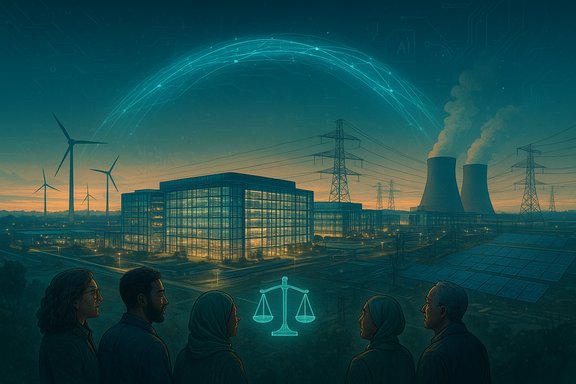
Satya Nadella’s blunt insistence that AI must first earn social permission before it is allowed to consume vast quantities of electricity crystallizes a fast‑escalating problem at the intersection of technology, energy and politics: the growth of generative AI is no longer only a compute and algorithm challenge — it has become a grid, environmental and democratic challenge that could tip public opinion and reshape policy toward the industry.
Background
The rapid diffusion of large language models, multimodal systems and always‑on inference services has driven hyperscalers to build a new class of high‑density, always‑operating data centers. These facilities demand sustained, high‑quality power and advanced cooling infrastructure, and their growth is projected to move the needle on national and global electricity systems through the remainder of the decade. Multiple independent energy analyses — including the International Energy Agency (IEA), Gartner and industry research firms — now place data center electricity demand on a steep upward trajectory, with scenarios that double or triple consumption by 2030 depending on assumptions about efficiency and workload mixes. Nadella framed the issue in political and social terms: he told a recent high‑profile interview that Microsoft recognizes the industry must earn social permission to draw so much energy, and that public acceptance hinges on broad-based economic benefits rather than concentrated returns for a few companies. That framing comes as elected officials and gubernatorial candidates in some regions have already campaigned on curbing the energy footprint of data centers, signaling a new political liability for hyperscalers.Why Nadella’s phrase “social permission” matters
The politics of infrastructure
When a technology leader publicly acknowledges that deployment must win public consent, it changes the conversation from engineering tradeoffs to social license to operate. That matters for three reasons:- Political vulnerability: Electoral campaigns that highlight local energy stress from data centers can yield concrete policy outcomes — moratoria, tighter permitting, or mandates on local sourcing of clean power. Policymakers respond to visible constituent pressure, and energy‑hungry facilities are highly visible targets.
- Local impacts are local politics: Data centers often cluster in rural counties where a single gigawatt campus can represent a major share of grid demand, water allocation and local land use. That concentration creates an easy narrative for critics and a hard practical problem for utilities.
- Reputation and trust: Public support for AI will be mediated not just by promised productivity gains but by tangible outcomes for communities — jobs, tax revenues, grid resilience and environmental stewardship. Nadella’s appeal to broad-based gains signals that Microsoft knows a narrow corporate windfall won’t buy political cover.
Industry response: storytelling and advocacy
The sector has already moved to defend itself politically. A well‑funded pro‑AI super PAC, Leading the Future, and its advocacy arm, Build American AI, have launched campaigns to reposition AI as an engine of economic growth and national competitiveness. Reporting indicates industry backers raised and committed more than $100 million to these efforts and have begun multi‑million‑dollar ad buys to shape public sentiment and federal policy. Those moves aim to blunt local backlash by framing federal preemption and national strategies as necessary to preserve U.S. leadership.The energy math: what the numbers say
Current baseline and near‑term forecasts
Independent sources present a consistent message: data center electricity consumption is large today and poised to grow rapidly.- The IEA and multiple energy analysts reported that global electricity consumption from data centers and AI workloads is already in the hundreds of terawatt‑hours (TWh) per year and could approach or exceed 900–1,000 TWh by 2030 in high‑growth scenarios. These numbers reflect both training of large models and the energy needed to serve inference at scale.
- Regionally, projections vary: Gartner recently estimated that data center electricity demand will rise sharply between 2025 and 2030, with AI‑optimized servers accounting for an increasing share of total consumption. Gartner’s scenario shows AI‑optimized hardware growing to represent a dominant slice of incremental power demand by the end of the decade.
- In the United States specifically, credible analyses estimate that data centers consumed on the order of 150–200 TWh in the mid‑2020s, with projections that this could more than double by 2030 depending on the scenario. That could move data centers into the single‑digits of national electricity consumption share in many forecasts, and into low double digits in U.S.‑specific, high‑case projections.
What those numbers mean in practice
Put differently:- A single hyperscale AI campus can require hundreds of megawatts of continuous power capacity when fully built out. Several of the largest planned facilities are envisioned to draw more than 100 MW each, and some future campuses are projected in the 500+ MW range. That’s utility‑scale demand concentrated in one location and it has engineering, permitting and transmission implications.
- Even if the per‑prompt energy use of efficient inference is small (fractions of a watt‑hour), billions of interactions add up. Training runs are another category entirely: large training campaigns can be megawatt‑scale, sustained for days or weeks, and are typically run in specialized clusters with high power density. Estimates of per‑model training energy vary and often rely on reconstruction, so single‑number claims should be treated as illustrative.
Technical realities: why AI is different from “ordinary” cloud workloads
Power density and duty cycle
AI servers — GPU or accelerator racks — operate at far higher power density than traditional enterprise racks. Typical AI racks now draw tens of kilowatts and can exceed 50–80 kW per rack in dense configurations. That shift requires different electrical distribution, cooling architectures and site resiliency design. Combined with nearly continuous operation for inference fleets and long contiguous training runs, AI creates both higher steady load and different peak profiles for electrical systems.Cooling and water
High‑density cooling often favors liquid and evaporative technologies that reduce energy per kilowatt of IT load but can increase freshwater usage. Estimates from industry analyses and government research show that hyperscale facilities account for the lion’s share of data center water consumption in the U.S., and projected water use could become a limiting factor in water‑stressed regions — adding a second dimension of local environmental friction beyond electricity.Grid interconnection and transmission
Securing a high‑capacity grid connection is not instantaneous. Interconnection queues, permitting, and new substation construction can take years, creating a practical mismatch between the rate at which chip inventories and server hardware can be acquired and the rate at which that hardware can be energized and put to use. Nadella himself has publicly observed that compute can be restrained not by parts shortages but by the availability of grid‑ready sites. That mismatch is now visible in markets where utilities and planners warn of multi‑year lead times to add dispatchable or firm power capacity.The environmental and social risks
Local backlash and political friction
Communities facing increased power demand, drought‑prone water stress, and large land use changes have pushed back with moratoria, local ordinances and even court actions in multiple countries. These reactions are practical — they reflect real competition for finite infrastructure and resources — and they create a tangible regulatory risk for tech companies. Several recent electoral campaigns have capitalized on these sentiments, turning data center energy into a political wedge.Carbon intensity and decarbonization pathways
Energy consumption alone isn’t the whole story: the carbon and environmental footprint depends on when and how the electricity is produced. A data center powered mostly by fossil‑fueled grids will have a higher carbon profile than one matched to 24/7 low‑carbon sources. The industry’s common pledge of net‑zero or renewable procurement is complicated by the fact that short‑term grid injections and time‑of‑use matching are technically and contractually complex. Several analysts note that relying on PPAs and averaged renewable claims may not equal real‑time carbon‑free operations at the moment of load. That gap is what Nadella alluded to when he emphasized the requirement for public trust and demonstrable benefit.Water, lifecycle impacts and supply chains
Cooling water, embodied energy in semiconductors, and frequent hardware refresh cycles introduce lifecycle environmental costs that are often underreported in headline electricity statistics. Municipalities are increasingly asking for disclosure and enforceable water use limits as part of permitting. Those constraints can slow builds or require tradeoffs in site selection.Industry strategies to reduce friction — and their limits
Efficiency, on‑device and hybrid architectures
Hyperscalers and cloud providers are pushing multiple technical levers to lower energy intensity:- More efficient accelerators and datacenter designs that increase performance per watt.
- Rewriting models and software stacks to use quantization, sparsity and lower precision where acceptable.
- Shifting some workloads to on‑device or edge compute to reduce central inference demand.
- Multi‑model orchestration that routes queries to the smallest model that meets quality requirements.
Power procurement and alternative generation
Companies are also expanding their approaches to powering data centers:- Long‑term power purchase agreements (PPAs) for renewables.
- Investment in on‑site generation or microgrids, including gas‑fired or battery‑backed systems as bridging strategies.
- Partnerships and investments in nuclear and small modular reactors (SMRs) as potential firm low‑carbon options for future decades.
Political advocacy and PR campaigns
Industry actors have chosen to fight public perception with focused messaging campaigns that emphasize national competitiveness, economic growth and job creation. The formation of Leading the Future and Build American AI — which have mobilized seven‑ and eight‑figure ad budgets — demonstrates that market participants view the contest as at least partly political. Those efforts will shape the legislative landscape; they may also intensify the impression that the industry is trying to buy legitimacy rather than earn it through operational and environmental performance.Economics, bubbles and Nadella’s investment claim
Nadella dismissed the idea that AI would create a pure investment bubble so long as AI translates into broad productivity gains across the economy. He argued that if returns concentrate narrowly in a few companies or regions without lifting real output and incomes more widely, the industry risks running into a “road to nowhere.” That’s an economic thesis with two parts:- If AI genuinely raises total factor productivity — lowering the cost of producing goods and services across sectors — then capacity expansion (and the energy to run it) can be justified by long‑run GDP growth.
- If AI’s benefits are captured narrowly and speculative capital chases infrastructure without sustainable demand, then oversupply, stranded assets and political backlash become realistic outcomes. The recent reports of targeted pauses or cancellations of planned capacity by major providers suggest hyperscalers are actively managing that risk by re‑balancing build plans and emphasizing efficiency over blind scale. Those moves are consistent with the idea that investment must align with fundamental demand and product value.
What Microsoft and peers can (and must) do
1. Make energy and water accounting auditable and local‑sensitive
Publish verifiable, time‑resolved data on grid and water sourcing for major sites, and commit to site‑specific mitigation plans for constrained geographies. Narratives of net‑zero through aggregated PPAs are insufficient where local grid stress and watershed scarcity exist. Local transparency can reduce opposition and enable better planning.2. Prioritize demand management and flexible load strategies
Design workloads, where feasible, to shift non‑time‑sensitive training and batch workloads to off‑peak or low‑carbon windows, and invest in co‑located energy storage and dispatchable resources to smooth peaks. That approach reduces local capacity upgrades and buys political goodwill.3. Accelerate model and software efficiency
Continue investing in model compression, sparsity, quantization and smarter routing so that the same user value can be delivered with less energy. That extends the practical limits of available power and reduces water and cooling burdens.4. Engage communities early and equitably
Offer binding community benefit agreements: workforce development, tax revenues sharing, local grid upgrades and clear environmental limits. Engagement should be proactive and address concrete community concerns rather than retrofitted as PR after opposition emerges.5. Collaborate on policy that balances national competitiveness and local protection
Work with federal and state policymakers to design frameworks that avoid a patchwork of rules while protecting local interests. Industry advocacy groups will press for preemption; companies should accept accompanying consumer and environmental protections to credibly argue for national rules.Policy implications and the coming public debate
Nadella’s comments arrive at a moment when the political terrain is fluid. On one hand, national leaders emphasize AI as a strategic asset and push for rapid industrial growth. On the other, local communities and some candidates have mobilized against the resource footprint of large data centers. The likely policy responses will include:- State and local legislation requiring greater disclosure, renewable matching metrics, and water use limits for new data center permits.
- Federal incentives for grid upgrades and for dispatchable low‑carbon firm power to serve digital infrastructure.
- Potentially contested battles over preemption: industry groups want federal rules that override state action, but any such preemption will almost certainly carry concessions or counter‑bills aimed at consumer protection and environmental standards.
Critical assessment: strengths and risks of the current industry posture
Notable strengths
- The industry is taking the energy issue seriously at executive levels, and public acknowledgements by leaders like Nadella help normalize the need for integrated solutions that combine engineering, policy and community engagement.
- Technical progress in efficiency and novel operational models (on‑device AI, multi‑model orchestration) provides a realistic route to delivering user value without linear increases in energy consumption per unit of output.
- Investments in energy partnerships (renewables, PPAs, and exploratory nuclear/SMR options) show the sector is diversifying approaches to secure firm low‑carbon supply. Those are long‑lead but valuable commitments.
Material risks
- Over‑reliance on average PPA accounting without demonstrable 24/7 carbon matching undermines public trust and provides a target for critics. Claims that appear more about optics than operational reality will fuel backlash.
- Local resource constraints (transmission capacity and water) are not easily solved by distant corporate procurement. They require on‑the‑ground accommodation and investment; failure to deliver those will result in regulatory friction and potential project delays or cancellations.
- Political advocacy that reads as “buying consent” through big ad buys can backfire if it is not paired with measurable outcomes at the community level. Dollars spent on messaging must be matched by dollars spent on local mitigation and benefits.
Conclusion
Satya Nadella’s call for AI to earn social permission to consume energy is more than public relations rhetoric — it’s a diagnosis of a systemic bottleneck that blends engineering, environmental stewardship and politics. The technical ability to build vast AI capacity has outpaced the social and infrastructure systems that permit that capacity to be used responsibly. Industry leaders can continue to fund communications campaigns and pursue national policy preemption, but long‑term acceptance will require tangible, verifiable commitments: demonstrable reductions in energy and water intensity, credible 24/7 low‑carbon sourcing plans, local investments that offset grid and environmental impacts, and clear, auditable reporting that moves beyond aggregated PPA claims.If the industry succeeds in pairing technological progress with transparent, locally sensitive stewardship, the broader productivity promise Nadella invoked is plausible. If it does not, the political and regulatory headwinds he warned about will not just slow expansion — they could reconfigure the economics and geography of AI deployment for years to come.
Source: Politico Microsoft’s Nadella: AI needs ‘social permission’ to consume so much energy
