

CES 2026 feels like it will be another turning point for the television industry — not because every manufacturer will promise brighter panels or higher refresh rates, but because they will quietly commit to something far more consequential: true, measurable energy optimization built into TVs as part of a broader smart-home energy strategy. This shift — commonly discussed under the umbrella term AI energy‑saving modes — is already moving from marketing copy into validated real‑world impact, and CES will be the moment many brands turn a soft promise into concrete features and cross‑device services.
Manufacturers have long shipped eco modes and automatic dimming, but those features typically force blunt trade‑offs: reduce brightness, reduce picture quality, and save some watts. The next evolution is dynamic and context‑aware energy management — software that adapts to actual usage patterns, room conditions, and grid signals to save energy while preserving the experience. Samsung, LG and other major players began sketching this future at CES 2025 and in subsequent product rollouts, and a verified real‑world results trail is now emerging that validates the potential.
This is sustainability that doesn’t demand sacrifice: a TV that saves watts where humans won’t notice and reallocates power where it matters most. That balance will determine whether AI energy‑saving modes are a headline gimmick or a genuine step toward greener, smarter homes.
Source: Tom's Guide https://www.tomsguide.com/tvs/the-o...t-we-expect-every-company-to-announce-at-ces/
 Background
Why energy matters more than ever for TVs
Modern TVs are no longer isolated appliances; they are high‑performance, always‑connected devices that can rival a compact PC in power draw and computational complexity. Peak brightness, advanced local dimming, high frame rates, and on‑device AI all push power consumption upward even as consumers demand higher fidelity and more immersive experiences. At the same time, global policy pressure, rising electricity costs, and consumer interest in sustainability are aligning to make energy efficiency a competitive feature rather than merely an afterthought.Manufacturers have long shipped eco modes and automatic dimming, but those features typically force blunt trade‑offs: reduce brightness, reduce picture quality, and save some watts. The next evolution is dynamic and context‑aware energy management — software that adapts to actual usage patterns, room conditions, and grid signals to save energy while preserving the experience. Samsung, LG and other major players began sketching this future at CES 2025 and in subsequent product rollouts, and a verified real‑world results trail is now emerging that validates the potential.
Overview: What are “AI energy‑saving modes”?
Definition and scope
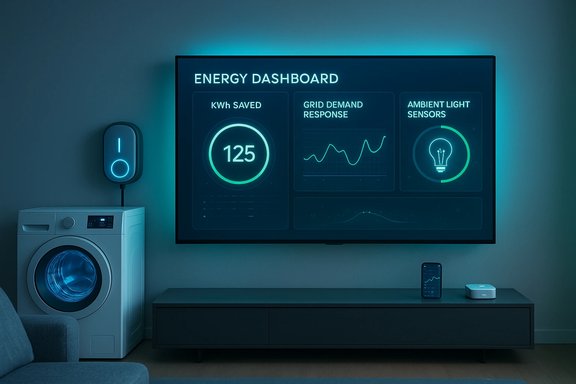
AI energy‑saving modes are a class of algorithms and platform services that dynamically optimize a TV’s power use based on contextual inputs. These inputs can include:- Ambient light and motion sensors to auto‑scale brightness and backlight distribution.
- User behavior patterns and schedules to avoid unnecessary power during predictable inactivity.
- Grid signals, demand‑response programs, or local energy tariffs to shift or curtail consumption during peak price events.
- Inter‑device coordination across a smart home to balance loads (e.g., delaying a dryer cycle while a screen is active).
How this differs from traditional eco modes
Traditional eco modes are reactive and coarse: a single setting reduces peak brightness or engages a fixed power cap. AI energy modes aim to be proactive and nuanced:- They learn when rooms are typically occupied and adjust preemptively.
- They allocate dimming zone power intelligently so contrast is preserved where it matters.
- They coordinate with other appliances via platforms like SmartThings to maximize household‑level savings without noticeable degradation.
Why CES 2026 is the right stage for this feature
A convergence point for hardware, software, and policy
CES is where manufacturers demonstrate not only hardware bumps but how devices behave in an ecosystem. Energy optimization sits at the intersection of hardware capabilities (local dimming granularity, peak brightness), on‑device software (image processing, AI routines), and cloud/platform services (home energy management, demand response). That ecosystem story is what CES shows best: televisions coordinating with washers, HVAC, battery storage, and utilities in real demos. Samsung’s Home for Efficiency concept presented at CES 2025 foreshadowed exactly this cross‑device play.Expectation vs. hype
Most booths will still headline brightness and AI upscaling, but at a practical level the sustainability narrative is gaining flesh. Vendors will position energy‑aware TVs as components of a home energy strategy, not just a display spec. That framing will help products move from “feature list” to measurable consumer value: lower electric bills, participation in grid programs that yield incentives, and brand sustainability claims backed by independent verification. Samsung’s recent verification under the DUCD specification shows that these claims can be audited and quantified, a narrative that will resonate strongly at CES.Real‑world evidence: What’s already been verified
Samsung’s DUCD verification — what it proves (and what it doesn’t)
Samsung announced that the carbon‑reduction effect of its AI Energy Mode for select appliances was independently verified under the DUCD (Decarbonizing the Use‑Phase of Connected Devices) specification by the Carbon Trust Assurance. The verification compared energy usage when AI Energy Mode was activated versus when it was not, yielding verified savings of 5.02 GWh and a reduction of 2,084 tCO2e across the sample and time window analyzed. That study covered about 187,000 high‑efficiency washing machines in use across 126 countries between July 2024 and June 2025. It is critical to be precise: the verified numbers come from appliances (washing machines) connected through SmartThings, not from TVs. The study proves the methodology and the potential of coordinated AI energy features across devices. It does not, to date, prove a specific nationwide energy reduction coming solely from TV energy modes. Nevertheless, the validation matters because it establishes a replicable approach and independent audit trail for connected‑device energy savings — an approach vendors can extend to displays.Independent corroboration and media coverage
Multiple outlets and regional press reprinted and analyzed Samsung’s announcement, giving independent coverage that corroborates the main claims and adds context about the DUCD specification and Carbon Trust Assurance methodology. Those reports emphasize that AI‑driven optimization delivered substantial, measurable savings when users activated the feature, and that broader rollouts will depend on interoperability and adoption.How AI energy‑saving modes will work on TVs
Short‑term technical tactics (what vendors can do immediately)
- Dynamic local‑dimming power allocation: Reassign available backlight power to zones with the highest perceptual impact, preserving perceived contrast while lowering total energy draw.
- Ambient‑aware brightness scaling: Use on‑device ambient light sensors to scale peak luminance automatically, rather than using a single global dimming slider.
- Content‑aware tone mapping: Analyze each frame to reduce unnecessary specular highlights outside focal regions, keeping important detail while trimming watts.
Platform‑level strategies (what smart homes will enable)
- Usage pattern learning: TVs learn family schedules and dim or sleep when predictable inactivity occurs.
- Grid‑aware operation: TVs can respond to demand‑response signals (e.g., SmartThings Flex Connect) to temporarily reduce power during grid stress events in exchange for incentives.
- Inter‑device orchestration: A TV could delay firmware updates or shift background tasks if an EV charger or oven is drawing power, preserving household comfort while minimizing peak demand.
User experience design: balancing savings and picture quality
A hallmark of successful AI energy modes will be seamlessness. The goal is to avoid noticeable picture degradation. Vendors will likely ship multiple tradeoff profiles:- Stealth Mode: Small, imperceptible adjustments that prioritize picture fidelity.
- Balanced Mode: Noticeable but tasteful savings with modest adjustments in peak brightness.
- Eco Mode: Maximum savings, with expected reductions in HDR pop and peak contrast.
Business and regulatory incentives driving adoption
Utilities, incentives, and demand response
Programs like SmartThings Flex Connect show the utility model for device‑level demand response: consumers receive rewards for temporarily reducing load, and aggregators stabilize the grid. Vendors that integrate TVs into these programs unlock two revenue or savings channels: direct customer incentives and marketing value from demonstrable sustainability features. Samsung has already expanded Flex Connect to larger markets and tied SmartThings devices into demand‑response participation.Policy and labeling pressure
Regulators in the EU and other jurisdictions have tightened eco‑design and energy label rules for displays and appliances. As policy frameworks increasingly require usage‑phase reporting and energy labeling, vendors who can document real‑world savings will enjoy a competitive advantage and face fewer compliance risk factors.Marketing differentiation and after‑sales services
Brands can differentiate products beyond raw specs by bundling energy reporting, long‑term software support for efficiency features, and renewable scheduling (e.g., run high‑power operations when solar or battery power is available). Those services create stickiness and open subscription or incentive pathways.Risks, caveats, and governance concerns
Measurement nuance and the need for independent validation
Not all AI claims will be equal. Real savings depend on user adoption, the device mix in the home, and how aggressively the algorithms act. The Samsung/Carbon Trust study is promising because it follows an independent verification model. Any TV‑centric claims should be accompanied by similar independent validation — otherwise, the industry risks greenwashing. When interpreting vendor claims, look for:- Clear scope and sample size.
- Independent third‑party assurance (Carbon Trust, similar entities).
- Transparent methodology: which devices, what time windows, and what baselines were used.
Privacy and control tradeoffs
AI energy modes often rely on sensors and behavioral models. Users must keep control of data flows and opt‑in settings. Instances where vendors pushed AI features into devices as non‑removable or default options have already prompted backlash and trust erosion. Energy features should be optional, explainable, and easily reversible. The TV should never be forced to be an always‑listening energy broker without explicit, granular consent.Experience risk: when savings harm the picture
If algorithms prioritize watt reduction over perceptual importance, viewers will disable the feature. The only sustainable path is perceptual optimization — saving energy where viewers won’t notice the change and preserving quality where they will. This makes the user‑feedback loop and carefully chosen defaults critical.Practical advice for buyers and integrators
For consumers
- Prefer TVs that expose detailed energy controls and explain what each profile does.
- Look for vendor commitments to long‑term software support; energy modes improve with software updates and learning.
- If you plan to enroll in utility demand‑response programs, verify which geographies and local utilities are supported.
For integrators and early adopters
- Pilot energy modes in diverse homes to collect performance and perception data.
- Instrument the results and demand independent audits to support marketing claims.
- Build fallbacks: allow users to set persistently preferred picture fidelity thresholds so the TV can never reduce quality below a defined point without explicit consent.
The competitive landscape: who’s likely to announce what at CES 2026
- Samsung: Expect broader SmartThings tie‑ins, expanded Flex Connect geography, and demos of Vision AI steering TV energy behavior as part of the smart‑home energy story. Samsung’s previous DUCD verification for appliances gives it credibility to lead the narrative.
- LG: Already shipping auto brightness and power‑saving features, LG will likely showcase tighter webOS integration for energy reporting, leveraging its Alpha processors to do perceptual optimization with minimal quality loss. LG Display’s claims of energy efficiency improvements in new panels also bolster this play.
- Sony and others: Expect platform plays and partnerships with smart‑home ecosystems; smaller brands will offer targeted savings profiles or demo aggressive hardware-level tricks (e.g., zone throttling) to claim eco leadership.
- Cross‑platform alliances: Watch for announcements about interoperability standards or certifications for energy features — standardization will accelerate utility integrations and independent verification.
Outlook: the next 18 months after CES 2026
What success looks like
Success will be visible in three measurable ways:- Measured kWh reductions reported by independent audits across device classes.
- Increased consumer adoption of energy modes because they preserve picture quality.
- Integration of TVs into utility‑level energy programs with meaningful incentives.
Where skepticism still belongs
Be wary when vendors quote large, single‑number percentage savings without context. Verify whether numbers come from controlled lab tests, aggregated opt‑in user data, or independent audits. The difference between a vendor‑run demo and a DUCD‑style verification is material for both consumers and regulators.Conclusion
AI energy‑saving modes are the one emergent TV feature that could transform both product design and the home energy equation without much fanfare. The technology is not a single toggle but a layered discipline combining perceptual picture science, adaptive algorithms, and platform orchestration. Samsung’s DUCD‑backed verification for SmartThings‑connected appliances proves the approach can be audited and real. CES 2026 will be the moment many manufacturers move from talk to tangible integration, showing TVs that optimize power consumption intelligently, cooperate with household devices, and participate in grid programs — all while preserving the cinematic experience consumers expect.This is sustainability that doesn’t demand sacrifice: a TV that saves watts where humans won’t notice and reallocates power where it matters most. That balance will determine whether AI energy‑saving modes are a headline gimmick or a genuine step toward greener, smarter homes.
Source: Tom's Guide https://www.tomsguide.com/tvs/the-o...t-we-expect-every-company-to-announce-at-ces/
